Search This Blog

Showing posts with label Movement Research. Show all posts

Thursday, April 20, 2017

Memories: FAB x MR DANCE BLOCK SALON Spring '17

Abrons Arts Center -- March 28, 2017
facilitated by Eva Yaa Asantewaa


All photos 


Fourth Arts Block (FABnyc) paired up Movement Research for their first collaborative Dance Block Salon. The organizations invited artists from their respective communities to show work in an atmosphere of non-judgmental sharing, radical support and community building. 

I was honored and thrilled to be asked to facilitate the evening and guide the feedback sessions.

Artists showing work included Rina EspirituJenny Boissiere & DancersCain Coleman of ColemanCollective and Shantelle Courvoisier Jackson.


Staff, presenting artists and dancers
gather in Abrons's studio G05 before the salon.

Introducing the evening:
Nadia Tykulsker, FABnyc Director of Programs (above)
Lindsey Dietz Marchant, Movement Research Managing Director (below)

Eva Yaa Asantewaa

Above: Jenny Boissiere talks about her work.
Below: Cain Coleman performs.

Choreographer Shantelle Courvoisier Jackson,
above and below

Shantelle Courvoisier Jackson's troupe performs.
Above: Rina Espiritu listens to audience feedback.
Below: Dance artist Heather Robles hugs Espiritu after feedback session.

Small, intimate feedback groups for each choreographer
encouraged easygoing participation.

Subscribe in a reader

Thursday, May 12, 2016

Movement Research presents "Body Disrupt" at Abrons

Mat Fraser as The Beast
(with Jonny Dixon and Jess Mabel Jones)
in the 2014 production of
Beauty and the Beast at Abrons Arts Center
(photo: Sheila Burnett)

Below: Julie Atlas Muz as Beauty
(photo: Sin Bozkurt)


Artists with disabilities and artists whose work disrupts normative notions of what constitutes a dancing body will come together in conversation.
 --about Body Disrupt, a Movement Research Studies Project panel

Body Disrupt
--a panel convened and moderated by dance artist Kathy Westwater at Abrons Arts Center for Movement Research--left my head buzzing, not so much with a bunch of questions or final answers but rich points of departure. In that way, I found it satisfying--again, not in the sense of finality or feeling sated but in the sense of deliciousness. Each panelist--Wendy Whelan, Petra Kuppers, Julie Atlas Muz (representing her husband and creative collaborator, Mat Fraser), Marissa Perel, Cathy Weis, and Westwater herself--offered a different history, pathway, insight and flavor. I consider them all guides who lead you to a good place and leave you there with confidence that you're smart enough to push on forward in your own way.

Westwater introduced the event by talking about how her engagement with somatic practices left her at variance with their emphasis on organizing the body. In her dance practice, she said, she was "pursuing a disorganized body, trying to understand what that was."

"Why am I trying to organize my body?" she asked. "I'm an artist. I want to express the body I have." Indeed, she turned to physical "disorganization" as a stimulus for a choreography of exaggerated dis-alignment that, she says, "never stops being interesting to me."

As the panel wrapped up, Westwater revisited this language and reworked it--referencing, instead, "different organizations of bodies."

As a dance writer, I found that revision at once enjoyable and useful. It made me remember a question someone recently posed to me: "What do you look for when you go to see a dance?" My response was perhaps different from what another writer might offer: I go to engage with what's there, whatever it might be, not to look for something predeterminied. In other words, if I expect anything, it's the possibility of something different, and I've signed up for engagement with it. While that's no guarantee that I will get it or like it, it's a protective against simply failing to respect its right to exist.

Westwater and Whelan, it turns out, are old friends from youth. Even so, Whelan's presence on this panel was surprising and proved refreshing. After all, her stellar career, though evolving, has been rooted in classical ballet technique, far from Movement Research's approach to dance. But here's the thing: At age 12, Whelan was diagnosed with scoliosis (curvature and rotation of the spine) and spent months in a chin-to-hip body cast while bravely resuming her rigorous ballet training. Treatment helped, but it did not wipe away her innate sense of difference. At times, the ballerina had to endure fault-finding by members of my profession for the look of her body and her dancing.

Today, Whelan considers her condition a gateway to the truth of herself, beyond picture-perfect ballet conventions, and to the pursuit of more adventurous means of self-expression through the works of contemporary choreographers.

"I strive to be fearless," she says. "I'm never afraid to embarrass myself."

Kuppers--a German-born community performance artist and disability culture activist, now based in Michigan--impressed me with her playful approach to the world as a model of easygoing engagement based in perception and compassion. From Muz--performance and burlesque artist married to an actor with thalidomide-induced Phocomelia--I simply inhaled a renewed affirmation of my femme self and a voracious pleasure in the age-old, radical power of the Outsider. Perel spoke of disabilities and pain hidden from view--"I've been able to look like a dancer"--and, in particular, what dance critics fail to take into account when they encounter her work. A poet, installation artist, choreographer and critic, Perel says she works with forms of art that will give her agency. "I don't really care what they are." Weis, diagnosed with multiple sclerosis in decades ago and facing the loss of her marriage, regained her own agency through turning not only to dance but to stained glass and, especially, to video as an extension of herself, made on equipment that she could handle by herself.

Body Disrupt offered notions of disruption that can instigate not only the work of movement artists but also the work those of us who view, process, document and critique their art. These artists encourage each of us to define and relish in our freedom.

*****
Movement Research Studies Project presents a series of artist-instigated panel discussions, roundtables, performances and/or other formats that engage issues of aesthetics, philosophy and social politics relevant to the dance and performance community.

All Studies Project events are free and open to the public.

UPCOMING:

June 7, 6:30pm
Festival Spring 2016 Studies Project
Curated by Aretha Aoki, Elliott Jenetopulos, Eleanor Smith and Tara Aisha Willis

Gibney Dance Choreographic Center
890 Broadway, 5th Floor, Manhattan
(map/directions)

If you like what you're reading,
subscribe to InfiniteBody!

Saturday, December 5, 2015

Movement Research Festival: Gwen Welliver and Abby Zbikowski

Choreographers  Gwen Welliver and Abby Zbikowski shared last evening's program at Danspace Project as part of the 2015 Movement Research Festival (Vanishing Point). The two artists were selected by festival curators Beth Gill and Cori Olinghouse to explore new ways of envisioning abstraction in contemporary dance. If postmodernists stripped "fantasy, metaphor and characters" from dancemaking, would it be possible to reclaim these compelling elements in fresh ways?

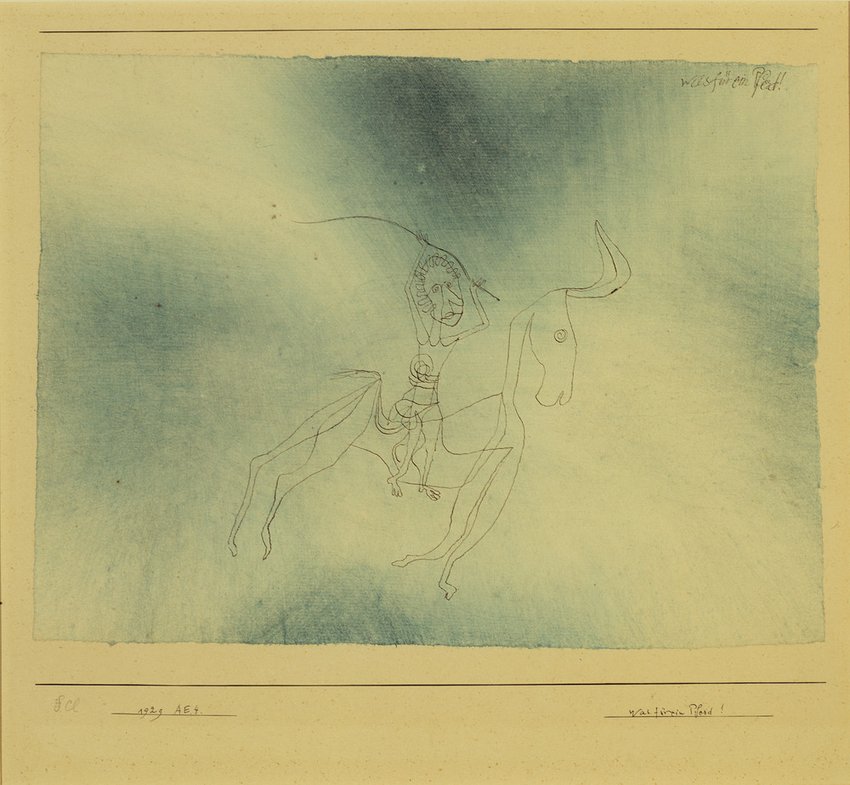
Paul Klee's Was für ein Pferd! (What a Horse!), 1929

With What a Horse!--the title alludes to a Paul Klee line drawing--Welliver works on this problem by transferring her own drawing practice to physical bodies on the move. Happily, two of the bodies in question belong to Claire Westby and Stuart Singer, both excellently suited for Welliver's heroic aesthetic here, capable of bold, substantial presence in space, with a launching as noisily assertive as Jake Meginsky's sound score. When Welliver has Westby extend a leg, for instance, it resembles both a puncturing weapon and a decisive act of punctuation. In either case, we quickly get that this is not a figure to tangle with, just as the childlike, spindly lines in the Klee drawing convey the electric dynamism of its horse and rider. Amid the plumped out, sculptural lines of Welliver's abstraction, there is some galloping, cantering, trotting and the introduction of a third figure--dancer Reid Bartelme (sporting a protective vest of what appears to be black leather covering a pale, satiny shirt) who heralds something of smoother, silkier texture in both movement and music.

If, as an abstractionist, Zbikowski takes interest in stripping anything away, it's stripping our sense that the art of dance is about making things look effortless. She foregrounds effort, even discomfort. In her duet, double nickels on a dime, she brings the "outside" influences of punk, hip-hop and martial arts into the formal space of concert dance but not as fetishized artifact but as form, energy and psyche embodied, in a matter-of-factly outrageous way, by wonderful Fiona Lundie and Jennifer Meckley. Like Singer and Westby in What a Horse!, these dancers take the space in great gulps, sneakers making noisy impact, legs striding wide, bodies jutting and wrenching within organized, neat lines of structure. Watch and you feel everything--the concision of the lines, the athletic power, the attitude of being ready for anything. Every now and then, I see a performance that would make an ideal bridge from the often insular world of contemporary dance to the rest of the universe, and this is one.

The 2015 Movement Research Festival concludes tomorrow. For information on remaining events, click here.

Danspace Project
St. Mark's Church-in-the-Bowery
131 East 10th Street (at Second Avenue), Manhattan
(map/directions)

Tuesday, October 6, 2015

Jock Soto and Carmelita Tropicana to host Bessie Awards

Carmelita Tropicana
(photo: Uzi Parnes)
Jock Soto
(photo: Rosalie O'Connor)

The 2015 awards show of the New York Dance and Performance Awards (The Bessies) will be hosted by former New York City Ballet principal Jock Soto and performance artist and playwright Carmelita Tropicana at Harlem's legendary Apollo Theater on Monday, October 19.

Doors open at 6:30pm for red carpet and pre-show celebrations, and the awards show begins at 7:30pm with an illustrious lineup of presenters, including Marcelo Gomes, Rennie Harris, Linda Celeste Sims, Kyle Abraham, Liz Prince and Ivy Baldwin.

Bessie Award-winning artists Camille A. Brown, Lisa Nelson and Storyboard P, recipient of the 2015 Outstanding Emerging Choreographer Award, will perform.

The evening will also include special presentations to Steve Paxton, recipient of the 2015 Bessie for Lifetime Achievement in Dance, and Movement Research, for Outstanding Service to the Field of Dance.

Get more information and your tickets for the 2015 Bessies celebration here.

The Apollo Theater 
253 West 125th Street, Manhattan
(directions)

Tuesday, February 3, 2015

Movement Research memorial planned for Elaine Summers

Memorial Gathering for Elaine Summers

Saturday, February 28 (6-10pm)

Judson Memorial Church
55 Washington Square South, Manhattan
(map/directions)

Visit elainesummersdance.com for more information about Elaine's life and work.

CALL FOR VOLUNTEERS!

Help is particularly needed with catering staff, clean-up and set-up, and greeting attendees. Please contact info@movementresearch.org with your availability.

Wednesday, January 21, 2015

Be careful where you sit!

By the time I walked into the studio at Gibney 890 for last evening's Movement Research Studies Project--What is The Role of Class?--there were few chairs to be had, and I am not one for sitting on the floor. I found an unclaimed chair and plopped down with my bulky winter coat, backpack and little bag of grocery shopping.

There was Jodi Melnick to the left of me, John Jasperse and a new friend, Barbara Forbes, to my right. The wondrous Beth Gill rushed up for hellos and a hug, and noted that I had sat with the group that would be talking about the economics of class--not "class" as in social status, but "class" as in where dancers go to explore and hone their craft. Taken aback by this sudden requirement, I looked about to see what the other group topics were, and Jasperse handed me his sheet of notes. Fine, I said, but I'm basically here to listen and learn. Still a bit confused about the evening's game plan, I told Gill and Jasperse I'd probably float around, listening from group to group. Then everything started, and no one had time to correct me.

Gill (and everyone else) didn't realize that the event's other organizers had not invited me to be a panelist. I didn't realize that several small groups of panelists--maybe "discussants" would be a more apt word, given the intended casual format--were arranged along my half of the misshapen circle, invisibly embedded, for the moment, in what would appear to be an ordinary gathering of people.

In other words, I'd landed in a hot seat.

When I finally realized this error, it was too late to move elsewhere. And so, at a livestreamed event, I was seen to be curiously reluctant to open my mouth and contribute remarks along with everyone else arranged around me.

Afterward, people kept coming up to tell me they were disappointed that they hadn't had a chance to hear what I might have to say. In fact, I have just received an email from someone expressing the same disappointment.

Oy!

Okay, I survived.

Far be it from Movement Research to do a panel discussion like anyone else would do a panel discussion. With, like, a clearly, spatially-identified panel.

The main drawback, here, was near-inaudibility in that big studio. Panelists at a far remove from nearly everyone else came to realize the need to turn not to one another in discussion but, as individuals, to face the room and project their voices.

So. A group of panels after all.

Once past this initial awkwardness, the discussions took off in many directions. Must a dancer go to class on a regular basis, or can that dancer's physical practice take other forms? What are the factors--cost chief among them, certainly--that keep dancers from attending class regularly or at all? How is teaching a form of continuous learning for the dance teacher? How do you work with students who come to class solely for physical technique when your interests bend more towards social justice? What is revealed and challenged when a US-based dance artist teaches in another country and culture? How can this community make dance training sustainable for teachers and students? How can teachers take what they know so well and market it beyond the professional dance field, helping to subsidize professional dance classes for more students?

All of these, and more, are valuable questions and ones not easily addressed in less than two hours. The issues raised at What is The Role of Class? call out for further discussion, organizing and action. They call out for commitment.

I woke up this morning, thinking about Janet Panetta's remarks about "hobby dance classes." She said, "That's what we used to call them," and she meant the classes that studios would offer for non-professionals who wanted to exercise to lose weight or just have some fun after the work day. The money from these classes made it possible to keep studios open for the serious students and pros. Now, though, people go to health clubs and yoga studios. They get their Zumba on. The discussion turned, briefly, to the challenge of recapturing that civilian market to keep studios and teachers alive.

I was thinking, You know what? If it were not for so-called "hobby classes," I might not be involved in this community where I've witnessed and written about dance for decades. I came up in a family and at a time when I probably could never have found my way into the field as as professional, but dance classes of all kinds were where I took myself, seriously, to get healed the way others might go to church or visit the local shaman.

So, you can never tell about this "hobby dance class" thing because you can never tell who's out there and what dance really means to them--or could come to mean to them. I think we need to get more curious about this. And we need to take some care with the way we identify and view the outside world and put more interest and effort into the way we communicate with it.

And we need to turn and face outward and project.

Friday, January 9, 2015

Elaine Summers remembered by Movement Research


Elaine Summers, 1973
(photo:Philip Hipwell)

It is with great sadness that we announce the passing of Elaine Summers, an original member of Judson Dance Theater and longtime friend of Movement Research.

For those of you who did not know Elaine personally, here are some bits from her bio, and we hope you will discover her and continue to enjoy her spirit and art in this world.

A memorial is being planned and details will be shared as we have them.

Elaine Summers, MA, Fulbright Fellow, MIT fellow (Center for Advanced Visual Studies) received her BA in Visual Arts in Boston, MA, and came to New York City in 1952 to study dance at Julliard. She worked and lived here ever since and became one of the founders of the by now legendary workshop that would form the Judson Dance Theatre. After her groundbreaking first large-scale intermedia concert "Fantastic Gardens" (1964) she founded the Experimental Intermedia Foundation and continued to produce work both nationally and internationally with her Elaine Summers Dance & Film Co. She received numerous awards and residencies, among others at the University of Iowa. Her work is being studied worldwide and is currently being archived at the Jerome Robbins Dance Collection of Lincoln Center Public Library, with the help of NYU Department of Cinema Studies.

Summers originated the movement approach Kinetic Awareness and has continuously explored and pioneered ways of moving with a healthy body. In 1987 she founded the Kinetic Awareness Center to continue the development and research of the Kinetic Arts & Sciences, as well as train new generations of teachers.

She worked with people as diverse as Trisha Brown, Davidson Gigliotti, Nam June Paik, James Byrne, the Wooster Group, Meredith Monk, Merian Soto, Amy Greenfield, Pauline Oliveros, and many, many others.

Her work has been shown at the Museum of Modern Art, the Solomon R. Guggenheim Museum, in Sanarcangelo / Italy, Australia, the UK, and Vienna. Her project, Skytime, was a web-based invitation to all the world to celebrate the sky together in any relatable medium. Its first beginnings can be seen at www.skytime.org.

www.elainesummersdance.com

Saturday, October 11, 2014

For Marjani Forté-Saunders, dance and activism are one

Portrait of dance artist Marjani Forté-Saunders
by Ian Douglas

The following statement, written by dancer-choreographer Marjani Forté-Saunders, was presented for conversation at the most recent Movement Research town hall meeting, held at Eden's Expressway on October 6. Saunders was in California to receive a 2014 Princess Grace Foundation-USA fellowship award in choreography and could not attend the meeting. Her statement was read for her, and a brief--and, in my opinion, tentative--discussion ensued. Saunders has graciously granted permission for me to post her words here in hope of inspiring further exploration and dialogue.

*****
“The precise role of the artist, then, is to illuminate that darkness, blaze roads through vast forests, so that we will not, in all our doing, lose sight of its purpose, which is, after all, to make the world a more human dwelling place.”
-- James Baldwin

“Looks like what drives me crazy
Don’t have no effect on you–
But I’m gonna keep on at it
Till it drives you crazy, too.”
-- Langston Hughes
At the approach of MR’s Town Hall October 6, I ask the community of Movement Research what tensions are felt in the balance of Art, Activism, and living as an Artist.

Nothing’s Simple in September.

So much starts and ends.

The Autumnal Equinox, sitting directly at the Sun’s Center, at the precipice of an ending season into the beginning of another, there is simply no wonder why in this awe-filled happening, some believed earth was the center of the universe. Everything is changing, at least on this side of the country (says the California girl, where mostly everything stays the same), and when I say everything, I don’t just mean the trees. Really, everything is changing for me.

I’m anxious, unnerved, questioning, doubtful, indecisive, and turning 30. My calendar is all over the place, my dates are clashing, and at the end of the night I’m saying, “What the hell does dance have to do with any of it, anyway?!” So much putting out, I miss having time or energy to put in, to get engaged, in conversation, in exchange, in service, in ANYTHING beyond planning the next performance, residency, rehearsal, class, or grant application. And I feel guilty about complaining, because, as least I’m busy--right? I haven’t had time to fill up though, and I sense the void.

So my questions, at the end of the night, go like this:

Am I putting my energy in the right places? When is the next Community Board Meeting (can I make it--oh, it’s on my only day off of the week, shit). Should I vote in Cali or NYC? Sorry I missed your show? Where am I most needed, where am I most powerful? Is there a place I belong? What’s a downtown dance community, I live in Harlem?

On the other hand (on with my rant) I’m frustrated with racism that is as American as Modern Dance and Apple Pie; the normalizing of white cultural aesthetics at the expense of black cultural innovators and revolutionaries, such as the teenagers on the train with the boomboxes, the real twerkers of Nigeria, Jamaica, and New Orleans. I’m even more frustrated that these aren’t new conversations. That Frederick Douglass, Ida B. Wells, W.E.B. Dubois, Zora Neale Hurston, Langston Hughes, James Baldwin, Toni Morrison, and generations and generations of others have been singing the same song.

I’m as fascinated with aestheticism as much as the next artist, but I stagger in contemplation with what the hell it has to do with the stolen lives of Sam Hose, Emmett Till, Oscar Grant, Renisha McBride, Trayvon Martin, Michael Brown, and so so so, many more.

I make art but I don’t feel like I have the freedom or the right to do so without reference to these crimes against humanity that continuously go, unchecked?

In this regard, reminded by my colleague and sister Paloma, I’m not alone in these questions or frustrations. I’m instead quickened by events such as Paloma McGregor’s Dancing While Black, Camille Brown’s The Gathering, UBW’s Convening, Jaamil Kosoko’s Black Male Revisited, The Requisite Mover’s Wellspring, all these intensives and gatherings that boldly discuss and strategize the galvanizing of resources to support black artists, voices, producers, writers, etc., to shift the lens and spaces in which our work is produced, reviewed, and heralded. Changing the tide, re-inventing, re-membering, re-cycling, re-birthing, and re-connecting.

It wasn’t until I joined Urban Bush Women in 2006 that I learned I could even do both, be an artist and activist. I had lived them as separate lives, under the umbrella of student-hood in college. Through UBW I learned about some of the intersections of Art and Activism, and later found those revelations echoed in the work of Nia Love’s BSD| Blacksmith’s Daughter, and Ebony Noelle Golden’s Betty’s Daughter Arts Collaborative, and many many others. These folks rouse my questions as I live out the knotty narrative of artist/activist.

Lately, as everything changes around me, as I too, change with the shifting seasons, the looming whisper of cold weather, I throw on that sweater, pull out those scarves, and find that I’m in fact all bundled up with questions; the communities I’m apart of, the dance circles I traffic, the work I see and make, the artists I work with.

At the Convening we called upon the resources of our community as Black Female Choreographers. I now call upon the pool of information and resources in my MR Community: How are WE navigating Art and Activism? How does our work interact with our nation’s socio/ecological/economic/political contexts? At the approaching Town Hall October 6 at Eden’s Expressway, might I request this be among the conversation?

Forté-Saunders in performance
(photos: Ian Douglas)


Marjani Forté-Saunders is a Pasadena, CA native and Harlem resident.  She traveled as a performer with Urban Bush Women Dance Company for five years, and is now co-founder with Nia Love, of LOVE|FORTÉ A COLLECTIVE. Saunders is a 2014 Princess Grace Choreography Fellowship Awardee for new work commissioned by Los Angeles-based dance company CONTRA TIEMPO. For her work being Here…: a trilogy of works examining the intersections of mental illness, addiction, and systemic poverty, she’s received support from the Foundation of Contemporary Arts--Emergency Grant (2012), Puffin Foundation (2013), 651 Artists Development Initiative Artist (2013), Lower Manhattan Cultural Council (2014), and a New Music USA (2014) grant for a fifth collaboration with husband and composer Everett Saunders in the construction of a 3-D sound installation [www.being-here.org].   Saunders has also received support from the Jerome Foundation (2013, 2014), Mertz Gilmore Foundation with LOVE|FORTÉ (2013), Yellowhouse (2013), and the Harkness Foundation (2014).

Saunders’ work has been presented by Danspace Project, the Kelly Strayhorn Theatre in Pittsburgh, PA, Movement Research at Judson Church, New Orleans Mckenna Museum, Harlem Stage, Dance New Amsterdam, The Pillsbury Theatre in Minneapolis, Spelman College, Pomona College, and Hunter College (CUNY).   She has worked in residence at  Dance Theater Workshop (2010), Movement Research (2011-13), Brooklyn Arts Exchange with LOVE|FORTÉ (2012-2014), Dance Place (2013), Kelly Strayhorn Theatre (2014) and will begin a New York Live Arts Studio Series Residency in 2015.

Saunders is a passionate educator, having taught master classes and workshops across the US and beyond, including the American Dance Festival and ADF China.  She is also a member of Urban Bush Women’s BOLD Teaching Network, offering UBW’s unique approach to dance training and community engagement. Saunders is currently serving as Adjunct Lecturer, teaching Modern Contemporary Technique at Hunter College City University of New York and will be Guest Lecturer/Choreographer at Princeton University in the Fall 2014.  With deep gratitude, she moves onward in her work honoring that it stems from being born in and having engaged with culturally rich, vibrant, historic, and politically charged communities.

Sunday, June 1, 2014

Joe Levasseur: Take a workshop with dance's wizard of lighting

Movement Research presents a workshop with Bessie Award winner Joe Levasseur, lighting designer for dance, at Abrons Arts Center, July 7-11.

Lighting Design for Dance
This classroom and practical workshop will be a technical tutorial and discussion about the process of creating lighting designs for dance. All efforts will be made to demystify lighting in order to promote informative decision making and more easeful discussion in future collaborative processes. This class is designed for anyone interested in dance lighting including dancers, choreographers, and stage technicians. Participants must be present for all workshop dates.
Monday-Wednesday, 6:30-10pm, Thursday-Friday, 5:30-9:30pm
Optional: Tuesday and Wednesday 10am-5pm

Fee: $165

Abrons Art Center
466 Grand Street (at Pitt Street), Manhattan
(map/directions)

Friday, May 9, 2014

Round-up: Turkish activism; Akerman closes in on Bausch; ballet fiction

Coming after a few dry presentations (Movement Research Studies Project panel on Vulnerable Bodies and the Embodiment of Resistance, Gibney Dance Center, May 6), Turkish dance artist Tan Temel held my attention with the clarity of his witness as a participant in the anti-development, Occupy-like protests in Istanbul's Taksim Gezi Park. His brief talk also greatly benefited from a slide show of vivid photos from the early days of the Taksim Gezi sit-in, demonstrating the activists' confident and peaceful creativity. Inspiring! (An audio recording of this panel will be made available on iTunes. Click here for play or download links to recorded Movement Research events.)

Chantal Akerman's 1983 film, One Day Pina Asked... (Dance Films Association screening/discussion at Gibney Dance Center, co-presented by Gibney Dance Center's Sorry I Missed Your Show, May 7), looks quite different from Wim Wenders's grand, gorgeous and better-known Pina (2011), and feels different, too. Akerman's choice of a passive but magnifying camera zoomed right in on Pina Bausch's dancers rehearsing or performing puts the viewer right into the mix. It's a dancer's-eye view. Remember the scene in Nelken (Carnations) where a pack of men crowd a lone woman, touching and increasingly manhandling her body? From a proscenium theater's potentially safe, intellectualizing distance, Bausch's imagery is already disturbing. But try it this way, and your skin will crawl. The encounter of two extraordinary artists--Akerman and Bausch--produced a documentary of rare sensitivity and power (distributed by Icarus Films).
image description
Novelist Maggie Shipstead
(c) Michelle Legro

Astonish Me, a novel by Maggie Shipstead (Knopf, 2014), astonished me a bit less than I would have expected, given the raves from book critics, some of whom spun remarks off the title (derived from Serge Diaghilev's challenge to Jean Cocteau: Ètonnez-moi). And it almost lost me, early on, with its account of a bland suburban mismatch--the stay-at-home mom who fled a low-level ballet career and never got over a brush with international intrigue; the husband who desired her first, married her somehow, but still can never quite feel sure of her. But, in the nick of time, Shipstead won me back with a scene centered around a fit of inappropriate, uncontrollable and infectious laughter. That's when I threw in with this writer. Even so, I can't say that I ever came to like or feel empathy for her characters, two generations worth. I never really settled into the narrative's chronological jumble, and at no time did I think the central "secret" would surprise any character or reader. But I did enjoy and rely upon Shipstead's shrewd, finely rendered insights into the psychology of her characters and their relations. This is where she truly shines. (ISBN: 978-0-307-96290-4)

Tuesday, November 19, 2013

Coming soon from Movement Research: Le Song, Ya?!


Like Christmas, signs of the annual Movement Research Festival--this year, entitled Le Song, Ya?!--are already in the wind. To see what curators Adrienne Truscott and Jibz Cameron (of Dynasty Handbag fame) have in store for the much-anticipated, reportedly lasagna-like festival week, click here.

Tuesday, December 3, should prove to be a particularly amazing day. It includes:

EXORCISE CLASS--facilitated by the aforementioned curators--"A hyper-aerobic, sweaty, instructional,conceptual dance party designed to work out you psychic fat blockage and tone up supersensory abz. While living your spandex dreams and looking real." (11am-1pm at Danspace Project; $10)

WE CAME TO THIS CITY TO SHIT ON A STAGE--"How do we make, define, notice 'transgressive' art in a city whose identity, economy and landscape are increasingly manicured, welcoming, mainstream, highly visible and inaccessible?" (6pm at Gibney Dance Center; FREE)

Also recommended:

PERFORMING VULNERABILITY--"What does it mean to be vulnerable in performance? Is vulnerability a state or can it be 'done?'" Panel moderated by Adrienne Truscott. Panelists include: niv Acosta, Ben Asriel, Hilary Clark, Miguel Gutierrez and Juliana May (6pm at Jimmy's No. 43, 43 East 7th Street, between 2nd and 3rd Avenues, East Village, back room; FREE) 

Movement Research

Wednesday, June 19, 2013

A video tribute to dance artist Jennifer Monson

Jennifer Monson Tribute Video, Movement Research Gala 2013 from movement research on Vimeo.
2013 Movement Research Honoree Jennifer Monson

Audio interviews: DD Dorvillier, Pooh Kaye, Alejandra Martorell, Cathy Weis, Jeremy Nelson

Written Quote: Yvonne Meier

Photos by Tom Brazil and Henry Hills; and courtesy of Pooh Kaye, Jennifer Monson and Jeremy Nelson

Video footage: "Zeena Parkins and Jennifer Monson at the Clocktower, July 2011" with videography by Ryutaro Ishikane and courtesy of Jennifer Monson and iLAND - interdisciplinary Laboratory for Art Nature and Dance; "Jennifer Solo - Cape Cod" from Live Dancing Archive and "14 Street Migration" (2001 and 2002) from the BIRD BRAIN project, courtesy of Robin Vachal; "Trash Can Study" (1983) courtesy of Pooh Kaye; "Mad Heidi" (2005) courtesy of Yvonne Meier; "String of Lies" (1995) courtesy of Cathy Weis; and "RMW(a)" (2007) and "Yvonne Meier and Jennifer Monson" (2010) courtesy of Movement Research

Music: Zeena Parkins, Orra

Video Production: Catherine Galasso and Rosalie Elkinton

Monday, December 3, 2012

Movement Research Studies Project studies curation, inclusion, community

Studies Project: Let Me In Let Me In Or I'll Blow This House DownCurators on Process and the Matter of Inclusion

Moderated by Juliette Mapp and Jen Rosenblit

Josie's
520 East 6th Street (between Avenues A and B), Manhattan

FREE

To feel a part of something. Communal, to have community. To be asked, invited in, to ask to be invited in. Access, entry. While the role of curator and the process of curation holds as much artistry as the making of dance and performance, we hone in on an equally important need for a touch of transparency surrounding the presentation of dance and the body. What issues and concerns arise inside of a shifting community where representation is crucial for belonging and sustainable support? What are we doing to reach out to more artists? Where are those artists? Who are those artists? What are the complexities that arise while supporting the sustainability of an artist? What responsibility do we have to an idea of cultivating and supporting "newness"? Where is the body inside all of this? How do we digest being on the inside or outside of something spiritually, aesthetically, emotionally and academically?
Participants include:

Ben Pryor (American Realness

Laurie Berg and Liliana Dirks-Goodman (AUNTS)

Rebecca Brooks

Barbara Bryan

Matthew Lyons (The Kitchen)

Tuesday, November 27, 2012

Movement Research seeks Operations Manager

Movement Research is hiring an Operations Manager.
This is a 51 week/year, 25 hour/week position. Compensation is $18/hour. Employee Contribution 403(b) plan is available. Employee receives free classes and workshops. Schedule is anticipated to be 5 hours per day, 5 days per week, alternating afternoons and mornings. 
 Position start date is January 3, 2013
To apply, please send resume and cover letter to  work@movementresearch.org. Interviews will begin immediately, and we will make our decision as quickly as possible.No phone calls please.

Operations Manager oversees facilities and office operations for Movement Research, including studio use and upkeep, daily IT and technology related needs, bookkeeping, overseeing interns, human resources managements, and more. The Operations Manager will work as a team with other Movement Research staff to ensure that classes, programs, and events run smoothly and help troubleshoot any day-to-day administrative and programmatic needs. This position reports to the Executive Director. 

Qualifications Include:
Minimum 3 years (or equivalent experience) in Nonprofit or Arts Administration
Reliability and self-motivation
Exceptional communication & organizational skills
       An acute attention to detail

Technology and Software platforms required: PC and Mac-based Operating systems, with emphasis on PC; Quickbooks; Filemaker Pro; MS Office, particularly Excel and Word

Commitment to Movement Research's mission of serving and supporting experimentation in dance and movement-based forms 

Experience managing others and comfort in instructing co-workers is extremely helpful

Familiarity with Google Wallet, Constant Contact, Wordpress, and social networking is helpful but not required

Position is responsible for:

    Bookkeeping: Handling all Accounts Receivable and Accounts Payable through Quickbooks, Google Wallet and MR's Custom Database (Filemaker Pro); Overseeing daily expenditures; Reporting to Executive Director regularly, Reconciling Bank, Cash and Credit Card Accounts in Quickbooks
    Human Resources: Managing Payroll, Health Insurance, 403(b) Plan, Employee and Contractor Records and Tax Forms, Maintaining current contracts with all program participants
    Office Management and IT: Setting office schedules and ensuring orderliness of space with help of staff and interns; Managing and maintaining email systems and office server; Maintaining organizational files, storage and archives; Overseeing and Managing Database; Keeping office and studio supplies fully stocked
    Facilities Management: Communication with landlords at various spaces regarding maintenance, repairs, supplies, etc.; Booking venues as needed for MR programs; Managing studio rental at Avenue C Studio and Eden's Expressway
    Intern program: overseeing interns and their schedules; volunteers as needed; interviewing and hiring interns as needed
 Programmatic assistance: Being available to help run and troubleshoot programs, including being an emergency contact for faculty, performers, etc.

Tuesday, November 6, 2012

(How) Do we value dance and dancers?

How does the current climate affect our lives and artistic work, and vice versa? What creative insights and understandings, structures and alternatives, have manifest during this time of financial challenge. 

Movement Research held its third annual town hall last evening at Joyce SoHo, hosted by Diana Crum (MR's Development Manager) and MR's Artist Advisory Council and moderated by Dana Whitco (Director, Center for Creative Research). The roughly three-hour discussion forum encouraged artists to share perspectives on the impact of the US recession on their personal and professional lives. Offering an overview of the evening's theme, choreographer Kathy Westwater spoke of "living in the worst economic environment of our lifetimes" but also noted that the arts have often flourished in times of economic crisis. "Does that create an opening for us?" she wondered.

In a structured forum--five minutes per speaker--Jen Abrams, Ilona Bito, Daria Fain, Jill Sigman and Enrico Wey shared varied experiences and ideas. These ranged from remarks on how both trust and fear are lodged in our kidneys and the necessity of changing our paradigms (Fain) to Occupy Wall Street as "performance score" (Bito) to a cautionary tale of how landing an apparently stable Broadway gig--thereby becoming "one of the 1%"--doesn't necessarily promote well-being (Wey).

Sigman--decrying the prevailing scarcity-mindedness of artists--redirected our attention to "what we do have" and described how a sudden awareness of the ongoing potential in trash led to her notable series of site-specific works, The Hut Project built around all kinds of recycled, re-purposed garbage. She spoke of how this new approach shifted her attention from conventional dance audiences and their expectations to people who share her values, who care about the same things. She found herself to be "not interested in meeting budget projections" but connecting to existing subcultures such as dumpster-diving meetup groups. She pondered how to "choreograph your values." Abrams--a co-creator of the bartering organization for artists, OurGoods--also chose to turn away from conventional channels of exchange and validation where, she says, artists experience a paucity of respect and acknowledgement. "How I know that my work is valuable is through the relationships I have forged with colleagues."

Underlying all of these sharings, and the subsequent contributions by others in attendance, was an often internalized conflict of values. In a money-driven society, artists feel pressured to fit their work--how they define it, package it, promote it--into a narrow, consumerist framework in which their only value, and the purpose of their creative labor, lies in growing into a strong economic engine for their communities. Fain noted our society's fixation on "stars." She said of more process-oriented artists, such as the ones drawn to Movement Research, "We're not perceived to be affecting culture."

The conversation circled back to issues of getting paid vs. not getting paid-- there are bills to pay, after all, and they can't be bartered away--and the fear of asking for what you need and deserve. How many artists feel empowered to ask about pay before they commit to a project?

Side discussions with Dance New Amsterdam's Catherine Peila during the break and, afterwards, with Peila and Fain led me to the conclusion that none of the opportunities hidden in crisis will be seized until dance artists reclaim a power ceded to others--presenters, funders, media--the power to name their own work and uphold their own values. I wish there had been time to begin this process last night. Perhaps Movement Research or some other community organization can hold a forum to create new language and tools to make this transformation possible.

Sunday, November 4, 2012

Movement Research: Moving right along...but carefully!

Post-Sandy, the intrepid Movement Research folks have postponed their Studies Project event, Jill Johnston and the Critic as Subject, originally scheduled for this afternoon at The New Museum. However, the following events are still on:

  • Studies Projects
    November 5, 6:30 pm
    Movement Research Town Hall Meeting
  • Studies Projects
    November 6, 6:45 pm
    JUDSON THROUGH THE EYES OF FILMMAKERS
    $10; $8 students/seniors/Friends of MR; $6 Anthology Members
    MR in Partnership with Anthology Film Archives
For complete details on these and other Movement Research programs, click here.

Tuesday, October 16, 2012

Honoring dance critic Jill Johnston


in conjunction with

Rethinking the Imprint of Judson Dance Theater Fifty Years Later: Movement Research in Residence

presents

Critical Correspondence co-editors Aaron Mattocks and Marissa Perel honor the celebrated writer and critic Jill Johnston, whose experimental and personal voice communicated the culture of the interdisciplinary 1960s art scene. In light of Johnston’s innovative contributions to the form, this conversation considers contemporary criticism and the writer as subject. Speakers include David Velasco (critic for Artforum) and Claudia La Rocco (critic for the New York Times). The event culminates as Movement Research artists perform readings of reviews on dance and performance.
Readers:

Thom Donovan
Ariel Goldberg
Cassie Petersen
Christine Shan Shan Hou


Sunday, November 4 (3pm)
Admission: $8 (general public) $6 (museum members)
1/2 gallery admission with same-day event ticket purchase

Information

New Museum
235 Bowery Street, Manhattan
(map/directions/visitors information)

Tuesday, September 18, 2012

Frances Alenikoff memorial announced

A memorial will celebrate the life and legacy of Frances Alenikoff, hosted by Alenikoff's family.

All are invited to toast Frances and share their memories with her fellow artists, friends, and loved ones.
Eden's Expressway
537 Broadway, 4th Floor
Sunday, September 30
6:30pm
Featuring words from Francesca Rheannon and from Movement Research, and a video presentation by Ray Grist.  Frances's art and writing will be on display. All with memories and stories of Frances are invited to share them.

Please feel free to bring a contribution of light fare or drink, in Frances's true spirit of community.

Monday, September 3, 2012

Clarinda Mac Low: scores and improv

The Score by Clarinda Mac Low
Critical Correspondence
Clarinda Mac Low reflects on dance scores in the second of a series of several writings for CC in 2012, which she has dubbed “The Year of Dance.” Mac Low will be presenting 40 Dancers do 40 Dances for the Dancers at Danspace Project this September 2012. The piece is based on The Pronouns: 40 Dances for the Dancers, a series of dance scores by her father, Jackson Mac Low.

Thursday, July 19, 2012

Movement Research to continue at Judson Church

Great news from our friends at 

APPLICATION DEADLINE ALERT: AUGUST 16

We are beyond pleased to announce that Movement Research at the Judson Church will continue!  

We have received the go-ahead to program dates from Fall 2012 - Spring 2013.

We want to thank you deeply for the amazing support you have given us, and the passionate appreciation for mr at judson that has been so evident in the past few months. 

Please note: Due to the delay in receiving confirmation from Judson for the upcoming year, we are having one application date. We apologize if this is inconvenient and thank you for your understanding of the circumstances. On the application sheet, please be sure to check off when you are available to show your work. More  flexibility around dates is extremely helpful to our application and scheduling process this year.
  
On to the fun stuff:

Applications for the entire year of programming, Fall 2012 through Spring 2013, are due on August 16, 2012. The guidelines and application form are available on our website. Click here for the guidelines, and click here for the application form.

This is a very short application period for us, so we greatly appreciate everyone spreading the word far and wide.

Questions? Email info@movementresearch.org, or call (212) 598-0551 and speak to a staff member.

Copyright notice

Copyright © 2007-2023 Eva Yaa Asantewaa
All Rights Reserved

Popular Posts

Labels