Search This Blog

Showing posts with label space. Show all posts

Tuesday, May 22, 2018

New Sokoloff Arts venue for Tribeca: Town Stages

Town Stages (first-floor event space shown above) is proudly woman-led.
(photo: Austin Donohue)
Left to right: Chie Morita (Deputy Director),
Robin Sokoloff (Founder/Executive Director)
and Staci Jacobs (VP, Development)
Not pictured: Joanna Carpenter (Bar Director)

Robin Sokoloff (Sokoloff Arts) has long chased one dream: "To create an inspired home for my artistic family, and build a platform for the next generation." 

Enterprising Robin Sokoloff last brought Manhattan Loft227, a snazzy, hi-tech venue in Chelsea for art incubation. Now, in collaboration with Chie Morita, Staci Jacobs and Joanna Carpenter, the versatile dancer/activist/carpenter/counselor/entrepreneur has set up shop in Tribeca, taking over what was once Churrascaria, a popular Brazillian steakhouse, and then White Street Restaurant and Bar. At 221 West Broadway--now called Town Stages--Sokoloff serves up 9,000 square feet over two floors of multi-use event and performance space with resources for creatives with a vision and a hankering for community. Town Stages offers flexible spaces suitable for almost any size performance as well as rehearsals, auditions, weddings, film shoots, corporate events and you name it. And White Street's curvacious bar--with its speakeasy appeal--is still there.

Last November, Sokoloff received the keys to what--with imagination, ingenuity, daring and sweat equity--she and her all-woman team would transform into Town Stages. Among its unexpected charms: a tiny, glass-enclosed wine storage area that now might serve as a box office, or a quirky performance space, or a site for the sound installation that Morita has in mind. Another tucked-away treasure: a cozy, window-lit room lit filled with quaint antiques from the now-defunct Pearl Theatre that could offer a place for singers to warm up or might be turned into a pop-up bookstore.

This handsome, state-of-the art, ADA-accessible facility--with its new, "small but mighty" elevator--was the culmination of an exhaustive, eye-opening search around the city.

"There were 298 landlords saying NO to artists and women and people of color," Sokoloff tells me. "All those storefronts we checked out are still empty. This one said YES.

"We think the city is liberal-minded and diverse and accepting to all. What I learned as an artist traveling through multiple spaces and with multiple kinds of people–especially those who don’t look like me–is that not everyone’s welcome. In fact, most artists are not welcome. 

"Town Stages is different because we recognize that if you don’t have the space to have a platform and represent yourself in whatever form you come in, you don’t have a voice. We are specifically interested in the advancement of women and people of color, LGBT, the underrepresented having space to do their work here."

But how affordable is Town Stages?

"There's no specific price sheet," says Sokoloff who's ready to sit down with any and all to chat about their ideas and needs first. Events and projects coming in with big budgets subsidize smaller productions--Sokoloff calls it her "Robin Hood model." This model also allows Town Stages to offer residency fellowships to creatives with a wide range of fresh ideas.

Deputy Director Morita--former Managing Director for the New York Neo-Futurists troupe--oversees the fellowship program. She says her eye is less on the type or quality of the proposed project than who the applicant is as a human being, how they might interact with and support others in shared space.

“If you are making something–dance, music, theater, an experience for people to walk into, an empowerment event, an app, a piece of clothing, a cocktail, a sandwich–there’s something collaborative about that experience," Morita says. "Bringing those people into a room and offering them the opportunity to collaborate and ask for help in an environment that is easy and comfortable is what we’re looking to build.

"That comes with amenities. Bring your lunch, and put it in our fridge. Bring your yoga mat from this morning, and stick it here and leave it overnight. Have a private room for auditioning. Meet your other fellows here, and talk about projects.

"In the first year, we didn’t advertise the fellowship or put it on social media. It was all word of mouth. From that alone, we got 65 applications. I can only imagine what will happen when we ask for applications from the general public!"

Dance is, of course, especially dear to the hearts of the team. Bessie Award-winning choreographer Ephrat Asherie developed her latest ensemble piece, Odeon, at Town Stages in preparation for its world premiere at Jacob’s Pillow Dance Festival this June. The all-women’s house dance crew Mawu, which affirms sisterhood and celebration over hypermasculine competition, offered creative dance workshops at Town Stages.

Sokoloff remains mindful of dancers' struggles, what she experienced and witnessed as a performer, choreographer and teacher in the field.

“Law of averages, very few dancers have a voice. They are bodies moving on stage. They’re in the background. I had a lot I wanted to say, a lot I wanted to change, a lot I wanted to do. I knew if I just kept dancing, there’d be no way to elevate all of this.

"I’m creating space for myself and my fellow dancers, but my vision and goals and activism are so much bigger than that. I’ve got to be louder than my body enables me to be and be on a bigger platform and a bigger stage.

“I’m still in shows, but going from dancing in studios eighteen hours a day to being on the front lines of real estate and construction is a shift. But it’s a necessary shift if this is all going to move in a better direction. I'm always asking, How can I change the paradigm?"

*****

To connect with the Town Stages team, set up a tour or get details on upcoming events, call 212-634-7690, or click here for their website. They are on Instagram (with daily check-ins) and Facebook as follows:

Instagram: Town Stages and Sokoloff Arts
Facebook: Town Stages and Sokoloff Arts

Town Stages
221 West Broadway, Tribeca, Manhattan
(between White and Franklin Streets)
A, C, E, N, Q, R, W to Canal Street; 1 to Franklin Street; or 2, 3 to Chambers Street

Subscribe in a reader

Thursday, March 29, 2018

Making space sing: Anna Sperber at The Chocolate Factory

Anna Sperber in Wealth From The Salt Seas
(photo: Brian Rogers)


The costumes for Anna Sperber's Wealth From The Salt Seas--a duet with vocalist/musician Gelsey Bell--display at least two variations on a theme of chocolate brown. (Sperber's pants, hard to make out in the lighting, might be of a hue between dull dark brown and charcoal.)  More than a possible sly reference to the work's venue, The Chocolate Factory Theater, the color has immediate effect--low-key and calming, earthy without being overly sensuous or overbearing, not stark like black. This, as it turns out, is a deep-brown dance.

It's appropriate for the choreographer who might easily go unnoticed when making her quiet, unremarkable first entrance with dark-brown hair pulled back from a scrubbed, serene face. She's just suddenly there, settled in place for a moment.

Sperber eventually drifts from one corner to another, positioning herself at one or another end of a row of viewers, slowly tracing hands over her face and neck and around her waist and hips. Her awareness is internal; you can feel that as easily as you feel the weight and slight friction of hands on skin and fabric.

Sperber's enigmatic, repetitive actions bring attention to the margins of the space and gather stillness and silence there like a gift. You might notice the difference this makes and think: Have I ever looked at performance space--or a performance--in quite this way?

Bell's entrance introduces sound--a voice that momentarily heightens in volume and shrillness. The sound score for the hour-long dance is produced by recorded and live voicings; the impact of feet on the floor; the strange effect of crouching and howling into the corner between two walls; the haunting bells played by the women as they bend their faces to them; and the reverberation of metallic sheets rattled and filling the air between Sperber and Bell as if, like whales, they signaled each other across an expanse of sea.

Curious props appear--a long, thick cable that Sperber manipulates; the odd-looking bells cast in blackish metal; a tarp of golden plastic; small, wooden scaffolds at either diagonal end of the space where the women climb and store their equipment. Curious, too, those moments when you swear you just saw one or the other dancer but she's suddenly out of sight, then she reappears as if nothing out of the ordinary happened.

Wealth From The Salt Seas continues through Saturday, March 31 with performances at 8pm. For information and tickets, click here.

The Chocolate Factory Theater
5-49 49th Avenue, Long Island City
(map/directions)

Subscribe in a reader

Saturday, April 29, 2017

Family life, fantasy life: Tamar Rogoff at La MaMa

Cover of Cherry Ames, Student Nurse (1943),
the first volume in Helen Wells's popular novel series for girls.
(from Collection of the Museum of Health Care)

Core cast members of Grand Rounds, a world premiere by Tamar Rogoff
Center: Cadence Rotarius
At left: Morgan Sullivan, Glen Heroy, Cyndy Gilbertson
At right: Jake Szczypek and Emily Pope
(photo: Asya Danilova)

In the 1950s world of
Grand Rounds, a 10-year-old inspired by the adventures of Cherry Ames, nurse and amateur sleuth, turns her perceptive gaze on the rituals of family life. What goes on behind closed doors and on the radio is fodder for her scientific reckonings. Rogoff invites audiences to sit bedsides to share the intimacy that propels her protagonist on a rescue mission of her own. 
-- from publicity for Grand Rounds

Core cast in rehearsal for Grand Rounds
(photo: Asya Danilova)


"They are the greatest cast I've ever worked with," said choreographer/director Tamar Rogoff after her world premiere of Grand Rounds at La MaMa's Ellen Stewart Theatre.

Well, they are certainly an interesting cast with individual backgrounds in everything from clowning for the Big Apple Circus to living with Parkinson's Disease. Working with all kinds of folks--even those without training in performance--is nothing new for the adventurous Rogoff. But while the unusual diversity of this cast, as well as their individual skills and all-in commitment, gives the work strength, none of that feels like enough. Even the expansive staging falls short of moving Grand Rounds from a curiosity to a consequential work of art.

Before seeing the show, I checked up on its title:
Medical Definition of grand rounds:  rounds involving the formal presentation by an expert of a clinical issue sometimes in the presence of selected patients (Merriam-Webster Dictionary)

Grand rounds: A formal meeting at which physicians discuss the clinical case of one or more patients. Grand rounds originated as part of residency training wherein new information was taught and clinical reasoning skills were enhanced. Grand rounds today are an integral component of medical education. They present clinical problems in medicine by focusing on current or interesting cases. They are also sometimes utilized for dissemination of new research information. (MedicineNet)

You could say Rogoff brings her "patients" 'round to us--though, instead of hospital beds, we get a close-up view of beds in a family's home. The beds suggest a modest home and the relationships within.

Rogoff grew up the daughter of a doctor, and her research and work have led her to an understanding of the dual nature of her mission as an artist--transformation and healing. In this new work, she foregrounds a child--a stand-in for herself, one would assume--whose attraction to the Cherry Ames books, popular from the 1940s through the 1960s, leads her to examine family life with the avidity of a smart young sleuth. The happenings here are her "grand rounds," too.

To start, some of the audience members are made to sit on cardboard boxes for sitting shiva in traditional discomfort--clever, that--positioned around the performance space so that we face one of several makeshift beds. The characters--a young girl, her parents, her grandparents--will shift from bed to bed. But, at first, we don't know that. So, as dancers in front of you perform a long series of movements in and around a bed, you might find your interest drifting away to catch what's happening elsewhere, particularly when the noise over there distracts you.

But when I saw Grand Rounds last night, we only learned from Rogoff's Q&A that she had wanted each of us to stay focused on the bed directly in front of us. Since these initial performances rotate among the beds and repeat, she explained, we eventually get to see everything that each character does--the young soldier/brother handily slipping right beneath his bed and repeatedly lifting it like a set of weights, the grandparents coyly approaching each other and dancing to swing music, the parents (superb Emily Pope and Jake Szczypek) in stylized and tense, faintly erotic conflict.

So, are we mourners? Are we doctors on grand rounds? Or are we--each of us--that little blonde girl who shows up everywhere to eye, or maybe imagine, influence, remember--what happens in each instance? The answer could be any or all of these things, but the problem, as I see it, is that it ultimately does not matter. Intimations of mortality--for instance, in the doleful soundscore, in the eventually overused shiva boxes--lead to events too predictable, and to drawn out, to land with emotional force.

And what of the rest of the staging, a sort-of fantasy placed at a remote distance from all of us and perched high on the theater's usual seating risers, where hospital scenes with cutesy doctors, student nurses and a patient could have been excerpted from a Broadway musical?

Neither here nor there: I had some Cherry Ames books when I was a child. I don't remember a thing about them except having once thought, "Why don't I have Nancy Drew books like everybody else?"  This slight resentment that might or might not have been justified. I have no idea. We can talk, another time, about how my seamstress mother and aunt chose to adorn me relative to what every other girl was wearing at the time.

Grand Rounds continues through May 14, Wednesday to Saturday at 7pm; Sunday at 4pm.  For information and tickets, click here.

La Mama (Ellen Stewart Theatre)
66 East 4th Street (between 1st and 2nd Avenues), Manhattan
(map/directions)


Subscribe in a reader

Friday, September 30, 2016

RoseAnne Spradlin marks her Joyce spot with "X"

L-r: Dancers Asli Bulbul, Connor Voss and Kayvon Pourazar
of RoseAnne Spradlin/Performance Projects
(photo: Glen Fogel)

 A quadrille is an 18th century dance performed in a rectangular configuration and viewed from four sides. To kick off its 2016/17 season, The Joyce Theater will be transformed for the NY Quadrille, a sensational two-week engagement created by renowned choreographer Lar Lubovitch and commissioned by The Joyce featuring a specially constructed platform stage designed to create viewing from four sides. Following through with the spirit of “four,” Lubovitch has selected four exciting choreographers—Pam Tanowitz, RoseAnne Spradlin, Tere O’Connor, and Loni Landon to create contemporary dance works on four sides. Each quadrille will be performed on its own program, with each program performed four times over the course of the two weeks. This transformation of The Joyce is sure to challenge audiences to embrace a new concept of the theater’s physical space and to appreciate the artistry of the four choreographers chosen to participate in this exciting event.
 --for promotional material for NY Quadrille

Lar Lubovitch's design and curatorial experiment, NY Quadrille, has landed on The Joyce Theater like an alien mothership scorching circles into a cornfield.

I hear that square performance platform now eating part of the regular stage area and part of the regular audience seating cost the Joyce a lot of coins. My first sight of it--from the vantage point of one of the remaining front-facing seats--made me think I must have overshot the mark and ended up a few avenues away at The Kitchen. Or maybe really overshot and ended up at BAM Fisher. To be honest, this was both exciting and unsettling. And that disturbing ambivalence only intensified when I saw what RoseAnne Spradlin had created for her turn at the quadrille--X, a trio for contemporary dance stars Asli Bulbul, Connor Voss and Kayvon Pourazar, all of whom deserve a hefty pay raise.

Kudos to Lubovitch for giving multiple Bessie-winning Spradlin her Joyce debut. NY Quadrille, on the whole, is an intentional risk. One Times writer, previewing the two-week series, actually called out the Joyce for habitual "staleness," and Lubovitch's initiative certainly throws open a new set of windows. But how will it play with the typical Joyce-goer?

I don't know how Tanowitz fared or how O'Connor and Landon will fare during their runs, but dance press seemed to outnumber civilians at Spradlin's opening night. And, yes, I'm wildly exaggerating, but you get the picture. Someone in the Joyce lobby wondered aloud if City Center's more affordable, aesthetically-accessible Fall for Dance might have drawn the usual Joyce fans uptown.

The evening did not go easy on those who took up the challenge. Spradlin's audience grew quite fidgety--in one man's case, openly surly. Even early on, people started bailing out of the show. And with Joe Levasseur's lights keeping dancers and their gawkers in constant view of one another, those departures were not exactly subtle.

X deserved better, certainly its dancers did, maintaining prodigious concentration and composure even in the face of one man crying out, "Just stop!" But, hey, I'm a downtown girl. I've sat through gnarlier (and less rewarding) stuff. Spradlin is kind of my jam.

Still, even for me, the hour-and-change with X was not without struggle. The audience annoyed me. A lot. I did not want to see or hear them. Glen Fogel's sound work reminded me too often of the less-decorous aspects and processes of life in a body. The repeated and repeated and repeated use of "Love's Theme"--Love Unlimited Orchestra's era-evoking instrumental--got under my skin. The dancers' stately, ritualized tasks of lifting and shifting and rearranging their gymnastic bars--suggesting, by rapid turns of association, heavy gym weights, portable ballet barres, monkey bars and barricades--eventually wore me out, too.

Yet these X-cesses read like a poem meant to burrow its way under the viewer's skin. A continuous push-and-pull between what cannot be easily controlled--human bodies in the wild--and the overlaying, controlling law of structure. Shifts and returns, both unexpected and, of course, expected. Voss's supple, sylph-like form rendered strangely weighty and awkward by Pourazar lifting and handling. Pourazar's unexpected reverse of this pattern--all floaty, slidey grace as he slips his body around Voss's with just a lightly-firm pressure from Voss's hand. Metal rods that, straddled first by Bulbul then by the others, combine the utilitarian with the suggestive. Sniper maneuvers mimicked, with dead seriousness, over disco sound: I'm never, ever gonna quit/'Cause quittin' ain't my stick.

Pourazar, Voss and Bulbul don't quit--even when some viewers do--'cause quittin' ain't their stick. With and for Spradlin, they refuse to compromise for our love but work damn hard for our respect.

X continues through October 2. For schedule information and tickets, click here.

The Joyce Theater
175 Eighth Avenue (corner of 19th Street), Manhattan
(map/directions)

Get your free email subscription
to InfiniteBody.

Friday, May 13, 2016

Ni'Ja Whitson: The seed knew itself from the beginning

Dance artist Ni'Ja Whitson in day (photo: Flybird Photography)


This year, Park Slope's BAX (Brooklyn Arts Exchange), founded by executive director Marya Warshaw, celebrates its 25th anniversary of commitment and service to the arts and social equity. BAX AIR, the multifaceted organization's Artist in Residence program, has earned an international reputation for nurturing emerging artists through provision of practical assistance, supportive community and the time and space to take risks. Alumni of the two-year program include Katy Pyle, luciana achugar, Abigail Browde, Dan Fishback, Young Jean Lee, Faye Driscoll and Dean Moss--some of New York's most distinct, most influential voices in dance, theater and performance.

Dance-choreographer Ni'Ja Whitson joined the 2015-2016 cohort of BAX AIR artists and has been developing, A Meditation on Tongues, a dance adaptation of the 1989 Marlon Riggs film, Tongues Untied. I asked first Warshaw and then Whitson to reflect on the artist's first-year work at BAX.


Whitson in day
(photo: Flybird Photography)

Ni’Ja Whitson applied to be a resident in 2015, already an accomplished artist, performer, choreographer and a powerful practitioner of indigenous African ritual and resistance forms. In both their proposal and subsequent interview, the conversation about their current project, A Meditation on Tongues, weaved through the intersections of gender, sexuality, race and spirit. Our conversation was and continues to be equally about the artistic home BAX could provide and the spiritual alignment necessary for real trust and growth.
Having already witnessed their work as a performer with former AIR Marjani Forte’s Being/Here, I knew and was excited by Ni’Ja’s startling and deeply intelligent presence on stage, and I looked forward to learning about them as a maker.
The 2015/16 cohort included Marissa Perel, Kristine Haruna Lee, Aurin Squire, and Paloma McGregor. With a variety of distinct backgrounds, races, disciplines and goals, Ni’Ja brings themselves and their experiences as a black artist, in queer and trans culture, with their history and with their marvelously inquisitive nature about others work and lives. Whitson has also expanded their teaching practice within the BAX youth education program working with BAX’s talented teenage dance students. Their presence has been greatly and positively felt in all facets of our community.
As a Director and mentor, I have witnessed Ni’Ja counter obstacles, learn new ways of breathing and re-connecting to their work, and along the way I myself have learned they are an even stronger artist than I originally thought.
Their new work, A Meditation on Tongues is a live adaptation of Marlon T. Riggs’ iconic documentary film, Tongues Untied, which found both language and frame through the two Open Studios at BAX and last weekend revealed itself.
The emotional stakes were incredibly high but completely authentic, and emerged from a place of stark honesty. The composition flowed naturally and provocatively, with each new image building upon the previous one.
I am deeply excited that Ni’Ja will return as a second year AIR and look forward to deepening their relationship to, and involvement with BAX, as well as being a part of the full development of the work.
--Marya Warshaw, Founding and Executive Director, BAX 

Whitson (rear) with Kirsten Flores-Davis
in When Water Dries the Mouth
(photo: Alex Escalante)


Questions for Ni'Ja Whitson
BAX Artist in Residence, 2015-16


EYA: When you launched your residency at BAX, at what stage were you in your process in developing A Meditation on Tongues?

NW: In 2013, I began a two-year residency with Movement Research in the initial explorations of this work.  I believed then that it would be an evening-length adaptation, however, I had not begun to experiment with the aesthetic possibilities, nor had I yet conducted significant historic, political and cultural research.  When my BAX residency launched in 2015, I had transcribed the film, engaged significant contextual research–including connections with contributors to the Tongues Untied film and Riggs’ estate–along with completed impactful performance experiments and lectures that revealed a lot about what the work was asking to be.

EYA: What questions sparked (and continue to spark) your process with this piece?

NW: I again watched Tongues Untied just a few months after Trayvon Martin was murdered.  I was immediately struck by two things: how the idea of Black love (received, perceived, or expressed) remained revolutionary, albeit contemporaneously absent in social narratives of Blackness; and the fact that there still existed no comparable documentary chronicling the lives of Black Queer women. Was (Black) love only revolutionary if experienced between men?And today, in our social conversations of gender, how does an ungendering or Queer gendering realize the revolutionary possibilities of loving?

I’ve sought to recontextualize the film’s language and representation of Black Gay masculinities, selecting A Meditation to (re)cast across expressions of gender and Blackness to reveal, question, map and challenge expectations and assumptions of identity. At the center of this project is the script, a uniquely constructed collage of poetry and essays by Black Gay and lesbian writers popularized in the 1980s and 1990s (including Essex Hemphill, Joseph Beam and Audre Lorde). To further reflect and unpack the dense nature of cinematic layering, I’ve assumed a methodology of “remix making” where the expanded the script enriches and complicates the storytelling of Black masculinity while the live performance echoes layering via the use of synchronicity and interdisciplinary aesthetics.  What results is a deepening in the experiences of Queer. Of  Blackness. Of gender. Of love.

Riggs’ film concludes with the now legendary (and controversial) words: “Black men loving Black men is the revolutionary act,” a statement which continues to provoke question and wonder for me.  For Black Queer people what does the audacity of love between one another conjure? What does it invite?  What does it, in the night and might of its dreaming make available for those who dare love against the grain?  As a Black Queer gender-fluid person, I wonder where are the bodies that look and love like mine and how might that narrative become find itself as a revolutionary model? I’m asking what an investigation into Black masculinity for gender non-conforming people, women and trans indentified people of color elicits? Can a Black masculinity that isn’t (or is not only) violent and patriarchal be envisioned?  Can that space for vision be created? I look to engage gender and sexuality as a site, an embodied locale where body, Black/Queer Masculinity and their meanings are excavated. I see this work as contributing to an expansion of the Black Lives Matter movement where the Black body has, too, expanded.

I’ve begun to really deepen the ideas of how shape-shifting exists as a physical process to speak to the questions of what exists beyond the body. Where the body out loud, a dancing body out loud, has the unique facility to create and shift space and self.  In A Meditation, I am encouraging a movement through states of being and body.  This is a phenomenal advantage of the liveness of performance: the emotional and physical landscapes have the opportunity to be witnessed, negotiated, transferred, and even rejected by its viewer. But it is an active and real exchange.  I’m questioning the ways in which people of color and Queer folks have created future selves in the present.  Honoring the value of mythological and metaphysical leanings in this investigation of the body and Futurity.

EYA: In what specific ways has working at BAX supported the development of A Meditation on Tongues? What did you need at first–and as you went along--and how are those needs being addressed?

NW: Because I walked in with my gumbo ingredients nearly almost all gathered (research, aesthetics, the “artist’s food”) I really just needed a lot of time to experiment and play, to edit, to compose.  I also needed to seriously explore additional funding resources to build out a creative team in support of what I want the work to have: a touring life.  The BAX residency offered a great deal of time and a “hands-off” approach where I felt no judgment or confusion around developing a group piece as a soloist a lot of times in the studio.  I believed that I initially needed to work with a group of about 5-7 people and that I would not be a performer in the work.  I learned after the first 3 months that the piece was actually a duet (or what I have spoken about as a group work for two people) including myself and Kirsten Flores-Davis who has been a part of the project from the beginning.  This was a hugely shifting discovery for the material.  Marya Warshaw was an instrumental sounding board for the many complications that arose conceptually and logistically in dreaming the piece in a new format.

As the residency deepened, I continued to learn that I needed to secure a viable financial life for the piece.  I’ve received support in applying for funding and receiving valuable application reviews that have additionally supported me to revise and deepen the language with which I communicate about the work.

EYA: The Marlon Riggs film, Tongues Untied, which you adapted for your piece, presents a corrective to the oppressive silence around and invisibility of Black queer lives. At one moment in your dance, I suddenly felt a powerful need to hear the sound of Kirsten Flores-Davis’s voice. That happened right before they began a physical struggle to speak what eventually emerged (from both of you) as toxic words. What are your thoughts on how you work with interior and exterior struggle throughout this piece?

NW: (I could spend a long time on this, Eva!!)  The interior landscape and the metaphysical/spiritual intersections in live performance are critical spaces of inquiry for me.  It is all sacred, all serious spirit/warrior/ritual making. One of the ways the film “works” for me is that it is rooted in Riggs’ personal exploration within a critique of race, masculinity and homophobia.  The material, while in places quite beautifully articulated in poetry, was also intimate, powerfully revealing.  The interior landscape for me was found in exploring the subtext, the undercurrent of that beautiful (and in places heartbreaking) poetry.
 
What I found this piece asked was to honor that the way to get at what a moment needs includes abstraction, omission, simultaneity.  The struggle to physicalize an internal or spiritual or cosmic intelligence has been in conjuring live moments that do that thing as opposed to show it.

Kirsten has become magical and masterful at engendering generosity between the internal and external. They entered the work already with those tendencies, and we’ve developed a great deal of trust in the process where we expect this negotiation of each other, along with myself creating tools wherein this is facilitated and held.

EYA: I’m only guessing at how you go about your work, but the result feels organic–like a seed drawing nutrients from its surrounding resources, which seem to be many, and steadily growing into a sturdy plant. In a way, the seed knew itself from the very beginning. Does that make sense?

NW: Yes, yes.  And it is inspiring phraseology!  Yes, I keep saying that sometimes my work with this piece was to get out of its way.  I had ideas about how to approach Riggs’ concepts and strategies of collectivism that really, just did not work.

However, the processes I’ve conducted with different groups has been instrumental to understanding what the piece wants. I mine my collaborators to access and make use of every inch of their ancestral and personal memory.

Memory is a powerful embodied intelligence that gets built upon and further revealed as we open ourselves to it. And because I am concerned with the sacred, I take great care in holding space for what shows up. I recognize in this work that there are many layers of memory in operation: that of the filmmaker and his collaborators’ speaking of their lives, the generation of Black gay men and women who experienced extreme loss during the height of the AIDS pandemic in the 1980s and who were the first audiences of this film, and additionally, the memory I am introducing, that which the performers and I are creating and carry in our bones.
 
The seed absolutely knew itself.  My work has been deep, deep listening to the material(s), and people in the room, which I learned eventually had to include myself.  And while superbly non-linear, a great amount of the material worked on/through/experimented with in process finds its way in the final composition in some form.  They may be smaller, brush strokes of an exercise, experiment, gestural or fully embodied movement material, but I’ve learned to trust that everything that happens in the process is purposeful and necessary. Even the things that seem to fail.

EYA: How did you arrive at your unusual and challenging ideas for space at BAX and placement of action in this piece?

NW: There were two major reasons I can call on in this moment that motivated my space arrangement at BAX.  One: I embrace that my performance work is, in a word, interdisciplinary, but in more words is working between genres, ideas, temporal and actual spaces in ways that are unique and can be challenging. I aim to shift space, time, body in the duration or journey of a work, so that site and self is not always placeable (that’s how we have always survived! Empowered transformation, shape-shifting, knowing and creating our beyond).  In order to do that the room itself had to be both new and raw enough that witnesses could go there.  The proscenium on its own almost never works for me, and this piece required that while we would have no space to hide, that we had space to hold and recreate it.  Additionally, I believe that this requires people to walk into the building and feel and know that the space is something different, thus to disarm the witnesses’ expectations in order to set the rules of the world early on.

Secondly, Riggs’ dense layering techniques as a director has also been very important to my creative considerations, and in alignment with how I have been working in the Theatrical Jazz Aesthetic.  I’ve appreciated the challenging task of translating cinematic layering and techniques in the live.  The proposed impossibilities of reimagining film to the performance have been freeing and encouraged me to expand the space (the frame) of the performance site and performing body.  So where, for example, moments were composed around a “zooming in” or “overlapping,” I looked to spatial arrangements that required narrow sightlines for witnesses or included physical obstructions (of objects or people).

EYA: The opening–in a narrow hallway with audience either lined against a wall or pooled in small areas–features a solo dancer, and I saw Christina James perform. Was the movement the same for Jonathan Gonzalez, who performed on the second night, or unique to him?

NW: It was definitely unique to him, and he had much more of a definitive role in the work.  Jonathan was invited to join the piece in the fall of 2015 when I attempted to reconstruct a larger group.  While I was not sure about what it meant for my vision to have a cis-male in the piece, I was very captivated by what he offered the work, his maturity, the ease with which he entered and contributed to the world of my ideas.  I took the performance weekend as an opportunity to reintroduce him in a role that was much clearer and strong, and out of a more traditional ensemble model.  Jonathan has a magnetic relationship to vogue material in his body and we worked on exploring that/him as a Guide/Goddess/Spirit who interjected strategically throughout.  He also sang “Come Out Tonight” live, the second night.

EYA: What have you taken away from the experience of previewing this work for audiences, engaging them in its development?

NW: I’ve learned that the spatial requests, requirements, arrangements are impactful and necessary.  It is a challenge for both the witnesses and Kirsten and I as performers, but this is such an important element in keeping the integrity of what is being communicated and shared.  It has been a long time in this work, and I’m taking away the reassurance that the piece works and is being asked for.

It may sound trite, but I have also taken away a lot of trust in my process, ideas and collaborators.  This was my first opportunity in New York to have complete access to a building and performance space for a repeat evening run and to be gifted people resource with which to realize my vision (which, I must say, is often encompassing).  It is important for an organization or presenter to trust your bigness, and I found with BAX the same kind of trust that my performers and collaborators over the years have generously offered me.

EYA: What do you look forward to as you enter your second and final year as a BAX artist in residence? Do you have specific objectives and goals for this or other work?

NW: My plan for this work in my second year is that A Meditation on Tongues premieres in the spring.  It may be in partnership with another venue.  I also am planning for the work to have a touring performance life, particularly in the cities for which Tongues Untied was significant: San Francisco, Washington, DC, Chicago, and New York.  The summer and fall will be focused on completing the full evening-length form to include remaining material from the film and research.  Since I aspire to take the piece outside of BAX, my second year there will be expanding on a new project to begin this summer/fall via my Process Space Residency at LMCC.

EYA: In your experience, what qualities or factors make BAX different and essential to artists?

NW: The AIR program is intimately and thoughtfully curated by Marya and she considers not only the work that will be shared between artists, but the potential critical and conceptual dialogues that will inform, challenge and inspire the cohort.  This has been very important for me and I believe is an important aspect of an AIR program of this type.

The BAX staff know and support their AIRs (in the work, and in the forward-thinking dreams/plans thereof), making for an engaged agency in the space.  BAX is unique and essential in its investment in the new/non-traditional/genre-bending which often times, and has been in my time there, another investment in the communities where these approaches are (or are understood to be) commonplace: Queer folks, People of Color interrogating important questions of the time–ability, oppression, futurity, radical love.

EYA: Is there anything else that you’d like readers to know?

I just want to offer that this piece couldn’t have been possible without the incredible support of Signifyin’ Works (the estate of Marlon Riggs’) with whom I pursued and secured the rights to excerpt and adapt the film.  As live artists this is not always seen as a necessary or surmountable task, however, I feel a great deal of accountability to the community for whom the film contributed to their coming of age/self and for who in the future this may be possible.  The writers, activists and camera operators of the Tongues Untied film community who shared their time and stories with me charged the work and were absolutely inspirational when I felt overwhelmed by the responsibility of working with such iconic material.

Portrait of Ni'Ja Whitson
from Quasar: Douglas Ewart, Matt Shipp, and Ni'Ja Whitson
(photo: Maurice D. Robertson)

Ni’Ja Whitson is a 2015 Bogliasco Fellow and a recipient of Creative Capital’s inaugural “On Our Radar” awards. Referred to as “majestic” and “powerful” by The New York Times and “multi-talented” by Gibney Dance, their performance and challenging work as an independent artist has received awards and recognitions across disciplines.

Whitson has been a student and practitioner of indigenous African ritual and resistance forms for over ten years, creating work that reflects the sacred in street, conceptual, and indigenous performance.  They engage a nexus of postmodern and African Diasporic performance practices, through the intersections of gender, sexuality, race, and spirit.  Working internationally, creative and scholarly works include collaborations and performances for leading artists interdisciplinarily such as Allison Knowles, La Pocha Nostra, April Berry, Darrell Jones, Merián Soto, and Marjani Forté. As a noted innovating practitioner of the Theatrical Jazz Aesthetic and accomplished improviser Whitson enjoys ongoing collaboration with award-winning artist Sharon Bridgforth, and currently as a touring company member of Bridgforth’s River See.  Additionally, Whitson is a member of Douglas Ewart’s (AACM) interdisciplinary performance ensembles touring notable venues across the country with leading creative and jazz musicians such as Mankwe Ndosi, Tatsu Aoki, and Joseph Jarmon.  Whitson’s work as an independent choreographer includes working alongside Dianne McIntyre on the 10-year anniversary revival of Crowns, written and directed by Regina Taylor at the Goodman Theatre, as choreographer for Nia Witherspoon’s Messiah Complex and Susan Watson-Turner’s directing of Anon(ymous) both of which received New York audience and ensemble awards. Recent Commissions and residencies include Harlem Stage, Gibney Dance, St. Marks Danspace, Dancing in the Streets, and residencies with the Bronx Academy of Arts and Dance and Movement Research.

Other recognitions and awards include Time Out New York and Chicago Critic’s Picks, Kennedy Center American College Theatre Festival Outstanding Ensemble Award, Downtown Urban Theatre Festival Audience Award, Vermont Studio Center Writing Residency, LinkUp Inaugural Artist in Residence, Chicago DanceBridge Residency, John G. Curtis Jr. Prize, Archibald Motley Grant, 3Arts Visual Artist Award Nomination, and a MFA Fellowship Award from the School of the Art Institute of Chicago.
Visit Ni'Ja Whitson on Facebook.

Visit Ni'Ja Whitson on Vimeo.

For more information about BAX, click here.

If you like what you're reading,
subscribe to InfiniteBody!

Friday, April 29, 2016

Kimberly Bartosik: In close quarters at Gibney Dance

Lance Gries and (in background) Joanna Kotze
perform alone in Gibney Dance's Agnes Varis Performance Lab.
(photos above and below: Scott Shaw)


If you're lucky enough to get in--I almost was not!--your first experience of Étroits sont les Vaisseaux might be the shock of nearly bumping into its two dancers already standing, breathing heavily and eyeing each other just inside the studio door. Well, there's not a lot of "inside' to the lobby studio at Gibney Dance: Agnes Varis Performing Arts Center. Choreographers seem to be increasingly drawn to its challenge.

For this world premiere by dance artist Kimberly Bartosik and lighting, sound and set designer Roderick Murray (Kimberly Bartosik/daela), audience seating must stop at around twenty. Chairs and cushions fill skimpy corners of the narrow space with the performance area marked off by tape strips. Dancers Joanna Kotze and Lance Gries don't get a lot of room to roam, but their powerful actions make that little space ring like church bells. Their more intimate actions make space disappear entirely.

Étroits sont les Vaisseaux ("Narrow are the vessels") draws inspiration from an Anselm Kiefer sculpture that is long, narrow (like the Gibney space) but also rough, forbidding, even violent in form. The performance runs precisely 24:50, with an 8pm performance recapped each evening at 9. That sounds short but proves to be just enough. We're sealed in--door closed; shade to the street window mechanically lowered--and so close to the performers as to be able to focus on individual sweat beads, strands of hair and fingernails.

Each dancer's focus varies--deep, quiet interiority; attempts to glimpse something other than each other; close engagement, loving and erotic in its implications. The spiky, birdlike Kotze gazes upward a lot, Gries, more compact and intense, often looks elsewhere. But then they do regard each other, almost touch, touch and guide, use one body as another's support, or melt away together towards the floor. Subtle sounds--thunder? crashing waves? a distant train?--imply an unseen environment that holds these two, perhaps an imagined or remembered "outside" to this radically confining "inside." We don't know who they are, but we can infer how they are, how they might have been and how they might yet be.

Leaving them is not easy, but when the time comes and the window shade draws up to once again reveal a mundane city street, we're literally shown the door (by Bartosik) and given access to our checked coats and bags. We leave Kotze and Gries to themselves and their lives. For all we know, these two beautiful dancers could have been in that narrow room forever and will remain so.

Étroits sont les Vaisseaux continues through Saturday, April 30 with performances at 8pm and 9pm. Contact boxoffice@gibneydance.org to inquire about ticket availability and standing room. For other information, click here.

280 Broadway (enter at 53A Chambers Street), Manhattan

If you like what you're reading,
subscribe to InfiniteBody!

Thursday, March 24, 2016

Gibney Dance celebrates an anniversary...and its home

Alexeya Eyma-Manderson (left) with Nigel Campbell
in a duet from Gina Gibney's Time Remaining (2003)
(photo: Scott Shaw)

Duets mean everything to choreographer Gina Gibney: evolving moments of human drama compressed, anchored, revealed and displayed in her work like new gems. This season, with a program entitled Duet, Gibney celebrates 25 years of dancemaking by overlapping and interweaving duets from her evening-length dances--from 1992's Landings to a preview of coming attractions.

The unique presentation takes advantage of Gibney's command of a sprawl of redesigned space at 280 Broadway, Gibney Dance: Agnes Varis Performing Arts Center, opened in 2014 at the site of the former Dance New Amsterdam.


Amy Miller (above) with Natsuki Arai
in a duet from Coming From Quiet (1998)
(photo: Scott Shaw)

The hour-long suite of dances moves performers and audience from a tiny downstairs studio lab to two larger studios and two transitional spaces--Gibney's gallery and a long corridor connecting the familiar Gibney floor plan to the rest of the building and a bank of elevators. Yesterday afternoon, in the middle of a rather fraught ensemble derived from 2013's Dividing Line, a chime suddenly sounded, and an elevator door opened onto the floor. Watching from the far end of the corridor, the audience could clearly see the leading edge of a plastic bag swing out and quickly draw back. Someone inside, spying several barefooted, black-clad bodies scattered around the floor, thought twice about venturing out!

Gibney's scheme for Duets has the flexibility to both allow for and recover from a possibly mood-shattering, if amusing, incident like that. Even the shuttling of audience from place to place can't diffuse the focused atmosphere created by seasoned veterans Natsuki Arai and Amy Miller along with impressive newcomers Nigel Campbell, Alexeya Eyma-Manderson, Devin Oshiro and Brandon Welch. I most enjoyed anything involving Campbell and Eyma-Manderson, two well-matched deities with lightning and intelligence crackling between them. Gibney's intricate, never less than human interactions--whether assertive, volatile, sexy, tender or contemplative--reward men and women with physical strength, range and genuine, one-to-one responsiveness. Duet offers ample opportunity to watch a promising, well-chosen team go to work.

Amy Miller (left) with Brandon Welch
in a preview from a work-in-progress, Folding In
(photo: Scott Shaw)

Duets continues through Saturday, March 26 with performances at 8pm each evening plus a 5pm matinee on Saturday. But don't delay, because ticketing is limited. The availability of chair seating varies from location to location. Dress comfortably for possible standing-room-only or cushion seating and cool temperatures. A complimentary coat check is provided. For information and tickets, click here.

280 Broadway (enter at 53A Chambers Street), Manhattan
(map/directions)

If you like what you're reading,
subscribe to InfiniteBody!

Thursday, March 17, 2016

Feel free to use the stairs: Maria Hassabi at MOMA

Mickey Mahar in PLASTIC


Wednesday, March 16

Site-adaptive work by Maria Hassabi 
performed continuously during museum hours
closing Sunday, March 20

All photos ©2016, Eva Yaa Asantewaa


Oisín Monaghan
Oisín Monaghan

Maria Hassabi


Niall Jones


Micky Mahar


Michael Helland


Maria Hassabi


PLASTIC information
Museum of Modern Art visitor information


Subscribe to InfiniteBody!

Thursday, March 10, 2016

New work by Molly Poerstel at Gibney Dance

Scenes from Are we a Fossil, and Of Facings by Molly Poerstel
Above: Jennifer Kjos, Eleanor Smith, and Alice MacDonald
Below: Kjos and MacDonald
(photos: Scott Shaw)


Energy.

It's one of the things I love most about dance, whether doing it or being there to see it. Molly Poerstel's Are we a Fossil, and Of Facings would have great, great gusts of energy even if it were not for the unusual audience seating arrangements which expose the viewer to it. These arrangements expose the viewer, too, creating a heightening and unnerving effect.

The hour-long dance takes place in the theater at Gibney Dance: Agnes Varis Performing Arts Center and tames that space by ignoring the customary rules of engagement. There's no front. Folding chairs for audience members are arranged around the floor of the performance area in a few single strands with small circles or clumps of chairs here and there, especially surrounding columns. You and your closet neighbor might find yourselves in chairs pointing away from a column at radically different angles, wondering how that's going to work later when, reportedly, there will be dancers and dancing to be seen.

Though dark and still somewhat heavy in feeling, the theater seems, if not airy, at least more encouraging of a flow of energy. You can well imagine a river of energy--or a real river--coursing through it.  It's a little bit nice but, as noted before, also exposing. You're forced to look around at everyone else sitting in their lines of chairs or their groupings, and you feel on display.

One of the secret little psychological perks about performance-going is that you're usually not on display. You sit back, and it's somebody else's show, somebody else's responsibility to make it all work.
Situating the audience inside the belly of the work, Molly Poerstel offers complex rhythmic structures and movement patterns in which forms calcify and disintegrate. Here, Poerstel gives agency to her performers as they unveil courageous bodies in transformation.
--from promotional material for Are we a Fossil, and Of Facings 
Being in that belly means you make decisions. You make mistakes. You make discoveries. Being in that belly means the likelihood of missing some courageous bodies in transformation--Jennifer KjosAlice McDonaldEleanor Smith and, at times, Tara Sheena--because you're looking one way and don't see one or another of them over there doing her thing; or turning your head to catch someone way off to the side and wondering if you're supposed to be doing that; or tucking your feet out of the way of a surging dancer or two or three.

And, boy, do they ever surge. Yes, these bodies are courageous, sculpted by Poerstel--statuesque, monumental, Winged Victories sweeping through in rhythmic, repetitive flight or charge or leaping trot. At a certain point, the movement to Dana Wachs's music recalls Laura Dean's work with Philip Glass--driven, repetitive with striking variations and developments. Some of Mandy Ringger's lighting schemes remind me of dramatic museum lighting on a precious object, darkening everything that surrounds and could distract from the object of focus.

Poerstel's prelude melds creativity with basic carpentry--an apt way to set the tone for this impressive performance.

Are we a Fossil, and Of Facings runs through Saturday, March 12 with performances at 8pm. For information and tickets, click here.

280 Broadway (enter at 53A Chambers Street), Manhattan
(map/directions)

If you like what you're reading,
subscribe to InfiniteBody!

Thursday, December 17, 2015

New spaces to open at Gibney 280: Take the survey!

Gina Gibney (CEO/Artistic Director) and Craig Peterson (Director of Programs and Presentation) hosted a town hall meeting last evening at Gibney Dance: Agnes Varis Performing Arts Center to address the organization's goal of developing an additional 10,000 square feet of raw space at its 280 Broadway location.
The key issues we face are how to raise funds for the renovation, how to create a sustainable operating model, and how to deploy the space to best advantage [for] the NYC dance community.
Preliminary plans show the potential for as much as seven new rental spaces in an area currently rented from Gibney Dance by Pace University on a short-term basis. Gibney and Peterson describe this area as perfect for dance with less column obstruction and beautiful windows providing lots of natural light.

The town hall drew a small attendance, but Gibney Dance hopes to extend its engagement and dialogue with the community via an online survey to determine space needs, priorities and preferences.

You are invited to participate in the survey and to share it widely with your friends and colleagues in the dance community so that more voices can be heard.

Please click here to begin.

Thursday, December 11, 2014

DoublePlus: new works by Anna Azrieli and Stuart Shugg at Gibney

Choreographer Stuart Shugg dances in Dear Washing Machine, Long Night
(photo: Alex Escalante)

Making work for the new DoublePlus series (Gibney Dance: Agnes Varis Performing Arts Center), choreographers contend with distinctive features of the theater space, including two stands of columns and a mirrored wall. My sense of this environment, its challenges and opportunities, has grown--largely on a subliminal level, I think--as I've attended these artist-curated programs over several weeks. But last night, as I watched ensemble works by Stuart Shugg and Anna Azrieli (curated by Jon Kinzel), it really hit me.

It's fascinating how both of these artists put themselves and their fellow dancers into the space, taking up strategies that previous choreographers have used and discovering their own approach.

That mirrored wall, for instance, could be avoided and even covered, I suppose, but DoublePlus choreographers often seem drawn to it. Columns can temporarily hide things from view. They can also suggest handy subdivisions in what what would be, for a piece with one or a few dancers, a fairly roomy play area. You can stash one or more dancers in one spot and force viewers to shift attention between that place and something happening elsewhere, making us work to piece together a relationship between the two or abandon all hope of finding one. Or you can even make the audience look beyond the space itself. For instance, while choreographer Audrey Hailes (showing Death Made Love to My Feet in an earlier DoubePlus program) danced alone in the center of the theater, a door opened onto a partial view of two dancers in a brightly-lit dressing room. We could only wonder what they were doing (playing cards, I think, and later, applying makeup) and why Hailes wanted us to be aware of their presence.
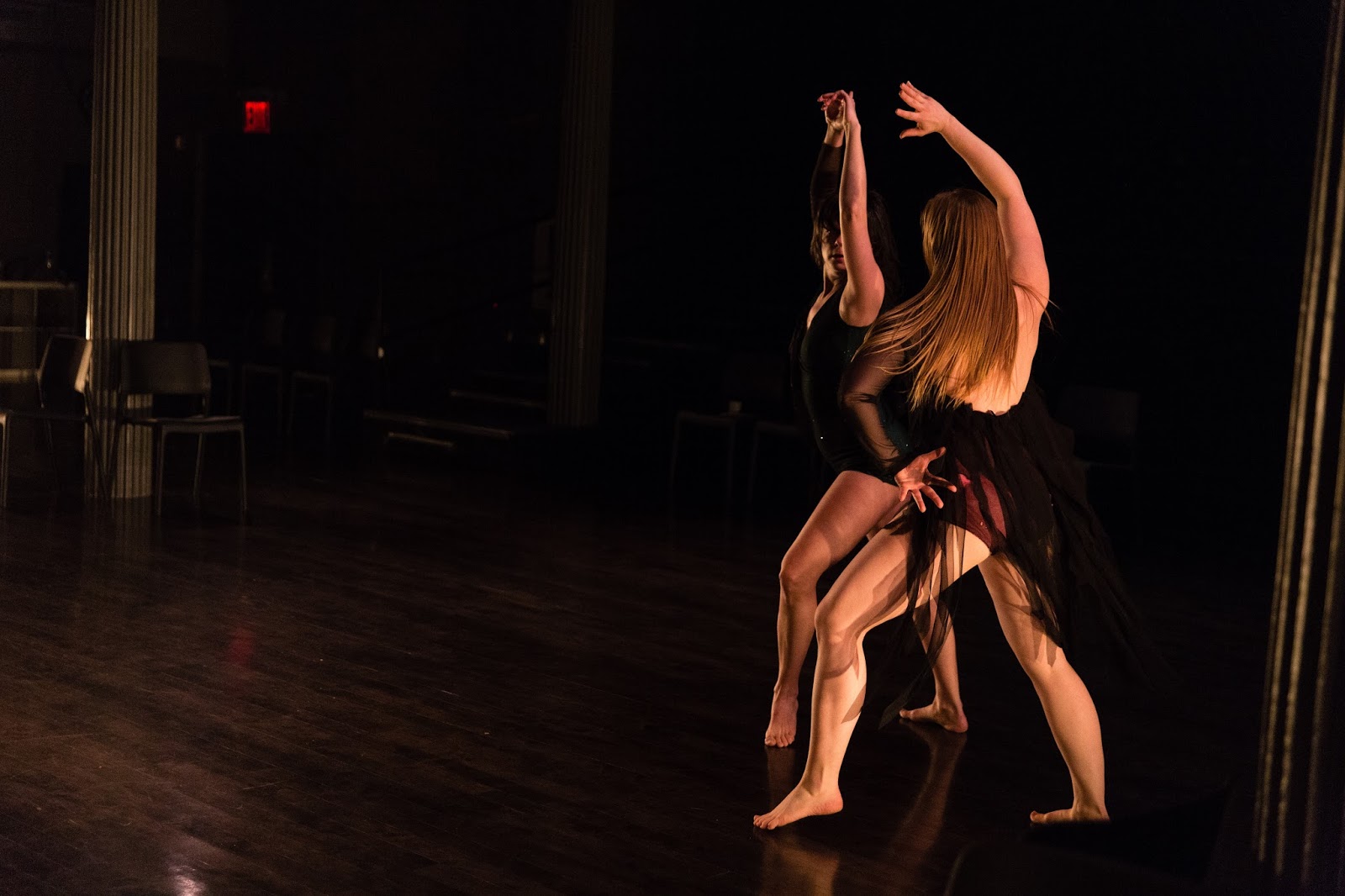
Shugg's Dear Washing Machine, Long Night
above: Hadar Ahuvia, front, with Shugg and TJ Spaur
below: Spaur, left, and Shugg
(photos: Alex Escalante)

I mostly liked Shugg's Dear Washing Machine, Long Night for qualities of springiness and momentum where one thing leads to another--a tilt, a swing, a toss of the arm, an easy communication that doesn't have to mean anything other than the flow of a body's internal messages continuously sent and agreeably received and acted upon. It pleased me to watch how Shugg and Hadar Ahuvia and TJ Spaur move. Shugg acknowledges the columns, seems to have made peace with them. His dancers touch, slide down or push away from them with gentleness. The columns could be partners, or wished-for partners, in the dance, and they lend an unobtrusive structure to something soft and evanescent.

Anna Azrieli's Averaging
(photo: Alex Escalante)

Like some other DoublePlus artists, Azrieli sends some of her dancers in Averaging to wash right up against the front row of the audience. Like the mirrored wall, the Gibney audience's edge seems irresistible to artists. And why not? We're right there on your level, dancers. Make us feel something. Even, as with Averaging, a touch of seasickness.

But pretty much everything about Averaging feels organic yet odd and out of place in the space, bearing a hint of transgression. With her fellow dancers Talya Epstein, Evvie Allison, Megan Kendzior and Katy Telfer, Azrieli has created an environment of endless shifting, incremental change, that appears to reference how things in nature make their way over surfaces. Undulating, sidling, crawling, rocking, wriggling, flopping, splaying and sloshing while sometimes humming, sighing or moaning. Plainly, it's not so much about the feet or us two-leggeds.

One focal image, though, comes from the decidedly two-legged world of ballet--the arabesque penché, a step where the dancer stands on one leg, tilting the torso forward while raising the other leg in a high, backward lift. There's a lovely serenity about an arabesque penché and a deliberately soporific serenity about its serial deployment here in Averaging, isolated from a typical ballet sequence. According to the work's description, Averaging engages with "the inevitability of being average" and a certain "mediocrity" and "vulnerability," Azrieli sees in the arabesque penché. There's also a lengthy, repeated bit of business drinking glasses of water and making like water dispensers that, to be frank, got on my nerves.

Kinzel's program is the next to the last DoublePlus presentation of this interesting premiere season; next week, curator Bebe Miller presents works by Maree ReMalia and Abby Zbikowski. On Wednesday, December 17, come early (6:45) for a pre-show Q&A with Miller.

Azrieli and Shugg continue tonight through Saturday with performances at 7:30pm. Friday's show will be followed by a Q&A with Jon Kinzel and the choreographers. For schedule information and tickets, click here.

Gibney Dance: Agnes Varis
Performing Arts Center
280 Broadway (enter at 53A Chambers Street), Manhattan
(map/directions)

Copyright notice

Copyright © 2007-2023 Eva Yaa Asantewaa
All Rights Reserved

Popular Posts

Labels