Search This Blog

Showing posts with label Cori Olinghouse. Show all posts

Saturday, December 16, 2017

Gibney's DoublePlus: Wesley Chavis and Cori Olinghouse

Wesley Chavis in his solo, Ku In Tuo Muah,
a DoublePlus presentation of Gibney Dance,
curated by Dean Moss
(photos: Scott Shaw)

In Ku In Tuo Muah, soloist Wesley Chavis's "physicalizing [of] his worship"--to use Gibney DoublePlus curator Dean Moss's words--adopts a widespread human practice with ancient origins, still active, for example, in the Black churches of Chavis's own Southern upbringing. Worship of higher, disembodied powers is often a practice of the body, and extreme, transcendent states of mind have always been powerfully accessed through the body, say in ritual dancing or ingestion of sacred hallucinogens. 

Ku In Tuo Muah, like most dance works I get to see, might have many behind-the-scenes influencers and supporters. But the few program credits--for "concept, audio/visual design and, of course, performance--go to Chavis solely, no stated collaborators. For the audience, this solo offers a privileged, if complicated, view of a path engaged upon decidedly alone. It's an internal, private, abstract exploration with challenges only one man can know.

Even the sounds that arise from this exploration are sounds of the breathing and gasping (and maybe unseen crying) of a human body. The emphasis on peeling off and shedding articles of clothing suggests continuous self-transformation and digging down to the person beneath persona beyond the grip and labeling of an outside world.

Stopping to remove his shoes and shirt is the first thing Chavis does as he walks through the door into the theater called Studio H at Gibney Dance: Agnes Varis Performing Arts Center. It's like watching a weary man come home.

At first, he does not enter the portion of the space directly in front of the audience seats and will not for a long time. Instead, he occupies that stage-left area near the mirrors. So we must look over, slightly sideways, to watch him. It's a brilliant distancing device. You see me, but you have to work a little for it. I'm still over here in my somewhat private space, and I'm going to make you feel like the voyeurs you are.

So we watch as he proceeds to disturb and distort the functional harmony of his body, and we watch the wrenching and shedding and listen to the ragged gasps. His entrance to the main section of the space, which is covered in shiny, black plastic introduces more sound--the noise of him scrunching that floor covering as he continues to contort and scrunch up his body.

At the end, Chavis simply gathers up his clothing and exits the theater, remaining someone seen with the physical eyes but not really known--an impressive, even beautiful, but remote performer. His dance, his ritual, remained--for me, at least--a journey monitored but not truly shared, and I note that with acceptance and respect.


Cori Olinghouse (above and below)
in GRANDMA
(photos: Scott Shaw)


What Cori Olinghouse calls Clown Therapy draws from The Fool's power to look at things sideways upside down and dismantle the everyday mundane and how we habitually see it. Her GRANDMA--an interdisciplinary piece for herself, Martita Abril and Kate Watson Wallace--is wacky without (for the most part) being funny. It really isn't clowning in the conventional manner. Its pace is most often glacial with stiff, stooped, dazed dancers shambling about a space littered with cheap snack food. Their overpowering, face-obscuring wigs and lipstick pink costumes, the recognizable snack food product placement, though--that's where the funny would normally be situated. The clown proffering little plastic-wrapped cupcakes could not be more pathetic as she apparently cannot bring herself to approach more than two people in the audience, her feet repeatedly colliding with the plastic cups that earlier exploded onto the floor right in front of us.

My sympathetic attention cleaves to one performer momentarily and sadly stuck facing a corner, as if in shame, confusion or both. The old-fashioned tv screen at the center of it all gives back nothing but static. Attempts to mop up the mess--or stuff slices of Wonderbread under one's wig--are futile, half-hearted and soon abandoned. The overall ineptitude and visual disarray speak to a growing upheaval at the core of something, and that must be the therapy Olinghouse chooses to agitate.

Olinghouse's inclusion of two pop hits--George Michael's "Father Figure" and Wham!'s "Everything She Wants"--will launch an army of earworms, I can attest. The songs underscore a displeasure with warped values, excess consumption and the detritus it generates.

Wesley Chavis + Cori Olinghouse concludes tonight with a performance at 8pm. For information and tickets, click here.

Gibney Dance: Agnes Varis Performing Arts Center
280 Broadway (entrance: 53A Chambers Street), Manhattan
(map/directions)

Subscribe in a reader

Saturday, December 5, 2015

Movement Research Festival: Gwen Welliver and Abby Zbikowski

Choreographers  Gwen Welliver and Abby Zbikowski shared last evening's program at Danspace Project as part of the 2015 Movement Research Festival (Vanishing Point). The two artists were selected by festival curators Beth Gill and Cori Olinghouse to explore new ways of envisioning abstraction in contemporary dance. If postmodernists stripped "fantasy, metaphor and characters" from dancemaking, would it be possible to reclaim these compelling elements in fresh ways?

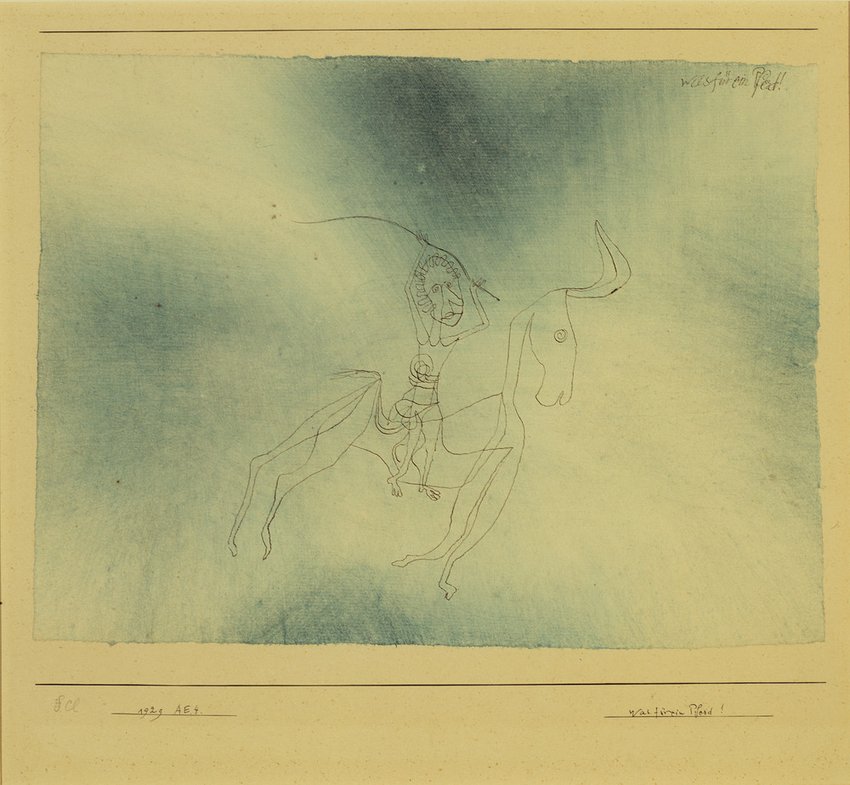
Paul Klee's Was für ein Pferd! (What a Horse!), 1929

With What a Horse!--the title alludes to a Paul Klee line drawing--Welliver works on this problem by transferring her own drawing practice to physical bodies on the move. Happily, two of the bodies in question belong to Claire Westby and Stuart Singer, both excellently suited for Welliver's heroic aesthetic here, capable of bold, substantial presence in space, with a launching as noisily assertive as Jake Meginsky's sound score. When Welliver has Westby extend a leg, for instance, it resembles both a puncturing weapon and a decisive act of punctuation. In either case, we quickly get that this is not a figure to tangle with, just as the childlike, spindly lines in the Klee drawing convey the electric dynamism of its horse and rider. Amid the plumped out, sculptural lines of Welliver's abstraction, there is some galloping, cantering, trotting and the introduction of a third figure--dancer Reid Bartelme (sporting a protective vest of what appears to be black leather covering a pale, satiny shirt) who heralds something of smoother, silkier texture in both movement and music.

If, as an abstractionist, Zbikowski takes interest in stripping anything away, it's stripping our sense that the art of dance is about making things look effortless. She foregrounds effort, even discomfort. In her duet, double nickels on a dime, she brings the "outside" influences of punk, hip-hop and martial arts into the formal space of concert dance but not as fetishized artifact but as form, energy and psyche embodied, in a matter-of-factly outrageous way, by wonderful Fiona Lundie and Jennifer Meckley. Like Singer and Westby in What a Horse!, these dancers take the space in great gulps, sneakers making noisy impact, legs striding wide, bodies jutting and wrenching within organized, neat lines of structure. Watch and you feel everything--the concision of the lines, the athletic power, the attitude of being ready for anything. Every now and then, I see a performance that would make an ideal bridge from the often insular world of contemporary dance to the rest of the universe, and this is one.

The 2015 Movement Research Festival concludes tomorrow. For information on remaining events, click here.

Danspace Project
St. Mark's Church-in-the-Bowery
131 East 10th Street (at Second Avenue), Manhattan
(map/directions)

Friday, December 13, 2013

This weekend: Cori Olinghouse's "Ghost lines"

Cori Olinghouse in Ghost lines
(photo by Andy Jordan)

Film is a ghostly art--the old silents, perhaps, the ghostliest of all, though all movies preserve traces of long-departed starlight. Cori Olinghouse's Ghost lines, a film/dance production running now at Danspace Project, raises the ectoplasm of entertainers like Buster Keaton, Snake Hips Tucker, the British eccentric comic Max Wall, all known for matchless physical signatures. It also draws from the extravagance of more contemporary clowns, specialty dancers and anime characters.

The hour-long piece is a phantasmagoric shadow play in two parts. The first fifteen minutes present a luminous, masterful film collaboration by Shona Masarin and Olinghouse where the choreographer performs a silent film-style act. Layers of cracks, blurs and sparkles make the images of her surreal and ever-receding. After a pause, the work continues with live dancing, including the performance, by Bessie Award-winning tap artist Michelle Dorrance, of a flashy Hal Le Roy solo from 1931 that she reconstructed. You can enjoy the sensational original here.

There's magical illusion in the way Olinghouse stacks and fans out her dancing characters like cards from a deck of poignant oddballs, how designer Andrew Jordan conceals their faces or costumes them in distracting fabrics and shapes (which makes me think of the pants legs excitingly whipping away from Le Roy's thin limbs in that movie clip), how Kathy Kaufmann's lighting moves snatch away from us, for moments, the power of sight and then restore it. Now you see it. Now you don't. And what you see has been carefully constructed for your transitory delight. Beneath one white-smeared face is someone we will never know. And like the veiled, black-clad Eva Schmidt on her hiked-up feet, the work picks up its heels and trips away.

With dancing by Cori Olinghouse, Eva Schmidt, Michelle Dorrance, Elizabeth Keen and Mina Nishimura

Ghost lines continues through Saturday evening with performances at 8pm. For information and tickets, click here.

131 East 10th Street (at 2nd Avenue), Manhattan

Wednesday, May 23, 2012

SHOW/SHARE: They showed. We shared.

Congratulations to the six independent choreographers (and their performers) who showed work at last night's SHOW/SHARE event at Gibney Dance Center:


Kathleen Dyer (KDNY Dance Company)

Carmella Ollero

Cori Olinghouse (Ghost Lines Project*)

Ashley A. Friend (The Contemporary Dance Core)

Amanda Hunt


It was a pleasure to sample your projects and to hear about your ideas, values and process. I wish you all the very best!

Thanks, too, to our audience for sharing what you saw, felt and imagined. Your feedback will give these artists encouragement for the future.

SHOW/SHARE is a comfortable, informal, two-hour "open mic" for choreography. For more information about future SHOW/SHARE evenings, click here (and scroll down). For information on other programs and services of Gibney Dance Center, click here.


*UPDATE:

And do check out this Kickstarter campaign for Ghost line--an intriguing film/dance collaboration between Cori Olinghouse and Shona Masarin.

Friday, February 4, 2011

House of Olinghouse

Absolutely no advance tickets remain for Cori Olinghouse's voix de ville, but don't hesitate to get on the waiting list! You'd be mad to miss a chance to see this show, part of PLATFORM 2011: Body Madness, at Danspace Project.

Before I go further, let's get another layer of titling out of the way: DP ED Judy Hussie-Taylor--wearing her curator's hat this time--has labeled her chosen PLATFORM sequence "Part 1--Absurdity & Wit." All of this sounds impossibly clunky to my ears, but it really doesn't matter what Hussie-Taylor or her fellow PLATFORM curators call this or anything else. They have turned New York's contemporary dance scene upside down by radically expanding the nature of work we usually envision in the sanctuary of St. Mark's.

The lush jewel box of voix de ville ("voices of the city") contains three gems. Olinghouse's opener--The Animal Suite: Experiments in Vaudeville and Shapeshifting--deserves a more relaxed title. But its actual execution is pure, lapidarian grace. It lifts the audience away from time and into a fanciful world where vaudeville, eccentric, postmodern and house dance overlap, where gender identity ebbs and flows, and where fairytale birds and bears may coexist in peaceable spirit. The five-member cast is perfect--especially exquisite Olinghouse and Neal Beasley, whose Keatonesque-Chaplinesque dancing is a tasty joy.

(I think you'll enjoy this conversation between Olinghouse and MIT professor, writer and performer Thomas DeFrantz: Click here.)

The eccentrically-costumed Kota Yamazaki dances Itsuko san--part-Butoh, part-drag-from-hell, part fever dream--as splashes and splotches of music whimsically flare up and depart. His locomotion gets him from here to there but never through a straight path or with deliberate steps, and the dance just slips away, evaporates at the end. Quite right.

Elements of Vogue--created and performed by the truly legendary Archie Burnett (Olinghouse's master teacher) and Javier Ninja of the House of Ninja--ends the evening with a real house dance bang. Ninja is comically robotic and fussy to Burnett's sexy earthiness, but they both move with astonishing conviction and power.

Try to see voix de ville at Danspace Project tonight or tomorrow at 8pm. More information here and ticketing info here.

Danspace Project
St. Mark's Church
Second Avenue and 10th Street, Manhattan

Copyright notice

Copyright © 2007-2023 Eva Yaa Asantewaa
All Rights Reserved

Popular Posts

Labels