Search This Blog

Showing posts with label New York Film Festival. Show all posts

Friday, July 26, 2013

August application deadline for NY Film Festival's Critics Academy

Aspiring film critics are invited to submit applications for the 2013 Critics Academy of the New York Film Festival.

DEADLINE: Friday, August 9
NOTIFICATION: by September 1
Emphasis will be placed on a diversity of voices, backgrounds and cinematic interests.
For complete program information and application guidelines, click here.

Thursday, October 6, 2011

Get crazier: Wenders' "Pina"

Pina (Germany/France; 2011)
Written and directed by Wim Wenders
106 minutes
in German, English and French with English subtitles

Pina Bausch's surreal choreography and her matchless Tanztheater Wuppertal dancers look marvelous in Wim Wenders' 3D. If regular film and video typically flatten and evaporate live dance performance, 3D restores a good deal of the magic of the moment.

Here, in Bausch's primal Le Sacre du Printemps, is a woman scrunching around in a layer of red dirt; the palpable sensation of a hand slowly gliding over clothing and skin; a ripple of soft fabric as another dancer runs. Another woman gets separated from a crowd, and that isolation becomes more than an arrangement, an idea; it's personally threatening, our empathy, for once, no longer abstract sympathy.

In other places, bodies slither through the legs of chairs or hurl through the air to be caught as the viewer feels it all. The camera takes us close up, into the dances. Bausch's Romantic Vollmond ("Full Moon"), with its watery environment, revs into life in 3D, too. Wild gyrations and impulsive exaltations in the onstage pool of water and the artificial rain shower leave you, sitting at a supposedly safe distance, feeling good and splashed.

Brimming with energy, the film also includes excerpts from Café Müller and Kontakthof, the latter showing scenes performed by some of its interestingly age-variant casts. But if you love Bausch's work, you must see this film especially for the clips of Bausch's own exquisite dancing and for Wenders' unusual, lovely twist on the expected, often overused, strategy of the talking-head interview.

The New York Film Festival will present Pina on Saturday, October 15 at 6:15pm. Tickets are currently unavailable. Please watch the NYFF blog, Facebook and Twitter pages for specific announcements about changes in ticket availability. In addition, there will be a standby line at the screening venue’s box office day-of. For additional information about standby policies, please visit the NYFF Ticket Info page. 

Pina will be released in US theaters on December 23.

The 49th New York Film Festival
Alice Tully Hall at Lincoln Center
Broadway and 65th Street, Manhattan

Subway: #1 local train to 66th Street/Lincoln Center Station
Bus: The M5, M7, M10, M11, M66 and M104 bus lines all stop within one block of Lincoln Center.

Wednesday, October 5, 2011

New York premiere of "A Dangerous Method"

A Dangerous Method (UK/Canada/Germany; 2011)
Directed by David Cronenberg
Screenplay by Christopher Hampton
99 minutes

David Cronenberg, a filmmaker with a peerless grasp on the mysteries of the mind and the body, turns his attention to a seminal chapter in the founding of psychoanalysis. Adapted from Christopher Hampton’s play A Talking Cure, A Dangerous Method charts the relationship between Sigmund Freud (Viggo Mortensen) and his protégé turned dissenter Carl Jung (Michael Fassbender), as it was shaped by the case of Sabina Spielrein (Keira Knightley), a young Russian Jewish patient of Jung’s. Cronenberg brilliantly dramatizes not just the rivalry and rupture between two pioneers who defined a field but also the birth of their groundbreaking theories of the unconscious and the forces of Eros and Thanatos. Featuring an electrifying trio of lead actors, who turn near-mythic figures into flesh and blood, this is a film of tremendous vigor and ambition, a historical drama that brings ideas to life. A Sony Pictures Classics release.
###

Forget trying to get tickets for the New York Film Festival's two presentations of A Dangerous Method this evening at 6pm and 8:30pm. They're long gone. It was hard enough getting into yesterday's press screening, but I made it! As a longtime Jung fan--his work has deeply influenced my own development and counseling practice--I took great interest in David Cronenberg's romantic dramatization of a curious transitional moment in the great healer's career and life.

Based on a play by Christopher Hampton and diligent research into correspondence and the period, A Dangerous Method stars Michael Fassbender (Carl Jung), Viggo Mortensen (Sigmund Freud) and Keira Knightley (Sabina Spielrein) along with powerful supporting turns by Vincent Cassel (Otto Gross) and Sarah Gadon (Emma Jung). A Dangerous Method was filmed in Cologne and near the Alps at Lake Constance on the Rhine.

The opening scene barrels towards you, thrusting captive, mentally-ill Sabina Spielrein into your face. She bellows and struggles as a carriage hurtles her towards a hospital where she will meet Jung and become his patient. Keira Knightley's physical transformation in this and many subsequent scenes is wrenching. Under Cronenberg's direction, she works and strains that familiar jutting visage and angular frame and those vulnerable, melancholy eyes to great effect. Watching scenes like this, I thought the actress might be overdoing it. But--as Cronenberg explained in a post-screening Q&A--Spielrein's documented physical behavior was far more tortured and alarming.

In Jung's office, the camera shifts us from Spielrein's perspective (looking up at the doctor) to his (looking down on the patient), giving the audience a visceral sense of the indeed dangerous imbalance of power. Things will get stranger and more dangerous as the brilliant young analyst and his also secretly brilliant patient--the masochistic daughter of a brutal father--commence treatment and, over time, mentorship and an unethical, clandestine affair.

As her disturbing secrets spill under Jung's careful, insightful questioning, the doom-eager Spielrein concludes "There's no hope for me. I'm filthy and corrupt. I must never be let out of here."

Of course, we will learn that she is no such thing as, under Jung's care and propelled by love of him, she unfolds her own true insightful self, eventually becoming an analyst, too. But in these early scenes, Cronenberg contrasts her trauma and turmoil with the world of orderly, if static, domesticity that is the wealthy Jung household--every clean, gleaming detail of decor in place and just so.

A sub-theme contrasting the Swiss-German Jung--whose wife Emma provides the high level of living while dutifully tamping down her sensuality and her own intellectual brilliance--and the Russian Jewish Spielrein becomes even more pronounced as Sigmund Freud first takes Jung under his wing and then rejects him. Freud, aware of his outsider status as a Jew in Vienna and fiercely protective of his theories and adherents, challenges every new sign that Jung is moving towards ideas and behaviors that could bring the fledgling science of psychoanalysis crashing down around their heads.

In truth, Jung is unraveling and doing so in ways that will bring deep pain to himself and others. The ultimate transformation in this, the flowering of Jungian theory and practice, lies way in the future beyond Jung's suffering and beyond the scope of this film. Cronenberg leads us across a treacherous footbridge then stops just short of land.

The casting of the German-born Irish actor Fassbender, an irrepressibly charming hottie, and Cassel, whose uneven features suit his Trickster-ish role, are master strokes, but the entire cast is very fine.

Be sure to see A Dangerous Method when it opens in US theaters in late November.

A presentation of The 49th New York Film Festival
Alice Tully Hall at Lincoln Center
Broadway and 65th Street, Manhattan

Subway: #1 local train to 66th Street/Lincoln Center Station
Bus: The M5, M7, M10, M11, M66 and M104 bus lines all stop within one block of Lincoln Center.

Wednesday, September 21, 2011

Go on singing, more, more: Jobim remembered

So I come back to my first note
As I must come back to you...

--"Samba de Uma Nota Só"/"One Note Samba" by Antonio Carlos Jobim and Newton Mendonça 

Music according to Tom Jobim (aka, The Music according to Antonio Carlos Jobim), a new film by Nelson Pereira dos Santos, takes me back not only to the heyday of bossa nova but to my own days of mad love for the sounds of Brazil and Brazil-infused jazz. Jobim's lilting, romantic music flashed through my nerves and sent my young imagination reeling. Now dos Santos brings all of that back with this unusual documentary tribute, soon to open at the Film Society of Lincoln Center's New York Film Festival 2011.

Rejecting the expected voice-over and talking-heads approach, Dos Santos allows music--plus an extraordinary collage of vintage, and sometimes quite worn, film and video performance clips--to tell the story of Jobim's career in Brazil and abroad and the huge influence his songs had on performers around the globe. If you're old enough, you probably remember Jobim for "Garota de Ipanema" ("The Girl from Ipanema")--a worldwide 1960s hit that gets satiric treatment here through a surprising series of perfomance clips from the cute to the beyond-belief ridiculous. But there was so much more covert power to the delicious, delicate magnetism of Jobim's range of songs. You can feel that sensual, if wistful, pull in "Dindi," "Insensatez" ("How Insensitive"), "Desafinado" ("Off key"), "Wave," "Corcovado" ("Quiet Nights of Quiet Stars") and the haunting "A felicidade" ("Happiness"), the theme from Black Orpheus. Written solo or with lyricists like Newton Mendonça and Vinicius de Moraes, these lovely standards are songs to curl up inside.

Nearly seventeen years after Jobim's passing, it's both cheerful and poignant to watch him perform his music in this film. The composer's warmth and joy animate his every appearance even as we watch time thicken and age him. Even in one of his late performances, which looks rather labored, you can sense his commitment to the music and to his audience.

Dos Santos and co-director Dora Jobim, Jobim's granddaughter, have compiled footage recording sensational interpretations of Jobim songs by Gal Costa, Silvia Telles, Judy Garland, Sammy Davis, Jr., Diana Krall (who, sexy enough in English, wows the Brazilians by singing in Portuguese), Dizzy Gillespie, Oscar Peterson, Errol Garner, Jane Monheit, Stacey Kent and Milton Nascimento among many others. If I could design a heaven, Sarah Vaughn would be singing "Wave," an astonishingly sensitive Frank Sinatra would be dueting with Jobim on "Girl from Ipanema," and Ella Fitzgerald would smash her bottle of champagne on the good ship "Desafinado."

To borrow and flip some lyrics from "How Insensitive," let me be clear: This love affair ain't over.

Music according to Tom Jobim

by Nelson Pereira dos Santos
Brazil, 2011 (Regina Films)
Portuguese with English subtitles
88 minutes

October 2 at 6pm and 8:30pm (tickets)

A presentation of the New York Film Festival
Walter Reade Theater at Lincoln Center
Broadway and 65th Street, Manhattan

Subway: #1 local train to 66th Street/Lincoln Center Station
Bus: The M5, M7, M10, M11, M66 and M104 bus lines all stop within one block of Lincoln Center.


Monday, November 22, 2010

"LENNONYC" airs tonight on PBS

Don't forget the PBS premiere of LENNONYC, a wonderful documentary by Michael Epstein, airing tonight on PBS (check local listings). I reviewed the New York Film Festival presentation of LENNONYC back in September, and you can find that review here.

PBS interview with filmmaker Michael Epstein

Friday, October 8, 2010

Only connect: Eastwood's "Hereafter"

Clint Eastwood (director)
USA. 2010. 126 minutes. Warner Bros. Pictures

Vacationing with her producer/lover on a Pacific island, a stylish French news anchor stops at an outdoor market to buy trinkets. Moments later, a tsunami roars through town, wreaking unimaginable destruction and death. In London, twin boys and their drug-addicted mother protect one another until separated by tragedy. Desperate to reclaim some measure of normalcy, a blue collar worker in San Francisco rejects and tries to conceal his former profession as a psychic medium with genuine, powerful ability. As he plainly tells his manipulative brother, "A life that is all about death is no life at all."

Writer Peter Morgan (The Queen, Frost/Nixon) and director Clint Eastwood present the world as a hazardous place, all the more horrific for the impersonal nature of most of this danger. We're helpless in the face of earth's changes, terrorist plots, downsizing industries, dysfunctional people. It's not about us, but the bad thing comes ripping through, and we are simply in the way. 

Life is hard--at the very least baffling, disappointing, lonely--and then you die.

And then what?

Psychic George (Matt Damon), tv superstar Marie (Cecile de France) and poor young Marcus (Frankie McLaren) all have good reason to ask. Morgan and Eastwood hurtle them through this film as through a classic mythic quest--with Damon's George as reluctant participant while the other two are valiantly driven. Because this is an Eastwood film, you know that geography will not separate these three questers for very long. In fact, only through interconnection will each one begin his or her true journey.

And then what?

With Hereafter, the 80-year-old Eastwood explores human vulnerability. At every turn, he renders his audience as vulnerable as children. The tsunami hits just a few minutes into the film; its amazingly realistic visual and sonic effects truly terrify. You almost feel the weight of the water, the impact of overturned vehicles slamming into structures and bodies. Camera work rushes the waves at you and submerges you. And that's only the beginning. Later scenes--depicting disasters large or intimate--are equally visceral, and we are given absolutely no time to shield ourselves. 

Eastwood displays, as always, the dry-eyed, old-school humanism of a tough guy with a basic sense of decency and compassion. Morgan's characters work our emotions; we find ourselves in them. In fact, with Eastwood's direction, McLaren and de France are, in every moment, almost too real. Only Damon--perhaps because we know this actor all too well--appears to be acting, sometimes spelled with a capital A. But very often something quieter, subtler, more intuitive comes to the fore--as in some cooking class scenes shared with his fellow student, a pivotal role overplayed to distracting, cutesy effect by Bryce Dallas Howard. Ignore Howard and watch Damon.

When George touches his clients hands, he gets brief flashes of information about their deceased loved ones. He tours the preserved home of Charles Dickens and touches objects that make him feel closer to his idol. The film concludes with the inevitable, though almost missed, clasping of hands. For Eastwood, touch--human connection--seems to be the only answer to the awesome, perhaps unanswerable questions about this world and whatever may follow.

Public festival screenings:
 
Sunday, October 10, 8:15pm (Walter Reade Theater)
Sunday, October 10, 10:00pm (Alice Tully Hall)

National release: October 22

Walter Reade Theater and Alice Tully Hall
Broadway and 65th Street, Manhattan
#1 to 66 Street

Friday, October 1, 2010

"Something rich and strange"


Julie Taymor (director/producer/writer)
USA. 2010. 110 minutes. Touchstone Pictures and Miramax Films

The vertiginous camera work in the early moments of The Tempest, where a ship founders in a sudden storm, gives viewers a good idea of what they're in for--an explosive, visceral ride. Julie Taymor (FridaAcross the Universe and Broadway's The Lion King) will swirl her trusty wand, conjuring a primal island commanded by Prospera (Helen Mirren), a female version of Shakespeare's master of high magick, cunning and insight.

Taymor's Tempest is "such stuff as dreams are made on"--silky, romantic dreams as well as fearsome nightmares, all larger than life. Huge close-ups of faces; vivid, textured landscapes; reverberating sound: This hallucinatory sensuousness bears down and sweeps you up.

Beneath these heady visions, though, lies the bedrock of things more inescapably human than magical: envy, betrayal, vengeance as well as the capacity for compassion and forgiveness. Shakespeare's Tempest is a tale in which the attainment of justice requires acceptance of humanity in all its light and dark elements, acceptance of the limits of one's power as a mortal being. The freedom Prospera frequently promises her helper spirit Ariel is the freedom she most craves for herself.

Mirren, our North Star, is an elegant authority. The mercurial play of thought across her face's terrain illuminates this narrative of an exiled leader and powerful mage at a personal crossroads.


Julie Taymor talks about The Tempest (AUDIO)
(New York Film Festival press conference, September 30, 2010)


Russell Brand (Trinculo)
Alfred Molina (Stephano)
Djimon Hounsou (Caliban)
David Strathairn (King Alonso)
Chris Cooper (Antonio)
Alan Cumming (Sebastian)
Ben Whishaw (Ariel)
Reeve Carney (Prince Ferdinand)
Felicity Jones (Miranda)
Tom Conti (Gonzalo)

Composer: Elliot Goldenthal
Production Design: Mark Friedberg
Costume Design: Sandy Powell

Public festival screening: Saturday, October 2 (10pm)
New York and Los Angeles release: December 10

Alice Tully Hall
Broadway and 65th Street, Manhattan

Wednesday, September 29, 2010

Sex sells


Screenplay and direction by Abdellatif Kechiche
France. 2010. 159 minutes. A MK2 production

Saartjie (Sarah) Baartman—the Khoisan slave known in 19th Century Europe as “The Hottentot Venus”--has been the subject of numerous literary works, including poetry by Elizabeth Alexander, a play by Suzan-Lori Parks and a novel by Barbara Chase-Riboud. Her story abides as one of the most bizarre, most shameful artifacts of slavery and colonialism, a compounded crime that did not achieve even its one small measure of justice until 2002, when Baartman's violated remains were finally released by France's Musée de l'Homme and properly interred in her South African homeland. Now, award-winning, Tunisian-born filmmaker Abdellatif Kechiche has brought this complex history to the screen in the powerful and disturbing Black Venus (Vénus noire).

Baartman might have lived the already difficult life of any enslaved woman, but her Afrikaner owner, Hendrick Caezar, hatched a plan to display the exoticism of her anatomical features—enlarged buttocks and labia—in the freak shows of London fairs. Abandoned by lovers and grieving the deaths of her children, the young, vulnerable (and probably alcoholic) Baartman saw in this scheme a path to survival and eventual freedom. She signed on as “partner” in this venture and began to take direction from Caezar. He convinced her that she was an artist and taught her to act as if she were a sub-human, barely-tamed beast, perform a cooked-up “dance of savages” and throw a few good scares into her lower-class audience. And this was most important to Caezar: She had to allow them to touch and poke at her buttocks. This last duty horrified her. As she endured the frenzy unleashed around her, she tried to hold onto one last shred of dignity. But Caezar restrained her and later, out of the audience's earshot, berated her for being unwilling to fully play along with the deception.

As disgusting as this sounds, it was only the beginning of Baartman's troubles in Europe. Caezar later hooked up with an actual animal trainer—a Frenchman the filmmaker names Réaux--who deceived and exploited him as he had deceived and exploited Baartman. “Réaux” began booking Baartman's act for high society Parisian parties of increasing coarseness and decadence. “Réaux” proved to be an even more demeaning “director” to this “actress,” demanding that her displays and interaction with her audience directly play to the sexual undertone of the Europeans' fascination with her. She became, for her audience, a mastubatory fetish. Eventually, when her popularity in France diminished, “Réaux” led her into prostitution. Weakened by pneumonia and veneral disease, she died in 1815.

Towards the end of Baartman's life, French scientists from the Royal Academy of Medicine measured every thing about her that they could get a good look at—everything, that is, except her genitals. They pressured her, and she refused. This violation she would not permit and so it is one of the parts they sliced from her corpse and pickled in a jar and held in display at Musée de l'Homme until 2002.

Kechiche's film goes all out in every possible way. It has the bearing of an old-fashioned historical drama, grounded in period detail and rich colors, textures and sound. It weighs in at a hefty and serious 2 hours and 39 minutes, although its gripping, unrelenting pace and tension make it seem to fly by. Its actors, from starring roles to bit parts, give superb, nuanced, individualized performances. These include convincing turns by Andre Jacobs as Caezar and Olivier Gourmet as Réaux-- so convincing, in fact, that you want to grab a few of the ubiquitous bottles of whiskey and break them over their heads.

And then there is Yahima Torrès. One day, Kechiche saw this young woman pass his house and knew he'd found his Saartjie Baartman. Her physical proportions were right, but the director noted that she also possessed an understated beauty that was right for the role. Untrained in acting, she brings intelligence and sensitivity--a hint of guarded interior life--that help us understand the depth of Baartman's suffering, her naïve complicity in her own oppression, and the source of her growing resistance.

For someone completely new to acting, Torrès accepted a role that must stand among the most difficult acting jobs of all times. It's truly ironic that, to play Baartman, she had to endure what Baartman endured. Kechiche spares her—and us, watching—almost nothing. Caged, prodded, made to roar and dance, groped and ridden like a beast of burden, stripped to a loincloth or completely nude--it is Torrès's body, a real body, that endures these things openly before our gaze. Publicity materials continuously emphasize the support given this courageous newcomer by the film's team.

For some viewers, Baartman's story might be new or vaguely known but far removed in time and somewhat abstract, if unsettling. Black Venus brings it to life in front of our eyes. The film might prove too explicit for some viewers—even, in some scenes, verging on the pornographic. Certainly, Kechiche risks offending many viewers by vividly recreating the very imagery that moved some observers and authorities to protest Baartman's treatment and attempt to prosecute Caezar. (Caezar escaped conviction because Baartman testified that she wasn't doing anything she didn't want to do.) Kechiche unequivocably highlights the violent, depraved brutishness of the Europeans who dared to consider this Black woman less than human, but it remains to be seen how his film will be perceived by women and Black people.

As a Black woman, I found it painful, nearly traumatic, to watch the outrages depicted here—the psychological and physical humiliation of this African woman—and to imagine that these things might continue to be enjoyed by contemporary racists and predators, even by some people who might be sitting around me in the theater.

Hard to believe, you say. Baartman's twisted story is ancient history, if true. What does it have to do with anything, with any of us, today? But please bear in mind that the Republican candidate for governor of New York--my state--is a man who thought nothing of forwarding racist, sexist, pornographic emails to his colleagues. For real.

Public screenings:

Thursday, October 7, 6pm
Saturday, October 9, 8:30pm

Alice Tully Hall
Broadway and 65th Street, Manhattan
#1 to 66 Street

Information and ticketing
Friday, September 24, 2010

The Psychosocial Network

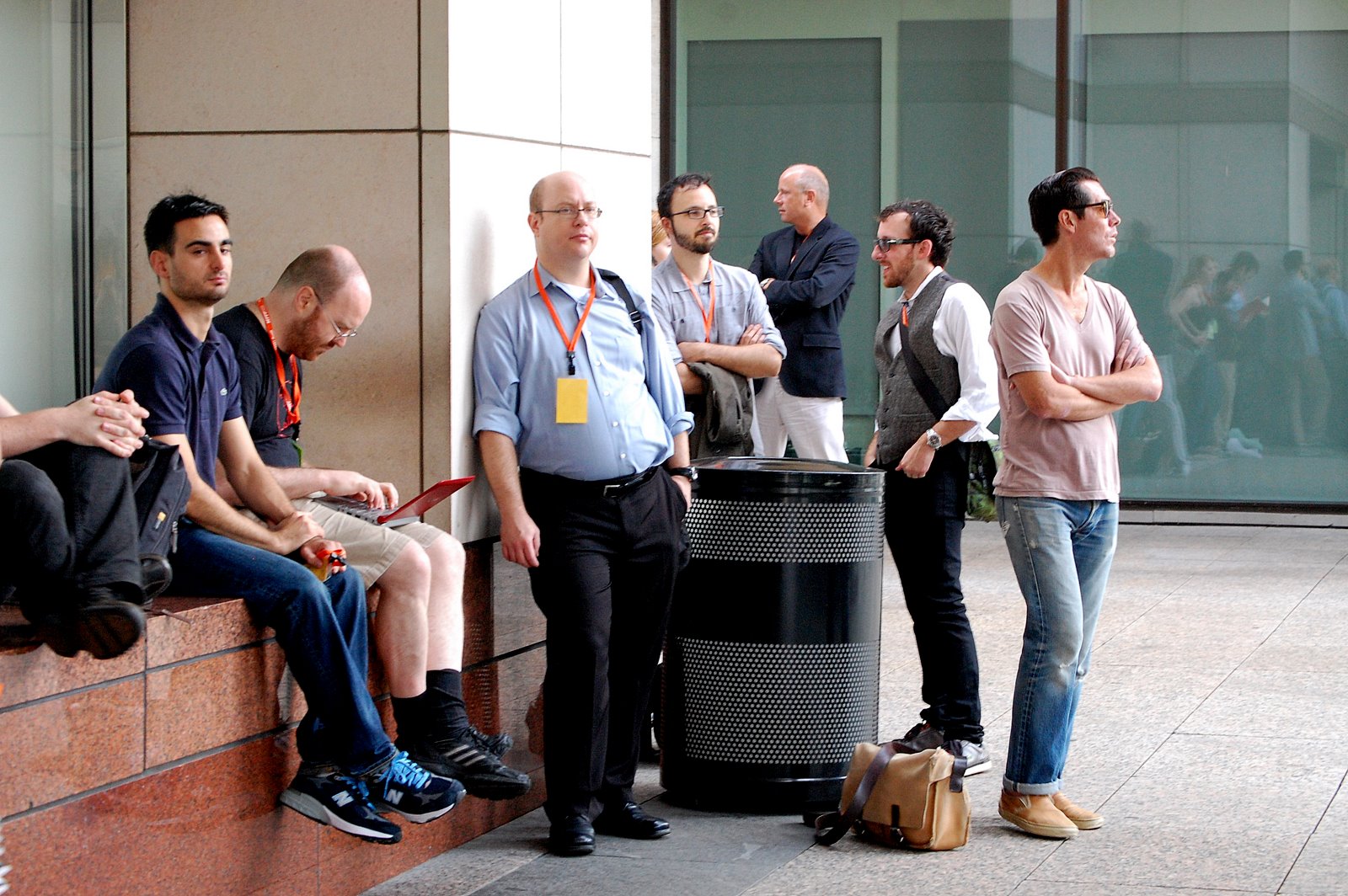
Press queue at Walter Reade Theater
(c)2010, Eva Yaa Asantewaa
Actor Jesse Eisenberg, left, with director David Fincher
(c)2010, Eva Yaa Asantewaa
New York Film Festival
Film Society of Lincoln Center

The Social Network (directed by David Fincher) USA. 2010. 120 minutes.

Columbia Pictures in association with Relativity Media. A Scott Rudin/Michael De Luca/Trigger Street production

Now that I've seen The Social Network, I can see why Mark Zuckerberg might be worried. Actor Jesse Eisenberg (The Squid and the Whale; Adventureland) who plays the young, nerdy whelp of an entrepreneur/billionaire-to-be in David Fincher's cautionary tale of brilliance and backstabbing, is now seared into the back of my eyeballs. I know I know, very well, what Zuckerberg looks like, but I can't actually remember right now, and that might be a problem. Why? Well, I'm guessing that a whole lot more people use Facebook than can pick Zuckerberg out of a lineup, and I'm guessing a huge number of these folks are going to see this movie. They're going to have Eisenberg seared into their eyeball's recesses, too, and lord help the real Zuckerberg because his depiction here sure ain't pretty.

On the other hand, Facebook itself is lookin' sharp. If I were Zuckerberg's friend--ahem--I'd tell him to relax. This is great for product. Everything about this film makes Facebook come off as the coolest innovation of the 21st Century. I'm hoping the 21st Century will end up having lots more to recommend it, but this has gotta be good for business.

Of course, The Social Network is the story of how we got there--500 million-strong and counting, spending hours of precious time checking in, again and again, to watch cat videos, post last night's party pics and rail about politics. Well, let's say, it's one of a few possible stories of how we got there. The real Zuckerberg is sticking to his story and, famously, others have theirs. Screenwriter Aaron Sorkin (The West Wing; Charlie Wilson's War) whipped up a Roshamon-style facemash of them, and Fincher (Fight Club; The Curious Case of Benjamin Button) blended them on High. You might come away from this film feeling grateful that, where you hang out, the stakes are not this high. Then again, maybe you won't.

The pace is killer--from the nimble verbal swordplay of some very young, very smart people to the occasionally zippy, completely unexpected jabs of humor, from the rapid, cross-cutting camera angles to the unrelenting tension. The visual tone is a class act, too--perversely beautiful eye candy all around. And the acting is unforgettable. Eisenberg works so many layers into his embodiment of Zuckerberg that it's like watching a variety of interior selves jostling for control. One, obsessive in nature and oblivious of everyone around him, keeps surging forward with the dead eyes of a shark. Another barely conceals demonic rage, using his computer-like brain and words like a switchblade. And yet another, awkward and raw and needy as a newborn, rarely allowed to see daylight, can't figure out a way to connect to people for real. Eisenberg doesn't make it easy for viewers to comfortably accept his character--or any of these sub-personalities--because they never comfortably settle into place. I won't give away Sorkin and Fincher's conclusion, but let's just say the irony is devastating.

Andrew Garfield, more than making up for Zuckerberg's total lack of charm, gives a luminous performance as Eduardo Saverin, Zuckerberg's college friend, CFO and eventual adversary. Justin Timberlake--as Sean Parker, the creator of Napster--is simply fantastic. I must admit I haven't followed his music career, nor was I aware that, in recent years, he had launched a film career. As the wily Parker, he's got total control--physically, vocally, emotionally. It's a masterful performance. Rooney Mara, as the young woman who dumps a heedlessly arrogant Zuckerberg--setting off both his fit of revenge and his date with destiny--made me want to stand up on my seat and cheer. I can't wait to see her bring Steig Larsson's intriguing, strange Lisbeth Salander to the screen in The Girl with the Dragon Tatoo, another Fincher project. On a smaller scale, but with huge impact, Douglas Urbanski nails a perfect moment in his brief role as Harvard president Larry Summers, dismissing Zuckerberg's former partners' complaints with withering condescension. (Watch out, Harvard! Larry's on his way back!) All in all, Fincher's tight ensemble could not be finer.

I've heard The Social Network already talked about as one of the great films of all times--a thrilling, archetypal story told with superb craft and beauty. Sounds like hyperbole, sure, but I agree. You will definitely get your money's worth and be entertained and maybe a little scared, too. Then you'll take out your iPhone and update all your friends.

For information on tonight's public screening (6pm), click here. The film will be released nationwide on October 1.

Complete NYFF information (September 24-October 10)

Wednesday, September 22, 2010

Lennon: Some Time in New York City

2010 New York Film Festival
Film Society of Lincoln Center

LENNONYC (written/directed by Michael Epstein) USA. 2010. 115 minutes.

Two Lefts Don't Make A Right Production, Dakota Group LTD and THIRTEEN's American Masters in association with WNET.ORG for PBS

Documentary director/producer Michael Epstein's latest work for the PBS American Masters series explores the final decade in the life of John Lennon, from the turbulent, creative 1970s through his murder in December of 1980. Epstein selected this period--Lennon's arrival in New York City, his disastrous exile in LA and his return to New York and redemptive reunion with Yoko Ono--because he wanted to avoid rehashing already well-covered material about Lennon's youth and the Beatles era. "I wanted to give you a John you hadn't heard before," he said in a post-screening Q&A. "I wanted people to feel they were a fly on the wall in the studio."

The film probes a time of intense possibility and equally intense pressure for Lennon and Ono. With American students rising to protest the Vietnam War, the peace-loving, outspoken couple found themselves increasingly at the forefront of activism. As long as their contributions might make a difference, Lennon said, "we were willing to be the world's clowns," tuning artistry to politics and politics to theater, inspired by radical colleagues like Abbie Hoffman and Jerry Rubin. Threatened by the prospect of an eloquent, charismatic celebrity of Lennon's magnitude at the helm of an increasingly militant movement, Nixon's administration and the FBI tracked the couple's every move, even spying on their musicians (Elephant's Memory). A four-year fight against an order of deportation ensued, taking its toll on Lennon's emotional health and his marriage.

LENNONYC, for most of its two hours, is a fast-swirling flood of sound and footage, occasionally enhanced by Brian Oakes's simple line graphics that recall Lennon's own love of doodling. The editing, by Ed Barteski and Deborah Peretz, is fierce; the film moves faster than you might expect from a documentary, and it rocks, too, with a selection of music that's just right, never obvious. There's pleasure for the eye as well, both in some of the original footage and photography and in the transformative arrangements of these materials.

You're guided through all this heady stuff by numerous interviewees who worked with and revered Lennon or whose own work or activism brought them into close contact with him. Friends and associates like Elton John, photographer Bob Gruen, producer/engineer Roy Cicala, radio host Dennis Elsas, television host Dick Cavett, and the guys from the rollicking, down-and-dirty Elephant's Memory offer insights into Lennon's creativity, disappointments, alcoholism and relationship with Ono and with their son, Sean. These clips never feel like talking heads interviews. Each one contributes essential, sometimes quite entertaining parts of the story.

Ono, who is also interviewed, gave full blessings to this project, and it depicts her, as both person and artist, with respect and compassion. Epstein did consult with her and accept suggestions, he says, but Ono exerted no control over his film--something that would greatly surprise her many critics. The film's interpretation of Lennon and Ono's bond is generous, to be sure, yet it can't help but raise questions about the addictive, medicating and yet potentially healing qualities of romance.

LENNONYC loses some steam towards its end with the victorious resolution of the couple's legal problems and the birth of Sean. In a way, this makes sense. "Hard times are over," as Ono sang on Double Fantasy (1980). There's no more conflict or dysfunction to propel the narrative. Lennon evolves into a sober, loyal and feminist husband, a loving dad who stays home, bakes bread, teaches his son to swim and is as content as can be. Ono, for her part, has developed business skills because Lennon is simply no good at that sort of thing. New York is a wondrous place to live, to be in love, to raise a kid.

We know the rest of the story. Epstein touches on the tragedy through the anguished faces of people holding vigil outside the Dakota and through interviews with Ono and Lennon's friends. He omits, however, the murderer's name and avoids dwelling on the particulars of his heinous act, refusing to dignify him with more attention than he has already received. At the Q&A, he called that "part of the shitty fame machine."

Epstein's closing remarks left us to wonder how Lennon--courageous and clever activist--might have addressed the current political flare-up around immigration in the US.

'John's story is an example of what makes America special," he said. "We don't share a common past, but what we share is a common vision for our future."

Public screenings:

Saturday, September 25, 9pm
Alice Tully Hall, 65th Street (Broadway/Amsterdam), Manhattan

Saturday, September 25, 10:30pm
Walter Reade Theater, 65th Street (Broadway/Amsterdam), Manhattan

PBS premiere: Monday, November 22, 9pm ET (Check local listings.)

Information and ticketing

Complete NYFF information (September 24-October 10)

Tuesday, September 21, 2010

Frammartino's Calabrian soul

2010 New York Film Festival
Film Society of Lincoln Center


Le quattro volte (written/directed by Michelangelo Frammartino) Italy/Germany/France. 2010. 88 minutes. Lorber Films

Without dialogue but with sense-filling imagery and sound, Michelangelo Frammartino (writer/director) traces the movement of soul within earthly matter as represented by his rural ancestral home, Calabria, across four seasons. Human, animal, vegetable, mineral: These divisions are also the "four turns" of the title and the four profound, interconnected elements of Calabrian tradition and practical survival.

The film opens as smoke wafts from holes in a black cone of charcoal erected and tended by carbonai (coal men), launching intertwined cycles of cause and effect. As the film progresses, the significance of this cone will become clear, and Frammartino returns to it near the end, showing the careful process of its construction and use. In between, we observe the stark, everyday flow of life in a Calabrian hill village where an aged, ailing goatherd (Giuseppe Fuda) lives by himself and tends his adorable charges. He also tends a persistent cough in a traditional way by ingesting blessed packets of dust swept from a church floor.

The goatherd serves as Frammartino's primary human focus. (The closeups of Fuda's face and hands and the few humble belongings in his home would have inspired van Gogh.) But sometimes I also felt as if I were getting down in the muck with the wonderful goats and their kids. We visit and revisit the Calabrian landscape, the film's rhythms returning us to certain views in differing lighting or times of year, as if we're perched on a higher hill looking out across the soft expanse. In most of the village scenes, we gaze downward as if standing atop the highest roof or floating above a road. The few verbal exchanges between villagers sound muffled. Distinct words are not as important as meaning; being human, we understand well enough. Frammartino lets clanging goat bells, rustling wind, a barking dog, jubilant villagers and growling chain saws tell the story and mark time's passage.

Despite the distancing viewpoints and Frammartino's unusually intense attention to the non-human elements in his film, Le quattro volte carries a strong emotional charge. You watch it, you feel, you care.

Read Michelangelo Frammartino's synopsis and intention.

Public screening: Sunday, September 26, 3pm

Alice Tully Hall, 65th Street (between Broadway and Amsterdam), Manhattan

Information and ticketing

Complete NYFF information (September 24-October 10)

Copyright notice

Copyright © 2007-2023 Eva Yaa Asantewaa
All Rights Reserved

Popular Posts

Labels