Search This Blog

Showing posts with label lectures. Show all posts

Thursday, March 17, 2016

Talks on "Dreams, Magic and Desire" at The Met: Part 2

Sir Edward Burne-Jones: 
The Beguiling of Merlin (1872-77)
Lady Lever Art Gallery

This morning, I attended "The British Invasion," the second of Alison Hokanson's excellent presentations on Dreams, Magic and Desire at The Metropolitan Museum of Art. Her talk, this time, focused on Britain's Pre-Raphaelites--exemplified by painters Dante Gabriel Rossetti and Sir Edward Burne-Jones--and their direct influence on the later Symbolist movement. (See my post from last week's talk about Belgium Symbolist Fernand Khnopff.)

Again, Hokanson led us through the factors that gave rise to Symbolism in many European nations--primarily the intensely nationalistic urge to break from the dominance of France-centric academic art, realism and Impressionism, and the desire to explore inner worlds and mystical realms. Symbolism, she said, was not a specific technique but "a range of principles," "a state of mind" valuing individual expression.

As the Symbolists took inspiration from the earnest, elaborately symbol-laden work of the Pre-Raphaelites, that movement looked even further back to paintings of the medieval and early Renaissance eras, citing their "immediacy, purity, authenticity" all that was "full of life and heartfelt." Burne-Jones belonged to the second wave of Pre-Raphaelites, artists devoted to an even more idealized depiction of nature, humanity, myth and mind.

Beauty of form grew in value for these artists, but beauty as "a way to guide the spirit" in a world lately upended by industrialization, commercialization, scientific discovery and political upheaval. The movement also embraced the decorative arts in furnishings, book illustration and objects of everyday use.

"The British Invasion"

Taking as a starting point the Met’s masterpiece The Love Song by Edward Burne-Jones, this talk highlights the appeal that the work of the Pre-Raphaelites in England had for the Symbolist generation in Northern and Central Europe. From Brussels to Munich and Vienna, artists drew on British models to develop modern styles that differed radically from the French trends that dominated the art world. Their work, as one critic put it, “rendered the profundity of life and a melancholy attitude of beauty.”

Sir Edward Burne-Jones:
The Love Song (1868-77)
The Metropolitan Museum of Art

Hokanson's talk centered on The Love Song--the romantic, atmospheric Burne-Jones masterpiece in the Met's collection--tracing its influences back to Botticelli, Giorgione and Titian. A gifted communicator, she made her feelings for this work most clear by adding a recorded chanson to our visual experience of this painting's overtly depicted and subliminal music. It was a sublime moment.

File:Sir Edward Coley Burne-Jones Flamma Vestalis.jpg
Sir Edward Burne-Jones:
Flamma Vestalis (1896)

Hokanson ended her discussion by noting the trauma of World War I and its sweeping effect on the arts in Europe. The Symbolist movement fell away, supplanted by emerging forms for a brutally altered world.

*****

For information on future art talks at the Met, click here. To learn about all other special programming at the Met, click here.

*****

Special note for dance fans:

David Dorfman Dance will take part in tomorrow's lineup celebrating the official opening of The Met Breuer with performances all day long, free with museum admission or membership. Click here for information.

If you like what you're reading,
subscribe to InfiniteBody!

Saturday, March 12, 2016

Talks on "Dreams, Magic and Desire" at The Met


Above: The Silver Tiara
Fernand Khnopff (1911)
The Museum of Modern Art

Below: Self-portrait, Fernand Khnopff (1879)
Willems Collection, Brussels


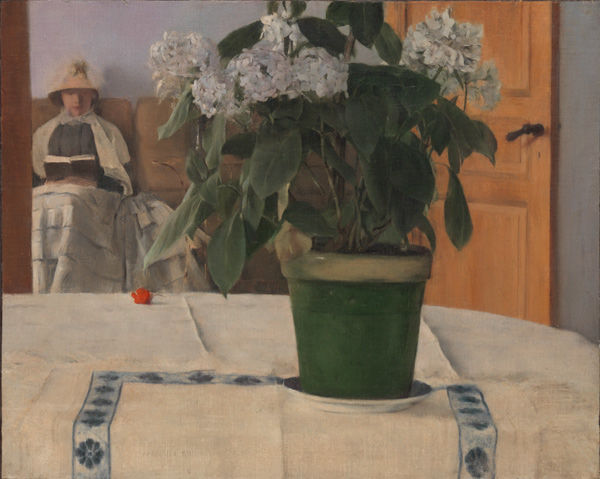
On Thursday, the Metropolitan Museum of Art presented a talk by Alison Hokanson (Assistant Curator, European Paintings) on Symbolism with a focus on the work of Belgian painter Fernand Khnopff. In discussing the broad and enigmatic Symbolist movement, with its concern with "desire, the unconscious, human mortality, timelessness and the inner self," Hokanson acknowledged that it had long been dismissed by most art scholars as "an artistic dead end, not sufficiently sophisticated or forward-thinking."  Now that assessment is under revision. A prime example of this new consideration: The Met's own recent acquisition of Hortensia, an interior innovative, for its time, in Khnopff's confident experimentation with perspective and foregrounding.


Fernand Khnopff's Hortensia (1884)
The Metropolitan Museum of Art

Hokanson is a clear, illuminating presenter, and if you missed this first talk from her Dreams, Magic and Desire series, I highly recommend catching the second--"The British Invasion"--on Thursday, March 17 (11am-Noon).
Taking as a starting point the Met’s masterpiece The Love Song by Edward Burne-Jones, this talk highlights the appeal that the work of the Pre-Raphaelites in England had for the Symbolist generation in Northern and Central Europe. From Brussels to Munich and Vienna, artists drew on British models to develop modern styles that differed radically from the French trends that dominated the art world. Their work, as one critic put it, “rendered the profundity of life and a melancholy attitude of beauty.”
Click here for ticket information.

The Grace Rainy Rogers Auditorium at
The Metropolitan Museum of Art
82nd Street and Fifth Avenue
(visitor information including map and directions)

If you like what you're reading,
subscribe to InfiniteBody!

Wednesday, January 15, 2014

New York Live Arts to explore the live ideas of James Baldwin

James baldwin.jpg
James Baldwin
As part of The Year of James Baldwin*, a city-wide, multi-disciplinary celebration, New York Live Arts will launch Live Ideas: James Baldwin, This Time!, April 23-27, at its Chelsea center. Through lectures, panels, conversations and programming in theater, visual art, dance, video and literature, New York Live Arts will lead an exploration of the continuing pertinence of this great American essayist, novelist, playwright and social critic.

Highlights will include the world premiere of Nothing Personal, starring Colman Domingo; previews of Carl Hancock Rux's Stranger on Earth and STEW's Notes of a Native Son; the world premiere of Dianne McIntyre's Time is Time; a discussion on Baldwin and Queer Futurity; and a conversation on what Baldwin would say about contemporary America, moderated by festival curator, Lawrence Wechsler.

Click the Soundcloud link below to listen to the January 15 New York Live Arts media briefing for Live Ideas: James Baldwin, This Time!


Speakers:

Bill T. Jones, Executive Artistic Director of New York Live Arts

Jean Davidson, Executive Director and CEO of New York Live Arts

Lawrence Weschler, non-fiction writer and Baldwin festival curator

Patricia Cruz, Executive Director, Harlem Stage

Rich Blint, Associate Director, Office of Community Outreach and Education, Columbia University School of the Arts

Aisha Karefa-Smart, niece of James Baldwin

For further information on Live Ideas: James Baldwin, This Time!, visit newyorklivearts.org/liveideas/.

*Partner/Collaborators in The Year of James Baldwin include Harlem Stage, New York Live Arts, Columbia University School of the Arts, The Office of Community Outreach and Education and The New School and its Vera List Center for Art and Politics and the School of Writing

Sunday, April 7, 2013

When God is queer


Godfull: Shape Shifting God as Queer
(with Carlos Motta)

Fri., April 12, 7pm-11pm

James Memorial Chapel at Union Theological Seminary
3041 Broadway (at 121st Street), Manhattan
(map/directions)

Free admission: RSVP Online
Godfull: Shape Shifting God as Queer is a performative symposium convened by artist Carlos Motta and minister Jared Gilbert featuring performative lectures and performances by a group of academics, activists, artists and theologians to explore the intersections of queer politics, spirituality and social justice.
Godfull: Shape Shifting God as Queer explores queerness as a constant force of disruption in theology and sexual politics. The participants speak of a "queerness" in theology that is particular and explicit of the queer body, a "queerness" that represents a constant pursuit of new social and spiritual revelations through deviant, subversive and indecent affirmations that will continue to challenge repressive notions of morality and respectability.
For complete information, click here.

Friday, May 4, 2012

Love tap dance? Join CDWNM & ATDF on 6/23

Love tap dance?

Hold this date:
Saturday, June 23 (Noon to 4pm)

Here’s your chance to hear more about the international tap dance phenomenon directly from its top professionals and experts!

Collective for Dance Writing and New Media and American Tap Dance Foundation invite you to Writing on Tap: Everything You Always Wanted To Know About Tap But Were Afraid to Ask on Saturday, June 23, Noon to 4pm.

Hosted by Tony Waag’s ATDF at New York’s American Tap Dance Center, Writing on Tap will offer a provocative, interactive forum featuring talks by Constance Valis Hill, dancer and author of the essential and lively tap history, Tap Dancing America, A Cultural History, and the multitalented Brenda Bufalino, internationally acclaimed for her singular style and innovation in dance and choreography, among other special guests to be named later. Fans, performers and dance writers are all warmly welcome to this afternoon of informative talks and small group discussions on issues in tap.

American Tap Dance Center
154 Christopher Street, #2B, Manhattan
(between Greenwich and Washington Streets)

Admission: $10 (cash at door). Space is limited. Reservations are required. Please RSVP to collectiveDWNM@gmail.com.

For more information, download a copy of our Writing on Tap press release here.

You will find Collective for Dance Writing and New Media on:

Twitter

Facebook

Google+

Tuesday, February 7, 2012

Contemporary dance from Turkey

Mustafa Kaplan and Filiz Sizanli of Taldans


Queens College Kupferberg Center for the Arts

Saturday, February 25, 8pm

As part of Queens College's extensive Year of Turkey: Exploring Past, Present, Future programming, TaldansMustafa Kaplan and Feliz Sizanli--two of Turkey's most notable dance innovators--will present work at the college's Kupferberg Center for the Arts. The artists join colleague Ayşe Orhon, an emerging choreographer, for INFLUX: Turkish Contemporary Dance, a free event.

Scholar Gurur Ertem, artistic director of programming at iDANS (Istanbul International Dance and Performance Festival) will moderate a post-show Q&A. 

On February 22 (12:15pm), Ms. Ertem offer the free lecture, "The Contemporary Dance Scene in Istanbul," at Campbell Dome.

A sociology doctoral student at the New School for Social Research, Ertem is developing a thesis on the sociology of contemporary dance. She frequently writes about contemporary choreography and is the editor of 20.YY’da Dans Sanatı: Kuram ve Pratik (2007, Bogazici University Publications, Istanbul; Turkish); Çağdaş Dansta Solo? In Contemporary Dance (2007, Bimeras Publications, Istanbul; Turkish and English); and Dance on Time! (2009, Bimeras Publications, Istanbul; Turkish and English). 

Both events are hosted by Edisa Weeks, QC Drama, Theatre & Dance Department, in collaboration with the Kupferberg Center.

Admission: Free


For complete INFLUX programming information, click here or call the box office at 718 793-8080.

For information about all of Queens College's Year of Turkey events, click here.
Goldstein Theater, Queens College Kupferberg Center for the Arts
65-30 Kissena Blvd. Flushing, Queens
(corner of Kissena Blvd and the LIE, Exit 24)
(map/directions)

Friday, January 27, 2012

The Arab contribution to Western music

presents

The Arab Contribution to Western Music

Thursday, February 9, 6pm

Without the brilliant, sophisticated music that informed the courts of Cairo, Baghdad, and Damascus, European music as we know it today would be quite different. Arabic music traveled west with Jewish troubadours and took root in Moorish Spain, lecturer and author Nimet Habachy will explain during this event. Refreshments will be served.
With musical examples from both worlds performed live by Simon Shaheen, the renowned violinist and oud player, we trace the influence of music of the Arab world to Mozart's Magic Flute and The Abduction from the Seraglio.
 Tickets: $25 (unreserved seating)

The Bonnie J. Sacerdote Lecture Hall
Uris Center for Education
Fifth Avenue at 82nd Street, Manhattan

Saturday, July 16, 2011

Jump back into that box!

Remember that wonderful advice about thinking outside the box? You do?

Well, forget it.


Creativity researcher Jacob Goldenberg, Ph.D. says creativity flows more freely, more effectively, within a "closed world."

"Getting outside of the box is not a useful idea," says Dr. Goldenberg, professor of marketing at the School of Business Administration at Hebrew University, Jerusalem and visiting lecturer at the Columbia Business School. "It could be used as a metaphor for a creative idea but not for the creative process itself. There is a box--the closed world--and the solution is inside it, not outside of it."

Solutions to practical and aesthetic problems can often be found within the problems themselves, he says. Constraints actually increase creativity because they restrict unnecessary distractions that can take us far off track or a myriad of choices that can confuse us. What's more, the popular practice of brainstorming with others actually generates fewer original ideas than do individuals working alone because of the likelihood that an individual's ideas will be ignored or discounted before they have had a chance to develop and show their potential.

While Dr. Goldenberg's interesting presentation at 92Y last Wednesday drew on examples of inside-the-box innovation within commercial product development and marketing--from Betty Crocker instant cake mix to the iPod Shuffle--a few writers in attendance questioned how his ideas could be applied to the creative arts.

This is clearly not Dr. Goldenberg's area of concern and expertise. But the questions made me think about poet friends and teachers who greatly enjoy working forms like sonnets or haiku or villanelles or the various game-like OULIPO structures. (Here's a fun OULIPO example.) The closed world of formal structure and technique obviously holds great significance in dance--from ballet to sacred hula and salsa dancing--and provides firm ground, to varying degrees, for the flow of creativity in movement style and performance.

So, here are a few questions for contemporary artists who work outside of traditional technical or cultural structures:

Have restrictions ever enhanced the creativity and effectiveness of your solutions? What constitutes your closed world? What structures do you like to have in place for creativity to flow?

Feel free to drop your comments below!

For information on upcoming events at 92YUptown click here. For 92YTribeca, click here.

Copyright notice

Copyright © 2007-2023 Eva Yaa Asantewaa
All Rights Reserved

Popular Posts

Labels