Search This Blog

Showing posts with label The Greene Space. Show all posts

Friday, October 11, 2013

Dreaming America with Sekou Sundiata

The 51st (dream) State
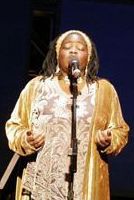
Singer Ronnell Bey
from the 51st (dream) state
Launched in April and concluding tomorrow night, Blink Your Eyes: Sekou Sundiata Revisited festival has spanned numerous performance sites around town, paying tribute to the Black poet-griot-activist who died in 2007. A presentation of MAPP International Productions, Blink Your Eyes offers a timely retrospective of Sundiata's work and of questions that preoccupied him, such as the still unfinished business of realizing American democracy and justice.

Last evening, the Jerome L. Greene Performance Space in Soho presented Sundiata's final theatrical work, the 51st (dream) state, in an adaptation for radio broadcast before a live audience. It was directed by Arthur Yorinks and hosted by John Schaefer of WNYC's Soundcheck. The unusually close, intimate space at the Greene heightened connection between audience members and an array of wonderful performers including jazz singer La Tanya Hall (taking Sundiata's role of narrator) and the original vocalists, Ronnell Bey, Audrey MartellBora Yoon and Samita Sinha.
La Tanya Hall as Poet/Narrator
Vocal cast of The 51st (dream) state
L-r: Hall, Bora Yoon, Ronnell Bey, Samita Sinha and Audrey Martell
Aside from a few times when the flourish of music swallowed Yoon's or Sinha's occasionally wispy vocalizing--both otherwise shine in quieter, spirit-filled passages--the work proceeded with fearless honesty and radiance. The small band--led by musical director/trumpeter Eddie Allen and conducted by Richard Harper--was tight, authoritative, sensuous to the max. Sitting just a few feet away, we could feel, to the core, everything they set before us.

The 51st (Dream) State is a post-9/11 meditation and intervention. Although, as Schaefer chose to emphasize, this is not "a 9/11 piece," Sundiata did not shrink from vividly invoking chilling imagery from that time of horror. He did so with exceptional courage to witness reality, free of sentimentality, and to grapple with consequences. And then he urged us to move on because we must--as a nation in flux and possibility--visualize who we want to be when we grow up.

Sundiata concluded with this challenge: "Why don't we get our hopes up too high?"

The poet has gone. His irreverent question resounds.

Watch the Blink Your Eyes presentation of the 51st (dream) state in its entirety here:


Blink Your Eyes: Sekou Sundiata Revisited continues with these remaining programs:

Days of Art & Ideas: Democracy, Imagination and Peeps of Color Now, a panel discussion at Harlem Stage Gatehouse. Tonight at 7:30pm. For information and tickets, click here.

Days of Art & Ideas: Blood, Muscle, Bone: the anatomy of wealth and poverty. Discussion and presentation on community-engagement by dance artists Liz Lerman and Jawole Zollar at Harlem Stage at Aaron Davis Hall. Saturday, October 12, 4pm-6pm. Free with reservation. Click here.

WeDaPeoples Cabaret: Fall 2013 at Harlem Stage at Aaron Davis Hall, Saturday, October 12, 7:30pm. For information and tickets, click here.

Friday, February 15, 2013

The Daily Show's Aasif Mandvi in conversation with Brooke Gladstone


WNYC’s “On the Media”

presents

Brooke Gladstone in a conversation with Aasif Mandvi

Tuesday, February 26 (7pm)

at WNYC’s The Greene Space

Aasif Mandvi is best known as the “Senior Muslim Correspondent” on The Daily Show with Jon Stewart, but as Charles Isherwood of The New York Times recently remarked, “Those who know this talented performer only from his perky mock-commentaries on The Daily Show may be surprised to discover what a skilled stage actor he is.”
On Tuesday, February 26 at 7pm, the actor and comedian will join WNYC’s On the Media host Brooke Gladstone to discuss the full breadth of his television, film and theatrical work. From reporting “fake news” to creating nuanced roles for South Asians on the New York stage, Mandvi’s work has often engaged the experience of being Muslim in a post-9/11 America. In an evening that is sure to be both entertaining and illuminating, he will discuss all this, as well as what’s next on his plate.
Aasif Mandvi made his first appearance as contributor on The Daily Show with Jon Stewart on August 9, 2006. He is the recipient of the OBIE award for his critically-acclaimed one-man show Sakina's Restaurant. Other New York stage credits include the recently ended Disgraced, the 2002 Broadway revival of Oklahoma!, Homebody/Kabul, Suburbia, Trudy Blue and Speak Truth to Power. His TV and film credits include The Proposal, Ghost Town, Music & Lyrics, The Sopranos, Sex and the City, Movie 43, and will star alongside Owen Wilson and Vince Vaugn in The Internship.
For tickets, click here.

The Greene Space
44 Charlton Street (between Varick and Sixth Avenue), Manhattan
(map/directions)

Wednesday, December 2, 2009

Return from exile: Sanchez illuminates World AIDS Day

Last night, I made my first trip to WNYC's Greene Space for a World AIDS Day event featuring performances by the pioneering poet Sonia Sanchez and acclaimed dancer-choreographer Ronald K. Brown as well as a conversation among Sanchez and health advocates. Greene Space's intimate setting created a special feeling of welcome quite appropriate to the artists' theme of acceptance, truthful dialogue and reconciliation within the Black family and within the larger family that is the Black community.

Warmly accompanied by jazz musicians Odean Pope (saxophone), Kenny Gates (piano) and Lee Smith (bass), Sanchez performed her award-winning Does Your House Have Lions?--a rhythmic conjure-work in book form. The poem deals with her gay brother's estrangement and struggles, his migration from the South to New York City where "a new geography created him," his political awakening and his passing, from AIDS, in 1981. Brown enhanced Sanchez's mesmerizing vocal performance with big, hungry, panther-ish moves. The radiance of speaker, dancer and musical trio reached across the short distance from artists to audience, hearts to hearts.

"How how how...how to return from exile?" Sanchez's poem asks. The evening's panel, moderated by pan-media journalist Esther Armah, explored this question as it relates to the disproportionate impact of HIV/AIDS on people of African descent. With an increase in HIV infection among Black men who have sex with men, young Black men and Black women under 30, the African-American community simply cannot afford to avoid frank, uncensored talk about sexuality and health.

Panelists Dr. Monica Sweeney, MD (Assistant Commissioner for HIV/AIDS for the New York City Department of Health) and Phill Wilson (Founder and Executive Director, Black AIDS Institute) offered some measure of hope, pointing to a gradual decrease in stigmatization of people with HIV/AIDS, even within Black churches, and more openness to honest talk about sexual orientation, sexual behavior and methods of preventing infection.

Societal and psychological barriers to prevention and care still exist, but Armah's panelists emphasized how individuals and communities can empower and protect themselves. "We need to have these conversations in more robust ways," Wilson said. "You have the power to stop transmission of HIV. You deserve to protect yourself."

Sweeney noted, with great concern, one segment of the population--women over 50--who sometimes engage in unprotected sex "as if age is a vaccine" and HIV something that happens to other people. She offers HIV testing to people of all ages and believes that if the test were part of all routine care, it would be accepted with no shame. The NYC health department's female condom program has been expanded, she says, enabling women to guard their health without having to figure out ways to negotiate safety with their partners.

One audience member raised the question of sexual abuse and domestic violence in the community and how they complicate prevention and healthcare. The panelists noted that the Black family and community have tended to shroud these issues in silence, although--thanks to high-profile cases, the testimony of celebrities who have been victimized, and works of art such as Sapphire's novel Push and the extraordinary film, Precious, based on it--more attention and resources are being directed to these parallel problems.

"AIDS is the health crisis of our day, and what we do about it will be our legacy," Wilson said. While he acknowledged the Obama administration's efforts around needle exchange programs, the extension of the Ryan White Act and the recent lifting of the ban for HIV+ people traveling into the US, he noted that we still lack a comprehensive, national AIDS strategy and meaningful healthcare reform.

I commend WNYC for presenting this informative and imaginative program. To view a schedule of upcoming events at the Greene Space, click here.

Monday, November 30, 2009

Copyright notice

Copyright © 2007-2023 Eva Yaa Asantewaa
All Rights Reserved

Popular Posts

Labels