Search This Blog

Showing posts with label William Shakespeare. Show all posts

Sunday, August 14, 2022

GUEST REVIEW: Choreographer Alexandra Beller Directs DE-CRUIT’s Macbeth Adaptation

GUEST REVIEW:

Choreographer Alexandra Beller Directs DE-CRUIT’s Macbeth Adaptation

by Kate Foster Vishniakova


The struggle is real. In 55 minutes, Make Thick My Blood at Theatre Row reveals what most productions of Macbeth ignore: the physical and psychological trauma a couple faces after the loss of a child.


The story usually told of Macbeth is one soldier ascending to the throne as king by killing its predecessor. Make Thick My Blood presents that story differently. There are two soldiers, not one. There are two crowns, not one. There are two struggles, not one. This is the story of two soldiers, a couple, carrying the dead weight of loss, fighting to fill the void that grief created, and reflecting back at each other the trauma they share.


Dawn Stern as Lady Macbeth (photo: Ashley Garrett)


The audience enters into a small, intimate space. The stage is covered with a burlap tarp reminiscent of a bunker, but the calm music suggests the war is already over. Lady Macbeth (Dawn Stern) is center stage on the ground bowing down, shrouded in a dress of mourning. Macbeth (Stephan Wolfert) enters, and the two fall into a dance of simple, sharp movements. Shoulders drop into a slumber, he carries her as she tries to hold on, he crawls away, fighting the air, fighting the mind, fighting to the top, to only collapse, and repeat. What weighs them down is the bright red stain revealed on Lady Macbeth's white undergarment.


The light splashes the entire stage red, and we are at the top of the play. We see the Macbeths grapple with the loss of their child. 


Her body becomes the dagger he sees. When Lady Macbeth convinces Macbeth to murder the King, it is not only with her words, but with her body as the weapon. Maybe if he does this, they can finally move on and forget their loss.


When they ascend to the throne, they wear identical crowns. They turn to face each other; a haunting reflection where they see the dark damned spots of their past. They walk slowly hand-in-hand, bearing equal weight of the glory and consequences of their actions. Loss of a second life does not replace the first.


A baby's cry is knocking. Their inevitable deaths are soon to come.


Stephan Wolfert as Macbeth with Dawn Stern (photo: Ashley Garrett)


DE-CRUIT, founded by Wolfert and Stern, adapts Shakespeare's texts through the lens of trauma survivors. Make Thick My Blood is no exception. After their loss, Lady Macbeth is present in everything that Macbeth hears, sees, and does. It is in her body that they lose their baby, and it is from that point on that her presence and this traumatic memory never escape Macbeth's mind. 


What is refreshing is that this production could have focused only on the nightmare. But it focuses on the effort to wake up; the effort to move on from what no human can fully move on from: the loss of a loved one. The movement in this production, under the helm of Alexandra Beller, an award-winning choreographer in her directorial debut, successfully brings the full range of emotion felt by the couple to the surface. The adaptation and direction carved out space for empathy and relatability in a story that other productions typically leave out. The story of one couple's trauma reminds us that, in our bodies, we all carry the presence of past trauma and that it can manifest itself in unpredictable ways.


[CLOSED AUGUST 6, 2022]


******


Kate Foster Vishniakova (photo courtesy of the writer)


Kate Foster Vishniakova is a dramaturg working in international and intercultural theater. She trained with artists at the Moscow Art Theatre School, in Germany as a DAAD grant recipient, and with IUGTE–International University Global Theatre Experience. She is a research dramaturg with the Verbatim Performance Lab at NYU and an HR consultant at Orr Group. MA German, Wayne State University. MFA Dramaturgy, Columbia University.

Friday, April 3, 2020

Artists Reach Out: Emily Carding

Dear friends,

Welcome to Artists Reach Out: reflections in a time of isolation. I dreamed this series of interviews out of grief for my work both as a documenting arts writer and curator of live performance. In this time of social distancing, we are called to responsibly do all we can to safeguard ourselves and our neighbors. It is, literally, a matter of life and death.

But there's no distancing around what we still can share with one another--our experiences, thoughts, wisdom, humor, hearts and spirit. In some ways, there are more opportunities to do so as we pull back from everyday busyness out in the world and have time to honor the call of our inner lives.

So, let me introduce you to some artists I find interesting. I'm glad they're part of our beautiful community, and I'm eager to engage with them again (or for the first time) in years to come.

--Eva Yaa Asantewaa, InfiniteBody


Emily Carding


Emily Carding
(Chris Bailey)


Emily Carding is an experienced Shakespearean actor, having appeared in versions of over twenty of Shakespeare’s plays, both on stage and screen. She holds a BA (hons) in Theatre Arts from Bretton Hall and an MFA in Staging Shakespeare from the University of Exeter.  Emily has, together with independent theatre company Brite Theater, created a number of challenging and innovative shows including Hamlet (an experience) and Richard III (A One Woman Show) both of which have won awards and rave reviews internationally. Both adaptations use the audience as characters within the play and create a truly immersive experience with very little other than actor, text, space and audience.

In 2018 Emily was commissioned by London Science Museum to create a solo theatre piece inspired by Mary Shelley’s Frankenstein. Quintessence imagines a future where humanity has become extinct and must be recreated by an AI, using Shakespeare as a guide to the human spirit. This won the outstanding theatre award at Brighton Fringe in 2019 and will be performed there again in May 2020.

Emily is also a published author of esoteric works, with So Potent Art: The Magic of Shakespeare due for release in 2021.

Carding performs her Hamlet (an experience)
in New York City
(photo: Ellen Kushner)
Carding's Richard III (A One-Woman Show)
(photo: Manuela Gusto)


Do you have a current or planned project whose progress is affected by the pandemic?

Quite a few things. There was a period of a few days where everything just fell off the calendar, one by one. Meetings and conferences that I was hoping would lead to incorporating tech into my show Quintessence and staging it on a larger scale, plus the next run of that show which I was hoping would lead to further booking for the next year; I was due to play Cleopatra in Antony and Cleopatra this Summer, a role I've always longed to play...that's now postponed; I'd just joined a group of mother performers connected with the Globe, and we were due to perform at the opening of the Climate Change Festival in London, but that was also cancelled. A performance of Richard III (a one woman show)...all gone. I have been booked for an exciting new musical in the Autumn about queer society in WWII, and I'm really hoping we're sorted by then!

Briefly, tell me about how you got involved in the arts and in your particular practice.

After training as an actor in the nineties, I took a long break to raise my (unplanned) daughter. When I felt the burning need to come back to the performing arts (I had been working as a writer and artist of esoteric works during that time), I was able to do an MFA in Staging Shakespeare which gave me a wonderful grounding in making my own work. This was in 2012-14 and included residencies at Shakespeare's Globe. My particular interest is in the energetic connection between actor, audience and space, using direct address and audience participation to create immersive experiences with minimal props and set.

In a more specific way, what are you practicing? And what are you envisioning?

The works I am currently best known for were created with Kolbrun Bjort Sigfusdottir of Brite Theater, which are Richard III (a one woman show) and Hamlet (an experience) which have both won awards internationally and had successful runs Off-Broadway. Both shows bring the audience directly into the play by making them characters and giving them an amount of creative freedom within that framework to co-create the piece, making it different each time. It is theatre that is truly alive in the moment, and I have to be ready to respond in character to whatever they choose to do. This is the work that really fires me!

How does your practice and your visioning align with what you most care about?

I believe that a performer should be working with a united physical, emotional and spiritual energy to be truly alive on stage. this is what I aim for myself, and the work I have created so far is part of that. Ultimately, I would like to devise a new school of training for actors using the Hermetic wisdom tradition, which was the subject of my thesis.

How does your practice function within the world we have now?
My work requires direct and intimate contact with an audience. For now, I'm attempting to find that through a camera where possible, but mostly I feel the need to be still and process the enormity of this shift. I am also editing and working on rewrites for my latest book, which is on the esoteric content of Shakespeare, and includes exercises helping people to bring theatre to their magical practice and vice-versa.

Briefly share one self-care tip that has special meaning to you now.

The guidance I have received in meditation is to remember how to simply be. Enjoy the simplicity. Breathe. Find beauty in the moment and source strength from that. Be grateful for what we do have. Hold on to love and kindness.

******

DISCLAIMER: In addition to my work on InfiniteBody, I serve as Senior Curatorial Director of Gibney. The postings on this site are my own and do not necessarily reflect the views, strategies or opinions of Gibney.

******

Subscribe in a reader

Saturday, January 13, 2018

SPAC's "Mugen Noh Othello" at Japan Society in sold-out run

Japan Society, celebrating its 110th anniversary,
and The Public Theater's Under the Radar Festival
present Satoshi Miyagi's Mugen Noh Othello.
(photo: Takuma Uchida)
Front left, Micari (Desdemona)
Front right, Maki Honda (Pilgrim from Venice)
with chanters (l-r): Kotoko Kiuchi, Yoneji Ouchi, Asuka Fuse,
Kazunori Abe, Fuyuko Moriyama and Haruyo Suzuki
(photo: Richard Termine)


North American premiere
presented by Japan Society (NOH-NOW SERIES, PART IV)


Satoshi Miyagi and his acclaimed Shizuoka Performing Arts Center center and elevate the role of Shakespeare's Desdemona in Othello in Mugen Noh Othello. Seen through the tradition of mugen noh theater, the warrior Othello's wife and victim becomes the potentially disruptive shade trapped between life and definitive death until she can work through her story in front of the living. This crucial process for moving on and finding ultimate rest is, in a real sense, a form of theater as ritual to release her soul. Unlike most otherworldly beings in mugen noh, though, Miyagi's Desdemona is a more humble than formidable figure, appealing to the audience's sympathy.

As the tragic ghost, Micari, silkily, eerily skims the stage on feet we never see, voluminous robes concealing what surely must be casters bearing a body that admits no articulation, drawn forward as if by magnetic force. In her thin, delicate crown, she's a doll, the very model of perfection, but our final sight of her--oh, that parting gesture!--might reveal how much her devastating fate will always define her.

The full-bodied percussive music has power. As kneeling members of the superb chorus, arranged at stage left, chant the story, you will have to scan and stare hard at each mouth to determine the source of each utterance. Supertitles provide English translations, but I bet you'll find it tough to tear your eyes from the stately beauty on stage.

Script: Sukehiro Hirakawa
Original music: Hiroko Tanakawa (arranged by the actors)
Costume design: Kayo Takahashi
Lighting design: Koji Osako

Remaining shows of Mugen No Othello (tonight and Sunday) are sold out. Wait list lineup starts one hour prior to curtain. For information, click here.

Japan Society
333 East 47th Street (between 1st and 2nd Avenues), Manhattan
(map/directions)

Subscribe in a reader

Wednesday, January 25, 2017

Donmar Warehouse brings all-woman "Tempest" to St. Ann's

Harriet Walter, above,
and Jade Anouka, below,
in the Donmar Warehouse production of The Tempest
(photo: Teddy Wolff)


How seductive--and risky--to interfere in the natural course of things for one's own ends. In The Tempest, Shakespeare's magician Prospero does just that. An aggrieved man--stripped of his noble status, surviving banishment and near-death--he fully believes in the rightness of uncommon power to control everything from the forces of nature to the romantic life of his daughter. He can twist to his designs everything from the quicksilver spirits of the air to a more fleshy, animal-like Other. Here, on his island of exile, he has enslaved two of each--Ariel, a clever sprite, and Caliban, considered uncivilized and monstrous--yet will come, at last, to learn he is the least free being of all.

As re-imagined by director Phyllida Lloyd for London's Donmar Warehouse and presented now in its US premiere run at St. Ann's Warehouse in Brooklyn, The Tempest unfolds the elaborate fantasy of an inmate doing hard time in a women's prison. Played with attentive, full-throttle investment by Harriet Walter, 66-year old Hannah has served thirty-five years of a 75-years-to-life sentence for her role as getaway driver in a robbery and murder that, she explains, had radical political motivations. We first glimpse her fellow inmates--most, women of color; she is white and Jewish--as they file through the lobby and into the theater ahead of us. When we enter, we ring their performance space on all sides as if it were a basketball court shrunk in size to give us close-up views of all the action. Characters climb or dash up and down the stairs or park themselves on the highest tiers and, at one point, we even get to play a role in the visual atmosphere of the play.

The first sensations we perceive are unyielding, mercilessly metallic--from the theater's own stark, technical features to the "cell doors" positioned at the top of the audience aisles to the grinding, rumbling, thunderous sounds that suggest the deadly, unnatural storm secretly conjured by Prospero/Hannah. That initial act of will sets the play's characters on a path that will expose and undermine a magician's desire to interfere with reality.

Like previous parts of Lloyd's Shakespearean trilogy--Julius Caesar (2012) and Henry IV (2014), which I have not seen--this Tempest's male roles are played by women actors, all representing women prisoner characters you can meet in a series of short video clips here. So, reality continuously intermingles with fantasy. Lloyd's characters are based on the stories of real women inmates who collaborated with her team on the development of this work. In fact, New York's governor, Andrew Cuomo, recently commuted the sentence of Judith Clark, the model for Walter's Hannah, convicted for her role in the 1981 Brinks robbery.

Shakespeare's Miranda--a female role--is played with Black punk-dyke style and zest by young Leah Harvey. Sheila Atim, her nominally-male Ferdinand, the shipwrecked prince, arrives on their wedding day in a thrift shop outfit as whimsically girly/boy-ly as her own.

Overall, the understated suppleness and focused power of these performances should quiet any objection to the non-traditional casting. It's exhilarating to see how performers like Jackie Clune (Stefano), Karen Dunbar (Trinculo) and the especially vivid and vivacious Jade Anouka (Ariel) simply muscle their way past any gender-related expectations a viewer might have. They make their characters live, and you have no say in the matter.

Composer Joan Armatrading  and movement director Ann Yee throw their own charm into the mix, especially in the wonderful wedding celebration. But for Hannah, and her audience, it's soon time to let dreams and make-believe go and face what is.

The Tempest runs through February 19. Running time: 2 hours, no intermission. For information and tickets, click here.

St. Ann's Warehouse
45 Water Street, Brooklyn
(Google map/directions)

Free email subscription
to InfiniteBody

Friday, August 19, 2016

FRINGE BENEFITS: Emily Carding--and you!--in "Richard III"

Emily Carding as Richard III
in Brite Theater's Richard III (a one-woman show)
at FringeNYC
(photos: Dixie Sheridan)


Instead of paying actors to play Shakespearean roles, Emily Carding gets them to work for free. By that, I mean most of the people in her small audience, each one sporting a lanyard ID--her "Duke of Buckingham," her "Lady Anne"--and occasional looks of uncertainty as Carding's masterful Richard III shares cynical confidences with one or gruffly orders around another. As the tale of bloody power grabs unfolds, condensed to under an hour, no one in attendance--even those without named roles--can fully relax. We know that Carding's Richard might suddenly lock eyes with us, requiring something of us, find us wanting.

We are not safe, Clarence. We are not safe.

What's more, Clarence, we can easily be offed by little more than an arsenal of office supplies.

An anticipated highlight of this summer's FringeNYCBrite Theater's Richard III (a one-woman show) comes to New York bearing awards from the Fringes of Prague and Edinburgh. And, by Richard's will and Carding's skill, it will conquer in its US premiere. The set-up of the new-ish Alpha Omega studio on East 4th Street provides just enough space for Carding to pace or impatiently push off on the wheels of her office chair while maintaining intimacy and a tyrant's grip on her audience.

This Richard's world of scheming and endless violence is our own, where battleground reports come via text message and leaders can instantly document their narcissism with selfies.

The narrow runner of space between two rows of seating--accommodating perhaps 25-30 people--is charged with the energy of Richard's malevolence and excess. Directed by Brite's founder Kolbrun Bjort Sigfusdottir, Carding interprets Shakespeare's Richard--a man of visible disability--with bearing and even speech that I'm greatly tempted to call dance. Dark business suit and skinny red tie askew, her body seems, at once, frozen and propelled in multiple directions even when still. And her speech, if failing in rhythm, moves with varying, unpredictable angles of attack. Deep into the performance, Carding seems to drop into a flow state from which she yields improvised snark--snapping at an unexpectedly stubborn "Lord Grey," Well now I know what you are getting killed for!--or minute, quite convincing facial expressions of fear and disintegration.

Make Richard III (a one-woman show) one of your priority stops along the Fringe. See it today at 4:30pm or tomorrow, Saturday, at 5pm. For information and tickets, click here.

And here's a special note to Fringe veterans and newbies alike: Happily, there's ample AC at Alpha Omega. In fact, you might want to bring a little wrap to throw over your shoulders.

Alpha Omega Theatrical Dance Company
70 East 4th Street (Lower Level), between Bowery and 2nd Avenue, Manhattan
(map/directions)

Saturday, February 20, 2016

Setterfield and Scott ask "Who is Lear?"

Valda Setterfield's sublimity (there's no other word for it) and her postmodern cred--dancing for Merce Cunningham and husband David Gordon--place her in the highest echelon of "downtown" royalty. Now, in Lear--a collaboration with Irish dancemaker John Scott at New York Live Arts--she plays a king, sort of. But if you're looking for Shakespeare's King Lear, go curl up with a copy.

At first sight, Setterfield reflects the true nature of her kingship and of this dance-theater piece. Her crown: a childish, white paper cutout flattened around her head. Her stride: direct but understated, drama-free. When was the last time a monarch tossed little wrapped candies at you?

You will wisely note the title--Lear, not King Lear--and contemplate the possibility that, for this character, status is already beside the point, a thing of the past or no longer of consequence.

Setterfield first breathes a few simple words: "Family. Love. Children...." Her arms and hands flutter but without fuss, merely hinting at tradition or story. "Daughters. Kingdom. Death." She seems to summon these things from within herself and, before long, "daughters" do indeed appear.

Solemnly pacing or pelting back and forth, three male dancers embody daughters Goneril (Marcus Bellamy), Regan (Ryan O'Neill) and Cordelia (Keven Coquelard), presenting a dilemma to Lear. Who truly loves Lear? Clever, seductive declarations ensue, as do conflicts, elaborately imagined in language and movement. The daughters appear to be devices that--irritating and irritable--rock Lear back to something resembling life.

Setterfield and Scott took the inspiration for Lear from shared experience--their dying fathers. They sample Shakespeare but keep us constantly aware of the today-ness of their personal investment in the themes and outline of the source material. And they do so with a light hand, humor, modest ambition and the reliability of Setterfield's clarity and restraint.

At the end, alone in the space, she revisits some of her earliest, and most mysterious, gestures as if re-folding the energy of the three conjured, now-vanished daughters into her body.

The John Scott Dance production of Lear concludes this evening with a 7:30pm performance. For information and tickets, click here.

New York Live Arts
219 West 19th Street (between 7th and 8th Avenues), Manhattan
(map/directions)

If you like what you're reading,
subscribe to InfiniteBody!

Friday, July 17, 2015

Skakespeare as we like it: out in the parking lot

"Sir, you have wrestled well, and overthrown
more than your enemies."

Jane Bradley plays Rosalind in As You Like It.
(photo: Lee Wexler/Images for Innovation)

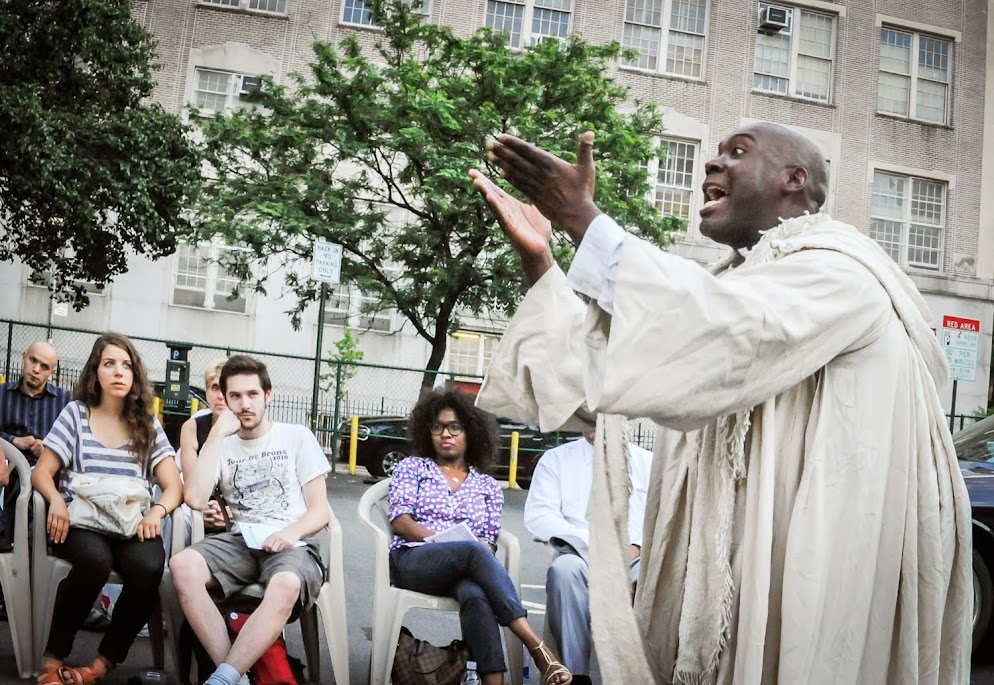
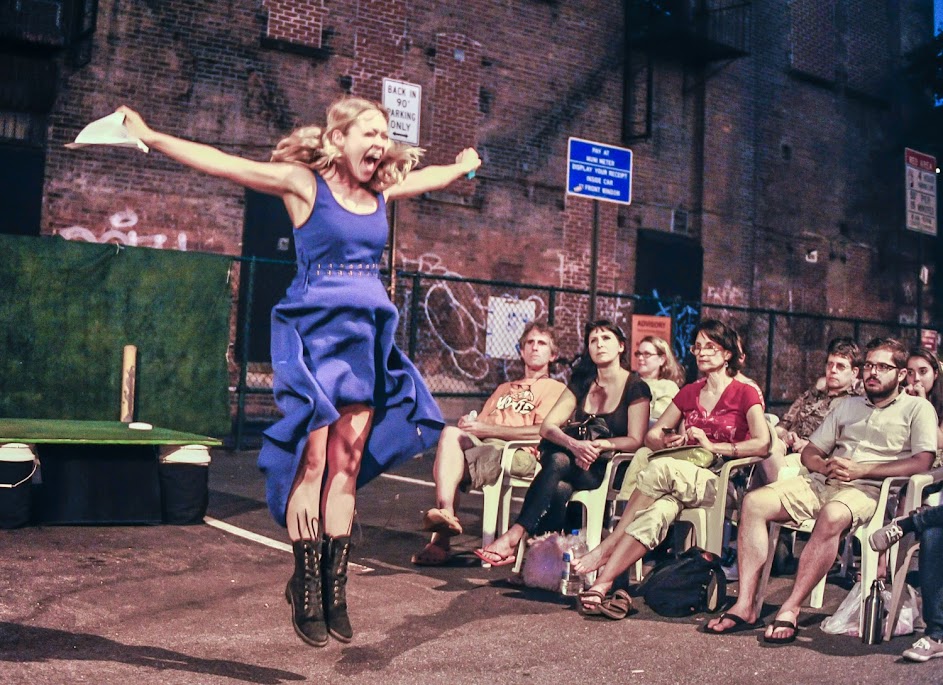
In its new home, outback of The Clemente, The Drilling Company's popular Shakespeare in the Parking Lot summer series brightly powers ahead with a Victorian steampunk As You Like It. This en plein air, in-the-round romantic comedy--with its multiple lovers and lasses--has tasty delights, chief among them detailed and zestful performances from Jane Bradley (Rosalind), Elaine Ivy Harris (Celia), Emmanuel Elpenord (Oliver) and Alessandro Colla (Touchstone). Of these, Bradley and Colla seem particularly resourceful--Colla remaining comically inventive and an unsinkable Bradley at sharp physical and vocal energy from start to finish.

Of course, this Lower East Side Forest of Arden has--for its adaptable players and equally adaptable audience--some unique features. Shakespeare's wit and Clancy's motley crew must compete with sirens and churning helicopters and Mr. Softee trucks, odd smells from takeout dinners and the occasional SUV driver scattering viewers as he attempts to back into the street.

Getting to the lot in a tardy fashion means you might have to peer around heads and bodies as you strain to follow the speaking actors. The rare, welcome cool breezes of a mid-July evening carry away the cast's less-robust voices. And if an actor turns the other way or speaks into his partner's neck....well, what did he just say?

But all of that is to be expected, part of the Shakespeare in the Parking Lot homemade fun. Quick costume changes behind a handy car. Simple strings of lights to relieve the dark when night settles in. Creatively shabby costuming and sometimes balky props that add to a feeling of intimacy, of something wonderfully weird and kind of sweet gifted to a neighborhood. And it's all free.

As You Like It runs through July 26 with performances at 8pm. Running time: Two hours. Bring your own chair, if you'd like. And--wonder of wonders!--Shakespeare in the Parking Lot now has its own Port-O-San!

Parking lot behind The Clemente
(The Clemente Soto Vélez Cultural and Educational Center)
114 Norfolk Street (between Delancey and Rivington Streets), Manhattan
(map/directions)

Other Shakespeare in the Parking Lot productions this season:

Macbeth, directed by Hamilton Clancy, at The Clemente parking lot, July 30-August 15

Romeo and Juliet at Bryant Park, directed by Dave Marantz, July 17-August 2

The Taming of the Shrew at The Clemente parking lot, directed by Alessandro Colla, September 4 to 20

Click here for complete information and schedules.

Saturday, March 1, 2014

It's a Fiasco! In a good way!

Paul L. Coffey (Angelo) and Emily Young (Isabella)
in Fiasco Theater's Measure for Measure
(photo by Joan Marcus)
WHY FIASCO?
Legend has it the word “fiasco” was first used to describe commedia dell’arte performances that went horribly (and hilariously) wrong. In those instances the performer would have to fare fiasco or “make a bottle.” In other words “You’re buying!” While we hope to avoid on-stage disasters, we do believe that it is only when artists are brave enough to risk a fiasco that the possibility exists of creating something special. 
-- from Fiasco Theater Web site
Gotta love it.

Anyway, the fiasco going on at New Victory Theater, as of last evening's opening of Measure for Measure, is not the work of the delightful Fiasco Theater, but the fix that Shakespeare's comic characters have gotten themselves into.

The laidback Duke of Vienna (Andy Grotelueschen) suddenly decides to take a powder--or so it seems--and dump all governing responsibility onto his deputy. He grabs a valise and scrams. The deputy, Angelo (Paul L. Coffey), turns out to be a vindictive law-and-order type, upsetting people's lifestyles and livelihoods and even chance of continuing to live at all. Fiasco!

Funnily enough, the errant duke actually remains right there in the city and in the thick of things, disguised as a friar, closely monitoring developments and, in the nick of time as only Shakespeare could nick it, setting things aright.

Before we get to the Happily Ever After with an Big Ol' Asterisk, Fiasco's performers, singing English Renaissance vocal works as lovely preludes to each act and doubling up characters, take us through twisty complications and disturbances of the social order. As physical actors, they have charming vitality--in particular, Ben Steinfeld (Lucio and Froth), Jessie Austrian (Escalus and Mariana), Noah Brody (Claudio and Pompey) and the terrific Emily Young (Isabella and Mistress Overdone). Unlike his colleagues, Grotelueschen has a tendency to rush through and sink back behind his lines. We know the duke is a man in a hurry, yet this actor need not be. But Grotelueschen pulls off a flawless Act Two scene as the friar conversing with Steinfeld's Lucio. Steinfeld is a hoot throughout the play but never more focused than here as these two guys lock eyes and bring out the best in each other. Electric!

Co-direction: Noah Brody and Ben Steinfeld
Set: Derek McLane
Costumes: Whitney Locher
Lighting: Tim Cryan

Fiasco Theater's Measure for Measure runs now through March 16. Get tickets here.

New Victory Theater
209 West 42nd Street (between 7th and 8th Avenues), Manhattan
(map/directions)

Saturday, February 1, 2014

How are the mighty fallen: Langella's "King Lear"

Harry Melling, Frank Langella, Steven Pacey
in Chichester Festival Theatre's King Lear
(photo by Richard Termine)

Yes, it's certainly Frank Langella's King Lear, as one would expect it to be and, perhaps, as it should be. But if everything revolves around the grave, magnetic center of Chichester Festival Theatre's production at the intimate BAM Harvey Theater, that doesn't mean that the show's satellites lack their own pull.

First to meet our eyes and impress is a simple but variable set design by Robert Innes Hopkins--variable not only in what can be done to it but also what we can imagine through it. It creates a rugged, rustic, elemental environment, but even the general winter's chill throughout BAM's theater--tip: don't divest yourself of your sweater--feels in character with the chilling events onstage.

Vibrant performances are especially offered by Max Bennett as Edmund, by turns, devious and a hoot ("Gods, stand up for bastards!") and Harry Melling as Fool with sizzling, infinite energy over sustained engagement. Of the three contentious women setting off the tragedy to come, Catherine McCormack, Lear's scheming Goneril, seems most her father's daughter. Regrettably, Isabella Laughland's Cordelia leaves me wondering. Promising flickers of expressiveness play across her facial features from time to time, but the performance lacks stable focus and embodied authority. Whenever she spoke her lines while not facing my direction, the lack of a face to try to figure out only served to further diminish her.

When Langella, 76, made his first royal entrance through a thicket of wooden planks, I watched him as I might watch a dancer. The rewards came quickly. I immediately saw a battered battle ship heading into more fire, too big and unwieldy to turn itself around in time. Ultimately, he will indeed run out of time.

He enters stooped, rigid, harboring rage. His body is one big tangle, but don't dare glance away: He's not dead yet. 

With every encounter and every directive, he uses whatever power is left in his body to dominate. He gets in your face. Further along, he grabs Goneril in a maneuver so swift and decisive, I missed it. He's a raptor diving, striking some hapless creature on the forest floor; those creatures can die from fear alone.

Langella looks ready to pop McCormack's arm right out of its socket as he curses her. ("How sharper than a serpent's tooth...") For good measure, he spits in her palm. Later in the play, he will enact a scene of perverse misogyny, once again, showing that, no matter how decrepit and out of his wits, this king can still depend upon anger to fuel life. Now he can move quite well, thank you. Hate is amazing that way.

I imagine the young actors sharing the stage with this monster--this master--and thinking to themselves, Damn! Pinch me! But I'm thinking the same: I got to see Frank Langella rocking King Lear. I must be dreaming.

King Lear, directed by Angus Jackson, runs through February 9. For schedule details and tickets, click here.

BAM Harvey Theater
651 Fulton Street, Brooklyn
(map/directions)

Friday, July 19, 2013

Park yourself in front of Shakespeare


Municipal Parking Lot
at Ludlow and Broome Streets
(c)2013, Eva Yaa Asantewaa
No, it's not.

It's a theater.

Because I say it is. 

And so does The Drilling Company whose open-air "Shakespeare in the Parking Lot" production of Cymbeline plays out across the asphalt now through July 27.

But as muggy summer evening gives way to night, and a few SUVs pull into parking spaces, the magic charm starts to wear off just a bit. 

But not before Hamilton Clancy's talented ensemble, the Lower East Side vibe and Con Edison ("Thanks for the street light," says Clancy) conspire to build up that charm over a straight two-hours and fifteen-minutes of charged action.

Keldrick Crowder as Cymbeline, King of Britain, with audience
(photo by Lee Wexler/Images for Innovation)

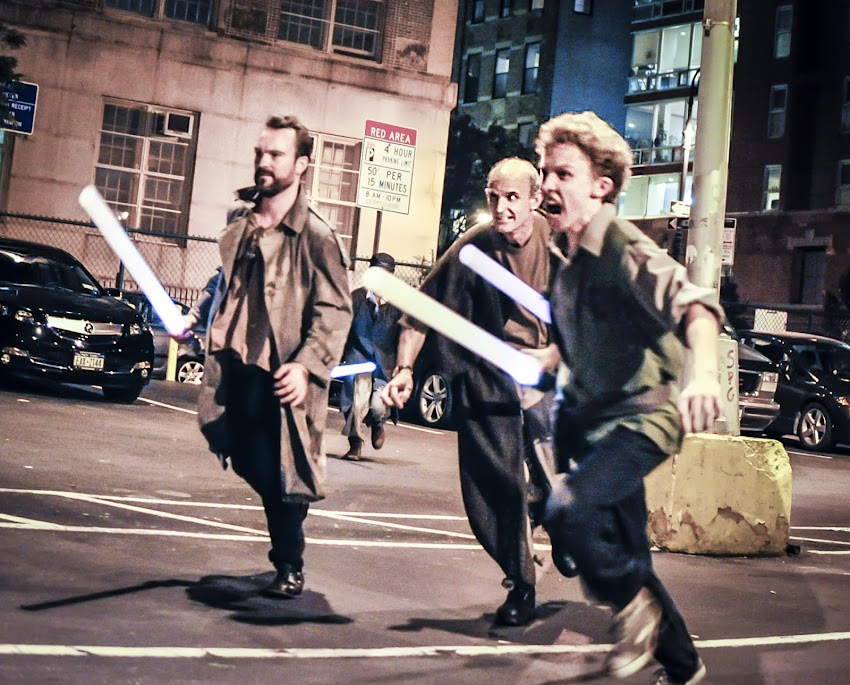
Lightsabers at the ready
L-r: Mark Byrne, Skylar Gallun and David Sitler
(photo by Lee Wexler/Images for Innovation)
Cheekily anachronistic elements--like characters wielding lightsabers or snacking on a bag of chips--appear to be remnants of time-shifting ideas Clancy had for this production. But their appearance in this vestpocket of the urban everyday has a funny way of making the players look like neighborhood kids gathered to put on a show. In this case, pretty sophisticated, highly trained kids. But kids, nonetheless, making do with their makeshift platform stages and curtains and props. And Clancy's actors--notably Andy Markert as comically apoplectic Cloten and the electric Mark Byrne as Guiderius--foreground a heady playfulness in Shakespeare's overstuffed plot that wins out over other elements like romance and horror. 

Amanda Dillard as Imogen, the princess
(photo by  Lee Wexler/Images for Innovation)
Playing Shakespeare outdoors and unamplified runs the risk of losing choice words to the air. Some of Cymbeline's performers were largely inaudible when out of range. Amanda Dillard (Imogen) delivered nearly everything at irritating screech pitch. But Philip Rossi's Posthumus Leonatus and Lukas Raphael's Iachimo, the two enemies, have wonderful voices that project just enough while retaining suppleness and subtlety. The same can be said for Byrne. For the show's vocal champion, though, see Keldrick Crowder, Cymbeline himself, who has a voice like solar wind and body language to match. If you go, you might catch a glimpse of Crowder "offstage," practicing what looks like qigong and silently mouthing his upcoming lines before heading back for the final scene. All part of the fun!

Admission is free, though donations are happily accepted. Bring cold drinks and fans. Come early for a good seat, or bring your own chair. And, no worries: Friendly nearby bars and restaurants welcome you to make a pit stop, if need be.

Thursdays-Saturdays at 8pm through July 27. For information, click here or call 212-873-9050.

For information on The Drilling Company's upcoming "Shakespeare in the Parking Lot" production of Richard3, click here.

Municipal Parking Lot
Ludlow and Broome Streets, Manhattan (one block south of Delancey Street)

Friday, May 10, 2013

Tom Gualtieri goes solo

Tom Gualtieri
Tom Gualtieri (photo by Rob Sutton)
He had us from "When shall we three meet again...?"

He never lets us go.

Tom Gualtieri is Macbeth.

And Lady Macbeth.

And pretty much everyone else, including that infamous trio of "secret, black, and midnight hags" that he embodies in fully-invested, tense and gnarled physicality.
Painting showing three faces with hooked noses in profile, eyes looking up. Each has an arm outstretched with crooked fingers.
Die drei Hexen by Johann Heinrich Füssli (1783)
I might still long to see Alan Cumming make his way through Shakespearean darkness alone (and, yes, yes, I do). But I'm not at all sorry to have spent eighty minutes in thrall to sly, supple Gualtieri and That Play: A Solo Macbeth at Stage Left Studio.

Even when not physically conjuring the three weird ones, he knows how to shape every minute tilt of the head or flick of the eye into telling elements along a winding, complex dance. His silky, sinuous, glittering snake of a Lady Macbeth could fill an entire performance on her own. You can feel how much he relishes his moments as her, his finest.

Tom Gualtieri
photo by Rob Sutton
A word of warning. Stage Left Studio--you may remember it from my review of Margaret Morrison's Home in Her Heart--is a tiny speck of space tucked away on the sixth floor of an unassuming building just south of Penn Station. Seating is not only scarce; it is virtually in the lap of any performer strutting and fretting his or her hour or so upon the slip of a stage. Audience and player(s) are both captive. And, in the case of That Play, you might find yourself fretting and sweating along with an increasingly desperate Scotsman, particularly when you're asked to recall...well, I'm not going to give that juicy part away.

Gualtieri and co-writer and director Heather Hill seem to take perverse pleasure in plunging each one of us into the shadows. For this is not just the "Scottish Play," but the Scottish Play with a clever, sometimes amusing Narrator who not only guides and comments but also obeys his own compulsion to, as he would put it, "write the darkness into the room."

Nominated for the 2013 Drama Desk Award ("Unique Theatrical Experience"), That Play: A Solo Macbeth concludes its extended run on May 25. Just five performances remain--Saturday, May 11; Tuesday, May 14; Wednesday, May 15; Thursday, May 16, and Saturday, May 25, all at 7:30pm.

For Stage Left Studio information and tickets, click here.
To visit the Web site of That Play: A Solo Macbeth, click here.

Stage Left Studio
214 West 30th Street (between 7th and 8th Avenues), Manhattan
(map/directions)

Friday, October 1, 2010

"Something rich and strange"


Julie Taymor (director/producer/writer)
USA. 2010. 110 minutes. Touchstone Pictures and Miramax Films

The vertiginous camera work in the early moments of The Tempest, where a ship founders in a sudden storm, gives viewers a good idea of what they're in for--an explosive, visceral ride. Julie Taymor (FridaAcross the Universe and Broadway's The Lion King) will swirl her trusty wand, conjuring a primal island commanded by Prospera (Helen Mirren), a female version of Shakespeare's master of high magick, cunning and insight.

Taymor's Tempest is "such stuff as dreams are made on"--silky, romantic dreams as well as fearsome nightmares, all larger than life. Huge close-ups of faces; vivid, textured landscapes; reverberating sound: This hallucinatory sensuousness bears down and sweeps you up.

Beneath these heady visions, though, lies the bedrock of things more inescapably human than magical: envy, betrayal, vengeance as well as the capacity for compassion and forgiveness. Shakespeare's Tempest is a tale in which the attainment of justice requires acceptance of humanity in all its light and dark elements, acceptance of the limits of one's power as a mortal being. The freedom Prospera frequently promises her helper spirit Ariel is the freedom she most craves for herself.

Mirren, our North Star, is an elegant authority. The mercurial play of thought across her face's terrain illuminates this narrative of an exiled leader and powerful mage at a personal crossroads.


Julie Taymor talks about The Tempest (AUDIO)
(New York Film Festival press conference, September 30, 2010)


Russell Brand (Trinculo)
Alfred Molina (Stephano)
Djimon Hounsou (Caliban)
David Strathairn (King Alonso)
Chris Cooper (Antonio)
Alan Cumming (Sebastian)
Ben Whishaw (Ariel)
Reeve Carney (Prince Ferdinand)
Felicity Jones (Miranda)
Tom Conti (Gonzalo)

Composer: Elliot Goldenthal
Production Design: Mark Friedberg
Costume Design: Sandy Powell

Public festival screening: Saturday, October 2 (10pm)
New York and Los Angeles release: December 10

Alice Tully Hall
Broadway and 65th Street, Manhattan

Saturday, August 7, 2010

A lot of Shakespeare

'Julius Caesar' - Shakespeare in the Parking Lot Looks at a Dictator
by Anita Gates, The New York Times, August 5, 2010

Copyright notice

Copyright © 2007-2023 Eva Yaa Asantewaa
All Rights Reserved

Popular Posts

Labels