Search This Blog

Showing posts with label painting. Show all posts

Thursday, March 17, 2016

Talks on "Dreams, Magic and Desire" at The Met: Part 2

Sir Edward Burne-Jones: 
The Beguiling of Merlin (1872-77)
Lady Lever Art Gallery

This morning, I attended "The British Invasion," the second of Alison Hokanson's excellent presentations on Dreams, Magic and Desire at The Metropolitan Museum of Art. Her talk, this time, focused on Britain's Pre-Raphaelites--exemplified by painters Dante Gabriel Rossetti and Sir Edward Burne-Jones--and their direct influence on the later Symbolist movement. (See my post from last week's talk about Belgium Symbolist Fernand Khnopff.)

Again, Hokanson led us through the factors that gave rise to Symbolism in many European nations--primarily the intensely nationalistic urge to break from the dominance of France-centric academic art, realism and Impressionism, and the desire to explore inner worlds and mystical realms. Symbolism, she said, was not a specific technique but "a range of principles," "a state of mind" valuing individual expression.

As the Symbolists took inspiration from the earnest, elaborately symbol-laden work of the Pre-Raphaelites, that movement looked even further back to paintings of the medieval and early Renaissance eras, citing their "immediacy, purity, authenticity" all that was "full of life and heartfelt." Burne-Jones belonged to the second wave of Pre-Raphaelites, artists devoted to an even more idealized depiction of nature, humanity, myth and mind.

Beauty of form grew in value for these artists, but beauty as "a way to guide the spirit" in a world lately upended by industrialization, commercialization, scientific discovery and political upheaval. The movement also embraced the decorative arts in furnishings, book illustration and objects of everyday use.

"The British Invasion"

Taking as a starting point the Met’s masterpiece The Love Song by Edward Burne-Jones, this talk highlights the appeal that the work of the Pre-Raphaelites in England had for the Symbolist generation in Northern and Central Europe. From Brussels to Munich and Vienna, artists drew on British models to develop modern styles that differed radically from the French trends that dominated the art world. Their work, as one critic put it, “rendered the profundity of life and a melancholy attitude of beauty.”

Sir Edward Burne-Jones:
The Love Song (1868-77)
The Metropolitan Museum of Art

Hokanson's talk centered on The Love Song--the romantic, atmospheric Burne-Jones masterpiece in the Met's collection--tracing its influences back to Botticelli, Giorgione and Titian. A gifted communicator, she made her feelings for this work most clear by adding a recorded chanson to our visual experience of this painting's overtly depicted and subliminal music. It was a sublime moment.

File:Sir Edward Coley Burne-Jones Flamma Vestalis.jpg
Sir Edward Burne-Jones:
Flamma Vestalis (1896)

Hokanson ended her discussion by noting the trauma of World War I and its sweeping effect on the arts in Europe. The Symbolist movement fell away, supplanted by emerging forms for a brutally altered world.

*****

For information on future art talks at the Met, click here. To learn about all other special programming at the Met, click here.

*****

Special note for dance fans:

David Dorfman Dance will take part in tomorrow's lineup celebrating the official opening of The Met Breuer with performances all day long, free with museum admission or membership. Click here for information.

If you like what you're reading,
subscribe to InfiniteBody!

Saturday, March 12, 2016

Talks on "Dreams, Magic and Desire" at The Met


Above: The Silver Tiara
Fernand Khnopff (1911)
The Museum of Modern Art

Below: Self-portrait, Fernand Khnopff (1879)
Willems Collection, Brussels


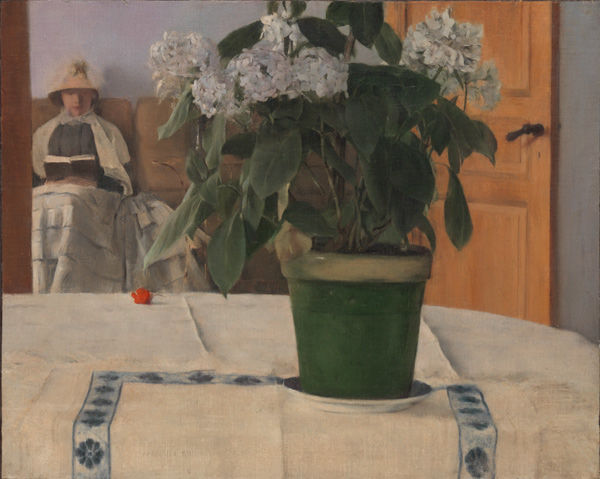
On Thursday, the Metropolitan Museum of Art presented a talk by Alison Hokanson (Assistant Curator, European Paintings) on Symbolism with a focus on the work of Belgian painter Fernand Khnopff. In discussing the broad and enigmatic Symbolist movement, with its concern with "desire, the unconscious, human mortality, timelessness and the inner self," Hokanson acknowledged that it had long been dismissed by most art scholars as "an artistic dead end, not sufficiently sophisticated or forward-thinking."  Now that assessment is under revision. A prime example of this new consideration: The Met's own recent acquisition of Hortensia, an interior innovative, for its time, in Khnopff's confident experimentation with perspective and foregrounding.


Fernand Khnopff's Hortensia (1884)
The Metropolitan Museum of Art

Hokanson is a clear, illuminating presenter, and if you missed this first talk from her Dreams, Magic and Desire series, I highly recommend catching the second--"The British Invasion"--on Thursday, March 17 (11am-Noon).
Taking as a starting point the Met’s masterpiece The Love Song by Edward Burne-Jones, this talk highlights the appeal that the work of the Pre-Raphaelites in England had for the Symbolist generation in Northern and Central Europe. From Brussels to Munich and Vienna, artists drew on British models to develop modern styles that differed radically from the French trends that dominated the art world. Their work, as one critic put it, “rendered the profundity of life and a melancholy attitude of beauty.”
Click here for ticket information.

The Grace Rainy Rogers Auditorium at
The Metropolitan Museum of Art
82nd Street and Fifth Avenue
(visitor information including map and directions)

If you like what you're reading,
subscribe to InfiniteBody!

Saturday, June 21, 2014

Sunday, November 10, 2013

Paintings of Merce Cunningham troupe will go on exhibition


presents

KENNETH E. PARRIS III:
104 Work Weeks: On Tour With The Merce Cunningham Dance Company 
Artist Kenneth E. Parris III, was on tour with members of the Merce Cunningham Dance Company for two years documenting their world tour through a series of drawings. Parris focuses on what happens on the road before and after performances providing an intimate glimpse into the lives of dancers and a more universal revelation of the human condition.
Opening Reception: Wednesday, November 20, 6-8pm

Hours: Tuesday to Saturday, 11am-6pm and by appointment


254 Broome Street (between Orchard and Ludlow Streets), Manhattan

Wednesday, July 10, 2013

Black...in the future


presents


Nov 14, 2013 - Mar 9, 2014


The Shadows Took Shape is a dynamic interdisciplinary exhibition exploring contemporary art through the lens of Afrofuturist aesthetics. Coined in 1994 by writer Mark Dery in his essay “Black to the Future,” the term “Afrofuturism” refers to a creative and intellectual genre that emerged as a strategy to explore science fiction, fantasy, magical realism and pan-Africanism. With roots in the avant-garde musical stylings of sonic innovator Sun Ra (born Herman Poole Blount, 1914–1993), Afrofuturism has been used by artists, writers and theorists as a way to prophesize the future, redefine the present and reconceptualize the past. The Shadows Took Shape will be one of the few major museum exhibitions to explore the ways in which this form of creative expression has been adopted internationally and highlight the range of work made over the past twenty-five years.

Read more here.

144 West 125th Street (between Lenox Avenue (Malcolm X Boulevard) and Adam Clayton Powell, Jr. Boulevard (7th Avenue), Manhattan

Sunday, February 26, 2012

Art Roundup: A Stein is a rose; radical cameras

Fans of Gertrude Stein, make your pilgrimage to the Metropolitan Museum of Art to view The Steins Collect: Matisse, Picasso, and the Parisian Avant-Garde, an immersive introduction to the prophetic taste of Stein, her brothers Leo and Michael and her sister-in-law, Sarah. Picasso, Renoir, Manet...all of that's fine, but what really lifted me were the images of the writer herself--photos, paintings, sculpture infused with her presence and the energy of how she was perceived by her contemporaries. The Steins Collect opens to the public on Tuesday, February 28 and runs through June 3. For information, click here.

Detail, Pablo Picasso, Portrait of Gertrude Stein, 1906
Metropolitan Museum of Art

The Met will also host a Gallery Workshop on Art and Writing: Making Creative Connections, led by Claire E. Moore, assistant Museum educator on Friday, March 30, at 6:30pm.
Explore the synergies between the artists and writers who were part of famed collector Gertrude Stein's Paris as you listen to inspiring literary excerpts, view works in the exhibition The Steins Collect: Matisse, Picasso, and the Parisian Avant-Garde, and respond through writing.
At the Met's Carson Family Hall, Uris Center for Education. Fee: $35. For more information or to purchase tickets, click here.

Also highly recommended:

The Radical Camera: New York's Photo League, 1936-1951 at The Jewish Museum, an exhibition of documentary photography-- most often treating social issues and conditions--that can surprise and inspire today's viewers by its fine aesthetic vision. The Radical Camera continues through March 25. For complete information, click here.

Friday, February 10, 2012

Spain's Neanderthal cave paintings

Cave paintings in Malaga, Spain, could be the oldest yet found – and the first to have been created by Neanderthals.
Read more: First Neanderthal cave paintings discovered in Spain by Fergal MacErlean, New Scientist, February 10, 2012

Copyright notice

Copyright © 2007-2023 Eva Yaa Asantewaa
All Rights Reserved

Popular Posts

Labels