Search This Blog

Showing posts with label Lower East Side. Show all posts

Friday, February 28, 2020

Marital burnout is no laughing matter...and yet: Sara Juli

Sara Juli in her show, Burnt-Out Wife, at Dixon Place
(photo: Nick Pierce)

Burnt-Out Wife
Sara Juli
Dixon Place
February 21-28

What a set! Designer Pamela Moulton's vision for Burnt-Out Wife, a solo performance by multi-talented Sara Juli, is lying in wait for the Dixon Place audience. And I say that advisedly, for this set is a monster, an eyesore. A cotton-candy-pink bathroom complete with polka dot toilet seat cover, a filmy pin-up girl robe with hot pink feather boa trim; and a wall splotched with wound-like flowers crafted, with childlike imperfection, out of who knows what. You gaze and wonder what Juli has in store for her unsuspecting visitors.

Burnt-Out Wife is everything that set suggests--and more. "I wanna get married...that's why I was born," sings Nellie McKay in the wry, melancholic song that ushers in this brilliant performance. Juli appears, giving the left-up toilet seat a certain look that immediately invokes the mate at fault and aiming another look at two baby dolls strewn about the floor. But if you think that tells you everything you'll need to know about Juli's project, think again.

Written by Juli, the performance draws clarity and vitality from her background in dance and stand-up comedy, and she shows ease and confidence in both genres. Marital burnout might not be first on your list of the funniest things in life, but Juli is really funny without straining and really fresh. She looks like a woman waking up to realize she's an Amazon and one with a future in performance art. She's physically strong--as you'll discover if she shakes your hand in a firm grip or strikes poses to represent the misalignment between her desires and her husband's--stronger than you might suspect from the weary look she gives the world most of the time. And she's smart as a whip, more than holding her own with the unseen spouse and her wackadoodle surroundings as she slyly, steadily lays waste to heteronormative conventions. In fact--through the magic touch of Moulton, costume designer Carol Farrell, sound designer Ryan McDonald and lighting designer David Ferri--she turns her hideous bathroom into a throne room worthy of pissed-as-hell royalty.

The surprises, joys and rewards of this show are many, and I will not spoil them for you as I hope you'll make your way to Dixon Place tonight for the final performance. But hurry! Last night's show was packed with happy people laughing their heads off.

Burnt-Out Wife concludes this evening with a show at 7pm. For information and tickets, click here.

Dixon Place
161A Chrystie Street, Manhattan
(map/directions)


******

DISCLAIMER: In addition to my work on InfiniteBody, I serve as Senior Curatorial Director of Gibney. The postings on this site are my own and do not necessarily reflect the views, strategies or opinions of Gibney.

******

Subscribe in a reader

Saturday, May 25, 2019

Ainesh Madan returns with "Phantasies"


Phantasies

Ainesh Madan
Speyer Hall, University Settlement
May 24-25, 2019

The play of children is determined by their wishes, really by the child's ONE wish, which is to be grown-up.... He always plays at being grown-up; in play he imitates what is known to him of the lives of adults. -- Sigmund Freud, "The Poet and Daydreaming"

Superbly skillful dance artist Ainesh Madan has worked with noted choreographers such as Bill T. Jones, Pramila Vasudevan, RoseAnne Spradlin and Heidi Latsky. He won a 2018 Gibney Work Up residency and intrigued audiences with his developing solo, Phantasies, on a strong program shared with performers Evelyn Lilian Sánchez Narvaez and Marion Spencer. He now lives and works in his native India but is back in New York this weekend with a handsome production of Phantasies.

This solo, now roughly 40 minutes, is episodic, stark sections tightly spliced together by changes in Emma Matters's lighting and distinguished by unexpected imaginings of ways in which props (coins, umbrellas) can be used. Apparently tireless, Madan seems suspended between adulthood and childhood--his rendering of a Sigmund Freud quote, above, about child's play inspired the piece--drawing a palpable vitality from being in that liminal state.

His choreography for the piece, though informed by contemporary aesthetics, invokes qualities of classical Indian dance--percussive force and sweep and a breathtaking precision and speed of arm and hand gestures conveying a narrative. Only, with Madan, that narrative often remains elusive. Why Rimsky-Korsakov's "Flight of the Bumblebee?" That music drops into the atmosphere like a memory, and might well be one, the significance of which we're left to imagine.

The piece, which opens with the sharp-pitched sounds of song birds, reads like a long series of random journal entries--or short-short stories, or a cycle of songs--each entry its own shiny facet in the diamond.

Here, by the way, is the original text of the quote from Freud's 1907 talk, "Creative Writers and Day-Dreaming."
A child’s play is determined by wishes: in point of fact by a single wish–one that helps in his upbringing–the wish to be big and grown up. He is always playing at being “grown up,” and in his games he imitates what he knows about the lives of his elders. He has no reason to conceal this wish. With the adult, the case is different. On the one hand, he knows that he is expected not to go on playing or fantasying any longer, but to act in the real world; on the other hand, some of the wishes which give rise to his fantasies are of a kind which it is essential to conceal. Thus he is ashamed of his fantasies as being childish and as being unpermissible. 
In that talk, Freud also spoke of the way artists learn to draw a veil across personal elements in their work, sparing us what we might perceive to be TMI. I think it's possible to enjoy Phantasies without gaining entrance to all that's going on within it--which is surely a lot--and to leave that to the dazzling performer at work.

Phantasies concludes this evening with an 8pm performance. For information and tickets, click here.

Speyer Hall, University Settlement
184 Eldridge Street (between Rivington and Delancey), Manhattan
(map/directions)

******

DISCLAIMER: In addition to my work on InfiniteBody, I serve as Senior Curatorial Director of Gibney. The postings on this site are my own and do not necessarily reflect the views, strategies or opinions of Gibney.

******

Subscribe in a reader

Saturday, March 16, 2019

Okpokwasili and Born's "Adaku's Revolt"

Okwui Okpokwasili
(photo: John D. & Catherine T. MacArthur Foundation)


Adaku's Revolt
Okwui Okpokwasili and Peter Born
Abrons Arts Center
March 14-24

One young black girl becomes alert to her inner signals, finds the strength to resist expectations, and revolts against efforts to straighten her hair. -- from Abrons Arts Center's website

Out of the blue, a thought visited me over breakfast today:

No, you can't touch my hair. My hair is part of my body. I do not give you permission to touch my body. So, why do you think you can touch my hair?

I'd swear I don't know where that came from, but I do know it's something I should have said, years ago, to one man--the husband of a fellow dance critic--whose white hand shot out and touched my woolly head. Happened so fast, I didn't have time to cringe, flinch or launch a preemptive strike, which I now so wish I had done.

And I also know Okwui Okpokwasili (with director/designer Peter Born) must have triggered something with a new ensemble work, Adaku's Revolt, just opened at Abrons Arts Center. It's not about white people touching Black people's hair, the site of both painful and glorious historical experience and culture. But it is about how white aesthetics touch Black people's hair...and bodies...and values...and lives.

Dear Okwui, as you must imagine, I know all about the perils of getting the "kitchen" straightened with a hot comb. I think you must have reached out and touched a nerve.

Urban Bush Women's dancers are also looking at the Black hair thing this season with Hair & Other Stories. But Okpokwasili's concept and Born's visual design appear to have the potential to help Adaku's Revolt work down into the subconscious in a way that UBW's far more direct piece--with audience participation that keeps our conscious minds centered and on high alert--might not.


Above: Dancer AJ Wilmore as Adaku
Below: Wilmore with Okwui Okpokwasili
(photos: Ian Douglas)


The audience is directed to its place on the stage of Abrons's theater through a back channel and instructed to take seats lining three sides of the performance space. As we enter and get settled, the scene has already been set, a compelling visual atmosphere already built. Before a white screen, four dancers lie on the floor with torsos stiffly arched and heads thrown back. Above them, a large windsock of pearly-white gossamer continuously flows out from a big fan, its hypnotizing, watery fabric reaching for another dancer, our Adaku (AJ Wilmore), who writhes, wriggles, tilts, chops and revs up as she sits in a chair. A dense assemblage of what appear to be ordinary desk lamps lights the area.

Within Born's vision, Okpokwasili's placement and movement of individual and group bodies take the shape of dreams with nonlinear but soul-tugging storytelling. White fabric engulfing and molding itself across faces. Bodies emerging from beneath pulsating fabric. Hips and feet twisting, pelvises rocking and left hands raised high in the air over a captivating--and destabilizing--polyrhythm of music and women's voice-overs and live singing.

I tried to jot down something Wilmore said before her turbulent yet mutually-supportive duet with Okpokwasili, and I think I got it right:

I'm going to open all the doors in my head.

Doors opening bring music and voices--both louder, brighter, undeniable--and the birth-like reclamation of bodies. I think the piece, just under an hour, seemed longer. For me, its conclusion fell short of grace or definitude. But something about it all clearly reminded me to revolt.

******

Choreographed and created in collaboration with Peter Born and performers Khadidiatou Bangoura, Peter Born, Audrey Hailes, Breyanna Maples and AJ Wilmore

Adaku's Revolt runs through March 24 with performances at various times. For information and tickets, click here.

Abrons Arts Center
466 Grand Street (at Pitt Street), Manhattan
(directions)


******

DISCLAIMER: In addition to my work on InfiniteBody, I serve as Senior Curatorial Director of Gibney. The postings on this site are my own and do not necessarily reflect the views, strategies or opinions of Gibney.

******

Subscribe in a reader

Saturday, March 9, 2019

Lime Rickey International presents "Future Faith" at Abrons

Lime Rickey International (aka Leyya Mona Tawil)
(photo: Vesa Loikas Photography)


Future Faith
Lime Rickey International
Abrons Arts Center
March 7-9
"Lime Rickey International is the superconsciousness of Leyya Mona Tawil, an artist working with dance, sound and performance practices. Tawil is a Syrian, Palestinian, American engaged in the world as such. Lime Rickey International emerged as a container for the world of lost homelands. The works of Lime reference Tawil’s training in Arabic dabke as well as decades of work in the realm of contemporary dance, improvisation and experimental performance." -- from publicity for Future Faith 
*****

Syrian-Palestinian-American transdisciplinary artist Leyya Mona Tawil first appears to us drenched in red light, hunched in a corner just to the side of the Underground Theater's staircase. We're finding our seats, and she's taking a private moment, crouched on the floor with the front of her body turned towards a wall. The audience seating has been shifted around from its usual orientation to now afford a view of the theater's door and staircase and part of the balcony. The theater space is not big but, gazing across at Tawil, an onlooker might feel, at once, both distant and invasive.

The deep red serves as the performer's shield, though; at the start, we can't detect, for instance, the glossy electric-blue/green cyan of her wig or shiny chartreuse of her costume. Later, these items become shields, too, for the human beneath.

There's a persistent drone that--even more than the visual elements--serves notice that we've stepped into altered, potentially hazardous space. Although it comes from equipment near Tawil, it might just as easily stream from her pores. Just who and what are we looking at, anyway, and what is about to happen?

*****
"The choreographers that I know and respect who are pushing dance forward right now are trying to create a model of relationships - not just between dancer and dancer, but dancer and audience, and also dancer and society, and stage and society. So what we're doing onstage is actually a suggestion for how we can treat one another in the world. Contemporary dance is a suggestion about how we wish the world would be. It is less about art reflecting society and more about art going through the wall and creating something more. This is a search for future forms." -- "Leyya Tawil in Conversation with Linda Weintraub" (Critical Correspondence, 2014)
*****

The visual and sonic mood eventually lifts, and we see Tawil more clearly despite the fake hair flopping over her skin. Dancing, she looks robust in her futuristic, kind of goofy costume, a strapping woman freely inventing and reinventing herself and not hesitating to assert herself in space. Her angular moves sprawl every which way, gesticulate as if she were a stick figure engaged in full-body sign language. She flaps and stomps, and I'm reminded that dabke--the name of an exuberant Arabic dance tradition she cites as an influence in her work--literally means the dance of stomping.

I do not know what it means when, late in the 45-minute piece, Tawil's sound swerves back into the threat zone, but it's like the room becomes a paper shredder, and I'm thinking that--what does she call it? superconsciousness?--is something formidable with which we should never presume to get too cozy.

Composition/Choreography/Performance: Leyya Mona Tawil
Live Lighting: Emese Csornai
Costume: Scott Tallenger
Set Design:Tim Clifford
Audio Tech: Ian Douglas-Moore

*****

Future Faith concludes with a 7pm performance this evening. For information and tickets, click here.

Abrons Arts Center
466 Grand Street (at Pitt Street), Manhattan
(directions)

*****

DISCLAIMER: In addition to my work on InfiniteBody, I serve as Senior Curatorial Director of Gibney. The postings on this site are my own and do not necessarily reflect the views, strategies or opinions of Gibney.

******

Subscribe in a reader

Friday, November 2, 2018

prettygirl264264 checks in from Abrons Arts Center

Ashley R.T. Yergens
in character for prettygirl264264
(photo: Fred Attenborough)

What you focus on increases. Or, maybe it's, What you focus on expands. Or what...ever.

That favored quote of New Agey savants came to mind at last evening's world premiere of prettygirl264264, when I gauged the distance--physical and otherwise--between trans performance artist Ashley R.T. Yergens and a flat screen television displaying appearances by singer Cher, the late Sono Bono and their trans son Chaz Bono. My interest in Sonny and Cher had faded out quite early, with their pop star heyday and my youth, and has not made a miraculous recovery in the current age of celebrity tv and Twitter. So, I was content to train nearly undivided attention on the present moment and the live action before us at Abrons Arts Center where the Underground Theater's floor was nearly blanketed by a cheery layer of party balloons. Yes, party balloons for something Yergens billed as his "premature funeral."

The service served an atypical "In Loving Memory Of" funeral card in lieu of a program. The dearly not-quite-yet-departed took a while to appear, the buildup to that appearance including a standout, if painful, performance of "It's All Coming Back to Me Now" by lily bo shapiro, dolled up in gleaming, cherry pink unitard and oversized, rhinestone-encrusted glasses. Yes, a Celine Dion anthem at a premature funeral where evocation of Judy Garland's connection to blackface, Sonny Bono's death by skiing into a tree, and a full-out dance duet routine to La Bouche's "Be My Lover" are not only inevitable but completely appropriate.

Not too long ago, I read a New York Times obituary that told the story of how the late actor James Karen asked his buddies, unbeknownst to one another, to draft his obit long before he actually passed. His wife finally revealed to one friend, George Clooney, that Karen had a habit of doing this so that he'd be around to enjoy what people thought of him. Not a terrible idea. And, in his way, Yergens is doing the same--inviting us in to indulge one trans man's moment of celebration and to contemplate how rare acknowledgement and celebration can be at the end of many trans lives.

If neither the celebs onscreen (one, a "gay icon" who is cisgender and straight; the other, an early, selective and reluctant object of mainstream media spotlight on trans lives) can fairly represent the range of trans experience, neither can Yergens, keenly aware of his white, able-bodied visibility and privilege. prettygirl264264--the title comes from an old AOL handle--speaks from a particular sliver of experience and sensibilities, bringing wry lightheartedness in a time of serious political struggle. And, yes, we need that contribution, too.

Video: Rena Anakwe

Performers: Sydney Boyu, Nico Brown, lily bo shapiro, Mur, Kristopher K.Q. Pourzal, Ashley R.T. Yergens

Lighting: Jennifer Fok

Original Music: Trashed My Living Room and ErasedMur

prettygirl264264 continues tonight and Saturday evening with performances at 7:30pm. 50% of ticket sales benefit trans rights organizations. Although both performances have sold out, Abrons promises to get some walkups in. So try for it! For information, click here.

Abrons Arts Center
466 Grand Street (at Pitt Street), Manhattan
(Plan your visit.)

******

DISCLAIMER: In addition to my work on InfiniteBody, I serve as Senior Curatorial Director of Gibney. The postings on this site are my own and do not necessarily reflect the views, strategies or opinions of Gibney.

******

Subscribe in a reader

Thursday, October 18, 2018

"Folk Incest": a new Juliana F. May ensemble at Abrons

Molly Poerstel dancing in Juliana F. May's Folk Incest
(photo: Ian Douglas)

In FOLK INCEST, five women interrogate seemingly unrepresentable subject matters including the Holocaust, sexual trauma, and the fetishization of young girls. As pop cultural references, genres, and bodily traumas compress into each other, the work’s biting humor offers catharsis, simultaneously critiquing and supporting abstraction. (from publicity for Juliana F. May's Folk Incest) 

Disorientation. It starts with being directed into one of the drab rooms at Abrons Arts Center not usually used as a venue for performance.

Once there, the audience for Juliana F. May's new, short ensemble--
Folk Incest--sits in a single row around the perimeter of the room. Last night, May drew a particularly chatty, lively group with a bunch of friends even posing for a cellphone photo before, strangely, everyone suddenly piped down. I looked around to see if there something signaled this quieting. If so, I couldn't detect it. Eventually, the lights lowered.

Then a woman appeared--amazing Molly Poerstel--seated in a chair near one of two doors to the corridor. A gentle light fell upon her, a marking that told us she was not really one of us. Or maybe she was. One of us. Plus.

She held a few sheets of paper. She began to read from them...or try to speak with great, forceful difficulty...and I rapidly became so engrossed in what I heard that I don't even recall if she was really glancing at the paper. Poerstel's monologue turned into a tour de force utilizing dexterous mental and vocal ability, beginning with stammering and sputtering, spinning out into something that...oh, I don't know...maybe an exorcist should be brought in to handle. Secrets blurted, profanities barked, surfaces erupting with the long-buried dead. Searing. Scorching. It felt of the moment.

In time, other women appeared in the space--Leslie Cuyjet, Tess Dworman, Lucy Kaminsky, Rebecca Wender, eventually joined by Poerstel. Their big, ungainly, willful, scattered movements smack away any sense that they will behave, or that we can relax, or that they don't belong there. Vengeful energies Poerstel's monologue unleashed, perhaps. Later, there came a wiping-off of makeup, a baring of breasts, a flurry of words sometimes tripping out too quickly to catch, an incredibly elaborate performance of something folksong-ish that, once again, made a viewer marvel at performers' abilities to memorize and recall.

I take the "folk" aspect of this to allude to commonality, and that is something we are certainly coming to grips with as we deal with #MeToo revelations and other testimonies of trauma. Traumatic experience and its consequences are common, not rare, one-off incidents happening to people we do not know. They happen to people we know. They happen in our families. They happen to us. They happen with such frequency to make us question the environments in which we should seek safety and solace. They are common, shared among us like the air we breathe, toxic and injurious to individuals and, ultimately, to all.

And they are festering under the skin and in the bones of the art we choose to call abstract.

Seating is limited, and remaining shows are sold out. But if there's a waiting list, Folk Incest is worth a try to get in.

Folk Incest continues through this Saturday, October 20, with performances at 7:30pm. For information, click here.

Abrons Arts Center
466 Grand Street (at Pitt Street), Manhattan
(map/directions)

Subscribe in a reader

Friday, September 21, 2018

By Association: New performance from Pallavi Sen, Elena Rose Light and Evelyn Lillian Sánchez Narvaez

Above: Elena Rose Light (left)
and Evelyn Lillian Sánchez Narvaez
(photo: Malcolm-x Betts)

By Association is a platform for artists to collectively experiment with the practice of associative thinking. An artist is invited to be the “instigatory link” in a chain of thought, who then invites another artist whose practice informs and/or challenges their line of inquiry. This artist then invites another artist, and so the pattern continues. For three nights, the chain fuses and breaks in the form of shared evening presentations that put artists in creative discourse with one another across artistic disciplines. -- from publicity for Abrons Arts Center's By Association: Elena Rose Light, Pallavi Sen, Bully Fae Collins

The Underground Theater at Abrons Arts Center bugs me. It is so infernally ugly with its brutal, oppressive design. There isn't anything I like about this space, though I've seen some cool things there. I sometimes think it's designed to eat whatever enters.

And it might have eaten Pallavi Sen's section of last evening's By Association: Elena Rose Light, Pallavi Sen, Bully Fae Collins, except that Sen's multifaceted visual display--a bustling, long/tall thing spanning most of the space while Sen sat all-too-gently reading its text at one side--seemed too monumental to be easily consumed by the theater...or by its audience. I must admit when I wasn't checking out the imagery in front of me, Sen's voice almost lulled me to sleep. I made an effort to shift focus to her, now and again, but I suspect she wanted to stay out of sight, her body folded close to the darkened floor and tucked away with her words (about her South Asian family and about loss) and her little reading light, while her projections unfolded a manifest of what her mind is really like. I can probably call to my own mind what her lost relatives looked like and everything dancing around their cameo portraits but, for the life of me, I will not be able to tell you much of what she told us about them or what Sen looked like last evening.

After a ten-minute break, though, collaborators Elena Rose Light and Mexico-born Evelyn Lillian Sánchez Narvaez ate the theater.

Their opening momentarily fooled us into thinking the intermission was just continuing. Lights did not go down. Eventually, at both extreme ends of peripheral vision, I became aware of presences at the tops of the long staircases leading down into the performance space from both sides of the theater. Presences barely visible. Presences beginning to vibrate. Presences that, when finally fully seen, presented as comic. Comic in their ridiculous suits painstakingly constructed of clear, crinkly bubble wrap. Comic in the way they endlessly bounced on their feet and pumped their arms and scampered all around and up and down the theater and its balcony like schoolkids chasing each other at recess.

I know a bit more about Sánchez Narvaez's work and have watched her start other performances with a similar scattered, extroverted approach and gradually unpeel, winding her way down to a deeper, quieter, more sensitive and emotionally brave place. What she and Light accomplish in this demanding, durational piece, as they strip away the plastic, becomes similarly revelatory and wrenching.

You won't catch much of what's said between the two; they have no mics. But you'll catch enough to recognize the triggering of issues of racial and class difference. Sánchez Narvaez first interjects this by calling out Light for having once complained, "I'm paying you more than I'm paying myself." It goes downhill from there with the performers appearing to be athletes in training...or an athlete (Light) with a particularly hardass trainer (Sánchez Narvaez)...or two collaborators who have hit a brick wall that only physical aggression and honesty might begin--only just begin--to demolish.

This is a very hard dance to do...and see...and think about.

The remaining By Association schedule pairs Pallavi Sen's solo with work by Bully Fae Collins (tonight at 7:30pm) and Bully Fae Collins with Elena Rose Light and Evelyn Lillian Sánchez Narvaez (tomorrow at 7:30pm). Get information and tickets here.

Abrons Arts Center
466 Grand Street (at Pitt Street), Manhattan
(directions)

Subscribe in a reader
Thursday, May 17, 2018

We gon' dance now: Hank Smith's "Story of Tap" turns 20

Hank Smith, host of The Story of Tap,
remembered the late Sammy Davis, Jr.
patting his shins, before rising from his chair,
and telling them, "We gon' dance now."
(photo: Charles Dennis)


I felt myself smiling nearly all the way through dancer Hank Smith's program last night at Dixon Place--The Story of Tap: 20th Anniversary. Launched back in 1998 at the original Dixon Place with Marion Coles and James "Buster" Brown as Smith's first guests, the evening works a bit like a tv talk show...but better. Way better.

The better part is that it's all about tap and has the elfin Smith--dancer and so much more--as genial host. Better in that this edition had kickass tap stars Jason Samuels Smith and Derick Grant as guests along with Ayako Shirasaki, a jazz pianist whose playing is simply delicious. Better, too, because you're not home on your couch in front of a screen. You're just a few feet from the action, helplessly smiling.

The Story of Tap offers Smith a venue for humorously chatting up colleagues and idols about how they started and built their careers; who taught and mentored them; the grand inspirations--like Gregory Hines and Jimmy Slyde--they most miss; places where their skills were tested and honed; values that drive them to this day; issues that continue to intrigue them. Conversation, illustrated by archival photos and video clips, alternates with tap improvisations--astoundingly intricate or blistering solos with each dancer setting the bar higher and higher; playful face-offs; and, of course, the traditional shim sham ensemble with friends from the audience bringing it all to a close. Shirasaki was also granted her own solo at the keys during which every last one of us fell in love and awe.

I can't urge you to go to The Story of Tap: 20th Anniversary. That story has been told. But I hope Smith plans to bring tap's wonderful stories back to Dixon Place next year and the year after that and then some.

CLOSED. For information on upcoming Dixon Place events, click here.

Dixon Place
161A Chrystie Street (between Rivington and Delancey), Manhattan
(map/directions)

Subscribe in a reader

Thursday, April 12, 2018

Eliza Bent gets personal on race and cultural appropriation

Eliza Bent
(photo: Knud Adams)


It's far worse than you might think.

No, that's not my review of Aloha, Aloha, or When I Was Queen, the new monologue written and performed by Eliza Bent, now at Abrons Arts Center. But that's what I believe Bent wants viewers to grasp.

The piece jumps off from the playwright's memories of a film on the 19th Century queen Liliuokalani, Hawaii's last monarch--a school project Bent cooked up at age 13 with a friend and classmate. The young auteur cast her white affluent self as the indigenous queen and now looks back on it--as we get to do; the film is both cringe-worthy and just ridiculously audacious enough to kind of work, ya know?--with no small amount of shame. I can't gauge how completely woke today's Bent is but, as things unfold, you will definitely see she's got her eyes propped open.

She might have forgiven her teenaged self (and begged our forgiveness) for youthful indiscretion. But she does not stop there.

Surrounded, inexplicably but beautifully, by Elizabeth Chabot's rich, thick textile art and a row of fetching portraits--Bent resembles some combination of high-class talk show host and star monologist. Wearing a buttoned-up little black dress with A-line cut, she talks nonstop with well-practiced intensity that pegs her as facile, artificial, privileged, ready for PBS or an NPR podcast.

Frankly, even when self-revealing, she's off-putting. You take note when she utters something amusing. You note that amusement and yet stand clear of enjoying it. You definitely stand away from Bent, and maybe she means you to do so, because her delivery of text is noticeably, oddly driven, airless, leaving no room for her breathing or your own.

At some point, you get used to that. Which might mean an unseen internal change within her or--and this is really what it felt like--something shifting inside you, like when a climber gets more and more acclimated to lower levels of oxygen.

Maybe, though, Bent's the sort best positioned to lead us where we need to go and show us what we need to see--what she's done and what she's witnessed, particularly in the world of media and the arts. (In addition to her stage work, she served, for several years, as a senior editor at American Theatre magazine.) Deep into the play, she circles back to her own relationships and disconnections--refusing to absolve herself for what remains unresolved, tasking herself and the rest of us with acknowledging the pervasive breadth and durability of privilege and the damage wrought. Not a curious fossil from the ancestral past. Not a specimen of a problem that has not a thing on Earth to do with us now.

Direction: Knud Adams
Textile panel art: Elizabeth Chabot
Sound design/original composition: Jerome Ellis
Lighting: Kate McGee
Make up and styling: Naomi Miyoko Raddatz

Aloha, Aloha, or When I Was Queen continues through April 21. For information and tickets, click here.

Abrons Arts Center
466 Grand Street (at Pitt Street), Manhattan
(directions)

Subscribe in a reader

Wednesday, January 17, 2018

"THIS" is what again? Adrienne Truscott at American Realness

Adrienne Truscott in THIS
(photo: Paul Goode)

Adrienne Truscott brought her adaptable THIS show to American Realness 2018 at Abrons Arts Center's Playhouse, and I caught that final performance on the night also marking AR's finale. The APAP conference, too, drew to its close Tuesday morning, although there are APAP-targeted festivities (PSNY's COIL shows; Under The Radar's added week for the great Split Britches duo) still going strong this week.

So, what exactly is THIS? And who exactly is Truscott?

The answer to both seems to be: A LOT. Also, probably, IT DEPENDS.

The woman has worked through numerous genres--from dance to writing to circus to cabaret and stand-up comedy--and THIS draws liberally from her history. Which is what makes it such a fun, elusive and magical this.

At Abrons, it started on a raw stage--look at that rough wall, that corrugated gate, the metal ladder in the corner, the stained paint cloth and other unidentifiable stuff littering the floor--with a rambunctious comic who might or might not be Truscott opening for Truscott, who is who we thought we had come to see and believe we're seeing but now might or might not be seeing because she says she's opening for Truscott who has worked really hard on what we're about to see. Anywho....

After issuing a warning about a blackout we're supposed to imagine that doesn't happen when she says it does but then happens when we think it won't, the unidentified opener is dropping sex-related jokes to varying degrees of success. ("Comedy and abortion have something in common.... Timing is everything.") Timing is important, too, to a stage
magician's sleight of hand, which is what THIS turns out to be. Anything can appear and disappear when we least expect it--elements of decor; running narratives that abruptly stop and run away and...wait...run back, then vanish again so you don't know where they were supposed to be taking you; a mechanical bird that flies prettily until...oh, no...it doesn't; and a performer who sometimes hides behind scenery even as she continues to talk to us.

What to make of it? It's such a...such a...thing, this THIS, and the audience I sat among--mainly young, I noticed--loved it hard and answered it with a big roar.

If you did not see this THIS but you happen get another chance to see THIS, I suspect you will see a somewhat different THIS. But, no worries. You will see Truscott--trust--and she is always worth it, no matter who shows up onstage.

Writing and performance: Adrienne Truscott
Direction: Ellie Heyman
Sound/video/set design: Carmine Covelli
Light Design: Mary Ellen Stebbins

Closed. For general information on American Realness 2018, click here.

Subscribe in a reader

Saturday, November 11, 2017

Jillian Sweeney's (un)reality show at University Settlement


Top: Jillian Sweeney dances in her Arrows & Errors
Bottom: from left,
Lindsay Reuter, Tara O'Con, Laurie Berg and Jodi Bender
(photos: Maria Baranova)

Who is "Myrna?" I'm certainly not going to tell, but if you go to see dancer-choreographer Jillian Sweeney's Arrows & Errors at University Settlement, you will not forget her--Myrna, that is. Or, at least, that's what Sweeney tells us, with insistence: You will never forget Myrna. I've got my own idea of who/what Myrna is, and I'm going to hold onto it. Yes, I guess Sweeney's right. Unforgettable.

What are the arts for if not to make something necessary where there was nothing. Even if that something is an illusion. That illusion points to something we could have and gives it a shape we can be energized by, a shape we can use. Why not Myrna, then? It seems artists know that however we manage this, it's okay. They give themselves permission to do it imperfectly, because imperfection works, too. There seems to be human energy in imperfection that just works--especially when people get together.

So, Jodi Bender starts off sitting in a chair on the top edge of an oval of light, an odd kind of spotlight. Her casual aspect is hardly star-like, and it's like the light is aware of her but half-heartedly includes her in its own space. In any case, she's just sitting, serenely gazing out at us. Then she's easily replaced by one or another of Sweeney's other dancers--Laurie BergTara O'Con or Lindsay Reuter. Easy substitutes.

Reuter, seated, introduces a rippling through the body, from tailbone to head, that the others copy, each in her own way. Some get up and carry this sloshing into short walks across the stage from one set of chairs to another. And, by the way, those lines of chairs along either side of the performance space? A few members of the audience sit there, too. So dancers periodically melt into the lineup, becoming almost invisible, or at least unremarkable, and only rise into visibility when it's time for the next task.

I noticed O'Con's and Bender's tiny smirks, completely absent from the other dancers' faces--the blank Reuter, the sullen or quietly skeptical Berg. The differences opened a few dimensions in the work, alternate places where it could live and be received. It seemed to ask me to notice these present but unforced expressions and to watch and see if they might change over time.

Beyond those micro-features, though, were the macro ones--like the way aggressive Sweeney imagined folding chairs--a game of musical chairs under new rules that might find two dancers crowding and pressing into each other and using chairs as supports, props or even costumes. The adaptive play parallels the choreographic process and life itself.

Sweeney goes old school with a collection of old tape recorders and cassette tapes that serve multiple imaginative functions--sonic and visual--throughout the piece. These also evoke the past, our memories of the past, which may or may not still be on Memorex, and they are beat up and outmoded, just like our very human memories. They have energy, though. Just the sight of them can take us places. Like to an old, classic tap dance routine that lights up in some of our heads (the more senior heads, surely) while she's showing us something entirely different.

I'm not sure what it is that makes Sweeney herself so fascinating to watch dance, both borderline amusing and borderline formidable. I'm not sure why, when she carries or drags out a bizarre mix-match of kitschy props (credit Michael DiPietro) they start off somewhat irritating to look at and end up making sense because, you understand, she's got an inner vision of them making sense and they must and they just sort of do or your resistance has been worn down and now you're seeing in them what she's seeing. In any case, as with Myrna, you're suddenly able to see them. Choreography!

Sound consultation: Robert Ramirez
Lighting:Vincent Vigilante
Dramaturgical support: Jeffrey Crano

Arrows & Errors continues with a performances tonight at 8pm and Sunday at 2pm. For information and tickets, click here.

University Settlement
184 Eldridge Street, Manhattan
(map/directions)

Subscribe in a reader

Friday, April 14, 2017

Rough playground: Abby Zbikowski at Abrons Arts

from Abandoned playground,
a new work by Abby Z and the New Utility
(photos: Eric Falck)

For abandoned playground, her world premiere at Abrons Arts Center, choreographer Abby Zbikowski converts the center's formal Playhouse stage into an intimate and drab, utilitarian performance space. No, let me type the word I first thought of: arena. Although that word might give you the false impression of large-scale size with Zbikowski's audience at a safe remove. Well, forget about it. No such size or safety exists.

Instead, abandoned playground is damned dangerous, as is Abby Z and the New Utility, Zbikowski's outrageous troupe--Alexa Bender, Shaela Davis, Justin Faircloth, Ali Herring, Fiona Lundie, Jennifer Meckley, Evelyn Sanchez Narvaez, Carlo Antonio Villanueva and Jessie Young--like STREB's action heroes. Sitting on the Abrons stage in a ring around these dancers, within inches of their propelled limbs, you find yourself flinching and tucking your body out of reach of thrusts and jabs and droplets of sweat and feet slicing too close to your face. The New Utility might have valiantly signed up for an hour of combat duty, but you did not.

Those moments when one or another dancer will step out of the space, fold over gasping for breath and maybe get a sympathetic back rub from a colleague--those are likely real, not just for show. Because what goes on inside, under Jon Harper's darkness-enhancing lighting, is driven and brutal.

Once the dancers are in the space, warming up in their soccer shorts, if you notice a physicality and physical practice similar to that of prize fighters, you're on the right track. Pretty soon, they're whipping up and around, scrunching, pivoting and rebounding as if fighting with something invisible while battling themselves.

They gradually exit and re-enter through a retracted metal gate at the rear of the stage to an explosive soundscape, like a video war game, and to momentarily stronger lighting. Flailing arms seem to jerk two women's bodies backward, like they might pull right out of their sockets. One dancer spins on her knees, and her head twists rapidly as if trying to detach. Another pair creeps together along the floor or scrambles sideways.

Among other dance styles--such as hip hop and Senegalese Germaine Acogny's technique--Zbikowski has tap in her background. For some reason I can't begin to explain, I began to see it in some manically aggressive yet rhythmic moves. By that point, I might have been hallucinating. Anyway, the impression passed quickly.

Another moment found a dancer rising into a neat headstand--a very satisfying look, no?  So virtuosic!--only to slam over onto her back. She got up and stood near me, loudly panting--sounds of breath and impact of bone on floor are big time here--only to bound back into the center for another punishing solo. Sidelined players sometimes shout encouragement to those on the field--You got it! You got it!

For anyone who, like myself, feels dance to the core, with empathy that draws you into the work, this playground offers a hardcore workout unlike any other. Or almost. Again, there's STREB. But what appears to be going on here--which separates this work from anything I've ever seen from STREB--is a comment on our threatening times and a call to toughen up in response. And that means you, audience, too. This is not mere spectacle.

With original music by Raphael Xavier

Abandoned playground runs through Saturday, April 15 with a sold-out run, but for information on possible wait-list tickets, click here.

Abrons Arts Center
466 Grand Street (at Pitt Street), Manhattan
(map/directions)

Subscribe in a reader

Friday, March 31, 2017

World premiere by Aynsley Vandenbroucke comes to Abrons

Aynsley Vandenbroucke
in her solo, And
Above: Banging on a pan.
Below: Making like Spalding Gray.
(photos: Ian Douglas)


There's no end to And.

Well, it does end--in the literal sense--because, of course, the audience is allowed to get up and go home. But, really, it could have picked up from there and rolled on. And I'm not sure I would have had a problem just sitting there, in Abrons Arts Center, watching and listening to Aynsley Vandenbroucke mostly talking about her life and doing other things. Why not? It's an expansive life lived by a woman self-possessed, awake, curious, always ready to tilt into next. We tilt with her.

And is autobiography bridging disciplines--visual, verbal, sonic, kinetic ones. And a bibliography; Vandenbroucke's program notes include a long list of her recent and influential reading. (Spending an hour with a smart cookie who wears her smartness with accessible humanity and ease ain't half-bad.) And's maker and mover regards the work as "a series of live, three-dimensional essays." Sometimes she tucks the many pieces of her story and her preoccupations inside an inventory of statistical details, at once containing and revealing, safeguarding and sharing intimate, emotional truths. ("Number of times I questioned my relationship to the world around me: Countless.") As she recites this litany, her voice--quiet at first, increasingly warm and supple and musical--she takes her quirky statistics to a level of monastic chant.

There is the dancemaker and the academic, both driven by questions and uncertainty. ("Number of times an older choreographer told me I'd stop asking questions as I got older: 1.") There is a marriage and an entrepreneurial partnership, both adventurous, both now ended. Backstory: With her ex-- photographer Mathew Poikok--Vandenbroucke had created and directed Mt. Tremper Arts in the Catskills. Purchasing property at Mt. Tremper also figures in a monologue by the late Spalding Gray, and she shares this video with us, repeatedly interrupting her own entertaining narrative with Gray's, one of a number of ways she toys with notions of structure and constraint. Both artists are dressed in countrified plaid shirts. One frets about gypsy moths; the other worries the details of hosting an arts center, like placing mints on artists' bed pillows.

And there's single life in one's late 30s, hook-ups in the digital age. There is Vandenbroucke dancing on video, a white woman nearly dissolving in the liquid fire of house music, her hair flying, arms flinging, face a blur though her shimmying body remains a distinct, black-clad, vertical column inside this ecstacy. She and the music belong to each other--though, ultimately, she belongs to herself.

Often single words, or single quotes, briefly flash on the theater's walls. We do or do not take them in. We do or do not notice or focus on them. We might grab one and swallow it whole because it means something to us. In that way, Vandenbroucke gets us dancing for her in a space we have made inside our own minds.

At one moment, Vandenbroucke entirely removes herself from the picture, sitting out on a nearby staircase as we gaze at the visuals playing out before us. At another time, she relocates herself and the locus of focus to a space in audience territory. In both incidents, you immediately feel the difference, which speaks to the confident, convincing presence she has established as And's performer.

*Live and video materials created and performed by Aynsley Vandenbroucke
*Lighting and overall production design by Nelson Downend
*Sound and video design by Max Bernstein

And runs through Sunday, April 2 with performances tonight and Saturday at 8pm; Sunday at 3pm. For information and tickets, click here.

Abrons Arts Center
466 Grand Street (at Pitt Street), Manhattan
(map/directions)

Subscribe in a reader

Saturday, March 4, 2017

Artists come together for global human rights at Dixon Place


This weekend, Dixon Place hosts a new arts festival dedicated to global issues around human rights. The International Human Rights Arts Festival has been launched by DP and producer Tom Block's Institute of Prophetic Activist Art, an educational venture drawing from a spectrum of mystical philosophies, from Martin Buber to Black Elk, for creative engagement with societal concerns. Last evening's opening ceremony was introduced by the venerable television writer, producer and progressive activist Norman Lear. Richard Nixon, he reminded us, derided his groundbreaking All in the Family as a show for and about "queers, fags, homos and hippies."

Well, "queers, fags, homos and hippies," frequently make up the audience at Dixon Place and might well enjoy much that's on tap at the IHRA fest now through Sunday. And there's certainly a lot with 2016 Bessie-winner Joya Powell (Outstanding Emerging Choreographer) showing work today at 1:30 with her troupe, Movement of the People Dance Company, on a bill with Spilling Ink Dance Company, a troupe devoted to the arts of India and the Indian diaspora. Another up-and-coming dancemaker, Jessica Chen has commissioned works for a 10pm show tonight featuring her J CHEN PROJECT troupe, Tom Tsai, Karla Garcia and Heather Robles. Edisa Weeks (Delirious Dances) and Jacqueline Dugal (Dugal Dance Projects) share tomorrow evening's 9pm slot.

And, whew! That's just the dance part!

With performance, film, poetry, theater, music, visual arts, kids activities, discussions, lounge performances and the ever-handy Dixon Place bar, there's truly something for every interest. Get a schedule of events and ticket information (including day passes) here.

Dixon Place
161A Chrystie Street (between Rivington and Delancey Streets), Manhattan
(map/directions)

Get your free email subscription
to InfiniteBody.
Click here!

Saturday, January 7, 2017

APAP SEASON CHOICES: Dana Michel

Dana Michel performs Mercurial George
in this year's American Realness festival.


The Black Canadian dance artist Dana Michel--who made a big splash at home and here in New York in 2014 with her solo Yellow Towel--is back with a new solo, Mercurial George, at Abrons Arts Center for American Realness.

She has described the hour-long piece as an act of “wading through the hairy rubble of a preliminary anthropological dig” asking “What is the smell of a plethora of someones that you have been avoiding your whole life? What do you do with the body?” A seeming extension of Yellow Towel, with its genesis in racial stereotypes, Mercurial George implies the release of an authentic identity not imposed by others.

This is pertinent for exploration. Identity and marginal otherness--from immigration status to religion to gender--are battlegrounds with renewed real life-or-death stakes in the current moment. And Michel is a curious, fearless explorer, eccentric and mercurial indeed in her body language, fascination with the odd prop oddly used, and tendency to randomly mumble or declaim. She opens dimensions of mind and body that we usually declare unseemly and diseased and seems to say, "Look what else is here."

It's an interesting task and an interesting approach, requiring a performer who can submerge her calm, charming persona and grab hold of a viewer, no matter how resistant, for the space of an hour. Not easy. Go take a look and see what else is there.


Mercurial George
(photos: Ian Douglas)


Here's a mini-interview with Dana Michel
on the occasion of her January 2014 presentation of Yellow Towel
for American Realness.
(And here is my review of that show.)


Mercurial George will be presented again on Monday, January 9 at 4pm and Tuesday, January 10 at 7pm. Run Time: 55 minutes. For information on this and other American Realness events, now through January 12, click here.

Abrons Arts Center
(Experimental Theater)
466 Grand Street (at Pitt Street), Manhattan
(map/directions)

Free email subscription
to InfiniteBody

Friday, October 14, 2016

Witness Relocation answers the call of "The Loon"

L-r: Eva Jaunzemis, Robert M. Johanson and Dan Safer in The Loon,
a world premiere by Safer's Witness Relocation
(photo: Maria Baranova)

Early into The Loon--Witness Relocation's new show at Abrons Arts Center--I surrendered. I knew I had no way to keep pace as its writer/monologist, Robert M. Johanson, raced through a discourse on time, on muon particles and on chaos and its possible comforts. His outpouring of words threw out a tensile, almost visible barrier between the audience and Dan Safer's dance ensemble despite the close quarters of Abrons's Experimental Theater. Safer and chorus hit back with robust gesture, churning bustle, smoldering glamour with an aura of danger; Kaz PS hit back with a barrage of projected imagery, dazzling and ambiguous. But Johanson remained a gravitational force to be reckoned with.

"How do you feel when he moon is full? Do you find yourself having strange thoughts?" he asks.

Described as "a knock-down-drag-out, dance/theater show based on 1. an educational record about loons; 2 sociologist Erving Goffman; 3. the western house; 4. late night parties that last until the next morning," The Loon is 60 minutes of overload punctuated with hostility, distraction, drunken wrenching about and tender slow-dancing to a song about sex and death. During that hour, you learn stuff--like how surprisingly easy it is for your mind to cough up two handfuls of small memories, or what are four types of cries a loon makes and the purpose of each. It is full-moon strange, indeed, a seductive collage with vibrant performances from Alexa Andreas, Kelly Bartnik, Sunny Hitt, Annie Hoeg, Eva Jaunzemis, Johanson, Vanessa Koppel, Trevor Salter and Safer.

The Loon continues through October 29. For schedule and ticketing information, click here.

Abrons Arts Center (Experimental Theater)
466 Grand Street (between Pitt and Willett Streets), Manhattan
(map/directions)

If you like what you're reading,
get your free subscription
to InfiniteBody
here!

Saturday, July 9, 2016

Seeking a friend for the end of the world: Monstah Black's HOT!

Clockwise from bottom left:
Shiloh Hodges, Monstah Black, Benedict Nguyen,
Alicia Dellimore and Joey Cuellar (center)
(photo: Peter Yesley)

The world is coming to an end!

(No kidding!)

So, what do you do?

Well, if you're Monstah Black, you grab your pals, slap on wigs and stilettos, shake your cocktails and throw a fabulous dance party. Hyperbolic! (the last spectacle)--running Fridays and Saturdays through July 23 for Dixon Place's 25th Anniversary HOT! Festival--takes place by the light of a mushroom cloud and suggests nothing more complicated than what a lot of us have been saying lately in the wake of one bad, unacceptable piece of news after another.

Wherever you go, there you are.

You bring to each crisis precisely who and what you are and do what you were sent to Earth (from, you know, wherever Sun Ra hailed from) to do. So, let's just get the funk on with it!

When we first meet Black and company, they most bring to mind the Wicked Witch of the West--after she's been slain by a flying house, that is. Dressing room chairs and clothing racks have already toppled, pinning them against the floor. Glittery pools of blood-like fabric spread away from their poor heads.

It's August 11, 2033, and only Tucker (Joey Cuellar) appears to have survived the fashion apocalypse, perched on a bed, curly white wig dangling from fingertips. But, like creatures arising from Michael Jackson's "Thriller" ("Midnight hour is close at hand...."), the others soon spring to life, as preoccupied as ever with their usual pursuits.

Johnnie "Cruise" Mercer's character, for instance, can't get enough of his phallic selfie stick. Really, really, really can't get enough. Others obsess over their mirrored reflections, and Black--addressing us from a balcony--frets about how to fit a huge shoe collection into one suitcase.

What's important is important. "I'm going to make sure I look good if the world is coming to an end," one dancer declares. And Black--who designed the amazing costumes--certainly made sure everyone looks smashing, not only in these clubbing outfits but also the show's brisk, cartoonish movement stylings.

A lot of disciplined teamwork went into this production, you can tell, and the creative, performance and production team is sizable and complex--even with multi-talented Black appearing numerous times in the credits. The end result is far more amusement and glamour than you'd expect from catastrophe. But, then again, that's why we have queer artists.

Hyperbolic! (the last spectacle) continues Fridays and Saturdays, July 9, 15, 16, 22 and 23 at 7:30pm.  For information and tickets, click here.

Dixon Place
161A Chrystie Street (between Rivington and Delancey Streets), Manhattan
(map/directions)

Get your free email subscription
to InfiniteBody.
Click here!

Saturday, March 19, 2016

And then Boom...erang!

Matty Davis (left) and Adrian Galvin of Boomerang
(photo: Mark Davis)

Boomerang almost didn't have a show last night at Dixon Place as a packed house sat waiting for, uncertain about, the arrival of drummer Greg Saunier (of Deerhoof) from somewhere we knew not where. A man without a cellphone. A man integral to the dance because not only needed for the live accompaniment but needed as frequent partner-prop in the movement. I use that term "partner-prop" advisedly, because this is Boomerang and, as you will see, that's how things go.

So there was an embarrassed Ellie Covan (Dixon Place founder and artistic director), a quite worried Kora Radella (choreographer) and a couple of dancers who just stood there looking stunned, Matty Davis and Adrian Galvin. Covan said nothing like this had ever happened to Dixon Place and fretted about how to organize refunds, if necessary. And I began to pack up my glasses, notebook and pen when a shout went up: He's here!

Everyone sighed in relief, and out came the glasses, notebook and pen. I never quite grasped the reason for Saunier's late arrival but, at that point, I don't think anybody gave a hoot. Covan pulled out her usual introductory shpiel, this time starting off: "Is there anyone here who has not been to Dixon Place before? [beat] Well, you're never going to forget it!"

Now see, the name of the brand new piece--a Dixon Place commission, inspired by new work from writer Lewis Hyde--is Repercussion. As that tells you, the percussionist should be pretty important. You might expect a Boomerang duet of Davis and Galvin, characteristically full of equal parts roughhousing, near-erotic intimacy and acrobatic efficiency, but the hour-long piece is actually a trio driven by percussion of both the musical and the physical kind.

In the ongoing swirl of things, parts of Saunier's drum kit often get commandeered by Davis and Galvin but so does Saunier. After a while--say, when dancers' cheeks rest against the metal of a cymbal, or dancers use each others' bodies for propulsion--it becomes hard to separate human from object, dance instrument from music instrument, and so forth. (Percussionists Mixing It Up With Dancers must be the theme of the week. See my review of Rebecca Lazier's There Might Be Others.) The Boomerang gang literally entwine and lock themselves in, their motion and interactions often bizarre, primal, even brutal, their momentum with the force of weather sweeping across the Great Plains.

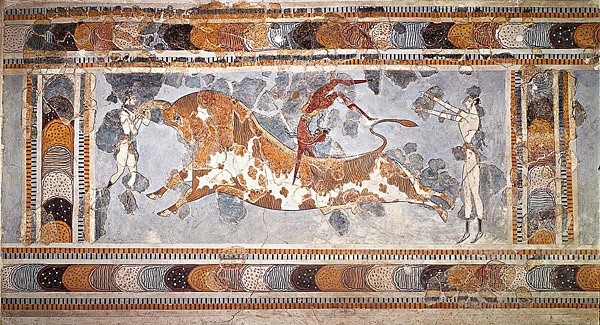
It's hard to pick apart the threads of skill, courage, endurance, beauty and sensitivity in all of this. They fuse, but I found the dancing sometimes taking me to ancient imagery like this:

Minoan bull-leaper
Fresco from the Palace at Knossos (17-15th centuries BC),
Heraklion Archeological Museum, Greece


and this Greek fresco I saw in Paestum in southern Italy:

The Diver (470 BC),
from the covering slab of the Tomb of the Diver
Paestum Archaeological Museum

Repercussion is an uncommon sensation--or many--only lessened by repetition of movement and relational ideas that jolt us without, in the end, taking us someplace new. In that way, it seems sealed in a circular environment. Even so, Davis and Galvin are always wonderful to see.

Repercussion continues tonight as well as next Friday and Saturday, March 25-26 at 7:30pm. For information and tickets, click here.

Dixon Place
161A Chrystie Street (between Rivington and Delancey Streets), Manhattan
(map/directions)
If you like what you're reading,
subscribe to InfiniteBody!

Copyright notice

Copyright © 2007-2023 Eva Yaa Asantewaa
All Rights Reserved

Popular Posts

Labels