Search This Blog

Showing posts with label symbolism. Show all posts

Friday, June 30, 2017

The Guggenheim's journey into the mystic


Armand Point: The Annunciation or Ancilla Domini (L’Annonciation), 1895
Tempera on panel, 99 x 51 cm
Private collection, courtesy Sotheby’s
Photo: Courtesy Sotheby’s


Solomon R. Guggenheim Museum

presents


Open now through October 4


Ferdinand Hodler: The Disappointed Souls (Les âmes déçues), 1892
Oil on canvas, 120 x 299 cm
Kuntsmuseum Bern, Staat Bern
Photo: Courtesy Kuntsmuseum Bern, Staat Bern


"The world is too much with us," wrote William Wordsworth, critiquing new realities wrought in Britain's first Industrial Age. Nearly a century later, French Rosicrucian writer Joséphin Péladan (1858–1918) struck a similar note, creating space for artists seeking refuge from a swiftly-changing Europe through the embrace of classical myth, Biblical narratives, nature's elevating beauty and the more ethereal, spiritual climes of imagination. The Guggenheim's new show, Mystical Symbolism: The Salon de la Rose+Croix, curated by Vivien Greene, samples Symbolist works that appeared in Péladan's annual salon of international works in Paris over its six years, 1892-1897.


Installation view
Photo: David Heald
©Solomon R. Guggenheim Foundation, 2017


Greene's installation spaces these works in a way that would encourage the sort of concentration and contemplation Péladan surely intended to inspire. But with its wan religious iconography intertwined with pagan flourishes, inert androgyny and women relegated to either virginal or monstrous roles, most of this visual art will likely merit attention mainly for its historical, influential connections to other artistic mediums of the period. I glanced at and breezed by much of it--the familiar (Khnopff, Delville) and the unexpected, such as Charles Maurin's remarkably political painting, The Dawn of Labor--but did find myself lingering with one pencil-and-chalk work on paper.

Armand Point's April or Saint Cecilia (1896) depicts the martyred patron of musicians strumming her harp before a lush cascade of ivy. Point's chiseled modeling of the bones of Cecilia's articulated hands held my eyes once and again. We are meant to notice those bones. Although willowy and idealized in her femininity, Cecilia is neither flattened nor vague and evanescent, unlike so many of the good girls and femmes mystérieuses rendered in Symbolist allegory. She fully inhabits a defined, structured body. And like legendary Orpheus, a subject popular with the Symbolists, she expresses a transcendent power through music.

Audio introduction to the exhibit and related poetry readings: click

Related programming: click

Visitor information: click

Ticketing: click

Guggenheim Museum
1071 Fifth Avenue (between 88th and 89th Streets), Manhattan
(map/directions)

Subscribe in a reader

Thursday, March 17, 2016

Talks on "Dreams, Magic and Desire" at The Met: Part 2

Sir Edward Burne-Jones: 
The Beguiling of Merlin (1872-77)
Lady Lever Art Gallery

This morning, I attended "The British Invasion," the second of Alison Hokanson's excellent presentations on Dreams, Magic and Desire at The Metropolitan Museum of Art. Her talk, this time, focused on Britain's Pre-Raphaelites--exemplified by painters Dante Gabriel Rossetti and Sir Edward Burne-Jones--and their direct influence on the later Symbolist movement. (See my post from last week's talk about Belgium Symbolist Fernand Khnopff.)

Again, Hokanson led us through the factors that gave rise to Symbolism in many European nations--primarily the intensely nationalistic urge to break from the dominance of France-centric academic art, realism and Impressionism, and the desire to explore inner worlds and mystical realms. Symbolism, she said, was not a specific technique but "a range of principles," "a state of mind" valuing individual expression.

As the Symbolists took inspiration from the earnest, elaborately symbol-laden work of the Pre-Raphaelites, that movement looked even further back to paintings of the medieval and early Renaissance eras, citing their "immediacy, purity, authenticity" all that was "full of life and heartfelt." Burne-Jones belonged to the second wave of Pre-Raphaelites, artists devoted to an even more idealized depiction of nature, humanity, myth and mind.

Beauty of form grew in value for these artists, but beauty as "a way to guide the spirit" in a world lately upended by industrialization, commercialization, scientific discovery and political upheaval. The movement also embraced the decorative arts in furnishings, book illustration and objects of everyday use.

"The British Invasion"

Taking as a starting point the Met’s masterpiece The Love Song by Edward Burne-Jones, this talk highlights the appeal that the work of the Pre-Raphaelites in England had for the Symbolist generation in Northern and Central Europe. From Brussels to Munich and Vienna, artists drew on British models to develop modern styles that differed radically from the French trends that dominated the art world. Their work, as one critic put it, “rendered the profundity of life and a melancholy attitude of beauty.”

Sir Edward Burne-Jones:
The Love Song (1868-77)
The Metropolitan Museum of Art

Hokanson's talk centered on The Love Song--the romantic, atmospheric Burne-Jones masterpiece in the Met's collection--tracing its influences back to Botticelli, Giorgione and Titian. A gifted communicator, she made her feelings for this work most clear by adding a recorded chanson to our visual experience of this painting's overtly depicted and subliminal music. It was a sublime moment.

File:Sir Edward Coley Burne-Jones Flamma Vestalis.jpg
Sir Edward Burne-Jones:
Flamma Vestalis (1896)

Hokanson ended her discussion by noting the trauma of World War I and its sweeping effect on the arts in Europe. The Symbolist movement fell away, supplanted by emerging forms for a brutally altered world.

*****

For information on future art talks at the Met, click here. To learn about all other special programming at the Met, click here.

*****

Special note for dance fans:

David Dorfman Dance will take part in tomorrow's lineup celebrating the official opening of The Met Breuer with performances all day long, free with museum admission or membership. Click here for information.

If you like what you're reading,
subscribe to InfiniteBody!

Saturday, March 12, 2016

Talks on "Dreams, Magic and Desire" at The Met


Above: The Silver Tiara
Fernand Khnopff (1911)
The Museum of Modern Art

Below: Self-portrait, Fernand Khnopff (1879)
Willems Collection, Brussels


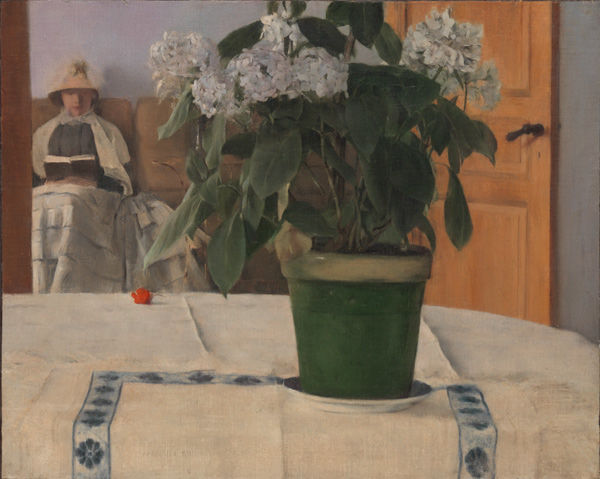
On Thursday, the Metropolitan Museum of Art presented a talk by Alison Hokanson (Assistant Curator, European Paintings) on Symbolism with a focus on the work of Belgian painter Fernand Khnopff. In discussing the broad and enigmatic Symbolist movement, with its concern with "desire, the unconscious, human mortality, timelessness and the inner self," Hokanson acknowledged that it had long been dismissed by most art scholars as "an artistic dead end, not sufficiently sophisticated or forward-thinking."  Now that assessment is under revision. A prime example of this new consideration: The Met's own recent acquisition of Hortensia, an interior innovative, for its time, in Khnopff's confident experimentation with perspective and foregrounding.


Fernand Khnopff's Hortensia (1884)
The Metropolitan Museum of Art

Hokanson is a clear, illuminating presenter, and if you missed this first talk from her Dreams, Magic and Desire series, I highly recommend catching the second--"The British Invasion"--on Thursday, March 17 (11am-Noon).
Taking as a starting point the Met’s masterpiece The Love Song by Edward Burne-Jones, this talk highlights the appeal that the work of the Pre-Raphaelites in England had for the Symbolist generation in Northern and Central Europe. From Brussels to Munich and Vienna, artists drew on British models to develop modern styles that differed radically from the French trends that dominated the art world. Their work, as one critic put it, “rendered the profundity of life and a melancholy attitude of beauty.”
Click here for ticket information.

The Grace Rainy Rogers Auditorium at
The Metropolitan Museum of Art
82nd Street and Fifth Avenue
(visitor information including map and directions)

If you like what you're reading,
subscribe to InfiniteBody!

Saturday, June 2, 2012

Anabella Lenzu premieres "Sangre & Arena"

In Sangre & Arena (Blood & Sand), Argentine-born choreographer Anabella Lenzu proudly works from an aesthetic associated more with the "classical" modern dance of Humphrey, Limón and Graham than with the intents and strategies of New York's contemporary dance makers. And Lenzu's 40-minute trio, given its world premiere last evening at Duo Multicultural Arts Center, looks backward even farther than those pioneering antecedents. Inspired by Roman Mithraic myth and ritual, the work evokes ancient, cathartic rites employing masks of fearsome animal gods; arresting movement gestures; heightened sounds of swirling wind, hypnotic chimes and terrifying gongs; nature-emulating cycles of repetition; and a profusion of blood--or what frightened initiates might easily take for real blood--used to effect lasting transformation.

Fellow dancers Lauren Ohmer and Julia Lindpaintner join Lenzu--disclaimer: she is currently one of my writing students at New York Live Arts--on Duo's little stage in the intimate theater. Ohmer and Lindpaintner's bodies get wildly smeared with paint as their behavior becomes more abandoned. Lighting (by Stephen Petrilli) and the dancers' thrashing in vivid tempera create three-dimensional art come to life. Lindpaintner's robust sturdiness is impressive, but Ohmer's precise, electric shapes make her the most watchable of the three.

Anabella Lenzu/DanceDrama continues at Duo tonight at 8pm and with a 2pm matinee tomorrow. For information and tickets, click here.

Duo Multicultural Arts Center
62 East 4th Street (between Bowery and Second Avenue), Manhattan
(map/directions)

Saturday, April 16, 2011

The Dancers Tarot

Check out Moti Zemelman's great Kickstarter project, which brings together dance, photography and Tarot. As you might imagine, it certainly makes all the sense in The World to me! :-)

The Dancers Tarot by Moti Mark Zemelman

Thanks to Facebook friend Francine Blackwell for drawing my attention to this project!

Wednesday, December 1, 2010

Friday, October 22, 2010

The magic of numbers

The Magical Properties of Everyday Numbers
by Daniel Gilbert, The New York Times, October 17, 2010

Friday, April 2, 2010

The sum of zero

Dancer-choreographer Kathy Wasik's fantasia on the number Zero--in a two-piece evening by the same name at Triskelion Arts--sent me on a search for fun facts about the ubiquitous and useful numerical oval.

Did you know, for instance, that a null pointer is a pointer in a computer program that does not point to any object or function? Or that in classical music, 0 is very rarely used as a number for a composition: Anton Bruckner wrote a Symphony No. 0 in D minor and a Symphony No. 00; Alfred Schnittke also wrote a Symphony No. 0? Or that in lattice theory, 0 may denote the bottom element of a bounded lattice? [Thank you, Wikipedia!] What the dickens is lattice theory? Will this be on the test?

From childhood, I've loved individual numbers (and letters) as symbols and entities with something very much akin to their own personalities and force. An instinctual Kabbalist type thing, I guess. I appreciate Wasik's idea of communing with Zero--surely the most buoyant, elusive and intriguing of numerical personalities--throughout her solo, Zero. The piece has its moments of visual pleasure and of whimsy, but I can't say I got it or took away much from the willowy, resilient Wasik's dancing--a long, dream-like performance in which her movements might be a bit too lovely and technically-controlled to speak up for her and her presumably visionary intentions.

On the other hand, Learning to Fall--Wasik's mysterious solo for beautiful Cara Liguori--is a much more cunning study. It uses the power of silence, chiaroscuro lighting (by Andy Dickerson) and carefully selected movement to focus attention. We zoom in on the exacting way Liguori readjusts one wrist with her other hand. She takes her time. She appears as one eternally suspended, touching her face, her hand or her shoulder while her mind seems to dwell elsewhere. Even the dance's ending seems to float in front of us, never landing.

Zero continues tonight and tomorrow night at 8pm at Triskelion Arts, 118 N. 11th Street (3rd Fl. R), Williamsburg, near Bedford Avenue L station

Google Map directions

Reservations

Sunday, March 8, 2009

Eva's Book Club (3)

Dance folks, what are you reading?

Latest on my nightstand:

The Known World
by Edward P. Jones (Amistad/HarperCollins, 2003)
Pulitzer Prize-winning novel about the culture of slavery. Highly recommended.

Just completed:

The Accidental Masterpiece: On The Art of Life and Vice Versa by Michael Kimmelman (The Penguin Press, 2005)

Magic Power Language Symbol: A Magician's Exploration of Linguistics by Patrick Dunn (Llewellyn Worldwide, 2008)

Use the Comments feature to tell us what you're reading!

Friday, April 6, 2007

Clare Byrne’s "To The Tree"

by Eva Yaa Asantewaa

On April 5th, the International Students Caucus of Union Theological Seminary hosted an unorthodox Holy Thursday service in its James Chapel. It was led by seminarian Claudio Carvalhaes and performed by Clare Byrne, a dance artist noted for her bold choreographic signature and experimental engagement with religious ritual. The forty-minute event drew a modest congregation of sorts, seated in a large circle around the focus of Byrne’s endeavor–a plain, rough-hewn wooden cross, thirteen-feet high.

Carvalhaes introduced Byrne’s dance, To The Tree, by reminding us that our habits and preconceived ideas can restrict our view of reality. If we free ourselves of these notions, “reality might turn itself upside down,” he said. “And this chapel, perhaps it is only a chapel, but perhaps it is capable of being other things, too.” The cross, Christianity’s most-exalted symbol, might be an anchor, he suggested. “Or a tree, or a hollow space filled with both the holy and the mundane.”

To The Tree evoked both Christianity’s cross of Jesus--the cross of sacrifice--and the pre-Christian, ancient and universal cross of opposites, a kind of schematic altar where worlds of matter and spirit intersect. The image of a tree has resonance for pagans and Kabbalists, too, and the wondrous hollow space, of which Carvalhaes spoke, is an important feature of numerous mystic and mythic traditions.

But what was most clear was Byrne’s guileless claiming of the cross for herself. With a long, wooden pole balanced across her shoulders, the petite, sinewy dancer approached the cross, regarding it for a lengthy moment, then simply made it her home. Over the next half-hour or so, she closely engaged with it, softly running her hands along the wood, embracing it, twirling before it like a dervish, running the pole through a hole in its vertical beam–an image that oddly conflated the piercing of Jesus’s flesh, an act of sexual intercourse, and the cleaning out of one’s pockets. The advancing pole noisily displaced a cache of coins and other items, including the plastic shards of a broken lipstick case.

With a congregant’s assist, Byrne climbed to the top of the cross and stretched out atop the crossbeam like a sleepy cat, perfectly comfortable. After more calm, simple maneuvers, she returned to the floor with no further help needed.

This cross, she seemed to say, it’s all good. I have loved it and healed it.

Her dance reminded me of something a metaphysical teacher said recently: that places that have seen great violence are like bodies in need of healing. I could offer examples, but they are legion; you could name them just as well.

After Byrne exited the chapel, Carvalhaes invited us to join together in singing a Christian hymn, write a few words about our experience of the dance and tape these slips of paper to the cross. As I circled the cross, I was surprised to see that a number of people had expressed feelings of anxiety. I wondered: Could it have been the physical risk? Byrne--very carefully, I thought–had swirled the pole near us, like a priest swinging incense smoke above our heads, as she moved in and out of our circle. Was it the way she scrambled to the height of the cross and balanced there? Or did something else trigger dis-ease and apprehension?

To The Tree made me feel anything but anxious. I felt the healing.

Byrne’s spring project continues with an evening performance of Letter to the Church at UTS’s Lampman Chapel on the evening of April 23rd and Kneelings in numerous locations around the city from April 22nd through May 6th. Visit www.clarebyrnedance.org.

(c)2007, Eva Yaa Asantewaa

Copyright notice

Copyright © 2007-2023 Eva Yaa Asantewaa
All Rights Reserved

Popular Posts

Labels