Search This Blog

Showing posts with label Asian. Show all posts

Friday, March 27, 2020

Artists Reach Out: Yo-Yo Lin

Dear friends,

Welcome to Artists Reach Out: reflections in a time of isolation. I dreamed this series of interviews out of grief for my work both as a documenting arts writer and curator of live performance. In this time of social distancing, we are called to responsibly do all we can to safeguard ourselves and our neighbors. It is, literally, a matter of life and death.

But there's no distancing around what we still can share with one another--our experiences, thoughts, wisdom, humor, hearts and spirit. In some ways, there are more opportunities to do so as we pull back from everyday busyness out in the world and have time to honor the call of our inner lives.

So, let me introduce you to some artists I find interesting. I'm glad they're part of our beautiful community, and I'm eager to engage with them again (or for the first time) in years to come.

--Eva Yaa Asantewaa, InfiniteBody


Yo-Yo Lin
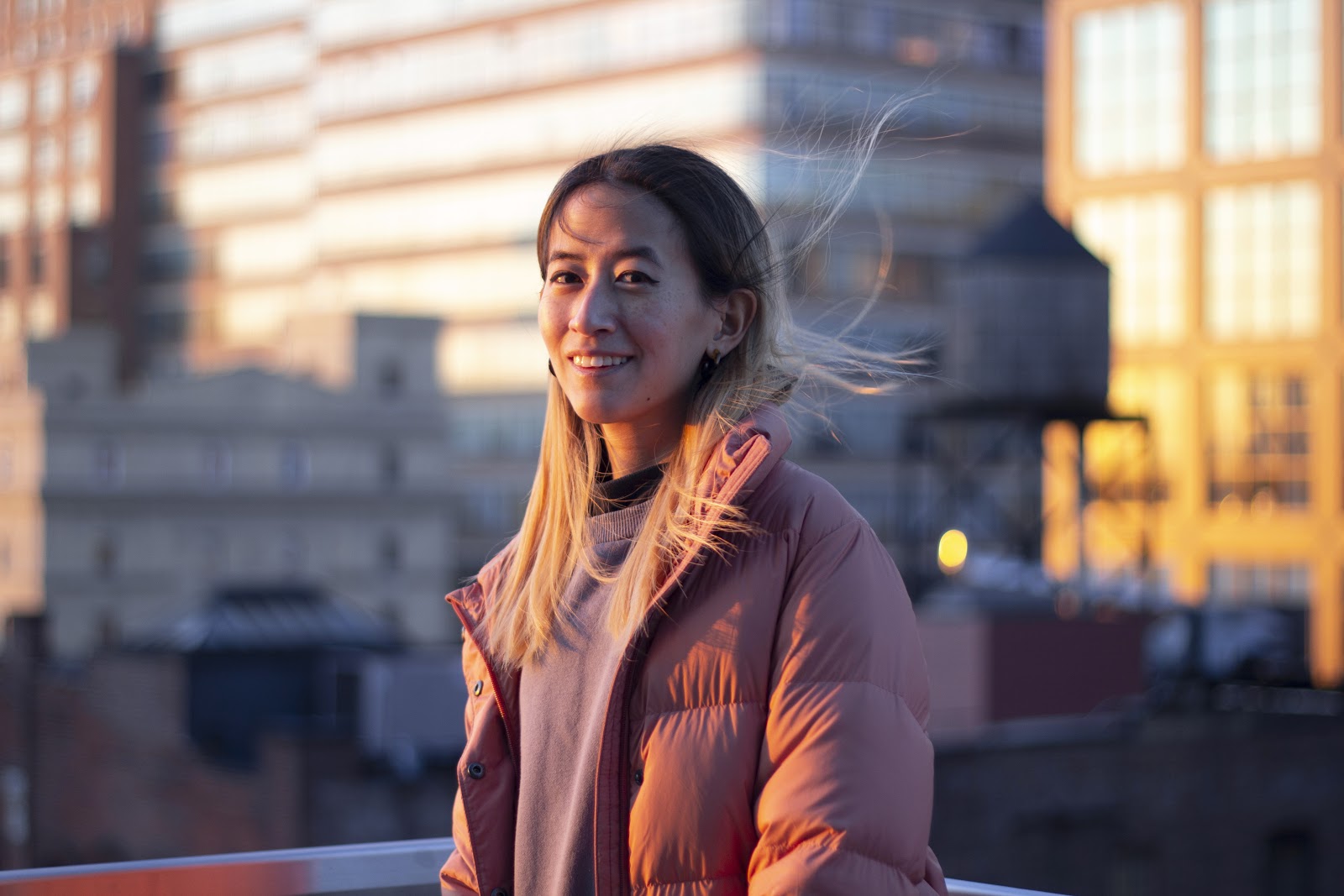
Yo-Yo Lin
(photo: Zack Filkoff)

Yo-Yo Lin is a Taiwanese-American interdisciplinary media and performance artist who explores the possibilities of human connection in the context of emerging, embodied technologies. Through an on-going exploration into ‘soft’ illness data, body sonification, and impairment-generated dance, she is researching and developing methodologies in reclaiming and processing chronic health trauma. Her latest solo performance the walls of my room are curved premiered last winter at Gibney. Recently, Yo-Yo co-facilitated a four-part movement workshop series “Modes of Embodiment: An Expressive Toolkit for Chronically Ill and Disabled Bodies” at Movement Research. Born and raised in Los Angeles, Yo-Yo now lives and works in New York City. More info at www.yoyolin.com.
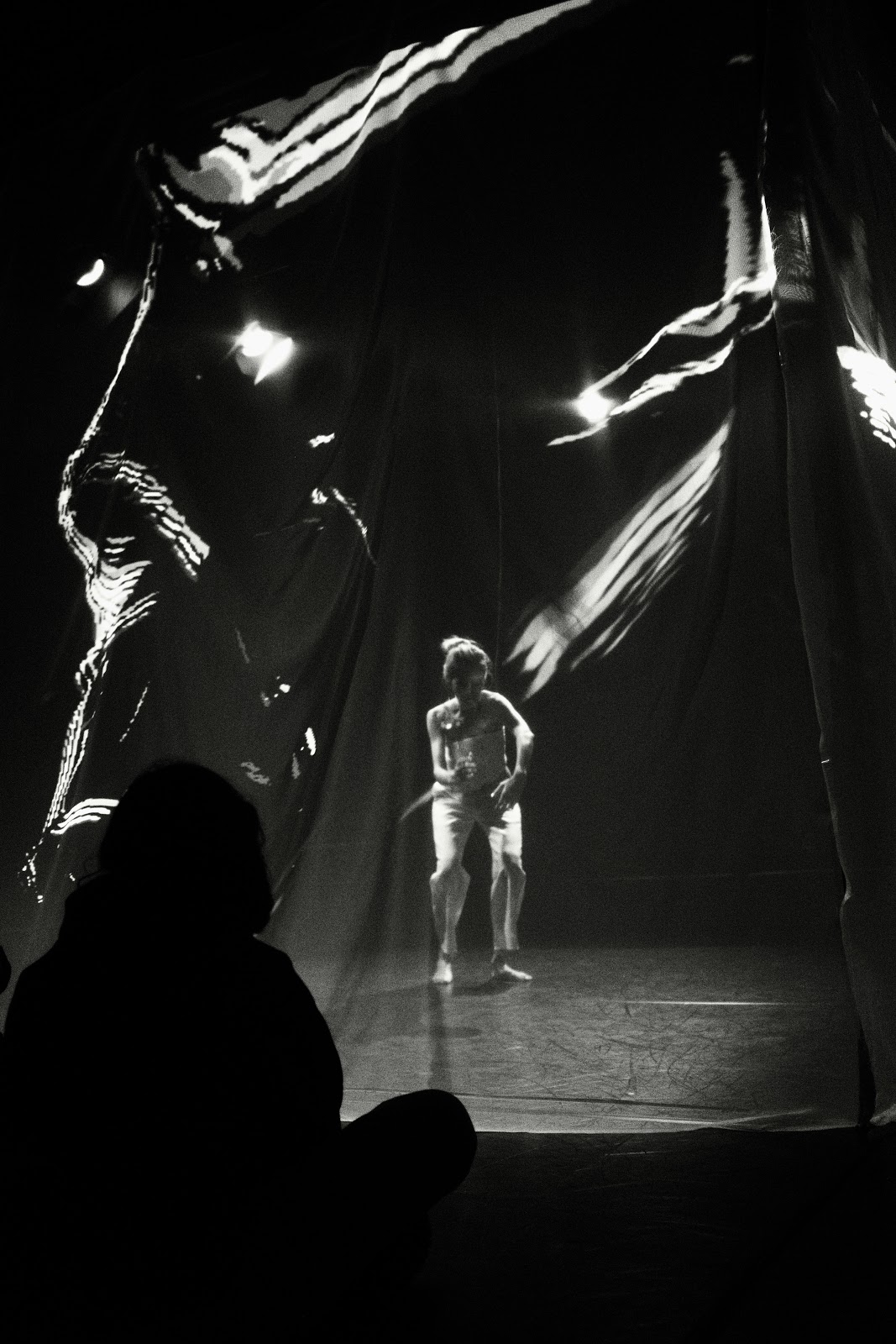
Yo-Yo Lin's the walls of my room are curved
(photo: Steve Dabal)

Do you have a current or planned project whose progress is affected by the pandemic?

I had planned on showcasing the performance the walls of my room are curved at two gallery openings this spring, both of which are now postponed indefinitely. the walls of my room are curved is a movement-generated sonic performance of the body living with a connective tissue disorder. The performance uses several microphones attached to my moving body, capturing the live sounds of creaking and crackling bones and joints as they shift, transfer, extend, and rotate. As I dance, an electronic musician samples, processes, synthesizes the sounds of my body into a musical score in real-time. I also have a group show currently up at the Jewish Community Center, entitled Rituals, that is now closed as well. Curated by Ezra Benus, the show addresses living experiences of illness and disability in abstract, ritualistic forms. I had planned on doing a durational performance based off of my data-tracking framework called The Resilience Journal but am now re-imagining it to be done remotely.

Briefly, tell me about how you got involved in the arts and in your particular practice.

I began with drawing and painting, then started making my drawings move. I was interested in moving images as a sculptural element--often taking these moving images and projecting them onto different surfaces. This led me into using real-time technologies--tools that would allow me to live-manipulate the visuals, map them onto 3D shapes, and sync with body movement. Naturally, live performance was the venue for these explorations. I often work collaboratively with musicians, dancers, and other performing artists in turning their visions into reality. As of recent, I’ve been combining my media art based practice with an emerging performance practice. I’ve been doing research into somatics, internal arts (including Tai Chi), and illness/ disability aesthetics in dance.

In a more specific way, what are you practicing? And what are you envisioning?

I am practicing a revealing and re-valuing of realities. Living with an invisibilized illness has prompted me to question the realities of my body in relation to time and space. I am discovering that illness is relativity. Notions of how the ill bodymind can be generative sources for creative expression--in visuals, sound, tactility, shape, space, movement--has coupled with my explorations in time-based media art and technologies, creating works that seek to make the invisibilized not just visible but felt, embodied, and honored in its complexity. These works span from ‘soft’ data visualization to soundscapes made from bone sounds, to impairment-generated dance scores, to extended reality nightlife spaces. These explorations sometimes echo the complicated relationship between the body and technology, often precarious, discomforting, and transformative all at once. But ultimately, these works reveal a yearning for a deeper understanding and vision of the self, reflected back in its wholeness.

How does your practice and your visioning align with what you most care about?

My practice belongs to a lineage of immigrant, ill/ disabled QTPOC womxn artists, all of whom have created art from necessity and with what they had. I find that “necessity” has produced the most honest, provocative art. I have been recently practicing with this idea in mind, unlearning the excess in technology-based art, acquainting myself with my body and the living planet, and holding space for grief and pleasure. I have been doing this not alone but with many others--creating and facilitating spaces for looking inward, safer discussions, and collective growth. Last fall, dancers Lara Marcin, Pelenakeke Brown and I facilitated a four-part movement workshop series entitled, “Modes of Embodiment: An Expressive Toolkit for Chronically Ill and Disabled Bodies” at Movement Research, where we sought to create an access-centered dance-making space. We dream of continuing to create communal space to honor the trauma in the bodyminds we own and building tools and methodologies to do so.

How does your practice function within the world we have now?

My practice continues to function, perhaps ever more urgently, in the world we have now. I see the able-bodied workforce employ techniques that chronically-ill and disabled folks have long asked for and use as a form of access. Suddenly what was deemed “impossible” to do for a disabled person--such as tele-communication, healthcare benefits, paid leave, virtual events--are suddenly possible. I would like to dwell in this reality we live in right now, to hold space for the grief, fear, and anger we feel as chronically-ill and disabled folks in a time where we see ableism in full-force. I also call upon the wisdom we have developed over generations of mutual aid, resilience, and crip magic. For us, illness is nothing new. We’ve been on our own before. In my practice, I hope to further highlight the generative nature of illness by utilizing tools I have to my disposal while in quarantine, and taking this time to rest, listen, and serve the most impacted.

If you can, please donate to: https://www.gofundme.com/f/crip-fund.

******

DISCLAIMER: In addition to my work on InfiniteBody, I serve as Senior Curatorial Director of Gibney. The postings on this site are my own and do not necessarily reflect the views, strategies or opinions of Gibney.

******

Subscribe in a reader

Thursday, March 28, 2019

Ballet Hispánico: all that and a stack of bowlers


From top: Bennyroyce Royon, Edwaard Liang
and Annabelle Lopez Ochoa

Ballet Hispánico
Works by Edwaard Liang, Annabelle Lopez Ochoa and Bennyroyce Royon
The Joyce Theater
March 26-31

The women of Ballet Hispánico
and their Magritte-inspired bowlers
in a work by Annabelle Lopez Ochoa
(photo: Paula Lobo)

For this Joyce Theater season, Ballet Hispánico bookends a cheeky, all-female performance of Annabelle Lopez Ochoa's Magritte-inspired Sombrerísimo--a 2013 work made for men--with world premieres by two Asian-American dancemakers. With El Viaje, Taiwan-born Edwaard Liang has gifted this ensemble with a meditation on immigration and the journey towards love, community and hope. What's the connection to this troupe's Latinx profile? Literally, the historic migration of a Chinese diaspora to the shores of Cuba; yet, beyond that specific backstory, the work--lucid and moving--will prove accessible to anyone with a heart. For music, Liang selected Academy of St. Martin in the Fields's sublime recording of Ralph Vaughan Williams's Fantasia on a Theme by Thomas Tallis--a performance that has always given me chills. With designers Danielle Truss (costumes) and Joshua Paul Weckesser (lighting), he has turned the Joyce stage into a jewel box displaying every elegantly-sculpted facet of individual movement, partnership and grouping. The dancers are profoundly supple and expressive. One cannot help but get swept up in the energy of Liang's searching and threshing of stage space.

Bennyroyce Royon's gift to Ballet Hispánico draws upon his Filipino heritage and his culture's Spanish/Asian intersection. As in El Viaje, but without the exalted poetics of Liang's dancemaking, Homebound/Alaala, suggests a variety of interpersonal relationships and environments in flux and in possibilities. This robust ensemble will be remembered most for a colorful, cleverly adaptable set design of large boxes developed, in collaboration, by Amanda Gladu and Royon. Continuously rearranged and re-purposed by the dancers, the boxes aid in the telling of stories of leave-taking and travel, of containers holding history and identity, of erecting and dismantling barriers between people.

Ballet Hispánico continues at The Joyce through Sunday, March 31. For schedule information and tickets, click here.

The Joyce Theater
175 Eighth Avenue (at 19th Street), Manhattan
(map/directions)

******

SPECIAL EVENT:

I'm also excited to announce that Eduardo Vilaro (Ballet Hispánico's Artistic Director and CEO) will join choreographer Bennyroyce Royon for a conversation and screening of excerpts from Homebound/Alaala at Gibney on Wednesday, April 17, 6:30-8pm.

This Sorry I Missed Your Show program is free, but seating is limited. So, please RSVP soon. Learn more here.

Gibney
280 Broadway (enter at 53A Chambers Street), Manhattan
(map/directions)

******

DISCLAIMER: In addition to my work on InfiniteBody, I serve as Senior Curatorial Director of Gibney. The postings on this site are my own and do not necessarily reflect the views, strategies or opinions of Gibney.

******

Subscribe in a reader

Saturday, September 15, 2018

A taste of Ballet Hispánico at 92Y Harkness

Choreographer Bennyroyce Royon is developing
a new work for famed Ballet Hispanico.
(photo: Kuo-Heng Huang)

92Y Harkness Dance Center's Fridays@Noon series regularly offers audiences up-close-and-personal views of dance. Yesterday, New York's Ballet Hispánico delivered a presentation so masterful and  charged that it was a wonder the relatively small space could contain its energy.

Billed as a celebration of Hispanic Heritage Month and an intersection between Asian and Latinx cultures, the Pino-Latino program gave a just a taste of what Eduardo Vilaro's troupe can do. The afternoon opened with Sombrerisimo (2014), Colombian-Belgian choreographer Annabelle Lopez Ochoa's male sextet with Magritte-inspired bowlers. It is filled with intense and slippery entanglements between and among men, acrobatic flourishes and dashes of salsa, flamenco and Fosse. Filipino-American dancemaker Bennyroyce Royon previewed a work in development, Homebound/Alaala. With its novel use of visual symbolism--primarily, numerous brown cardboard boxes--and the dancers' deeply expressive performances, this ensemble reflects on caring, longing, suffering, mourning, collaboration and community resilience, speaking to what and how we share as human beings.

Following these performances, John-Mario Sevilla, Harkness's director, engaged Vilaro, Royon and two dancers (Raúl Contreras and Gabrielle Sprauve) in a conversation that often returned to the value of the arts for the health of society. When evoking difficult histories (in this case, the ravages of colonialism), the arts can also strengthen cultural identity and help dissolve artificial and destructive barriers between people.

Hurry, hurry, hurry if you want tickets to catch this beautiful company  on either October 12 or October 13 at New York City Center's Fall for Dance Festival. Click for information here.

For information on upcoming Fridays@Noon at 92Y Harkness Dance Center, click here.

92Y
1395 Lexington Avenue (91st-92nd Streets), Manhattan
(map/directions)

Subscribe in a reader

Friday, April 1, 2016

Enrico D. Wey presents new solo at Danspace Project

Displaying Wey1_ElyssaGoodman_courtesyDanspaceProject.jpg


Displaying Wey3_ElyssaGoodman_courtesyDanspaceProject.jpg
Enrico D. Wey performs his new solo,
to warring states, a useless tool,
at Danspace Project.
(photos: Elyssa Goodman)

In his third Danspace commission, Enrico D. Wey presents a deeply personal examination of Asian male identity and embodiment. Wey explores clichés such as the Asian body as a fetishized and invisible minority, asking, “Can I reclaim my own physical body from the gaze of others and from my own embedded prejudice?”
--from promotion for Enrico D. Wey's to warring states, a useless tool

At first sight, the set-up of Enrico D. Wey's solo at Danspace Project--to warring states, a useless tool--first resembles an improvised boxing ring. Audience seating lines all four sides of a large, square space covered in a white, illuminated plastic mat, its parameters neatly defined by festive, tricolored tape. A pink ribbon, anchored in the air by cords extending from the sanctuary's columns, encloses this area like the ropes of a boxing ring.

We enter, claiming chairs or cushions, to find Wey already stationed at the square's center, standing as still as a rubber doll, his long, black hair completely veiling his face, his chest, legs and feet bare. Oksana Meister's costume--largely front and back panels of multicolored fringe--wraps his lower body from waist to knees. Although the set suggests a competitive match of some sort, the costume introduces a different association--cultural ritual. As we will see, both associations are fair entry into the work.

The solo moves through an hour--most of that time, astonishingly glacial in pace. It takes a while at first, and close observation, to even detect change in Wey's body. But, yes, those arms are slowly rising and spreading. That might not register until the positional change becomes obvious. Fifteen minutes, at least, have passed before the arms find an arch like half-unfurled wings. As if to (sort of) highlight the moment, Elliott Jenetopulos's lighting gives the tiniest, fleeting uptick that seems almost like a hastily-corrected mistake.

Wey's arms begin a descent, his head and back dipping forward, folding downward at the same pace. A half-hour has passed, and he is suspended above the floor, nearby shadows tinted strawberry and green. Abruptly bursting into motion, he rapidly pumps, thrashes up and down, over and over, sharply exhaling, panting, snorting, shifting from one to all four directions. About forty-five minutes in, there's humming, sudden panting, something that sounds like yodeling, scatting, muttered gibberish and then ritual chant. Never, though, the revelation of his face. We're not granted that. The lashing motion blurs whatever we might have been able to see. He is there and not there. Or there in some form of absence that removes his actual identity from easy access. Forced or deliberate. Negative or positive. Make of that what you will. Make of him what you will.

In the post-show Q&A with writer Jaime Shearn Coan, the Taiwan-born performer spoke of sourcing material from traditions ranging across several Asian cultures--including, in his furious, ecstatic lashing, an aboriginal tribal dance of Taiwan performed solely by women. He was driven by a need to put himself at the center "and always at the center," embodying what appears to be stuckness but, as he sees it, is truly "activated space."

"I'm going to place that at the center of my work and see what spins out from it," he said. "That gray space in between, I want to be able to sit in that space and take from it."

Multitalented Wey has also worked in puppetry where, he noted "the idea is to make the puppet breathe" thus changing the nature of the puppet's movement and the audience's perception and understanding. The dancer in to warring states inhabits a space between inertness and dynamism, between being acted upon and acting, between being object and subject. He might be oppressively obscured or protectively hidden. He might be invisible or visible and apprehended and known in multiple ways. The states war. He is a vessel, useless or otherwise, in this adroit and fascinating performance.

to warring states, a useless tool continues tonight and tomorrow with performances at 8pm. Seating is limited. For information and tickets, click here.

Danspace Project
St. Mark's Church in-the-Bowery
131 East 10th Street (at Second Avenue), Manhattan
(map/directions)

If you like what you're reading,
subscribe to InfiniteBody!

Copyright notice

Copyright © 2007-2023 Eva Yaa Asantewaa
All Rights Reserved

Popular Posts

Labels