Search This Blog

Showing posts with label interdisciplinary. Show all posts

Wednesday, May 27, 2020

Artists Reach Out: Monstah Black

Dear friends,

Welcome to Artists Reach Out: reflections in a time of isolation. I dreamed this series of interviews out of grief for my work both as a documenting arts writer and curator of live performance. In this time of social distancing, we are called to responsibly do all we can to safeguard ourselves and our neighbors. It is, literally, a matter of life and death.

But there's no distancing around what we still can share with one another--our experiences, thoughts, wisdom, humor, hearts and spirit. In some ways, there are more opportunities to do so as we pull back from everyday busyness out in the world and have time to honor the call of our inner lives.

So, let me introduce you to some artists I find interesting. I'm glad they're part of our beautiful community, and I'm eager to engage with them again (or for the first time) in years to come.

--Eva Yaa Asantewaa, InfiniteBody


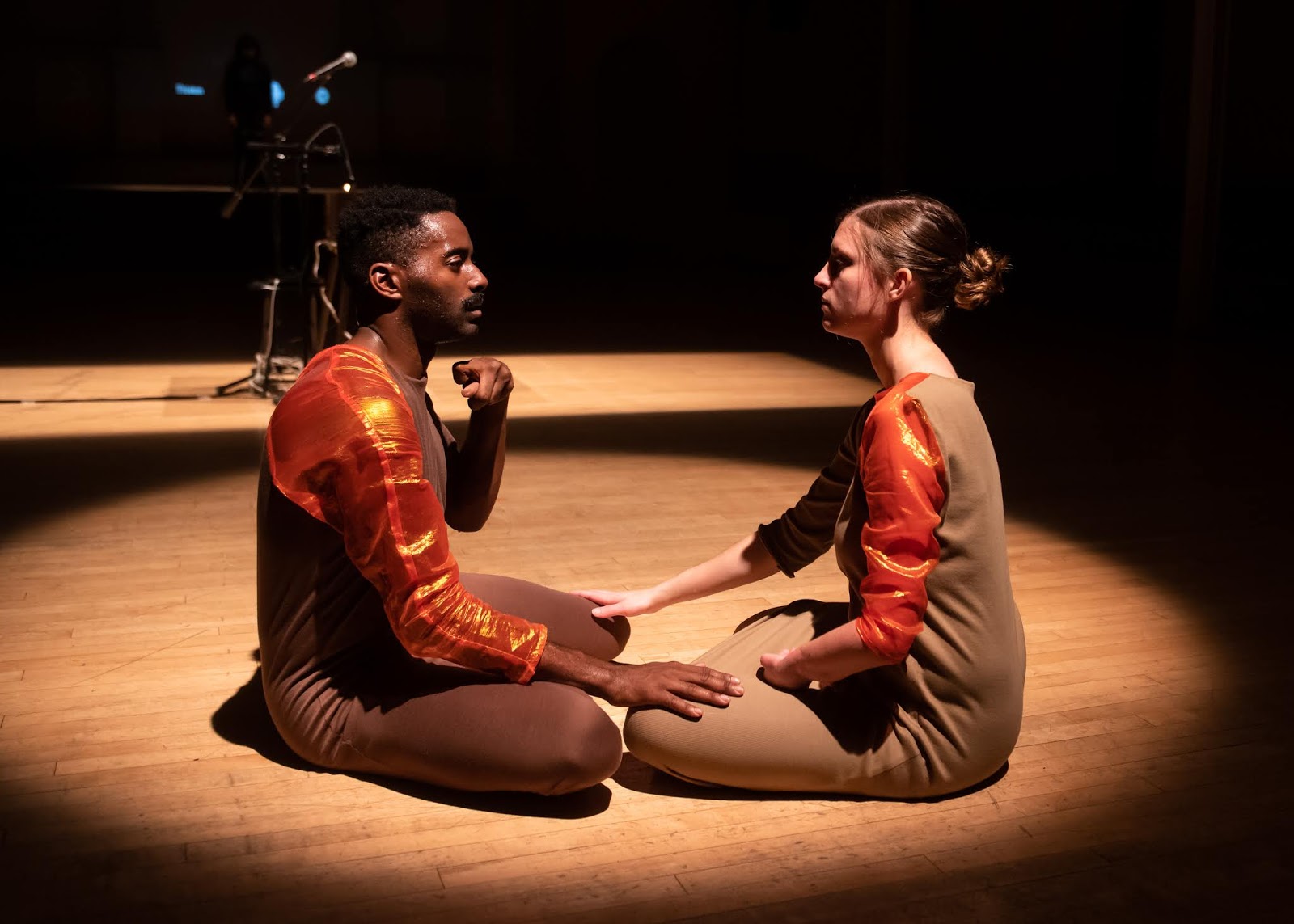
Monstah Black


Monstah Black
(photo: Lia Clay for the 2018 Queer|Art Community Portrait)


Monstah began his career as a performance artist with an emphasis on dance, costume design and music composition. He received an MFA in New Media Arts and Performance from Long Island University. He is currently one half (with his husband) of the electronic duo The Illustrious Blacks. Together they write, produce, record and perform internationally their original music.

Awards include Open Call The Shed NYC recipient, The Tom Murrin Performance Award, Franklin Furnace Fund, Lower Manhattan Cultural Council, American Music Center Live Music for Dance and NYSCA.  He has garnered support from New York organizations including Joe’s Pub at The Public Theater, The Field, Movement Research and New York Live Arts. Publications include New York Magazine, Billboard Magazine, Paper Magazine and The New York Times.

Monstah is a Queer Arts Mentorship and Yaddo fellow as well as a Long Island University New Media Art and Performance, MFA.

theillustriousblacks.com


Do you have a current or planned project whose progress is affected by the pandemic?

The Illustriousblacks (Monstah and Manchildblack) have had to readjust and remix most of our plans for projects in 2020. The quarantine has allowed us to take a deeper focus.

A residency project that was a year long at Jamaica Center for Arts and Learning (JCAL) in Queens experienced a complete remix due to COVID-19. Survival mode became re-imagining original ideas and remixing what was in our immediate surroundings. It caused me to reach beyond comfortable boundaries I’d created for myself (sound, visual and movement qualities). This is how our “Walk-in Closet” was born as a venue for Back In The Closet w/ Monstah Black.

It gave me, and continues to give me, a platform in which to share steps in the process as we build on new ideas. For JCAL, it became a direct opportunity as a marketing strategy to promote my film Cotton, screening in June.

Briefly, tell me about how you got involved in the arts and in your particular practice.

When I was a child, my parents encouraged me to practice and study all the things I showed skill in. They’re responsible for dance classes and church choir; most of my creative interests are inspired by them. Other responsible culprits would be Prince, Michael Jackson, Stevie Wonder, Marvin Gaye, Donny Hathaway, Sylvester, Flip Wilson, Lola Falana, Cher and Parliament Funkadelic.

The choice to go to undergrad for Choreography/Performance at Virginia Commonwealth University sealed my destiny for becoming and staying an interdisciplinary artist.

In a more specific way, what are you practicing? And what are you envisioning? 

I am currently practicing bringing attention back to my rib cage and everything below it. For several years now, I’ve built tons of material and improvised structures based on my upper body, arms, fingers, facial expressions and spine articulation. The quarantine is bringing me back to a place of being more grounded, and that, ultimately, is affecting my vocal quality as well as my body.

I’m currently envisioning a life of streaming/film and television. I love performing for the camera.

How does your practice and your visioning align with what you most care about?

I care most about being able to influence and inspire younger generations to love themselves no matter how much they may feel marginalized and been told otherwise. My practice has been to reach beyond the boundaries and limitations that were put before me. I continue to do that in hopes that it inspires others to do the same.

How does your practice function within the world?

My practice (as well as The Illustriousblacks) flourishes in the idea of togetherness and joy. This is most apparent in environments where music, dance and visuals meet harmoniously (dance parties). That’s a language that is fluent in all cultures. Through music, dance and visuals our goal is to spread the idea of love and unity.

Briefly share one self-care tip that has special meaning to you now. 

Morning Movement Meditation and squats. Sorry that’s two lol.

******

DISCLAIMER: In addition to my work on InfiniteBody, I serve as Senior Curatorial Director of Gibney. The postings on this site are my own and do not necessarily reflect the views, strategies or opinions of Gibney.

******

Subscribe in a reader

Thursday, April 30, 2020

Artists Reach Out: Peter Sciscioli

Dear friends,

Welcome to Artists Reach Out: reflections in a time of isolation. I dreamed this series of interviews out of grief for my work both as a documenting arts writer and curator of live performance. In this time of social distancing, we are called to responsibly do all we can to safeguard ourselves and our neighbors. It is, literally, a matter of life and death.

But there's no distancing around what we still can share with one another--our experiences, thoughts, wisdom, humor, hearts and spirit. In some ways, there are more opportunities to do so as we pull back from everyday busyness out in the world and have time to honor the call of our inner lives.

So, let me introduce you to some artists I find interesting. I'm glad they're part of our beautiful community, and I'm eager to engage with them again (or for the first time) in years to come.

--Eva Yaa Asantewaa, InfiniteBody


Peter Sciscioli


Peter Sciscioli
(photos: Anna M. Maynard)


Peter Sciscioli is a Brooklyn-based interdisciplinary performer, creator, educator and producer whose work encompasses dance, music, theater and film. Since 1997, he has been creating performance works through a choreographic lens with a wide variety of collaborators in venues around the world. In 2012, Peter founded the International Interdisciplinary Artists Consortium (IIAC), a network of artists and producers working across disciplines and cultures, designed to share resources. As a performer, he has worked closely with Jane Comfort and Daria Faïn, and with Meredith Monk in various capacities. Peter has taught his approach to Voice as Movement in Central and North America, co-initiated The Sounding Body workshop series at Movement Research (MR) and currently offers private lessons online. He has received recent support of his work and initiatives from MR’s Global Practice Sharing (GPS) program and the U.S. Embassy Tegucigalpa, Honduras. Each summer Peter also serves as facilitator for a IIAC residency and Moving Arts Lab, a festival meeting ground for interdisciplinary exploration, at Earthdance in Western Massachusetts. www.petersciscioli.com


La Voz Como Movimiento


Do you have a current or planned project whose progress is affected by the pandemic?

For the last two years I’ve been engaged in a group process intended to deepen my research and practice of an approach to the voice and body I call “Voice as Movement.” Initially, I invited a few colleagues to explore some ideas and inquiries, and that process has evolved into creating a work that can eventually be shared with others.

We’d intended to move to a next-stage this spring, but instead have continued meeting once a week online. In some ways, living through this pandemic has allowed us to deepen our process, allowing something to unfold in its own time and in connection to the now, and acknowledging that the process itself has inherent value. Those have been some of the gifts. Much gratitude goes to Sara Galassini, Luisa Muhr and Petra van Noort for continuing to share their wisdom, care and curiosity so generously.

Briefly, tell me about how you got involved in the arts and in your particular practice.

“Voice as Movement” is informed by years of engaging in music, theater, movement and energy work, and has evolved over the last ten years or so. As a child, I studied Western classical violin and performed in musical theater and operas. I later acted in plays and began formal dance training in college. After graduating, I moved to Chicago where I was fortunate to join Chicago Moving Company under the tutelage of Nana Shineflug, one of the city’s matriarchs of modern dance who specialized in activating the chi-body. I also performed, taught, choreographed and was an administrator for Hedwig Dances, directed by Jan Bartoszek.

After moving to New York in 2002 I started working with Meredith Monk, from whom, along with members of her Vocal Ensemble, I’ve learned immeasurably. Later performing with Jane Comfort and Company and Daria Faïn allowed me to grow in both a dance theater practice and in energetic work, respectively.

In a more specific way, what are you practicing? And what are you envisioning?

In a large sense, I think what I’m practicing is integration. The group process combines somatic practices, voice and violin, while drawing inspiration from a theatrical source as well as a companion planting method and a connection with nature (Three Sisters). My ongoing teaching encourages a deepening into the connections between breathing, movement and the voice. This extends to a personal practice of checking in daily on how I’m feeling, using similar practices I share with others, and trying to nurture myself through a variety of means. While a mantra for me during the pandemic has been “one day at a time”, I’m trusting a continuation of these practices and I would like to envision physical spaces that we can return to, in order to experience direct connection, sharing, and learning with others in the near and safer future.

How does your practice and your visioning align with what you most care about?

I’ve always been interested in and curious about what makes us feel more alive. While engaging in the arts from a young age was exciting and liberating, I later discovered and was able to identify an emergent value system underlying all of these practices. While self-expression is a way of sharing ourselves with the world, I’ve found that ego can often get in the way. One of the things I value most is the ability to attune to oneself and others at the same time. These practices have helped me learn how to listen, to trust in intuition, to be vulnerable, to be strong, to feel connection and a sense of community, and to learn how to communicate through the wisdom of the body. Being able to engage in them with others erases boundaries so that we can connect more on a soul level, expanding our perception beyond ourselves. Kindness, care and compassion feel like deepening presences along the way.

How does your practice function within the world we have now?

While I’m very grateful to be able to continue with these practices right now, the shape of them has changed. Nothing can replace in-person-ness, direct exchanges of energy, the sense of touch and being physically affected by being in the same time and place as other people. The shift to teaching online sometimes impedes my ability to perceive what is happening physically in a person’s body, both visually and aurally, though a good deal is still possible, and I think, is of use. In the group practice, we can’t all sing at the same time and hear each other, nor can we obviously explore what’s physically possible between us. There are distinct limitations. At the same time, the fact that this technology is out there is amazing. I also try to remember the simple fact that we are all living in a body and that it’s through the body that we perceive the world. I continue to be humbled by the ability, abundance of inquiry, contemplation and knowledge that is available to me.

******

DISCLAIMER: In addition to my work on InfiniteBody, I serve as Senior Curatorial Director of Gibney. The postings on this site are my own and do not necessarily reflect the views, strategies or opinions of Gibney.

******

Subscribe in a reader

Artists Reach Out: Sara Juli

Dear friends,

Welcome to Artists Reach Out: reflections in a time of isolation. I dreamed this series of interviews out of grief for my work both as a documenting arts writer and curator of live performance. In this time of social distancing, we are called to responsibly do all we can to safeguard ourselves and our neighbors. It is, literally, a matter of life and death.

But there's no distancing around what we still can share with one another--our experiences, thoughts, wisdom, humor, hearts and spirit. In some ways, there are more opportunities to do so as we pull back from everyday busyness out in the world and have time to honor the call of our inner lives.

So, let me introduce you to some artists I find interesting. I'm glad they're part of our beautiful community, and I'm eager to engage with them again (or for the first time) in years to come.

--Eva Yaa Asantewaa, InfiniteBody


Sara Juli


Sara Juli
(photo: Brett Deutsch)

Sara Juli in
Tense Vagina: an actual diagnosis
(photo: Kristofer Alan Thompson)


Sara Juli has been creating and performing comedic dance-theater for two decades and has performed her work extensively around the world. Sara is the 2017 Maine Fellow for the Performing Arts, is a Mid-Atlantic Arts Foundation USArtists recipient, a National Dance Project recipient for 2019-2021, and is touring her newest solo, Burnt-Out Wife nationally. Sara is Chair of Bates Dance Festival’s Advisory Board and an Affiliated Artist of Bates College. She is the Founder/Director of Surala Consulting, a fundraising consultancy supporting arts organizations and individual artists. www.suralaconsulting.com www.sarajuli.com @sarajulimoves


Sara Juli in Burnt-Out Wife
(photo: Nick Pierce)


Do you have a current or planned project whose progress is affected by the pandemic?

In 2018-2019, I imagined, wrote, choreographed and built a new solo performance piece about the decay and detritus of marriage over time--Burnt-Out Wife--the largest production of my career. I invested deeply in an incredible collaborative team including a dramaturg (Michelle Mola), set designer (Pamela Moulton), costume designer (Carol Farrell), sound designer (Ryan MacDonald), illustrator/graphics designer (Devon Kelley-Yurdin), co-songwriter (Sorcha Cribben-Merril), and lighting designer (Justin Moriarty). We worked for many months on creating a Pepto-Bismol-pink bathroom, where the character dances, laughs and sings-out her emotions and secrets.

I feel beyond fortunate that I was able to premiere the work in Portland, Maine, thanks to a commission from SPACE and Portland Ovations and additionally grateful I was able to bring the show to New York City through a commission from Dixon Place and American Dance Festival. I was also able to perform the show in Concord, NH and Portsmouth, NH--the latter on March 7-8 when everything was just starting to shut down. However, my tour was just getting started, and my hard work was just starting to pay off.

Thanks to receiving the National Dance Project, I had a robust tour scheduled for 2020 and 2021, which is now either cancelled or tenuous, at best, for the foreseeable future. To have invested so deeply both artistically and financially into the creative process, and to not be able to share/tour the work, nor receive any (much needed) compensation is devastating. This work is my livelihood in every sense of the word.

Briefly, tell me about how you got involved in the arts and in your particular practice.

My parents enrolled me in a creative movement class in New London, CT when I was three years old. My teacher, L’Ana Burton, still calls me her first dance student, a title I wear proudly. A few years later she founded and became director of the Connecticut College Children’s Dance Center where I danced technique and improvisation classes until I was fourteen. L’Ana taught me to find portals into my imagination and to access tools that would form movement thoughts and ideas that had depth.

At Conn College, during high school, I met Martha Myers who encouraged me to attend American Dance Festival where I enrolled as a student for six summers. My undergraduate experience was at Skidmore College in Saratoga Springs, NY where I was a Dance major. As a senior, I took a two-week intensive workshop with Deborah Hay.  The workshop was long, slow and meditative. I lost myself fully in her practice of harvesting magic and, literally one day, something clicked. I had an actual AHA! moment where I unearthed an artistic practice and voice (literally) that I have been cultivating and growing ever since.

In a more specific way, what are you practicing? And what are you envisioning?

Currently, I am practicing a combination of parenting, exercising, stress-eating, calling friends and family, cooking for my family of four, and trying to make, find or borrow money to live. A lot of my time is spent on meal planning. How is it that breakfast and lunch are so close together? Why does the biggest meal of the day come at a time when I’m most exhausted?

Envisioning is a difficult practice these days, and I have good days and bad. On a bad day, I envision never being able to perform live for audiences again. As a performer who physically touches audiences heavily during shows, I envision that part of my work not being possible anymore. I envision needing to get a job in a different industry. Maybe I could be an Event Planner? Maybe I need to work full-time as a Development professional and let go of my artistic practice?

On a good day I envision there being a space where my solo work can be performed safely. I envision people’s need for laughter, and my gift for making audiences laugh. I envision writing and performing a stand-up comedy show that gets picked-up by Netflix or Hulu. I envision the Burnt-Out Wife tour resuming. I envision a teaching platform where I can help empower our artistic community to fundraise in a landscape that is primed and ready to donate to the cause. I envision so many things each day, it’s hard to keep track.

How does your practice and your visioning align with what you most care about? How does your practice function within the world we have now?

I most care about my two wonderful daughters. I expend a lot of energy trying to give off the appearance that all is well. And some days all is well.

We are self-isolating in a home that I love, with a yard and fresh air in abundance. We are trying to get a dog. We are so lucky and blessed. We’ve been playing Four Square, Scrabble, dancing in our underwear, watching Broadway musicals, and painting rocks as part of another attempt at a garden. My husband and I are taking long walks together. We argue. We are kind. We are scared. We parent our children as best we can.

I am learning to move slower and to stop and smell the flowers. (No, literally I smelled some daffodils in our yard the other day--who knew?) We are finding silver linings.

I think about the relevance of the arts and my practice during times of crisis. I think about being a housewife. I think about my mother. I think about laundry--all the time. I think about recording myself singing a song in my bathtub. I think about “becoming a digital artist” and get lost every time. I think about my value. I think about death. I think about keeping my children safe. Mostly, I think about finding a new normal for my children and myself, and about a future where dance exists, and I am still a part of it.

Briefly share one self-care tip that has special meaning to you now.

I have been e-exercising with a group of newish dance friends, who I know from Bates Dance Festival, each morning at 10am.  I look forward to seeing their smiling faces, laughing, chatting and then sweating our asses off together.

******

DISCLAIMER: In addition to my work on InfiniteBody, I serve as Senior Curatorial Director of Gibney. The postings on this site are my own and do not necessarily reflect the views, strategies or opinions of Gibney.

******

Subscribe in a reader

Tuesday, April 28, 2020

Artists Reach Out: Nile Harris

Dear friends,

Welcome to Artists Reach Out: reflections in a time of isolation. I dreamed this series of interviews out of grief for my work both as a documenting arts writer and curator of live performance. In this time of social distancing, we are called to responsibly do all we can to safeguard ourselves and our neighbors. It is, literally, a matter of life and death.

But there's no distancing around what we still can share with one another--our experiences, thoughts, wisdom, humor, hearts and spirit. In some ways, there are more opportunities to do so as we pull back from everyday busyness out in the world and have time to honor the call of our inner lives.

So, let me introduce you to some artists I find interesting. I'm glad they're part of our beautiful community, and I'm eager to engage with them again (or for the first time) in years to come.

--Eva Yaa Asantewaa, InfiniteBody


Nile Harris


Nile Harris
(photo: Chloe Bellemere)


Nile Harris is a Brooklyn-based interdisciplinary artist working in the intersections of theater, choreography, and time-based media. His work has been presented at the Palais de Tokyo, Dixon Place, Secret Project Robot, Bronx Academy of Arts and Dance, Movement Research at Judson Church and The Watermill Center, where his commissioned installation, curated by Robert Wilson, was featured in publications such as New York Magazine, W Magazine, Art News, and Vulture. His work has been supported with residencies at Brooklyn Arts Exchange, Abrons Arts Center, and Otion Front Studio with funding support from the National YoungArts Foundation, Foundation for Contemporary Art, and Pepatián. As a performer, he has performed for various artists including 600 HIGHWAYMEN, Jaamil Olawale Kosoko, Malcolm-x Betts and in Broadway and Off-Broadway productions including The Inheritance and Occupied Territories.


Nile Harris
(photo: Marisol Diaz)


Do you have a current or planned project whose progress is affected by the pandemic?

Prior to Covid-19, I was working on an evening-length installment of my performance series, The Rise and Fall of the Huxtable Family which was to premiere at the Bronx Academy of Arts and Dance this May.

Briefly, tell me about how you got involved in the arts and in your particular practice.

I grew up a quintessential theater kid. I was fortunate to go to a wonderful magnet high school (shoutout: New World School of the Arts!) where I was allowed to explore the fullness of my identity and creative curiosities at a relatively young age.

I began writing and directing plays. I became obsessed with writing these silent dramas that told stories through activating images through scenography and moving bodies. I’ve never had any formal dance training and at the time never considered what I was making in proximity to what I understood to be “dance.” And then I moved to New York and was exposed to downtown dance and performance communities and folks working in the intersection of forms, and I thought, "This makes sense to me!"

In a more specific way, what are you practicing? And what are you envisioning?

I create interdisciplinary worlds on the stage that manipulate time and perception through the use of the body. I’m interested in making dynamic live spaces and interactive experiences that interrogate the cultural histories we embody. With that, my work questions the often insidious narratives told around those histories that enable the current power structures present in the America project.

Technically speaking, I practice failure. I am in the practice of embodied experimentation and envision a world that values experimentation as a means to radically re-imagine the world that we live in, and I believe that failure and experimentation are kindred acts.

How does your practice and your visioning align with what you most care about?

I believe that I am in a constant state of becoming, so in my practice I value the process as equal to the product. My favorite part of making a show is the collaborative nature of things. And with that in mind, I work with BIPOC individuals who challenge and inspire me, because prioritizing those voices in my work and in the world is one of my deepest priorities.

How does your practice function within the world we have now? 

I’m in the process of figuring that out and trying to be okay with sitting with the not knowing.

******

DISCLAIMER: In addition to my work on InfiniteBody, I serve as Senior Curatorial Director of Gibney. The postings on this site are my own and do not necessarily reflect the views, strategies or opinions of Gibney.

******

Subscribe in a reader

Wednesday, April 22, 2020

Artists Reach Out: Mitsu Salmon

Dear friends,

Welcome to Artists Reach Out: reflections in a time of isolation. I dreamed this series of interviews out of grief for my work both as a documenting arts writer and curator of live performance. In this time of social distancing, we are called to responsibly do all we can to safeguard ourselves and our neighbors. It is, literally, a matter of life and death.

But there's no distancing around what we still can share with one another--our experiences, thoughts, wisdom, humor, hearts and spirit. In some ways, there are more opportunities to do so as we pull back from everyday busyness out in the world and have time to honor the call of our inner lives.

So, let me introduce you to some artists I find interesting. I'm glad they're part of our beautiful community, and I'm eager to engage with them again (or for the first time) in years to come.

--Eva Yaa Asantewaa, InfiniteBody


Mitsu Salmon


Mitsu Salmon
(photo: Rich Matheson)


Mitsu Salmon creates performance and visual works that fuse multiple disciplines. She was born in Los Angeles to a Japanese mother and an American father. Creating in differing media—translating one medium to another—is connected to the translation of differing cultures and languages. Salmon received her MFA from the School of the Art Institute of Chicago in 2014 and her undergrad degree from New York University.  She has participated in artist residencies at Taipei Artist Village (Taiwan), Incheon Art Platform (Korea), Oxbow (MI), Guildhall (NY) and PAM (LA) as well as in Chicago at Links Hall, High Concept Lab, HATCH, and the Chicago Cultural Center. She has performed solo work at places such as Performance Space 122, Dance Theater Workshop, and Highways Performance Space. She has received the Midwest Nexus Touring Grant, Chicago Dancemaker’s Lab Grant, and DCASE IAP.


Mitsu Salmon
(above: courtesy of the artist;
below: Nick Witten)


Do you have a current or planned project whose progress is affected by the pandemic?

Yes, I was working on a solo performance called Orchid about the history and symbolism of orchids as connected to imperialism, sexuality, and the environment. The piece looks at the choreography of plants, both in terms of physical gestures and their human-intervened transportation. This work was supported through a lab grant from the Chicago Dancemakers Forum which is the biggest grant and opportunity I have received so far.

For the last year, I was given a rehearsal space, working weekly with a dramaturg and collaborating with sound artists. Right before the stay-at-home orders in Chicago, I was scheduled to share a work-in-progress performance of the piece. But that was canceled, and the talks for the final showing postponed.

Now I am wondering how to pick up this work again? How do I stay engaged when I have no idea when it can be performed? How do I develop the piece outside of a dance studio and in my small living room? How can this work and process feel relevant given what is happening in the world?

Briefly, tell me about how you got involved in the arts and in your particular practice.

My father is a multidisciplinary artist and runs an experimental theater company, Open Gate. When I was a child, I would accompany him to his rehearsals and started dancing in his shows when I was eight. I went to an arts high school in Los Angeles, where I majored in theater. It was there I realized I actually wasn't interested in conventional theater and began making videos, writing, and doing these irreverent public performances. My practice currently blends and interweaves multiple art forms such as dance, voice, and visual arts as ways of non-linear storytelling.

In a more specific way, what are you practicing? And what are you envisioning?

The other day I was speaking to my friend, Nami, who is a gardener. She had been commissioned to grow specialized plants by restaurants. But now those restaurants are struggling, and she is unsure if they will need her vegetables. When I asked her what she is going to do, she said, "Keep growing!" I then said, "Do you mean internally or keep growing your plants?" She said, "Both."

This struck me. She was going to keep tending to her garden even though she doesn't know where her vegetables will go. And I will tend to my visions even though I don’t know where they will go.

As an artist right now, with only canceled or postponed opportunities and unsure of the point of my efforts, part of me wants to just let the ground go fallow. However, after speaking to her and inspired by the plants, I envision and aim towards growth. To water, weed and give sunlight to the seeds spread despite not knowing where and how their fruition manifests.

How does your practice and your vision align with what you most care about?

My current practice is talking to family and friends, cooking, taking walks, reading the news, hugging my partner, and processing what is happening through dance vignettes and watercolors.  I envision this growing into something new that I don't even know yet. I want to invest my energy into a larger project. But, with all this shifting of the world of my world, and focusing on care and grieving, I find it challenging to concentrate for things beyond the immediate. Even to respond to these questions took discipline. 

I care about roots and relationships. Roots reaching and grounded in the body, in life, in family, in history, and in possibilities. Relationships of care. Seeing now more than ever how deeply interdependent we all are.

How does your practice function within the world we have now?

My practice is in the world now, in sanitizing, grieving, foraging for food, breathing, avoiding people, washing my hands, taking Instagram dance classes, zoom birthday parties, worrying, more worrying, and then feeling okay for a moment.

******

DISCLAIMER: In addition to my work on InfiniteBody, I serve as Senior Curatorial Director of Gibney. The postings on this site are my own and do not necessarily reflect the views, strategies or opinions of Gibney.

******

Subscribe in a reader

Thursday, April 16, 2020

Artists Reach Out: Stephanie Acosta

Dear friends,

Welcome to Artists Reach Out: reflections in a time of isolation. I dreamed this series of interviews out of grief for my work both as a documenting arts writer and curator of live performance. In this time of social distancing, we are called to responsibly do all we can to safeguard ourselves and our neighbors. It is, literally, a matter of life and death.

But there's no distancing around what we still can share with one another--our experiences, thoughts, wisdom, humor, hearts and spirit. In some ways, there are more opportunities to do so as we pull back from everyday busyness out in the world and have time to honor the call of our inner lives.

So, let me introduce you to some artists I find interesting. I'm glad they're part of our beautiful community, and I'm eager to engage with them again (or for the first time) in years to come.

--Eva Yaa Asantewaa, InfiniteBody


Stephanie Acosta


Stephanie Acosta
(photo: Jessie Young)


Stephanie Acosta is an interdisciplinary artist who places the materiality of the ephemeral at the center of her practice, questioning meaning-making and manufactured limitations. Blending performance with practice-based and studio research. Engaging ensembles in facilitated processes, she creates fleeting performance works that examine site, space, and perception in shared experiences. Acosta has presented her works with and for Museum of Art and Design, Museum of Contemporary Art of Chicago, Chocolate Factory Theater, Knockdown Center, the Current Sessions, Miami Performance International Festival, Anatomy Collective, IN>Time Symposium, the Chicago Park District, the Performance Philosophy conference, High Concept Labs, Read/Write Library, No Media, and Radius. Acosta has recently collaborated with artist Miguel Gutierrez, on multiple projects including Cela nous concerne tous (This concerns all of us), commissioned for the Ballet de Lorraine in Nancy, France, and This Bridge Called My Ass, premiered 2019 American Realness with a dynamic cast of Latinx performers, currently touring. Postponed World Premiere March 2020 the multi-platform work Good Day God Damn at the Chocolate Factory Theater LIC, NY, as performance work, Acosta will continue expanding on research of the cosmic and surreal in crisis, with a series of cinematic shorts and publication.

stephanieacosta.org


Video still from Extra Terrestrial (2018)
Good Day God Damn series
featuring Miriam Gabriel and Leslie Cuyjet


Do you have a current or planned project whose progress is affected by the pandemic?

Deeply. I’ve been working on a multi-platform series of works called Good Day God Damn that has been building for two years, and was about to premiere its evening length work at the Chocolate Factory Theater. It has been postponed but also deeply compromised in context. Good Day... is, at its core, a series of works around the concept of a multi-crisis existence, its absurdity, and the impossibility to process the immense webs that make up our world. The aesthetics and specifics then evolved around the American landscape, the cinematic thriller, extraterrestrial engagements and road trips. My ensemble, made up of dancers Leslie Cuyjet, Miriam Gabriel, Angie Pittman, and Jessie Young, have been working with me on and off in the studio with movement research score development, video art pieces, and writing. We ended up with a work full of a terrifying amount of foreshadowing. An example:

In a micro play called Looking Up by Cuyjet, two characters stand outside an institutional space modeled on the Met, with a public; that institution shifts into a civic one, a court house, and the public into a protesting crowd, then finally into an impenetrable edifice, and a revolt. During this absurdist little ditty, an oracle, played by Young, whose entire face and suit is constructed of face shields, sees the full-tiered shift in a flash of minutes and a planet played by Pittman orbits them all, attempting to provide salvation but unable to slow enough to bring it. 

That is a scene we wrote over a year ago, and costumes I designed during a previous residency in the first year.  I think one of the things artists and all of us really will have to address is context, how to grasp a global experience, and global grief, the disproportionate effects and relief that follows, the ripples are going to be constant and will need listening and action. 

Beyond that we had further west coast and EU touring coming up for This Bridge Called My Ass that are all now postponed or canceled. My co-curated series (with curator Alexis Wilkinson) was hoping to return this Fall after our sabbatical year but will now have to wait and see as its full purpose was a way to offer curatorial performance opportunities for artists culminating in a live event about gathering and the salon vibe of living rooms and generous sharing.  We are now conceptualizing a translation into digital zine form as a way to continue to think about curating curatorial space for performance makers and cross-disciplinary discourse.

Otherwise, I’m working on balancing my rage. I am at the rage part of my grief. And it’s hard but maybe also the right response. Maybe it’s also okay to be angry because there is a lot to be angry about and a lot of fuel that can come from rage. So I’m working on how to focus my rage into power and action instead of the current self-destruction that can creep in.

Briefly, tell me about how you got involved in the arts and in your particular practice.

I started participating in theater and dance early, and though it has had lots of titles, I have often felt avant garde theater is my origin practice. I also started with my first camera the same year I started dance and theater so the dualism of practices, studio practices that run alongside and parallel my performance practices has always been true. I often say I kept doing photography because after being in rehearsal all day I need the quiet solitude of a frame and a dark room. I don’t tend to illustrate one modality with another and can often have simultaneous works developing but often the overreaching research and questions is what is the umbrella. One practice or medium picks up where the other leaves off.

My particular practice is rigorous wandering, inquisitive rambling, discursive tending. In truth, I do have to say that theater is where I had a chance to ask all these questions first. Where thinking about objects and abstract environment building, along with soul-ravaging avant garde movement and performance experimentation, communicating and collaborating one idea through multiple departments and modes to come together in one experience for the viewer/receiver/audience, I learned that all there.

But it’s all those strange solo hours in studios through my 20s and graduate school that showed me how to contend with all those loud voices when you are alone, looking at a blank wall or empty studio, and knowing you are the one who needs to choose to make the mark. It’s rather horrible and beautiful.

In a more specific way, what are you practicing? And what are you envisioning?

In many ways, I’m practicing more fidelity to practice, to repeated and returning engagements, like meditation, cooking, reading, planting, I’m engaging the specificity of daily life and incubating in micro ways the attention to what is being affected around me, what is shifting. That is the mode of attention I make work about and from, I cultivate in my work’s processes of listening, translating, warping, and reentry. But to apply it to myself more directly in this stillness is more of a return. I am envisioning a messy, regenerating, in all its violent, necessary, beauty, I hope for revolutions and radicalizing that allows artists to come back to the table and see their solidarity with labor, with populations they live amongst. I am envisioning an art world of consideration, wildness, and unquenchable inquiry where we allow life over capital to lead. Where we allow ourselves to see our roles as artists to include citizenry, solidarity in ACTION, and our role in a new tomorrow. We will have to build it, but that’s what I hope I have been preparing for. I’m not producing now, I am preparing for the road to come. I am working to face this continued world, and formulate futures.

How does your practice and your visioning align with what you most care about?

I have always been working to formulate futures.

How does your practice function within the world we have now?

I am taking my time to manage myself, my complicated inner life and the role I have in control and acceptance. It's a form of consideration in a lot of my practices with my performers, but this deeper listening has evaded my personal reality because of the challenges of being a freelance artist.

We are dealing with a shifting, precarious and, for many, a dangerous world, and this pandemic is letting us see in real time just how quietly damage can be done on many scales. My practices almost all come down to varying modes of listening, considering, analyzing, interpreting, and then doing it all again. I’m allowing my practice of that to exist as part of my lived experience, not focusing on producing works but allowing myself to see the purpose of practice and making in the life I am living, and the lives being affected and lost outside my own reality, my own field, and home. I hope that my practice as it expands back into a wider world contributes to the nuanced consideration and calls to action and attention we need. I hope that I will keep focusing within my work on the cracks and margins of what is easy to see, that I and my teams will remember that this mess is the world we already had, it’s not new, we are being given a horrible opportunity to see its cracks in real time, and I hope that we don’t let that visibility go to waste. Perhaps that’s my hope for how my practice might function, my hope for how I might serve.

Briefly share one self-care tip that has special meaning to you now.

I bless the “points of energetic entry” in the apartment often. My grandmother did it with holy water and incense. She told me when I was little to go around to all the entry points, but then couldn’t understand why I was going to the facets and window frames, and mirrors. We just agreed to expand the definition of entry points. It helps me consider for a moment what comes in and out, of the larger space, and the multiple interior environments within our space. I find it not only allows me to ground myself in the space but to widen the scope and consideration I give to the space as a whole. There’s a lot of ways in and out of most things, places, and ideas.

******

DISCLAIMER: In addition to my work on InfiniteBody, I serve as Senior Curatorial Director of Gibney. The postings on this site are my own and do not necessarily reflect the views, strategies or opinions of Gibney.

******

Subscribe in a reader

Sunday, March 22, 2020

Artists Reach Out: olaiya olayemi

Dear friends,

Welcome to Artists Reach Out: reflections in a time of isolation. I dreamed this series of interviews out of grief for my work both as a documenting arts writer and curator of live performance. In this time of social distancing, we are called to responsibly do all we can to safeguard ourselves and our neighbors. It is, literally, a matter of life and death.

But there's no distancing around what we still can share with one another--our experiences, thoughts, wisdom, humor, hearts and spirit. In some ways, there are more opportunities to do so as we pull back from everyday busyness out in the world and have time to honor the call of our inner lives.

So, let me introduce you to some artists I find interesting. I'm glad they're part of our beautiful community, and I'm eager to engage with them again (or for the first time) in years to come.

--Eva Yaa Asantewaa, InfiniteBody


Olaiya Olayemi


Selfie by Olaiya Olayemi


olaiya olayemi is a blk/trans/femme/womxn/artist/educator/and activist who centers women of the african diaspora in her performative/literary/cinematic/and sonic works of art that explore love/sex/relationships/family/history/memory and radical joy/pleasure. her work is informed by blk/queer/feminist theories/aesthetics/and politics and african indigenous and diasporic spiritual traditions. she has performed at Brooklyn Arts Exchange, JACK, AAA3A, The Wild Project, The Langston Hughes House, Starr Bar, Mayday Space, and Dixon Place. she holds a bachelor of arts in english/creative writing (with a minor in african/black diaspora studies) from depaul university and a master of fine arts in creative writing from emerson college where she was a recipient of the dean's fellowship. she is currently a performance fellow in Queer Art's mentorship program. she currently lives in queens.

Do you have a current or planned project whose progress is affected by the pandemic? I am currently working on a solo performance piece entitled ado (a remix of my name). I have been able to do some work-in-progress showings of the piece over the last year. Thankfully its progress has not been derailed by the current climate. The great thing about being a writer is that I can work from anywhere and because it's a solo piece, I can rehearse whenever I want. I have great freedom in that way. I also have many other projects that I am writing/thinking/dreaming about. Briefly, tell me about how you got involved in the arts and in your particular practice. I have always been a creative. I was involved in the chorus and art club in elementary school, I was in my school play in junior high school , and I participated in my high school's speech team. I took as many writing classes as I could in undergraduate. While in graduate school, I decided that I specifically wanted to focus in on writing for live performance and visual media. By participating in a queer performance workshop at Brooklyn Arts Exchange, I discovered that I was also a performer. In a more specific way, what are you practicing? And what are you envisioning? I am practicing radical ways of existing. I am shedding layers, I am gathering the pieces of myself and putting them together bit by bit. I am practicing the very best way to be myself in this world and being a mirror for others to be their very best selves. I am healing/organizing/teaching myself and others through my art. I am envisioning a world where joy and pleasure overflow, a world where liberation and justice are commonplace, a world that we used to live in and will live in again in the future. How does your practice and your visioning align with what you most care about? I care most about living a pleasurable existence. It is my belief that living in pleasure and joy is the point of life. We are not meant to suffer or sacrifice. In many ways, we've been duped by the system in which we live. But it is up to artists to envision new ways of being. I feel that my art is instructional in that way. I am crafting alternative worlds and universes so that people can imagine new ways of living other than the stilted/stifling/imitative ways that we've been taught. How does your practice function within the world we have now? Life is a performance. We participate in it as players in a game that we did not design. Hopefully my practice pushes us toward more pleasurable futures by (re)imagining a pleasurable past. It is my belief that by investigating the past, we can recreate ourselves and this senseless system.

******

DISCLAIMER: In addition to my work on InfiniteBody, I serve as Senior Curatorial Director of Gibney. The postings on this site are my own and do not necessarily reflect the views, strategies or opinions of Gibney.

******

Subscribe in a reader

Wednesday, November 13, 2019

can you can you: Jerron Herman and Molly Joyce at Danspace Project

Jerron Herman and Molly Joyce
in Breaking and Entering at Danspace Project
In deep background below: ASL Interpreter Kathleen D.Taylor
(photos: Ian Douglas)


Breaking and Entering
by Jerron Herman and Molly Joyce
at Danspace Project
November 12, 15-16

Breaking and Entering, a collaboration between two well-regarded disabled artists--Jerron Herman and Molly Joyce--creates an intriguing relationship among its players and with its audience. Early on, we're introduced to American Sign Language Interpreter Kathleen D. Taylor whose signing rings with a robust, dancer-ly flow.

Uh-oh, I thought at first sight of her hands in motion, knowing all too well my tendency to gaze long at ASL interpreters whose particular style draws me in. What if I look at Taylor and miss important things that Herman might be doing?

No chance of that, really, since Herman is not exactly someone you can miss. Moreover--and curiously--Taylor soon gets relegated to deep backdrop, removed to the upper reaches of St. Mark's Church's altar steps for the rest of the piece. Thinking back on that now, I realize that distancing, blurring any initial, vivid connection to Taylor, might be by complicating design.

The words accompanying the work's three movements--entitled "Compliance," "Defiance" and "Emergence"--suggest a negotiated relationship with others, perhaps with viewers, perhaps with parts of the performers' own bodies.

Herman, who bills himself as "an interdisciplinary artist, primarily working in dance," is a snazzy performer with hemiplegic cerebral palsy which has caused him to devise ways to work balance and propulsion differently. His energy in the space is wrenching, surprising and always thrilling. Composer/musician Joyce, disabled in an accident, often moves with Herman, sings high and sweet, and plays a vintage toy piano set up in the middle distance between far-off Taylor and the audience. Their textures are so different, they make me think of their performance space as a painting canvas generous enough to make room, at once, for the roughest impasto and a silky brush.

The evening ends in an invitation to the audience to join the artists on the floor and dance to a DJ's fifteen-minute set. Disability activist and scholar Kevin Gotkin dj'ed last evening; Michael Hammond and JIJI will do the honors on Friday and Saturday, respectively.

Text: Marco Grosse, Molly Joyce, Jerron Herman
Sound: Michael Hammon
Costumes: Gerald and Cynthia Herman

Breaking and Entering continues with performances this Friday, November 15, and Saturday, November 16, at 8pm. Besides ASL interpretation, audio description is also provide for each performance. Each concludes with a fifteen-minute dance party for the artists and audience. For information and tickets, click here.

Danspace Project
131 East 10th Street (and Second Avenue), Manhattan

******

DISCLAIMER: In addition to my work on InfiniteBody, I serve as Senior Curatorial Director of Gibney. The postings on this site are my own and do not necessarily reflect the views, strategies or opinions of Gibney.

******

Subscribe in a reader

Friday, September 27, 2019

La Mama hosts the great Germaine Acogny

Germaine Acogny, "Mother of Contemporary African Dance,"
performs SOMEWHERE AT THE BEGINNING
(photo: Thomas Dorn)

SOMEWHERE AT THE BEGINNING
by Germaine Acogny and Mikäel Serre
FIAF's Crossing The Line Festival
La MaMa Ellen Stewart Theatre
September 26-28

SOMEWHERE AT THE BEGINNING--a US premiere for Crossing The Line Festival by renowned Senegalese/French contemporary dance artist Germaine Acogny and director Mikäel Serre--unfolds as if it were dreamt, a full-sensory haunting both sustained in time and elusively fluid in nature. A rich soundscape makes the viewer feel surrounded, engulfed. Visual design tucks things far out of reach or behind layers of other images, or suddenly zooms them large or slips them back into darkness, seriously messing with rational sense of space.

Its fascinating and troubling text, adapted for the stage by Serre, is often spoken in French by Acogny while also running in English as supertitles. If you do not comprehend French, this regularly pulls your gaze up and away from the stately moving sculpture that is Acogny.

You make your choices here; they're difficult, disruptive, regretful and the only ones you're allowed. At almost every turn, she and her creative team suspend us in a phenomena from which we cannot turn away. Even the smell of baby powder and the tickle of tiny, airborne feathers will eventually reach our unguarded selves.

A stage-spanning string curtain serves as a scrim onto which ghostly images may be projected and into which solid objects (and our beloved dancer) can be swallowed out of sight as if dragged below waves.

Like the simple props that will gather dramatic meaning--an open notebook, its white pages reflecting light; a pillow the dancer hugs to her chest, a heavy rock--Acogny contains the brooding power of history, of secrets, a complicated narrative with webs of connection to the Greek Medea and the tragedy of today's refugees seeking safety in Europe.

One surprise discovery, among many, in a diary--the words "Power is passed down from woman to woman." How to access that inheritance? Does it come from things--a set of formidable butcher knives passed along to the wrong person? Or is it knowledge, the force of truth about oneself that can purge the evil wrought by colonialism, patriarchal religion, racism, male supremacy?

Now in her 70s, Acogny--choreographer, performer and educator--has been called "Mother of Contemporary African Dance." Watch as she makes startling use of Johnny Cash's recording of "Hurt" with its evocation of self-inflicted pain and "empire of dirt," and you will grasp why this artist can claim worldwide reverence. Do not miss her historic performance at La MaMa.

Concept and direction: Mikäel Serre
Choreography: Germaine Acogny
Set design: Maciej Fiszer
Costumes: Johanna Diakhate-Rittmeyer
Music: Fabrice Bouillon "LaForest"
Video: Sebastien Dupouey
Lighting design: Sebastien Michaud

Talkback moderation: Okwui Okpokwasili
Translation: Courtney Geraghty

SOMEWHERE AT THE BEGINNING runs through tomorrow evening at La MaMa with performance at 7pm. For information and tickets, click here.

For information on other events in Crossing The Line, an annual presentation of French Institute Alliance Française, click here.

La Mama (Ellen Stewart Theatre)
66 East 4th Street (between Bowery and Second Avenue), Manhattan

******

DISCLAIMER: In addition to my work on InfiniteBody, I serve as Senior Curatorial Director of Gibney. The postings on this site are my own and do not necessarily reflect the views, strategies or opinions of Gibney.

******

Subscribe in a reader

Sunday, May 12, 2019

Eiko Otake: Distance is Malleable

Eiko Otake
at Middle Collegiate Church, East Village
during Danspace Project Platform 2016: A Body in Places
(photo: Eva Yaa Asantewaa)

This year's Soshitsu Sen XV Distinguished Lecture on Japanese Culture--presented by Columbia University's Donald Keene Center of Japanese Culture--was given by venerable dance/interdisciplinary artist Eiko Otake who showed up fully as Eiko Otake, a body in places. The place, in this case, was the lobby of Columbia's Miller Theatre.
Fukushima is everywhere.
-- Eiko Otake
She showed up, as always, a wound in motion. Trailing crimson cloth behind her. Thwacking a yellow CAUTION WET-FLOOR sign on the tile floor. Darting out into the daylight of Broadway. Dropping white sheets of manifesto poetry from the theater balcony like a lazy snowstorm.

And only then talking. But not without images from her epic collaboration with photographer William Johnston that help her help us bridge the nearly 7,000 miles between New York and Fukushima, sites of mass trauma, of what she calls "fast violence and slow violence."
There's a sense of agitation in me, in finding two places so connected in me.
-- Eiko Otake
Her lecture--Distance is Malleable--gave us a mini-tour of her work of recent years, including residencies, installations and performances at Danspace Project (2016) and The Cathedral of St. John the Divine (2016-2017) that I was fortunate to attend. It came with the poetic manifesto that a reader could drop into at any point and swim for a long, long time. All told, Otake's poem and her holistic performance--I will refrain, now, from calling it a lecture--offered valuable insights into this woman and artist I have long admired.
I don't want to dance in studios. Going to places is my choreography.
-- Eiko Otake
I now more clearly grasp the consistency of her presence and witness, how she seeks to interrupt societal trance and avoidance, to archive and deliver evidence through ragged and asymmetrical aesthetics, to reshape time and distance through her body so that we, in turn, might reshape what we think important enough to care about.
People make things not knowing what to do when they break.
-- Eiko Otake
I suddenly, and enviously, get the radical freedom she has long claimed for herself--Decide where to go, when, with whom, how and for how long/Decide where to learn, when, with whom, how, and for how long--and I marvel at it. Self-curation! That's what she calls it, excitedly adding that exclamation point. (In Nguzo Saba terms, I have long exclaimed the Kwanzaa principle called Kujichagulia, self-determination, my favorite.) Otake's Self-curation! strikes me as bearing a double-meaning. Exercising your right to do what you want and need to do in your own way, yes, but also fundamentally curating a self--and doing that your way, too.

When she next writes of how the student chooses the teacher (not vice versa), I feel the strength of her determination. She knows her own mind. She has been on this path a long time and is an excellent teacher to choose.

Follow Eiko Otake's work here.

Learn more about the illustrious history of the annual Sen Lecture here.

******

DISCLAIMER: In addition to my work on InfiniteBody, I serve as Senior Curatorial Director of Gibney. The postings on this site are my own and do not necessarily reflect the views, strategies or opinions of Gibney.

******

Subscribe in a reader

Copyright notice

Copyright © 2007-2023 Eva Yaa Asantewaa
All Rights Reserved

Popular Posts

Labels