Search This Blog

Showing posts with label masculinity. Show all posts

Saturday, March 7, 2020

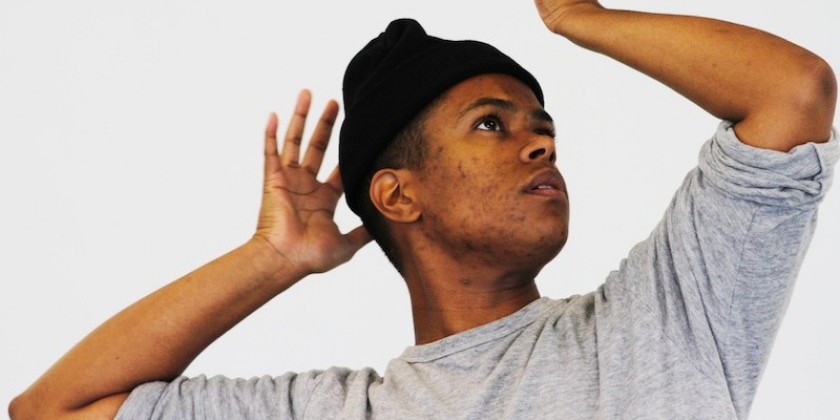
Oona Doherty: the stories she's carried

Belfast's Oona Doherty is a thrilling soloist
in Hope Hunt and The Ascension into Lazarus.
(photo courtesy of the artist)

Hope Hunt and The Ascension into Lazarus
by Oona Doherty
92Y Harkness Dance Festival
March 6-7

Such a percussive and narrative, if mystifying, title: Hope Hunt and The Ascension into Lazarus. It makes the heart beat a bit harder and the breath come a bit faster just to read it out loud. And that's an appropriate reaction. It really is a bracing kind of story, an epic one with what seems to be hundreds of characters--working-class men you might find on the byways of dancer-choreographer Oona Doherty's Belfast, Northern Island.

The multiple award-winning artist brought her electrifying tour de force to 92Y Harkness Dance Festival for a short run of three performances over two days. I hear tell it's the last time she'll ever perform it. So, head there this afternoon or tonight because she's worth a look.

The piece begins directly in front of 92Y at the Lexington Avenue curb and sidewalk with some crunchy pelting and hip-hop tumbling about in hoodies. This launch introduces Doherty and a couple of her compatriots, two young men who soon speed away from the scene. A first impression, it deftly encapsulates how reckless she's willing to be as a mover but, in retrospect, I don't know how much of this you actually need once you've seen what she does upstairs in 92Y's Buttenweiser Hall.

For, once there, you're captive to a short solo that moves past you at the speed of light--or as if someone took a very long novel and flipped the pages so you'd get flashes of characters in action, flashes of speech, all of it thrown your way with tremendous force and unexpected fluidity, with transitions from one situation to another that would seem to be impossible but, no, there they are unfolding right in your face.

Once there in your seat, the first thing you notice are flashes of Doherty's flesh caught in light, the parts not covered by a dark, shapeless, nondescript costume, as she whips back and forth from one side of the darkened space to the other. Then she comes forward in the space, building an impression of harsh environments and harsh life with her repetitive, explosive vocalizations, physical and vocal tics and eruptive movements. You hear a fan chanting at his favorite football team, a man trying (and failing) to make time with someone named Stephanie, and any number of people you give up trying to hold onto in the avalanche of scenes and players.

Life is raw, vivid, fleeting. Doherty's putty-like tomboy's body, expressive face and vocal dexterity make her a thrilling performer in full mastery of this roaring stream of consciousness.

It takes little over a half-hour to complete but, really, how much more could Doherty's body have sustained? She has given so much.

She accepts our grateful applause and goes away only to come right back and draw aside a curtain, revealing her DJ, Joss Carter. She invites the audience to get up and dance and--if I heard this right--find some cans of beer among the garbage (her set) tucked away in a far corner of the space. The music played, and a small handful of folks rose from their seats, but this ending seemed oddly awkward, lifeless and superfluous.

Nevermind. If Doherty is saying goodbye to all the men she brought through in Hope Hunt and lived with since 2016, I'm quite eager to see where she's moved to since then and where she's moving next.

Music by Oona Doherty and Luca Truffarelli
Set and costumes by Oona Doherty

Hope Hunt and The Ascension into Lazarus continues and concludes today with performances at 4pm and 9pm. For information and tickets, click here.

92Y Harkness Dance Center
92nd Street Y
1395 Lexington Avenue, Manhattan
(map/directions)

******

DISCLAIMER: In addition to my work on InfiniteBody, I serve as Senior Curatorial Director of Gibney. The postings on this site are my own and do not necessarily reflect the views, strategies or opinions of Gibney.

******

Subscribe in a reader

Wednesday, February 6, 2019

Camille A. Brown's superheroes write their names in "ink"

Maleek Washington and Timothy Edwards
performing ink by Camille A. Brown
(photos: Christopher Dugan)


ink
Camille A. Brown & Dancers
The Joyce Theater
February 5-10

Do not trifle with Camille A. Brown. The woman knows her mind, and her secure creative imprint has been felt, now, not only on dance stages but on television and Broadway. Ask her a question--as folks did during her audience dialogue at The Joyce's opening night for ink--and, without any hesitation, you get Direct Camille. Her movement might appear, to some, a chain of several interlocking dance genres, but it is not thoughtlessly or simplistically so. Nor can we shove it under a safe, defining label. What to call what she crafts in her work? "It's me," Brown says.

ink exemplifies that. For about 75 uninterrupted minutes, it energizes the Joyce stage under two weathered-looking billboards of collaged images designed by David L. Arsenault. There's the startling thwack of percussion that opens the evening, and a typically atypical solo for Brown whose raptor-like power, adept control of physical isolations and ability to adapt her shape to handle any environment or condition are markers for the intricacies of Black intelligence and creativity, skills for surviving and thriving under duress.

Above: Camille A. Brown's opening solo
Below: Catherine Foster
(photos: Christopher Duggan)

And then comes the spill of movement from her six dancer/collaborators, accented with gestures that have come to bear private meaning, a language accumulating maturity from one dance to the next. It is this precious, complex language, she might say, that gives her people--my people--a fighting chance to stay alive. With movement drawn from the Black diaspora--traditional, contemporary and invented--this artist clears room to write her manifesto across the air, rewriting the lies of so-called history, the stereotypes and limitations thrown on Black bodies and Black culture. Following the previous works of Brown's trilogy--Bessie-winning Mr. TOL E. RAncE and the Bessie-nominated BLACK GIRL: Linguistic Play--ink uses solos and duets to expand the way we think about Black possibility, especially as it relates to gender and how people exist with one another.

Juel D. Lane (left) with Beatrice Capote in ink
(photo: Christopher Duggan)

With no boxes around the way souls and bodies are "supposed" to behave and respond to life, there is freedom, and there is caring where division, competition and violence might have been expected. The trilogy ends with an embodied wish for our future, a lesson in what we will need to get there.

******

Director/Choreographer: Camille A. Brown in collaboration with the dancers

Dancers: Beatrice Capote, Timothy Edwards, Catherine Foster, Juel D. Lane, Yusha-Marie Sorzano, Maleek Washington and Camille A. Brown

Music Director: Allison Miller

Musicians: Juliette Jones, Allison Miller, Scott Patterson, Wilson R. Torres

Dramaturgs: Daniel Banks, Kamilah Forbes, Talvin Wilks

Lighting and Scenic Design: David L. Arsenault

Sound Design: Justin Ellington

Costume Designer: Mayte Natalio

******

ink continues at The Joyce through Sunday, February 10. Hurry and click for schedule information and tickets!

MAP/DIRECTIONS

******

DISCLAIMER: In addition to my work on InfiniteBody, I serve as Senior Curatorial Director of Gibney. The postings on this site are my own and do not necessarily reflect the views, strategies or opinions of Gibney.

******

Subscribe in a reader

Friday, November 2, 2018

prettygirl264264 checks in from Abrons Arts Center

Ashley R.T. Yergens
in character for prettygirl264264
(photo: Fred Attenborough)

What you focus on increases. Or, maybe it's, What you focus on expands. Or what...ever.

That favored quote of New Agey savants came to mind at last evening's world premiere of prettygirl264264, when I gauged the distance--physical and otherwise--between trans performance artist Ashley R.T. Yergens and a flat screen television displaying appearances by singer Cher, the late Sono Bono and their trans son Chaz Bono. My interest in Sonny and Cher had faded out quite early, with their pop star heyday and my youth, and has not made a miraculous recovery in the current age of celebrity tv and Twitter. So, I was content to train nearly undivided attention on the present moment and the live action before us at Abrons Arts Center where the Underground Theater's floor was nearly blanketed by a cheery layer of party balloons. Yes, party balloons for something Yergens billed as his "premature funeral."

The service served an atypical "In Loving Memory Of" funeral card in lieu of a program. The dearly not-quite-yet-departed took a while to appear, the buildup to that appearance including a standout, if painful, performance of "It's All Coming Back to Me Now" by lily bo shapiro, dolled up in gleaming, cherry pink unitard and oversized, rhinestone-encrusted glasses. Yes, a Celine Dion anthem at a premature funeral where evocation of Judy Garland's connection to blackface, Sonny Bono's death by skiing into a tree, and a full-out dance duet routine to La Bouche's "Be My Lover" are not only inevitable but completely appropriate.

Not too long ago, I read a New York Times obituary that told the story of how the late actor James Karen asked his buddies, unbeknownst to one another, to draft his obit long before he actually passed. His wife finally revealed to one friend, George Clooney, that Karen had a habit of doing this so that he'd be around to enjoy what people thought of him. Not a terrible idea. And, in his way, Yergens is doing the same--inviting us in to indulge one trans man's moment of celebration and to contemplate how rare acknowledgement and celebration can be at the end of many trans lives.

If neither the celebs onscreen (one, a "gay icon" who is cisgender and straight; the other, an early, selective and reluctant object of mainstream media spotlight on trans lives) can fairly represent the range of trans experience, neither can Yergens, keenly aware of his white, able-bodied visibility and privilege. prettygirl264264--the title comes from an old AOL handle--speaks from a particular sliver of experience and sensibilities, bringing wry lightheartedness in a time of serious political struggle. And, yes, we need that contribution, too.

Video: Rena Anakwe

Performers: Sydney Boyu, Nico Brown, lily bo shapiro, Mur, Kristopher K.Q. Pourzal, Ashley R.T. Yergens

Lighting: Jennifer Fok

Original Music: Trashed My Living Room and ErasedMur

prettygirl264264 continues tonight and Saturday evening with performances at 7:30pm. 50% of ticket sales benefit trans rights organizations. Although both performances have sold out, Abrons promises to get some walkups in. So try for it! For information, click here.

Abrons Arts Center
466 Grand Street (at Pitt Street), Manhattan
(Plan your visit.)

******

DISCLAIMER: In addition to my work on InfiniteBody, I serve as Senior Curatorial Director of Gibney. The postings on this site are my own and do not necessarily reflect the views, strategies or opinions of Gibney.

******

Subscribe in a reader

Thursday, October 26, 2017

It's complicated: Cynthia Oliver celebrates Black masculinity

At left, Duane Cyrus with Jonathan Gonzalez
in Cynthia Oliver's Virago-Man Dem
(photo: Chris Cameron)

The Latin prefix “vir” means “man”; the suffix “-ago” indicates female. Thus, the term “virago” has, since ancient times, suggested that elusive flicker between genders we know so well and deny so violently. 
--from promotional text for Cynthia Oliver's Virago-Man Dem

Dance artist Cynthia Oliver centers the human body in her adroit Virago-Man Dem, just opened at BAM's Next Wave Festival. In fact, the four bodies centered here--Duane Cyrus, Jonathan Gonzalez, Ni’Ja Whitson and Niall Noel Jones--comprise one of the most cunning, most satisfying performance ensembles on hand this season. But Virago-Man Dem also boasts visual and sonic design of strong-enough confidence to support its movement without distracting or detracting from it. Particularly impressive is the work of Black Kirby (Afro-speculative comics artists John Jennings and Stacey Robinson) with projections and animations by John Boesche and lighting designer Amanda K. Ringger's rich imagination of place, time and mood. With costume designer Susan Becker and composer Jason Finkelman in the mix, Oliver directs a dream team of adepts at BAM Fisher.

With this piece, Oliver cracks open masculinity as a fixed idea received and upheld by Black men. Inspired by her dancers' experiences as well as her dual sensibilities as a woman of Afro-Caribbean birth living and working in the US, she draws from observation of masculinities, finding material in a deceptively easy stroll down the street, a clever dash on a basketball court, a sinuous sashay along imagined catwalks and more. What makes her resulting dance not merely a patchwork of a bunch of stuff done by three male-identified performers and one gender nonconforming performer is her taste and talent for connective flow and her eye for how being willfully or ecstatically off-center or molten or in-between uncovers the more inside the person. More self, more capacity, more joy, more supple, resilient strength. It's this more that, sadly, often threatens individuals, families, communities, religions and nations. It's this more--isn't it?--that for which we secretly yearn and which artists brilliantly model for us.

It might not necessarily take a woman to watch these things from the outside and bring them to her canvas or stage, but it takes this woman, perhaps, with  apparently endless reserve of movement ideas to bring her concepts alive and keep us interested over 75 minutes. And from the work's beginning (in physical stillness and visual murkiness) through the hoodie-covered dancers' testing of bodies and selves and their growing clarity and enlivening, with Ringger enhancing the dimensions of Oliver's sculpted movement, we're kept on the edge of our seats.

Here's a journey ready to be taken more than once, but consider yourself lucky if you get to see Virago-Man Dem even just one time.

Virago-Man Dem continues tonight through Saturday evening with performances at 7:30pm. For information and tickets, click here.

Prior to tonight's performance, Cynthia Oliver will offer a free talk, Examining Black Masculinity, at 6pm in Wendy's Subway Reading Room, downstairs at BAM Fisher.

BAM Fisher
321 Ashland Place, Brooklyn
(map/directions)

Subscribe in a reader

Saturday, July 15, 2017

D'Lo bears witness--and gets laughs--at Dixon Place

Dixon Place presents comic performer D'Lo
in To T, or Not to T,
a highlight of the 2017 Hot! Festival,
DP's annual celebration of queer arts and culture.
(photos: Ryan Harper Gray)
Bearing witness is the only way I know to be alive. -- D'Lo


From the outset, D'Lo literally trampolines and pogo-sticks into our hearts and, if you haven't seen him perform before--and I hadn't--you figure that's cute. But where will he go after this wacky first impression?

To T, or Not to T--a Dixon Place commission for this summer's Hot! Festival--hooks in and never lets you go. Just over an hour in length, this one-trans show is, by turns, hilarious, tender and sharp. D'Lo's so talented and smooth, he makes it all look effortless, but you know a hellawork went into getting all this material to line up and flow this well.

To T, or Not to T traces D'Lo's experience being raised as a girl in a Tamil-Sri Lankan family in Lancaster, California ("aka Sri Lancaster, California") and gradually coming to terms with his true gender identity. He has now been on testosterone for two years. Right there, that's a whole lot of content. Heavy-going, you say? Oh, no. Not one bit.

What gives D'Lo and his narrative so much lift and embraceable charm is how strongly it is rooted in his observation of and complete delight in his family--a family that wrestled with challenges but ended up cheering him on in the most heartwarming way. Which makes me think: Despite the idiot in the White House and his delusional supporters, we're actually living a moment in America where D'Lo's relatives and friends could easily find themselves the subject of a quality tv sitcom. And I would watch it. Every last episode.

To T, or Not to T continues tonight and July 21-22, all performances at 7:30pm. For information and tickets, click here.

For a full Hot! Festival schedule (through August 4), click here.

Dixon Place
161A Chrystie Street, Manhattan
(map/directions)

Subscribe in a reader

Friday, September 16, 2016

nora chipaumire delivers a MAN-ifesto at BAM Next Wave

nora chipaumire
in portrait of myself as my father
below: with Shamar Watt
(photos: Gennadi Novash)


What a scene at BAM Fisher's Fishman Space!  People excitedly grabbing each and every one of the general admission seats. Stragglers desperately searching for places to sit with companions. Harsh lights gleaming from the corners of a boxing ring. The crowd arranged along three sides of the ring and starting to fill the balconies. And as people enter, the evening's star--Zimbabwe-born dance artist nora chipaumire--giving each person gliding past her an appraising once-over, not always silently, although her imperial silence can and will burn anything to a crisp.

I watched chipaumire with amusement and trepidation, the latter brought on not only by the mystery of what might be going on inside her regal head but also by the look of her shoulders braced and armored in football pads, the way she thrust her Black body out beyond the ring's edge and right up into our faces, the amplified animalistic growls arising from some darkened corner of the ring. And, mostly, her restlessness as she examined each unknowing, distracted bypasser, the sense of her engines revving, revving, revving.

Lemme hear you say, Yeah, she says. (Someone bravely answers, Yeah.)

I've been waiting for you.

I'm ready. I'm ready.

Her moves are rhythmic, rolling, spongey, every well-oiled joint sure of itself, tilting forward, ever at the ready.

I been ready. In fact, I was born ready.

Come on,  Brooklyn. Let's do this!

Give me a green light. Now. Now.

The name of her extravagant trio--co-presented by BAM's Next Wave, 651 Arts and Théâtre de la Ville--is portrait of myself as my father. Except that the word "father" is struck out. Here, with thoughts of her father--estranged from his family since she was only five--chipaumire takes on masculinity, specifically Black African masculinity, and sets it down in the boxing ring of imagination and of daily life. Here, no matter what time it is, it is somehow always Round One for the Black man.

nora chipaumire
(photo: Julieta Cervantes)

One-part Muhammad Ali rumbling in the jungle. One-part James Brown rumbling at the Apollo. And quite a lot of Black men fighting for their very lives on the daily. This is chipaumire, our chin-thrusting, strutting champion, delivering her MAN-ifesto along with collaborating performers, Shamar Watt and Pape Ibrahima Ndiaye (aka Kaolack).

Pape Ibrahima Ndiaye (Kaolack) with chipaumire
(photo: Julieta Cervantes)

But I have not yet mentioned the visual element that, from first to last, most spoke to me--the elastic boxing ring ropes that tether chipaumire and Kaolack's bodies and which occasionally threaten to entangle all three players. You can see them as rough leashes restraining dangerous beasts or puppet strings controlling the range and articulation of their actions. They're worn by the dancers as a matter of course--like no biggie--but why? Like the ring itself, they define how far these characters can go but, within those limits, chipaumire and her mates do their most, infusing the space with energy, with aggression, with sexuality, all the while acknowledging the lingering distortions and damage wrought by colonialism and white dominance.

I think chipaumire hopes we will see those tethers as less restricting than we might first think them to be. She is invested in breaking open the way we see African men and Africa itself. And, in a time when Black male bodies, in popular awareness, are most associated with entertainment, incarceration or genocide, she wants to imagine how Black bodies might matter to Black bodies, how Black bodies might seize their own right to life, liberty and the pursuit of happiness. She is seeking the life her father and his generation never had and striving to snap the tethers his generation accepted.


Pape Ibrahima Ndiaye (Kaolack) with umbrella
leads chipaumire and Watt.
(photo: Gennadi Novash)


Ladies and gentlemen, the question is: How do you become a Black man? A Black African man?

You slow down...you slow way down. Like you have the time, like you own time. In fact, you become time.

During the useful post-show Q&A, moderated by Simon Dove, one audience member admiringly referred to the show as "a dangerous work." I agree and admire, too. This production and its three performers are outstanding. Moreover, with this portrait, chipaumire has delivered her clearest and most commanding work to date.

With original music/soundscore by Philip White

portrait of myself as my father continues at BAM Fisher (Fishman Space) tonight and tomorrow with performances at 7:30. For information and tickets, click here.

BAM Fisher/Fishman Space
321 Ashland Place, Brooklyn
(map/directions)

Get your free email subscription
to InfiniteBody.

Thursday, September 24, 2015

Jaamil Olawale Kosoko: #negrophobia in brief

Jaamil Olawale Kosoko
(photo: Scott Shaw)

I like the odd little Studio A at Gibney Dance: Agnes Varis Performing Arts Center. You know, that room, right off the Gibney lobby, that you mostly ignore as you sign in with the guard and climb the stairs. It's 15 x 30 (got that off the Gibney Web site), suitable for, say, a sleepover with a small bunch of girlfriends. It's also the space of choice for Nigerian-American performance artist Jaamil Olawale Kosoko, presenting his new work, #negrophobia as part of Gibney's Fall 2015 Making Space season.

The experience of being physically drawn inside a work of art, and one that's alive with change, cannot be called new. But there are times when it seems particularly apropos. #negrophobia qualifies.

Studio A, transformed by Kosoko, looks like a Pinterest board. Prints of photos snake along the floor. Looking around, I recognize, for instance, James Baldwin, Forest Whitaker, an arrested Tiger Woods. Iconic books like The Bluest Eye and PUSH take talismanic places of honor. Mounds of tangled celluloid stand in, I suspect, for the murky history of Hollywood's relationship to the Black body and Black talent. On one table rests a memorial card for Kosoko's deceased brother. (There's a story there, which I don't know, but Kosoko will later show us "my dead brother's shoes" and we will hear clink of chains running through his hands.) A lithe, incredibly model-slender dancer (Kentrell/IMMA MESS), wearing only a cloth mask, blonde wig and tomato-red thong, slinks and slithers around taking selfies and live video, sometimes interacting closely with the bling-spangled Kosoko. One wall features video projections, and music pumps through the space. Kosoko is a little bit Olivia Newton-John ("Magic") and a little bit Seal ("Crazy").

The audience can sit on slick white floor runners, stand on the sidelines or, within considerable limits, move around to view things from different angles. What we cannot do is leave.

There's one door, and it's largely--I sense, deliberately--obstructed by Kosoko's stool and microphone and Afrofuturistically golden being. Tiny Studio A becomes all about airless confinement, blockage and, through the Kosoko's text, the toxic detritus of other people's sick thinking about the Black body, specifically Black masculinity.
God, I wanted a Cosby Show life, and you gave me a reality show life.

You ain't shit...You ain't even gonna be shit.... From the moment you're out of your mama's womb, you are being told [this]. What does this do to childhood? How do you build your dream? I'm obsessed with this question.... How do you push against this to realize yourself?
Kosoko points and picks at the source of this devastation, although I do not think he disrupts it much in #negrophobia. That may be impossible, and fruitlessness might be the point. But as I looked around the room, I wondered if even the young white people in attendance--clued-in at least enough to go to something called #negrophobia--found anything here unfamiliar enough to be urgent, eye-opening news.

One interesting feature is the ending that isn't. Kosoko gets to a point where it looks as if he has completely lost it and wants to throw in the towel. Over and over, he seems to dismiss us: "It's over. You can go now." He insists, wearily and somewhat testily. "You can go home to your Manhattan apartments. You don't have to watch it anymore."

Not a single person moves, because you can't really, and you can see this is just the exhaustion talking. The exhaustion of breathing in decades of toxic fumes and struggling to stand. Besides, there's some more costume foolery up ahead to watch and now--possibly forever--a perky KKK song to listen to. As Yogi Berra would have said, "It ain't over 'til it's over." And it ain't.

Nightly through Saturday, September 26, at 7:30pm* with limited ticketing. Friday night's performance will be followed by a discussion with George Sanchez. For information and tickets, click here.

*UPDATE: A show has been added for Saturday at 5pm, but hurry!

Learn more about Jaamil Olawale Kosoko|anonymous bodies here.

Gibney Dance: Agnes Varis Performing Arts Center
280 Broadway (entrance: 53A Chambers Street), Manhattan
(map/directions)

Friday, July 31, 2015

Hamilton and Zachery at University Settlement's Performance Project

André M. Zachery (left) and LaMont Hamilton
(photo: Layla Zami)

The dance series Five on the Black Hand Side/Dapline! draws its title from the practice of the dap ("dap" meaning "dignity and pride"), a spectrum of elaborate gestural greetings and supportive hugs between Black men. Visual artist/photographer LaMont Hamilton and André M. Zachery of Brooklyn's Renegade Performance Group have curated three programs that can be seen as commentary on, as Hamilton has written about one of the works, "Not 'Black Lives Matter' but blackness as matter moving throughout the space; real and present."

Last evening, the series opened with three works that approached this embodied Black presence in different ways, each with a flavor of dreamlike timelessness.

Oxana Chi
(photo: Layla Zami)

Oxana Chi (Oxana Chi & Ensemble Xinren) comes to us from Germany, a dancer of Nigerian and Eastern European origin. A chart of her dance background would look like a spinning globe--from ballet and Cunningham and jazz to Javanese and Egyptian dance. Her solo Neferet iti, performed to live music by Layla Zami and a recorded score by Gilbert Trefzger and Abdoul Aziz Sinka, dares to draw visual and kinetic elements from different cultures, too, in a quilt-like, multi-textured performance. Her Central American plumed headdress, her yellow-gold harem pants, her hip thrusts and shimmies, her archer's bow draws, Masai jumps, capoeira maneuvers, vogue hands and dervish spins add up to a heady mixture. She believes it all works--you can see that--and makes it work. A somewhat delicate presence, she is, nevertheless, a woman writ large, claiming concert dance space for a diverse and teeming world, blessing that space. I don't claim to understand the two theatrical sneezes--clearly not real afflictions--that punctuated sections of Chi's performance. Perhaps the audience was meant to respond by offering its own blessing.

Hamilton collaborates with sound artist Jeremy Toussaint Baptiste on Evil Nigger (pt 1), a hallucinatory performance in which he sits behind a small table covered in a drop cloth and smears his dark chocolate face and white dress shirt and tie with a succession of gloopy paints--white, red and black. He is flesh-and-blood canvas, wrecking convention, striking out for something unknown in what starts off, it might appear, as a sendup of blackface and veers out of control. Like the droning, distorted music, the streaks and splotches and ungainly blends of stark, gleaming wet color eventually turn him into a still object of art fading from our view as the lighting slowly drains away.

The dap originated in the Vietnam War/Black Power era with Black GIs and spread throughout African American communities as a way for Black men to express cultural identity and support. In Zachery and Hamilton's ensemble piece, Dapline!, six men of color perform a fugue-like imagining of military discipline and, at the same time, reveal a tight community responsive to the pain, frustration and momentary failures of its members. The idea of the dap is addressed both in spirit and, later in the piece, in technical execution. The viewer marvels at the unity and elegance of this corps of men, the clean architecture of their shifting arrangements and movements in space, the softness and tranquility that can emerge when masculinity is unshackled, given more than one narrow definition. We watch some of the daps performed in slow motion, skin sliding over skin, our eyes absorbing the beauty and meaning of these silent interactions. These are duets; one quite fanciful interpretation unfolds like a stretchy, twisting tango. If I could have anything reconsidered about Dapline!, it would be its duration. Portions of it seem unnecessarily repetitious and drawn out. Rounding out the program, it makes for a long evening. But this important work is given magnificent and affecting performances by its dancers--Brian Henry, Andre Cole, Johnnie Mercer, Malcolm McMichael, TJ Jamez and Stephen Galberth.

Five on the Black Hand Side/Dapline! continues this evening with guest artists Candace Thompson/Nehemoyia Young and University Settlement's New Youth Movement Collective (NYMC). On Saturday evening, the series concludes with Laurie M. Taylor/SOULMOVEMENT and Hamilton and Baptiste's Evil Nigger (Part 2). Both programs include performances of Dapline!, not to be missed.

For information and tickets for tonight and tomorrow's performances, both at 8pm, click here.

Speyer Hall
University Settlement
184 Eldridge Street (between Rivington and Delancey Streets), Manhattan
(map/directions)

Monday, February 10, 2014

Image to movement: Kosoko's "Black Male Revisited" at Danspace Project

Whitney V. Hunter
(photo by Sylvain Guenot)
The challenge of representing and questioning the image of the black male is great. Black masculinity suffers not just from overrepresentation, but oversimplification, demonization, and (at times) utter incomprehension.
I wanted to produce a project that would examine the black male body as body and political icon.
--Thelma Golden, curator, Black Male: Representations of Masculinity in Contemporary American Art, Whitney Museum of Art, 1994
Our challenge...is how to widen the conversation within the aesthetic, again."
--Greg Tate, Danspace Project Conversations Without Walls panel on "Revisiting Black Male Today: A Look 20 Years Later"
I'm revisiting the catalogue I bought in 1994 at the Whitney's multi-media Black Male: Representations of Masculinity in Contemporary American Art show. Its dramatically matte-black card cover contains and confines a multitude: "pretty" Muhammad Ali in his prime, white towel slung over his perfect, gleaming chest; Emmett Till, dead, his ruined face for all to see in that open coffin; an anonymous slab of muscular thighs and genitals, courtesy of Robert Mapplethorpe; a homeless man revealed as if by Rembrandt's light; O.J. Simpson awaiting judgment; King and Malcolm clasping hands while gazing anywhere but at each other.

Each time I lift this book, I'm surprised anew by its heft and its stiff, awkward, locked-in feel; the small type of its text hinting at how very much there is to say and all that is still not said.

In its time, Black Male triggered confusion and strong objections. Some in the Black community felt that curator Thelma Golden's choices--including works by artists who were not Black, not male or not heterosexual--dangerously reinforced racist stereotypes. Others thought that the Whitney's first Black curator had missed a significant opportunity, that the show was not extreme enough to be truly subversive. When Golden later brought Black Male to Los Angeles (UCLA Armand Hammer Museum of Art and Cultural Center), community groups mounted alternative exhibitions devoted to imagery they considered more representative and positive.

Now, twenty years on, performance artist Jaamil Olawale Kosoko has taken Thelma Golden's controversial project as a springboard for his own inquiry into Black masculinity. For Danspace Project, Kosoko curated a three-evening, multi-genre program, Black Male Revisited: experimental representations through the ephemeral form, "incorporat[ing] voices from trans and queer artist communities and situat[ing] their work inside an experimental dance context."

I attended two of Kosoko's Saturday afternoon panels where most of the panelists admitted only tenuous, if any, personal experience with the 1994 exhibition. But in the era of Obama and racist backlash, of stop-and-frisk, of obsession with what's on--not in--Dante de Blasio's head, and when a Black man might become the NFL's first openly gay active player, there remains good reason for new generations to explore the images and meanings of Black masculinity in American society. The Black-Dominican transgender performer niv Acosta--whose recent piece, i shot denzel, I reviewed here--is an interesting example. [Listen to Acosta, introduced by panel moderator Thomas Lax, here.]

On Friday evening, I attended a performance featuring solo turns by Rafael Sanchez, i n d e e, Whitney V. Hunter and IMMA/MESS (Jarrod Kentrell).

Taking a portion of space in Peter Stuyvesant's sanctuary, Rafael Sanchez (Con-Sume me/Con-Sume You) constructed a contrarian altar, setting before us a protective clear plastic drop cloth and a variety of kitchen aids and produce.

Splatter of sliced and puréed produce. Mess of hypersexual hip hop. Burlesque of feral masturbation of butter- and chocolate-smeared cucumbers. I'll see you, Karen Finley, and raise you....

Time and again, a frenzied Sanchez took a machete to his own fake phallus, replaced the slippery prosthesis and set about massaging or mangling it again. Blending a potion of green-tinged phallic juice, he poured it into a bottle shaped like a crystal skull and offered it. Some audience members willingly raised this elixir to their lips.

The wide, vaulting space of St. Mark's Church seemed hushed, untouched, drawn back, like a pearl-grey hem, from the riot of sound and action. And when Sanchez was done, how quickly, how efficiently every trace of was whisked up in the plastic and carted away. A sense of I'm throwing the worst of it in your face followed closely by That never happened. Just how much force does it take to make change? St. Mark's Church floor--held sacred by Christians and dancers alike--was once again empty, spotless.

The performer i n d e e describes themselves as "a queer evolutionary transmasculine multi-gendered femme" who investigates "non-normative gender expressions found amongst black females in the performance realm." In the concise Oh MiMi My, they shed clothes and spin/wrap/firmly bind their entire torso in cling film--plastic containment again--before donning high heel boots and a wig and launching a lipsync and dance routine.

Whitney V. Hunter, entering the space in D.R.O.M.P., could be any guy on his way to do manual labor. He's dressed in pristine white coveralls and carries a white bucket and a big roll of white paper under one arm. In short order though, he approaches a mic and addresses his onlookers. With a warm smile, he tells us "don't be shy; don't be embarrassed" if we're called upon to give him a hand.

A voice recites single words, one by one--cool, strong, vulnerable, independent, well-spoken, restrained, sexual, reflective--and Hunter becomes its scribe, unrolling a stretch of paper and laying one end of it over his body. As he scribbles each word on the paper's surface, he slides sideways beneath it. The rustling paper accepts these words that, otherwise, might be projected upon his Black body. He controls the paper, cutting and, if necessary, ripping it into sections. But why do this alone? In a playful spirit, he races towards the audience, pulling up a group of folks to help speed the work.

Like i n d e e and Sanchez, Hunter finds that sweet spot where confinement gives way to possibility. Those coveralls, it turns out, conceal gold-spangled bikini briefs and some inexplicable plastic patches stuck to his bare skin. He spins in joy as his "assistants" make a hash of the torn, crumpled paper. (D.R.O.M.P. stands for "Don't Rain on My Parade," the song heard on his soundtrack.) In his exuberant resistance, all of those labels--cool, strong, well-spoken, restrained--become liberated and fluid, disposable or recyclable, at his will.

Hunter scoops up every shred of paper to stuff inside his discarded coveralls. This belongs to you, I imagine him thinking. Here, you take it! The white cloth swells to receive the paper and takes the shape of a body, not so much a person as a man of straw, and I envision that straw man burning.

Finally, Hunter carefully feels around his legs, shoulders and back for the mysterious patches. Monitor patches, perhaps? Whatever they are, he makes sure to peel each and every one of them from his body.

Imma/Mess (Jarrod Kentrell)
(photo courtesy of the artist)
In Ordinary Love, which closed the program, Jarrod Kentrell (aka Imma/Mess) worked within a rectangular box of light (shades of Sanchez restricted to his rectangular, plastic altar). He werked Beyoncé's "Haunted" (All the shit I do is boring, all these record labels boring/I don't trust these record labels, I'm torn/All these people on the planet working 9 to 5 just to stay alive) with his real face obscured and with super-pliable and spastic movement.

Performance creates a space of transparency and focus, a space of ritual, which is about doing the work that makes a future possible. Of these four rituals, Hunter's D.R.O.M.P. offered me the clearest sense of forward movement--of breaking out and going somewhere of one's own choosing.

Black Male: Representations of Masculinity in Contemporary American Art is closed. For information on upcoming Danspace Project programs, click here.

Friday, January 31, 2014

New York Live Arts presents world premieres from niv Acosta and Tess Dworman

Tess Dworman's new trio, macromen--opening last night at New York Live Arts on a program with niv Acosta's i shot denzel--had a quirky-fresh way of turning everything, from potted trees to flesh-and-blood dancers, into flat, malleable, playfully disappearing items. But what Acosta dropped into that familiar space felt a whole lot more radical and compelled the whole of my attention.
Dance Up Close to niv Acosta
niv Acosta
(photo by Nicole Whelan)
denzel, I hear, has had five previous lives in the imagination and developing work of Acosta, a Black-Dominican, transgender-identified performer. This was my first encounter with Acosta's attempts to extract himself from the archetypal Denzel Washington and common notions of what it means to be a Black man. What got me is how uncool it all is.

I like several things about that. Going on a stage and singing when you're Black and your voice is adequate but not remarkable is uncool, and that's great. Bringing your gorgeous, singing mother onstage with you and dancing near her in a way that foregrounds all the tender vulnerability within your Black masculinity is uncool, and that's great. Reciting too-revealing, over-the-top text when people might expect Strong Silent Type or Angry Black Male is uncool, and that's great. Doing all of this in a body that defies both dance aesthetic expectations and gender conformity may not be all that uncool, or uncommon, especially at New York Live Arts, but it's still great. Repeatedly taking aim and smacking that body against a big ol' white wall might be painfully obvious and kind of futile and therefore uncool, but that's great.

niv Acosta and Yessenia Acosta in i shot denzel
(photo courtesy of New York Live Arts)
Sort of mixing up where audience should go and live musicians should go is kind of wacky, though not original, and that's not bad if not truly great. The only thing I thought was the exact opposite of great was how I couldn't make out the emotional Spanish lyrics Yessenia Acosta sang to, and apparently about, her son. The higher sound level for the band muffled her voice, and they were positioned closer to the audience. I hope that will be corrected for tonight and tomorrow's shows.

"No one has died inside of me," Acosta says at one point in his forceful monologue atop the white wall. Everyone and everything is there, and that's great.

Acosta's performance in i shot denzel makes me sorry that I'm just now catching up with this series, which has possibly reached its end. I enjoyed his dancing--his voguing and scrupulously clean inscriptions against space--but even more, I enjoyed all the uncool.

Performed by niv Acosta, Yessenia Acosta, Lee Free, Amy Gall, Lydia Berg-Hammond, Caitlin Marz, Jo Pang, Julia Read, Aleksei Wagner and Gary Zema. Music by niv Acosta and Jo Pang.

niv Acosta/Tess Dworman runs through Saturday, February 1 with performances at 7:30pm. For information and tickets, click here.

Come Early Video Installation created by Anna Pinkas and Lani Rodriguez
(on view Thursday, January 30-Saturday, February 1)

Friday, January 31 - Stay Late Discussion: none-other: regarding the alien and the uncanny in the work of niv Acosta and Tess Dworman, moderated by Marissa Perel

New York Live Arts
219 West 19th Street (between 7th and 8th Avenues), Manhattan

Copyright notice

Copyright © 2007-2023 Eva Yaa Asantewaa
All Rights Reserved

Popular Posts

Labels