Search This Blog

Showing posts with label women's issues. Show all posts

Tuesday, March 3, 2020

Colleen Thomas: Woman power is persistent and global

Dance artist Colleen Thomas.
(photo: Lovin Ostenrik)

Joanna Leśnierowska (below) in light and desire
(photo: Miguel Anaya)


This year marks the centennial of the ratification of the 19th Amendment to the U.S. Constitution (August 18, 1920), which granted women citizens the right to vote. light and desire--a new, full-evening dance ensemble by Colleen Thomas and her multi-national team of collaborators--comes at a time when lack of respect for women’s political leadership is again a matter of concern and struggle. The piece will have its world premiere at New York Live Arts, March 25-28 (7:30pm), during Women’s History Month.


Colleen Thomas (US), director, performer
Ermira Goro (Albania/Greece), performer
Joanna Leśnierowska (Poland), performer
Ildikó Tóth (Hungary/Germany), performer
Rosalynde Le Blanc (US), performer
Carla Forte (Venezuela), film director, performer
Alexey Taran DP for film
Stacey-Jo Marine, lighting design
Rebecca Makus, mask design
Robert Boston, musician/composer featuring Jo Morris, voice

For further information and tickets, click here.

______________________________________________________

Yesterday morning, I met with Thomas at Gibney to learn more about light and desire. Read on for what she had to say about the concept and making of this timely piece on women's resistance and radical expression.

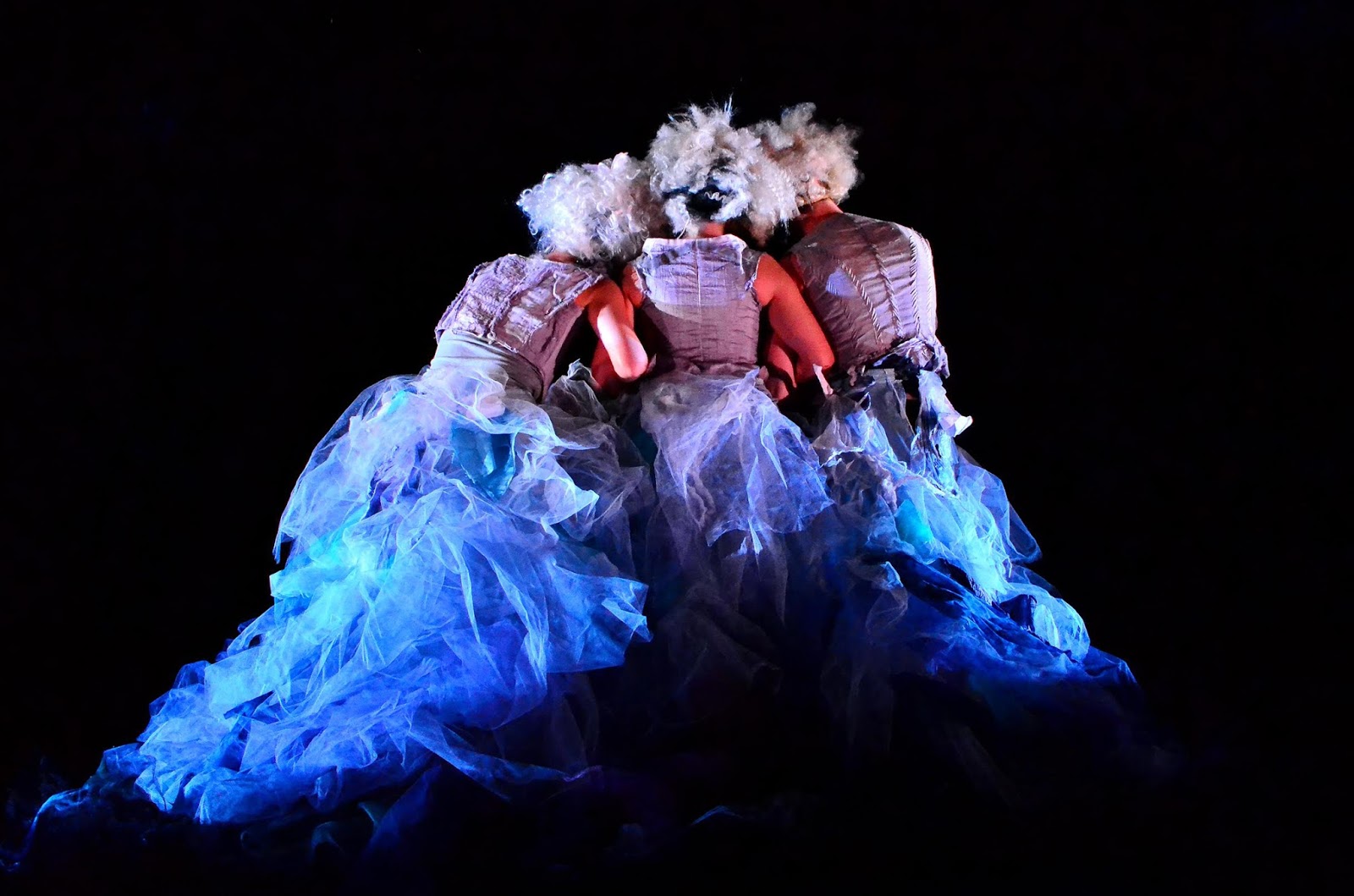
Some performers in light and desire,
by Colleen Thomas and her international collaborators,
premiering at New York Live Arts, March 25-28
(photo: Nadia Halim)

In 2016, I think I was very privileged--and unaware of my privilege--as an American. With the [presidential] election, I just couldn’t believe the misogyny. I sort of woke up to the misogyny that had always been in my world. Maybe I felt I wasn’t good enough, things weren’t happening for me, wouldn’t go my way or just would feel wrong. I’m not good enough, smart enough. It was all on me.


Seeing the way that people looked at the candidates in 2016, how people talked about Hillary Clinton’s personality, which had nothing to do with what her experience was.... Meanwhile, there’s this other person whose personality isn’t great either! But, no, people are talking about her. Even my women friends--smart and artistic, some of the most intelligent, aware people--said things like “I just don’t like her. I don’t know why.” There were other people, family members in other parts of the country, who said things like, “She’s a criminal.” 


I work in academia, I work in this world, and I collaborate with a man in a lot of my work. I just started to question: What is this bias and hatred?


Because of the election, I started talking to people, to women about it. We couldn’t stop talking about it. It was like Voldemort had arrived! None of us had slept. We were in shock. Thank God for New York and our community. But I started talking to people around the globe, people I had worked and toured with for many years. Most of them had worked with us here.

That’s where I woke up to my privilege: Oh, I think it’s so horrible here in America, but they’ve lived through having to move out of their own country to somewhere else where they felt they could have a life. They had personal stories about growing up in a new country. It was really interesting to work with and very cathartic in a way.


All of these women are just extraordinary people. I wanted to work with them because of their dancing and because of who they are, but they are all older now--we’re all older now!--they’re “successful,” whatever that means. We’ve got these jobs, we’re creating art, we’re chairs of departments, we’re successful women. And it’s just interesting to me because I’m not sure we feel that success.


How we feel our power was really interesting to me, how we moved through obstacles. I was interested in telling some personal stories about these women, hopefully something that other people also experience. It went from a political, angry place to “How do we heal? How do we move through? How do we get to this place where we can feel our power, go into our communities and support that?" At the beginning, I was focused on all the negatives: There’s no hope. There’s never going to be a woman president. It’s so deep. And [reflecting on the current presidential candidacy of Elizabeth Warren], we are physically exhausted. I am at the place now where I can’t even read the news.


The stories are an important part of the work. I always work with people’s personal history. That’s what’s real for me rather than having them do something that’s in my mind. Collaboration is so interesting.


There are five other women besides myself, and one--Carla Forte--is Venezuelan-born, a dancer and a documentary and feature filmmaker. She lives in Miami now, but I met her in Venezuela fifteen years ago, and we worked together, toured in different places together. I think she has lived in Miami--where I’m from--ten years now.


When Venezuela just sort of got crazy, she and her husband came here to America. I started off asking each artist how they moved through hard times, passed through their obstacles, and she started talking about being seen a certain way as a Venezuelan in America and even how her mother or their culture expected certain things.

I have a teenage daughter who’s going through a major transition. My husband said this one day--because he’s a man!--”I was a boy, and I went through puberty, and I could just do whatever I wanted.” And he was watching his daughter be seen a different way for that moment of transition where, all of a sudden, other people are seeing you differently, you’re seeing yourself differently, and there’s some kind of freedom that’s lost through how other people look at her. So he just had this epiphany. Really? (laughing hard) Now? At this age, you’re just realizing it now?


So, the piece has become about this idea of transitions, what happens in those moments in between change--slowing down those moments to see what those shifts are. We started with the idea of slowing down the film Carla created for the piece. When things are very, very slow, you can’t tell very clearly what’s happening. Singing can look like a scream...or a laugh. You’re not really sure. That became really interesting to me, the transitions in all forms--women getting older, women moving through hard times, transitions of getting to power, transitions of giving up. Do you give up and move out of your country because it’s so bad there?


Carla talked about her mother wanting her to be a kind of woman like Miss Venezuela--beautiful with the makeup--and she wasn’t. She talked about people in Miami calling her whore because she’s Spanish-speaking. And I talked to people like Ildikó Tóth who lives in Germany, and she said she never felt objectified or anything like that. She said, “I just always dressed like a boy.” Ermira Goro, she lives in Greece now, and she danced with us as well and was here for many years, and then she went on to DV8 [Physical Theatre, a London-based troupe]. She talked about when she moved from Albania to Greece and living with a friend, not having her family there. Everybody seemed to have stories that pertained to their moms and, because I was interested in my daughter’s changes, there's a little flicker of mom stuff in there.

Joanna Leśnierowska is not primarily a dancer; she’s a curator, dramaturg and designer, born in Poland, running a festival. Doing body research with her was really interesting. She’s just so real. She connects to what the truth of the movement is right away, even though she questions, “I’m not a dancer. Should I be doing this?”


I was getting so inspired by my students at Barnard [College] and by [climate change activist] Greta Thunberg, by all these young people who are active out there trying to make change, and they’re like “You guys fucked it up, and we need to do something.” There’s a lot of work I watch my students do that I’m sort of amazed. The idea of having a chorus in the piece, bringing these [local community] people in, was a representation of the inspiration and hope they bring to what’s happening now. 


At first, I wanted a lot of women to take the stage and just stand there, make the audience feel uncomfortable. I was so angry! But then I started workshopping with them. I hope that when I get to do this piece in other places, I will get to workshop with women in these communities. The workshop--working with them through improvisation and talking about their own experiences--it was different because they are a lot younger [than the main cast]. There’s power afforded to us because we have some experience, and we feel strength from the places that we’ve moved through. But the hope that I feel is in working with these young people, talking with them about when they’ve felt erased or objectified or passed over and how they got up and kept going.

These are all my alums of different ages. I have such a personal connection to everybody in this cast. We rehearsed the other day, and I cried after they ran this one section. I realized I know their stories, you know?


The mood I feel, through them, is support--for me, for this piece--and comraderie, community, kind of like the Buddhist sangha. I feel the strength through them. They’re not giving up. They are in a place where they believe they can make change and, just like the masks they wear in the piece, the grotesque becomes beautiful. All of these dancers are able to be vulnerable, which is not always pretty. They have nothing to prove.

That’s the other thing. Maybe that comes with being over 50: I’m done trying to be something. We’re all trying to share this experience with the audience. It gets ugly and uncomfortable, but then, somehow, we work through it--I hope! (laughing hard)


-- Colleen Thomas

See light and desire at New York Live Arts, 219 West 19th Street (between 7th and 8th Avenues), Manhattan (map/directions). For further information and tickets, click here.

******

DISCLAIMER: In addition to my work on InfiniteBody, I serve as Senior Curatorial Director of Gibney. The postings on this site are my own and do not necessarily reflect the views, strategies or opinions of Gibney.

******

Subscribe in a reader

Thursday, May 31, 2018

Who is this body? Anabella Lenzu at La MaMa Moves!

Anabella Lenzu
(photos: Anabella Lenzu Dance)
"This is my body. The dance is coming from my body,
not the body of a 25-year-old."
--Lenzu in her post-show conversation with director Daniel Pettrow


What I most appreciate about Anabella Lenzu (Anabella Lenzu/Dance Drama), whom I have known since she took my dance writing course at New York Live Arts, is how fully she inhabits the moment. She's all there, a force of self-determination, and that serves her well in her vivid new solo, No more beautiful dances, a world premiere for La MaMa Moves!

It's a generous presence in which Lenzu--plunging headfirst into performance after a long time focused on making work for others--ramps up what it means to be a dancer. It means your body speaks for you; it is your art, one vulnerable to the judgment of others as well as your own, offered up for display and assessment. Lenzu aims to stay honest about all that. With the audience as witness, she desires to serve, too, as her own outside eye.

She marks thick lines in menstrual red around her feet and thighs, outlines she will then fill with the same color and with furious energy. She allows two live-streaming cameras--one from above, one from below--to snoop around every surface and crevice of her 42-year-old body. This reads a bit like feminism of the My Body, My Self kind, an effort to take look at herself, journal what she observes, understand and come to grips with the changes undergone with the years and after giving birth to her two kids.

With the help of director Daniel Pettrow and the mentors she will cite after the show, this "journal" has been distilled down to about 40 minutes. But it encompasses so much--all that can be seen and all that needs to be imagined upon reflection of the viewer's own history. It stretches across the walls of The Downstairs theater's waiting area where blown-up, drawing-enhanced selfies of the dancer have been hung. It includes Lenzu's sturdy, expressive movement, of course, and her husband Todd Carroll's video projections but also Lenzu's speaking and songs recalled from her Argentinian youth--all to recapture a grounding sense of a self almost lost here in a new land.

In her post-show chat with Pettrow and the audience, Lenzu answered the inevitable question about her title, No more beautiful dances, by calling it a warning: "This dog will bite you."

Oh, yeah, I get that. When I first read the title, I thought of it as: "No more beautiful dances...for YOU, MISSY!" I also could not help but hear a poignant question: "Am I no longer able to make beauty?"

But I think an audience member figured out something better, something true of Lenzu when he offered this:

"No more pretty dances. Ah, but beauty...!"

Costumes: Jennifer Johanos
Lighting design: Hao Bai

No more beautiful dances has a final performance tonight at 7pm. For information and tickets, click here.

La MaMa The Downstairs
66 East 4th Street (between 2nd Avenue and Bowery), Manhattan

Subscribe in a reader

Tuesday, September 19, 2017

At National Black Theatre, a "peculiar patriot," loyal to her people

Liza Jessie Peterson performs her one-woman show,
The Peculiar Patriot, at National Black Theatre
(photos: above by Garlia C. Jones-Ly;
below by Jean Chambers)


Time and time again, Betsy LaQuanda Ross spends tedious hours riding a bus to and from upstate towns, visiting family and friends like her city homegirl, Jo Jo. She takes Jo Jo hand-quilted squares bearing precious symbols that represent the incarcerated mother (an orange moon) and each of the children she desperately misses (stars). She comes laden with personal stories of life on the outside, told with verve and spice, almost ceaselessly at a breathtaking clip. Together, the women--one we see and one invisible to us yet made palpable through Betsy's love and insight--help us understand the devastating impact of America's prison industry on communities of color, particularly women.

Liza Jessie Peterson
(photo: Ani Berberian)
Below: Director Talvin Wilks
(photo: Adam Nadel)


The Peculiar Patriot--directed by Talvin Wilks and starring its extraordinary writer, Liza Jessie Peterson at Harlem's National Black Theatre--could have been 90-minutes of pure didacticism about a social ill. But it is no such thing. From the moment the pointedly-named Betsy Ross enters the space--set up like a prison's visiting room, with neat, bleak rows of industrial tables and chairs--and calls out "Hey, Boo! Look at you!" you're in her firm grasp.

Peterson, who derived her material from years counseling prisoners at Riker's Island, goes full-on Anna Deavere Smith in adopted body language, facial expressions, vocal intonations, emotional range and expert timing. Not easy to do and sustain but, let me tell you, she's brilliantly on point at every turn.

Her Betsy is hilarious, a Wanda Sykes just waiting to be discovered. But she's there at the prison on a mission to keep her friend's spirits up--as well as her own. In the meantime, we learn much about what it's like to be shut away while your kids are so far, growing up without you; what it's like to have a pal you can't lean in and whisper to and hug and cry with any time you want; how easy it is to get caught up by stringent sentencing laws that disregard your humanity.

If--when--you see this show, you might have a hard time keeping up with the mostly black-and-white slide and video projections that play throughout Peterson's monologue. You'll mostly notice some of these images with your peripheral vision, when aware of them at all, but that's going to be enough. Pay attention to that experience. Peterson holds your attention. Peterson alone, the living, breathing, ebulliently colorful person at the center of this machine. That's as it should be.

Of the many unfortunate, outrageous things The Peculiar Patriot informs us about, as it entertains us, is a new initiative restricting prisoners and their visitors from conversing in person. Some prisons--encouraged by corporate profiteers--have begun instituting visits by video only. When Betsy learns that she and Jo Jo will never again meet face to face across a table, she's shocked and heartbroken, and we immediately get it. Removing the possibility of human touch and connection, like Betsy and Jo Jo have enjoyed, represents one last, inhumane way for the prison industrial complex to control and exploit people caught up in its system. Our only partial awareness of the flat, drab visual projections has been steadily leading us, in a subliminal way, to this moment. By coming to love Betsy--and, through her, Jo Jo--we know what matters and the cost of its loss.

Set and lighting: Maruti Evans
Projections: Katherine Freer
Sound: Luqman Brown

The Peculiar Patriot runs through October 1 with performances on Thursday, Friday and Monday at 7:30pm; Saturday at 2pm and 7:30pm; Sunday at 4pm. There is no late seating. Each performance is followed by a talkback with Peterson. For information and tickets, click here.

National Black Theatre
2031 5th Avenue (at 125th Street), Manhattan
(map/directions)

Subscribe in a reader

Tuesday, April 25, 2017

Lea Marshall: Who--and what--reinvigorates ballet?

Dance writer and educator Lea Marshall
(photo: courtesy of Lea Marshall)


Guest contributor Lea Marshall responds to New York Times dance writer Roslyn Sulcas's conversation with three contemporary ballet choreographers--Justin Peck, Alexei Ratmansky and Christopher Wheeldon (April 20, 2017).


*****

Open Letter to The New York Times
on the Memorable Occasion of 
“A Conversation With Three Choreographers 
Who Are Reinvigorating Ballet.”

by guest contributor Lea Marshall


Monday morning, when I opened my weekly ArtsJournal emailed roundup of dance articles from around the web, I knew better than to click on the title above. I knew better, but I clicked anyway. And then I posted the piece on Facebook with the comment, “Huh. Three white men. Imagine.”

The image alone was enough.  You wouldn’t even have to read the piece to understand whose voices are most valued in ballet today, according to the Times. There they are, all in a row: Justin Peck, Alexei Ratmansky and Christopher Wheeldon--three white men.

Under my Facebook post, a friend asked: “Lea, not being into the dance scene like you, and acknowledging the racist and sexist nature of the article, if you had written this article, who would you have included?”

In response, I realized I wanted to dismantle the whole premise of the article and start over. Editors, the problem lies not just with ballet, but with you.

If we’re presented with this question--“Which choreographers have reinvigorated ballet?”--and the answer we come up with is “These three white male choreographers,” we must re-examine the question. What does it mean to “reinvigorate ballet”? Obviously, in this equation it doesn’t mean taking dramatic steps toward diversity, or critically thinking about ballet’s de facto position at the “top” of our white, western, racist, sexist, popular cultural understanding of what dance is. Rather, it appears that in this context to “reinvigorate” means to make dances that seem fresh and appeal to the tired eye of the Eurocentric or Balanchine-worshiping balletomane.

Of course these choreographers make great work. But the context for that work demands examination and discussion. Sulcas actually asks the men why more women don’t hold “major choreographer” status in ballet. For the most part, their answers are laughably inadequate.

So, let’s change the whole question so that the answer includes Dance Theatre of Harlem; includes Misty Copeland, Michaela DePrince, Yuan Yuan Tan; includes American Ballet Theatre's Project Plié’s goal to diversify American ballet companies; includes Ballez (performance, company, class and community, that invites everyone to witness and celebrate the history and performances of lesbian, queer and transgender people). New York Times, you can do so much better.

Throughout the day after the piece appeared, a great flurry arose that focused in large part on the choreographers’ responses to that question about women. But the problem, as I’d hope we all realize, extends far past the privileged men; it’s with the system that privileges them, including the Times.

There’s an easy fix for this article, as a start. Change the headline to: “Privileged Positions: Three White Male Choreographers Get Extra Credit in Ballet.”

*****

Lea Marshall is Associate Chair of the Department of Dance and Choreography at Virginia Commonwealth University, as well as a dance writer, critic and poet. She writes for Dance Magazine, Dance Teacher and Richmond’s Style Weekly.


Subscribe in a reader

Saturday, February 11, 2017

Choreographer Hansen critiques misogyny in "Mr. Gaga" film

Anneke Hansen
(photo: Baille Younkman)


Yesterday, I received a letter dance artist Anneke Hansen sent to film producer Barak Heymann about Tomer Heymann's documentary, Mr. Gaga. After seeing the film, which deals with the life and work of acclaimed Israeli choreographer Ohad Naharin, Hansen spoke with the producer to voice her concerns as outlined here.

*****

Dear Mr. Heymann,
I am writing, as promised, to reiterate my dismay at the misogynistic filmmaking displayed in Mr. Gaga.

As I mentioned, I was appalled by the section of the film that covers Ohad Naharin's early years in NYC. The film shows archival footage of the women whose bodies helped realize and establish his aesthetic. It uses the voices of these women. For several minutes they occupy the screen without ever being credited by name. In contrast, a male dancer, Daniel Tishman, I believe, is identified by a caption. This is a great and offensive mistake.

The disrespect is deepened by the fact that, at the same point in the film, Mari Kajiwara is introduced as "the most beautiful woman" Ohad has ever seen. We watch Ms. Kajiwara dance for many minutes, learning of her unique artistry, her acclaimed work with Alvin Ailey, and - rather smugly - of Ohad's conquest, without ever learning her name. Again, this is shameful. It is only after several minutes that Ms. Kajiwara's first name is introduced, leaving the audience to wonder, for quite some time, what her full name might be.

This treatment of Ms. Kajiwara, and other women who danced with Mr. Naharin, is shameful. Your film treats them as lesser beings, as objects for Ohad Naharin's male brilliance, rather than the great artists who allow for the work's existence. The misogyny of your filmmaking accidentally highlights an old and ugly tradition in the field by replication: women have often been the clay from which men mold their names.

As a choreographer, I'm usually grateful to see a film about dance - especially when it receives some critical acclaim and support. In this case, however, I was left with a foul taste in my mouth.

I sincerely hope you will re-edit the film to name these women and give them respectful recognition for their work and contributions to Mr. Naharin's success. I intend to share this letter with the NYC dance press and community. I look forward to your response.

Best regards,
Anneke Hansen
 
*****
Anneke Hansen is a choreographer, performer, and teacher based in new york city who primarily presents dance works through her company, Anneke Hansen Dance. A graduate of Sarah Lawrence college, her work has been presented in NYC by the Chocolate Factory Theater and as part of the La Mama moves! Festival, Draftworks at Danspace Project, Movement Research at Judson Church, Dance Conversations @ The Flea, and at University Settlement. Hansen has been international guest artist-in-residence at Dance House in Dublin, Ireland, Universidad de las Americas in Puebla, Mexico, and her company has enjoyed creative residencies at Rockbridge Arts Exchange in Virginia, and Vermont Academy in Saxtons River, VT. The company's work has been featured at the Big Range Dance Festival in Houston, TX, among other venues, and her site-specific work has been performed in NYC parks and abroad in Washington D.C. and Amsterdam, the Netherlands. Her most recent project, a collaboration with Lori Yuill, was selected as Best of Fringe at the Houston Fringe Festival, 2016. Anneke Hansen Dance has received funding from LMCC’s Manhattan Community Arts Fund, NYFA’s BUILD grant, and the Puffin Foundation. As a performer, Hansen has had the pleasure of dancing for New York choreographers Sara Rudner and Susan Rethorst, and for Australian choreographer Russell Dumas, among others. A student of anatomy, she served as assistant to master anatomist and neuromuscular educator Irene Dowd. In addition to teaching dance in both the US and abroad, Hansen maintains a practice as a private movement instructor in NYC, specializing in rehabilitative movement and performance training, and has taught anatomy at several area colleges. www.annekehansendance.com

Free email subscription
to InfiniteBody

Thursday, December 8, 2016

"What Will Be Different?": Who do I stand with?

It has been a month since the US presidential election and--as we watch the president-elect steadily arm himself for assault on every aspect of our society's progress, any hope that our democracy might be a true guiding light in the world--many of us continue to struggle to process, on mental, emotional, even visceral levels, just what has happened.

Last Monday, New York Live Arts opened its doors for a gathering, Open Spectrum: What Will Be Different?, conceived by marketing consultant Brian Tate and curated by Tate and NYLA's Associate Artistic Director Janet Wong in alliance with MAPP International.

The forum examined issues of concern to women, a demographic with complex effects upon the course of this election. Program notes set forth the following questions:
The election is over. Now the future awaits, and the lives of women--of us all--will be transformed. What shifts of policy and culture can we expect for women under President Donald J. Trump? How should we respond as citizens to advance the cause of justice and equal opportunity for women from today forward? To meet that challenge, how will we ourselves change?
[I take full responsibility for that strikeout, by the way.]

Tate noted three other questions to guide each of as we each find our best response to the challenge of this time:
What do I stand for?
Who do I stand with?
What am I ready to do?
It was the second question that interested me most as I looked around the studio and noted the striking predominance of white women of professional/upscale appearance. And although there were some dance artists in attendance, this apparently was not an event with much draw for the dance community. Although the excellent panel featured notable performing artists (Adrienne Truscott, Susana Cook), cultural scholars and critics (Catharine R. Stimpson, Margo Jefferson) and Brooklyn Museum chair and arts activist Elizabeth A. Sackler along with human rights activist Rana Abdelhamid in a venue historically grounded in the art of dance, it was fascinating that the crucial role of the arts and of artists scarcely came up for consideration.

Cook's experience of growing up under military dictatorship in Argentina offered insight into how the unacceptable gradually transforms itself into the norm. It would have been good to hear more about how Argentinian artists, forced to work under the radar, managed to carry on their struggle. Jefferson--one of the panel's most searching speakers--cited King Lear:
The weight of this sad time we must obey. Speak what we feel, not what we ought to say.
And yet what hung over the room was a sense of shock, grief and apprehension still so raw that perhaps everyone, artists included, are still figuring out how to balance that weight and how to shape feelings into effective action.

The question was raised: Who are our models for responsible civic engagement? From the perspective of the arts and artists, the answers called out were revealing: Cecile Richards, president, Planned Parenthood Federation of America; activist and scholar Angela Davis; German Chancellor Angela Merkel; filmmaker Ava DuVernay, my first choice; and Sylvia Rivera, the late trans-activist veteran of Stonewall, whose name was not familiar to most of the audience. I kept thinking, a downtown arts audience would know Rivera's name right away.

Who do we stand with?

Future Open Spectrum gatherings will address the post-election concerns of other demographic groups, including people with disabilities, Black youth and immigrants. For information, contact New York Live Arts here.

See the video of Open Spectrum: What Will Be Different? here.

Get your free email subscription
to InfiniteBody.

Thursday, October 13, 2016

"Ship of Fools" docks at HERE Arts Center

Scenes from Ship of Fools
at HERE Arts Center
(photos: Josiah Shelton)


Last evening, HERE launched its 2016-2017 season with Ship of Fools, a multidisciplinary production created by visual artist and puppeteer Jessica Scott with Anonymous Ensemble.  After some delay, we were waved into the tiny Dorothy B. Williams Theatre, filling seats atop what would prove to be our very own "ship of fools"--a platform slowly rotating us past various scenarios of puppetry, dance, music-making and video installation tucked along the perimeter of the space.

My first, innocent step onto this seating area made me fear I was having vertigo--or a heart attack! I stepped, immediately and inexplicably pitching sideways, somehow managing to keep my feet and reach an empty chair. Something probably jostled the platform--maybe even just my stepping onto it--but I didn't figure that out until, during the performance, the platform suddenly began to revolve. That realization would have been reassuring had this turning not felt unpleasant. So this is my trigger warning. But go. You'll eventually get used to the sensation and experience some striking artistry along the way.

Scott plunges us into a shifting terrain that evokes both mental instability and the irrational fear and exploitation of what she calls "women as a dark continent."
From France’s famous all-female asylum Saltpetriere, to the Mary Laundry’s of old England, the overwhelming incidence of modern female depression, to the recent attacks on women’s reproductive rights, diagnosing femininity has forged our modern psychology and politics sewing a seed of an insidious fear: a conviction that the fault line between woman and world lies not in the constructions of popular culture but instead somewhere rooted our inherent femaleness.
--from publicity for Ship of Fools 
Scott and her collaborators turn the theater into a combination wax museum, puppet theater, fun house and house of horrors brought to life by her performers--Kate BrehmLiz DavitoJacob GrahamTakemi KitamuraSarah LaffertyGeorgie Tisdale and Jessica Weinstein. We're trapped in a compelling nightmare--equal parts elusive imagery, numinous beauty, amusing absurdity, disorientation and looming terror. I must resist the temptation, here, to open this box of surprises, but I particularly enjoyed one famous, unmistakable article of clothing that undergoes a wardrobe malfunction of epic proportions. Its construction and puppet-like manipulation are just a taste of the wild imagination and detailed, painstaking craft on display in Ship of Fools.

The production does have some sluggish, awkward moments--including a few text passages spoken by the otherwise wonderful vocalist Liz Davito. But, no worries. This ship just keeps on turning, always delivering you to something new to discover.

Co-direction, puppetry, costume and set design: Jessica Scott
Co-direction, text and projection design: Eamonn Farrell
Original compositions: Alex Klimovitsky
Lighting design: Ayumu "Poe" Saegusa
Sound design: Gavin Price
Live music and vocals: Liz Davito

Ship of Fools runs through October 22. For schedule and ticketing information, click here.

HERE Arts Center
145 Sixth Avenue, Manhattan
Enter on Dominick Street, one block south of Spring Street.
Get your free email subscription
to InfiniteBody.

Friday, May 13, 2016

Spiderwoman: "Material Witness" to violence against women

Gloria Miguel of Spiderwoman Theater
in Material Witness at La MaMa
(photo: courtesy Spiderwoman Theater)

I leave the door open for the spirits to walk about freely.
I welcome all the guardians to our space.
--Gloria Miguel in Material Witness

I never saw Spiderwoman Theater's original Women in Violence--the first production by this legendary Native American troupe, premiered in New York in 1976. But, last night at La MaMa, I got a good look at its rambunctious offspring, Material Witness, a piece designed to reach out to today's young women. It aims to remind them, and all of us, that physical, sexual and emotional abuse has not been eradicated from Native communities and that silence about it remains a deadly force.

Material Witness is directed by Spiderwoman co-founder Muriel Miguel, co-written by its six-woman cast with Miguel, and co-presented with Aanmitaagzi, an indigenous, interdisciplinary troupe from Nipissing First Nation, Ontario.

The 90-minute work bears all the hallmarks of Spiderwoman--communal, community-minded theater, story-based exposition, rollicking physical humor often reminiscent of vaudeville and slapstick comedy, and strong musical drive. The 1976 tune from AC/DC, "Dirty Deeds Done Dirt Cheap"--its chorus cheekily woven into a narrative about deeds most dirty--meets up with Lady Gaga's "Til It Happens to You." But, of course. And its new generation--the radiantly charming and kickass Cherish Violet Blood, Penny Couchie (choreographer), Donna Couteau, Ange Loft and Tanis Parenteau--share the stage with veteran Spiderwoman Gloria Miguel who serves as witness to their struggles and stories, setting and holding the space for them, collaborating in their honesty and victories. The music is dance-club loud, Soni Moreno's costume and decor colors and combos are eye-popping, and the performers' energy rocks the house.

Let me issue a standard trigger warning:  Some stories related here can be uncomfortable for anyone, especially survivors of violence, to hear. But I must also leave you with this laughter trigger warning: Spiderwoman's commitment to humor as a disinfectant has not and will never quit.

Material Witness continues through May 29 with performances Thursday to Saturday at 7:30pm and Sunday at 2pm. Panel discussions are scheduled following certain performances. For information and tickets, click here.

74A East 4th Street (between 2nd and 3rd Avenue), Manhattan

If you like what you're reading,
subscribe to InfiniteBody!

Thursday, April 14, 2016

Alicia Grullón reenacts Wendy Davis's Texas filibuster at BRIC

Alicia Grullón performs Filibuster
at BRIC House
(all photos: Eva Yaa Asantewaa)

It began with a pair of pink Mizuno Women’s Wave Rider 16 Running Shoes. On June 25, 2013, Texas State Senator Wendy Davis stood for 11 hours in these pink sneakers, filibustering against a restrictive abortion bill and creating history. Bronx artist Alicia Grullón will recreate this piece of history in its entirety (in an identical pair of pink Mizuno shoes) from 10am until 9pm Wednesday, April 13 at BRIC House.
--posted by BRIC Art Blogger, March 25, 2016


When, with the anti-abortion bill HB60, a defiant Texas legislature wedged itself between women and their physicians, State Senator Wendy Davis took a stand--literally--hour by hour, speaking truth to power. Her 11-hour embodied act of principle was not a stunt, and neither was FilibusterAlicia Grullón's reenactment of this historic and remarkable effort, presented as part of the BRIC House exhibition, Whisper Or Shout: Artists in the Social Sphere.

I spent just one half-hour, yesterday, seated in front of Grullón on the porch at BRIC, but each of those thirty minutes hit hard. One particular story cited in the letters Davis/Grullón read concerned an expectant couple told their baby was severely ill and would not survive. Day and night, the mother lived with anguish that her child might die inside her before she could ever see and hold her.

"I was petrified that my baby was going to die while I was asleep," she wrote. "We decided to have labor induced. We were informed that it really wasn't possible." Why? Because her health insurance was provided by her employer, a faith-based firm.

"Knowing that your daughter is dying is heartbreaking," she wrote. "It feels as if your soul is ripping apart."

But the legislators who heedlessly wandered in and out of the Texas chambers as Davis read these words and other testimony had no interest in real life, just the pandering politics of so-called "pro-life."

Grullón read from another protesting letter: "I've seen the 1950s, and I don't want to go back there."

I witnessed only a short part of Filibuster--neither Grullón's first reenactment nor her first filibuster, as you can read here--but I know the physical, mental and emotional discipline required to perform it must have been enormous. As a woman of color, Grullón committed to this challenge to underscore the impact of retrogressive social policies on women and families of color and the need for us to be at the forefront of movements for social justice.

The exhibition Whisper or Shout: Artists in the Social Sphere continues through May 1 in the Gallery at BRIC House. Click here for information.

BRIC House
647 Fulton Street, Brooklyn
(directions)

If you like what you're reading,
subscribe to InfiniteBody!

Tuesday, March 1, 2016

Revolution revisited: WOW pioneers celebrate now


Left: Carmelita Tropicana
Right: Claire Olivia Moed (at left) and Peggy Shaw
(photos: Eva Yaa Asantewaa)

Moments after the thought crossed my mind, Lois Weaver spoke it: "This is like the high school reunion I always dreamed of!" Then she held up a book to show to the merry, over-spilling crowd of, mainly, lesbians of a certain age (like mine) last night at Dixon Place. Co-edited by Holly HughesCarmelita Tropicana and Jill Dolan and published by University of Michigan Press, Memories of The Revolution: Celebrating the first ten years of the WOW Café  features "scripts, interviews, photos, and critical commentary documenting the riotous beginnings of this long-lived experimental theater space for women" founded in 1981.

Last night's gathering was pretty riotous, too, with many shrieks of recognition, hugs, laughter and gratitude for the way WOW nurtured community and encouraged DIY spirit and free expression. This funky, spunky theater space launched some notable careers including performance artist Hughes, poet Eileen Myles and Tony-winner Lisa Kron (Fun Home's book and score). "Coming to WOW," Kron said, "changed everything about my life."

Running close to three hours, the show featured numerous WOW favorites, such as the Split Britches team of Weaver, Peggy Shaw and Deb Margolin (performing their goofy West Side Story/Yiddish theater mashup) and the Five Lesbian Brothers (Moe Angelos, Babs Davy, Dom Dibbell, Peg Healey and Kron), reigniting crushes that we had on all these charming and inspiring performers back in the day. One of the strongest moments, though, was a serene one--Sharon Jane Smith, quietly singing and playing her mandolin, drawing her audience closer and closer.

It's heartening to know that, despite the challenge of surviving in a changing New York, WOW Café still carries on (click here). But it's a little sad to have to give this particular event and its audience a hashtag: #WOWSOWHITE. For the most part, it appeared that younger women and people of color found other things to do last night. Maybe that had something to do with the demographics of the cohort celebrated in Memories and reflected in last night's lineup. Or maybe it was the ticket price (which, to be fair, included a copy of the book).

*****

Don't miss the next Memories of The Revolution event--"Memories of The Revolution: Locating Lesbian Culture in the Age of Queer"--a panel discussion tomorrow, March 2, at 6:30pm at New York University's Bobst Library.
The panel, composed of WOW alumnae in dialogue led by theater historian and critic Alisa Solomon and performance studies scholar Ann Pellegrini, will address the impact of feminist and lesbian voices on the downtown New York culture of the 80s and 90s, and discuss the legacy of WOW for current generations. Karen Finley will introduce the event, and Jessica DelVecchio will open it by performing songs from the period.
Other participants include Alexis De Veaux, Gwendolen Hardwick, Holly Hughes, Lisa Kron, Eileen Myles and Carmelita Tropicana.

RSVP to
with your name and title/date of the event.


Bobst Library
New York University
70 Washington Square South (at LaGuardia Place), Manhattan
(map/directions)

*****

Help keep WOW Cafe Theater open for future generations of women and trans artists: CLICK!


If you like what you're reading,
subscribe to InfiniteBody!

Tuesday, January 26, 2016

Girl Be Heard on eating disorders and the diet industry

Members of Girl Be Heard
perform Embodi(ED).
(photo: Ashley Marinacccio)

They will inform, delight, alarm and help you to reawaken
that authentic voice that still lives within you.
– Gloria Steinem

Girl Be Heard--the award-winning troupe that empowers girls to tell their real-world stories with guidance from theater professionals and activists--announces Embodi(ED), a dance and theater piece about eating disorders and "the American distorted perception of body images."

Directed by Ashley Marinaccio, and produced by theater-maker and activist Jessica Greer Morris, the production will run at HERE for eight performances, Thursdays through Sundays, February 11-21.

All performances will be followed by a 15-minute talkbacks, featuring health professionals, women’s rights activists and the creative team.

For Embodi(ED) tickets, 
click here or call 212-352-3101.

Learn more about Girl Be Heard 
here and on YouTube.

Facebook: www.facebook.com/girlbeheard

Twitter: @girlbeheard


145  Sixth Avenue (entrance: Dominick Street, one block south of Spring Street), Manhattan

Friday, September 25, 2015

Adrienne Truscott: a fool in the king's court

Dance/performance artist Adrienne Truscott writes that when, in the early stages of exploring stand-up comedy, she booked her fledgling act on a lesbian cruise, she ran into a little trouble. A feminist telling jokes about rape to a staunchly feminist audience? What could possibly go wrong?

"It was an incredibly 'safe' space as a woman and an unpredictably conservative space for a comedian," she writes in her "Creator's Note" for Adrienne Truscott's Asking For It: A One-Lady Rape About Comedy Starring Her Pussy and Little Else.
No comic or anyone else for that matter wants to be told what they can or can't say, nor should they be. It is often a comic's job to utter the unutterable; that doesn't mean that they (we?) are beyond rebuke. Comedy is bold, powerful and supple but not unassailable. There is a difference between a fool and the fool in the king's court....
Now through October 3, you can watch this court fool perform a show that gives new meaning to the word chatterbox, a show where Truscott manages to be, at once, giddy and spot-on.

Hosted by Brooklyn eatery and comedy club The Creek and The Cave, co-presenting with The Chocolate Factory and Performance Space 122, Adrienne Truscott's Asking For It gives Truscott a platform to land important points about rape culture, victim shaming and right-wing hypocrisy while dissolving her audience in laughter. And there's even more educational value! Science nerds will enjoy detailed lessons in duck anatomy and gerbil crisis management. It all works, and while I'm still baffled by the gears in this machine, I'll note that if I told you a single joke out of context, that funniness might fall apart. The wholeness of Truscott's performance is the thing that works.

Truscott's exuberant persona is wildly nonstop, relentless, irresistible and, famously, naked in the netherparts region. Yikes! No wonder she likens this stand-up act to an act of rape!

The most real danger you'll face from Truscott, though, is the likelihood of getting smacked by a denim jacket ripped off and hurled from the stage--my face stung from a slight graze--in one of her acts of divestment. Let's just say, if Trickster Truscott were Salome dancing for Herod, she'd be working 70 veils, not seven.

What she's stripping at, though, is our tendency to avert our eyes and stay silent about things that upset the state of order. (It took a long time for some people to snap out of the Cosby Show trance, didn't it?) But there's absolutely no escaping when pussy's got something to say, damn it, and she will not be denied!

Adrienne Truscott's Asking For It runs tonight at 8pm and this Saturday at 7pm. It continues Wednesday-Saturday, September 30-October 3 at 8pm. For information, visit The Creek and The Cave's Web site here.  To purchase tickets, click here.

The Creek and The Cave
10-93 Jackson Avenue, Long Island City, Queens
(map/directions: scroll to bottom of page)

Copyright notice

Copyright © 2007-2023 Eva Yaa Asantewaa
All Rights Reserved

Popular Posts

Labels