Search This Blog

Showing posts with label arts festivals. Show all posts

Monday, November 1, 2021

DANCE NOW's final bow

Today, DANCE NOW’s Founders and Board announced in a letter to artists, audiences and supporters that they had made the difficult decision to shutter operations as of December 31, 2021. The full text of the letter is shared below.

******

 
Dear Beloved DANCE NOW Community,


DANCE NOW started in 1995 as a wild experiment to bring artists and audiences together through unconventional and accessible programs as a catalyst for creativity and exploration. From a small program in the Soho Arts Festival to a widening network of performance, creative development, and educational opportunities, DANCE NOW (DN) has been steadfast in our love for dancemakers and their ability to tell stories, to connect and provoke, to move and inspire. It is with a heavy heart, but also tremendous pride and gratitude, that DN shares that this is our final bow. The combined challenges of the COVID epidemic, the uncertainties around live performance, and loss of some foundational income has led the Board to this necessary decision. While the leadership announced the close of programming
by December 31st, DANCE NOW is honoring all existing commitments to artists through 2022, including the commissioning fees of 22 digital works and a creative commission for Kyle Marshall. The Fall On Demand program, featuring short dance works by The Davis Sisters, Davalois Fearon, Paul Singh, Rourou Ye, Audrey MacLean, and The Bang Group, will premiere at a virtual Watch Party on November 4, 2021 and will serve as the final performance event for DN.

Over the years, DN presented dance in more than 25 traditional and unconventional venues throughout NYC, and became the fall kick-off to the dance season. In 2003, DN created the Dance-mopolitan series, using the intimate setting of Joe’s Pub at The Public to inspire creativity and to give audiences an up-close and personal cultural experience. In the past decade, DN has diversified its programming to help start, expand, and  advance the careers of artists through residencies, teaching and performance opportunities, including more than 25 evening-length works for Joe’s Pub. DN constantly grew our community of artists, seeking out new voices, while continuing to support and promote existing artist
relationships across many generations. In response to the challenges of COVID, DN celebrated our 25th Anniversary through a new digital platform and interactive artist-to-audience celebrations. DN has presented the work of 1,000+ choreographers and more than 10,000 performers have graced our
stages and screens.

To our partners, funders, and audiences, thank you for your faith, investment and support on this exciting adventure. To our staff, Board and advisors, thank you for helping to steer the ship over the years. To Lauren, thank you for going above and beyond in every role you’ve taken on to realize the DN vision for 13 years. And to our beautiful, brilliant and passionate community of artists, thank you for 25 years of extraordinary dance and magic.

It has been our honor and privilege to have been an ally, accomplice, advocate, and ringleader. We look forward to seeing how we can all continue to dance outside the box!

With much love,

Robin Staff, Founder & Artistic Director
Tamara Greenfield, Founder & Board Chair


******

DISCLAIMER: In addition to my work on InfiniteBody, I serve, at Gibney, as Senior Director of Curation and Editorial Director. The postings on this site are my own and do not necessarily reflect the views, strategies or opinions of Gibney.

******

Subscribe in a reader

Wednesday, May 30, 2018

June 8-10: La MaMa’s Squirts: Generations of Queer Performance

Madison Krekel, left, with musician Isaiah Singer (photo: Nina Fleck)
and (below) Bessie-winner Jasmine Hearn (photo: Scott Shaw)
will appear in this year's La MaMa's Squirts festival, June 8-10


I'm thrilled to announce that I've curated one of this year's La MaMa's Squirts shows, and I want you to come out, represent and support!

The annual festival of queer performance, created by Dan Fishback's Helix Queer Performance Network, will feature three evenings curated by Linda LaBeija, Shannon Matesky and myself, performed at La MaMa's The Downstairs theater, Friday-Sunday, June 8-10, all at 7pm.

I'm showing up for all three shows, because they're going to rock, and I hope to see you there!

Here are your details:

Friday, June 8, 7pm: Q(here)magiQUE

curated by Eva Yaa Asantewaa

Q(here)magiQue is an evening of improvisation, manifesting multidimensional queer space for queer spirituality, casting spells through dance and the word.

Featuring:

Antonio Ramos
iele paloumpis
Jasmine Hearn
Madison Krekel (with Isaiah Singer)


Saturday, June 9, 7pm: The LaBeija Showcase

curated by Linda LaBeija

You can glimpse the House of LaBeija in great films like The Queen and Paris Is Burning but, in The LaBeija Showcase, peek into the life and history of the House and where it is today, with an evening of collaborative, devised theater. Through vogue and modern movement, original music, and lip sync performances, bear witness to the performative talents and fashions of this iconic collective. Learn who they are and learn what they stand for. Learn it and learn it well!

Commentator/Co-Director: Leggoh LaBeija
Choreographer and Dancer: Monster LaBeija
Sound Director: Skyshaker

Featuring:

Rozay LaBeija
NYC Father Legendary Freddie LaBeija
Krystal LaBeija
Egyptt LaBeija
and more!

Sunday, June 10, 7pm: Four Questions

curated by Shannon Matesky

Shannon Matesky, creator and curator of Queer Abstract, curates an evening of theatrical performances highlighting queer artists as they grapple with four pivotal questions in honor of Nina Simone's “Four Women."

Featuring:

Regie Cabico
Gary Champi
Aviva Jaye
Ni'Ja Whitson
Shannon Matesky

For information and tickets--including your 3-performance 50% discount pass!--click here.

La MaMa (The Downstairs)
66 East 4th Street (between 2nd Avenue and Bowery), Manhattan

Subscribe in a reader

Thursday, February 1, 2018

David Thomson opens world premiere at Performance Space New York

Scenes from he his own mythical beast by David Thomson
Above and below: Thomson, at left, with Paul Hamilton
(photos: Maria Baranova)

he his own mythical beast interrogates the complexities of American culture and draws from Hitchcock’s Rear Window, James Baldwin, the confession booth, Claudia Rankine, high school fights, Judith Butler, baptism, Roland Barthes, and Trisha Brown. Venus, a character that flirts with black face, gender ambiguity and sexuality, becomes a guide on this journey. Part beast and part myth, Venus is named after the Hottentot Venus, aka Sarah Baartman – an enslaved black woman who was exhibited as an exotic in the early 19th Century London and Paris. This code-shifting chimaera is Thomson’s response to the post-modern performance aesthetic that historically privileged neutrality as a means of subverting the personal narrative.
--promotional material for he his own mythical beast, a world premiere at Performance Space New York 
At center, Jodi Bender (left) with Katrina Reid
(photo: Maria Baranova)

This week, David Thomson wraps up Performance Space New York' 2018 COIL festival with the world premiere of he his own mythical beast, a work he has developed and shown, in various iterations from Danspace Project to BRIC, since 2012. A quartet with video and projected text installation, it feels like something massive punching its way out of a confining container.

I hated, but also sort-of understood, the space it inhabits--a black coffin of a room with audience rows set up along one long and two short sides, and woe to you if you happened to be positioned on one of those short ends trying to figure out what's going on at a spot that seems many cold miles away, the dancers like austere, awesome planets and moons. From the distancing and darkness rose stark ring lights washing across dark faces and torsoes--Thomson's and Paul Hamilton's dark Black skin. The men turned their limbs into layered sculpture, feverishly churning within a square on the floor, its space and boundaries sealed by tape. Compressed, trained to be small and of controlled beauty, the dynamism, fluidity and complexity of these two men only grew more apparent.

Above and below: Thomson
(photos: Maria Baranova)


The solid core of Thomson's project, with its numerous sources of inspiration and extraordinary creative contributors over the years, is the situation of the Black body--his body and Hamilton's and Reid's, too, though this Black woman's role here seems perhaps deliberately secondary--within aesthetics and systems upheld by white postmodernism. In a straightforward sequence, Bender--the sole white dancer-- gets to humiliate and brutalize Hamilton over and over and over and over again and then some more. The viewer, appalled, might flash back to some of the hallway's projected text--a brief exchange, between two speakers, about slavery reenactments--that runs alongside the loop of a Looney Tunes cartoon. Does it help, here, to remember that the dastardly, Road Runner-chasing Wile E. Coyote always brought about his own undoing? Maybe. I can't help but think that a good part of that punching out I felt from the whole work was about punching the hell out of one's own mindset.

Fierce performances make this work special and memorable, but I also credit the striking visual and lighting concepts realized, respectively, by Peter Born and Roderick Murray.

he his own mythical beast continues with performances tonight and Friday at 7:30pm and Sunday, February 4 at 3pm. These performances include an installation, and you are invited to arrive early to view it. For information and tickets for this and other COIL events, click here.

Performance Space New York
150 First Avenue (between 9th and 10th Streets, 4th Floor), Manhattan
(directions)

Subscribe in a reader

Friday, January 26, 2018

Lumberyard: Japan's Kei Takei returns with "LIGHT"

Kei Takei solo in LIGHT, Part 8
(photos: Kate Enman)

I remember Japanese choreographer Kei Takei from back in the 1970s when her company made its home in New York, and I used to think of her as "that woman who dances in diapers." Her vision seemed to arise from an earthly environment--she called her troupe Kei Takei's Moving Earth--but also from the humility and scrappiness inspired by watching and feeling and loving the elements of Earth. And, she's no different now at age whatever--which I hear she does not reveal--after many years of being off the New York scene.

Kei Takei's Moving Earth Orient Sphere has opened a season at New York Live Arts, launching this year's Lumberyard in the City Winter Festival. (BTW, while we debate PS 122's re-branding, surely it's time for Lumberyard to retire this festival's clumsy name.)  I was excited to reacquaint myself with Takei's work, which I recalled from the early days of my dance writing career. It felt amazing to revisit her solo from LIGHT, PART 8 (1974) in which this small, scampering character continuously ties fresh white garments to her body, growing into a bulbous, immobile mess that must be carried away by stagehands. The direct, naked lighting on all that white fabric--layered on so thickly--made my eyes sting. Honestly, I don't remember what I made of this absurd, caustic solo back in the day, but last night I wanted to burst out laughing. The opening night audience gazed at it quietly and responded to it, and the ensemble work LIGHT, Part 44 (Bamboo Forest), with reserve and polite applause.

Takei is as funny as a clown...with purpose. Like a clown, she puts her whole body into it. This physical investment you can't help but feel--or, at least, I can't--and that's what made me want to laugh. At the same time, I realize that here she is, an artist of movement, tying herself up and weighing herself down with things she does not need--whether they are material objects or useless ideas or restrictions. Fill in the blank, as I'm sure she'd want us to do. We've all been there. We could be there today, as could our world.


Takei, center, and members of her troupe
in LIGHT, Part 44
(photo: Kate Enman)

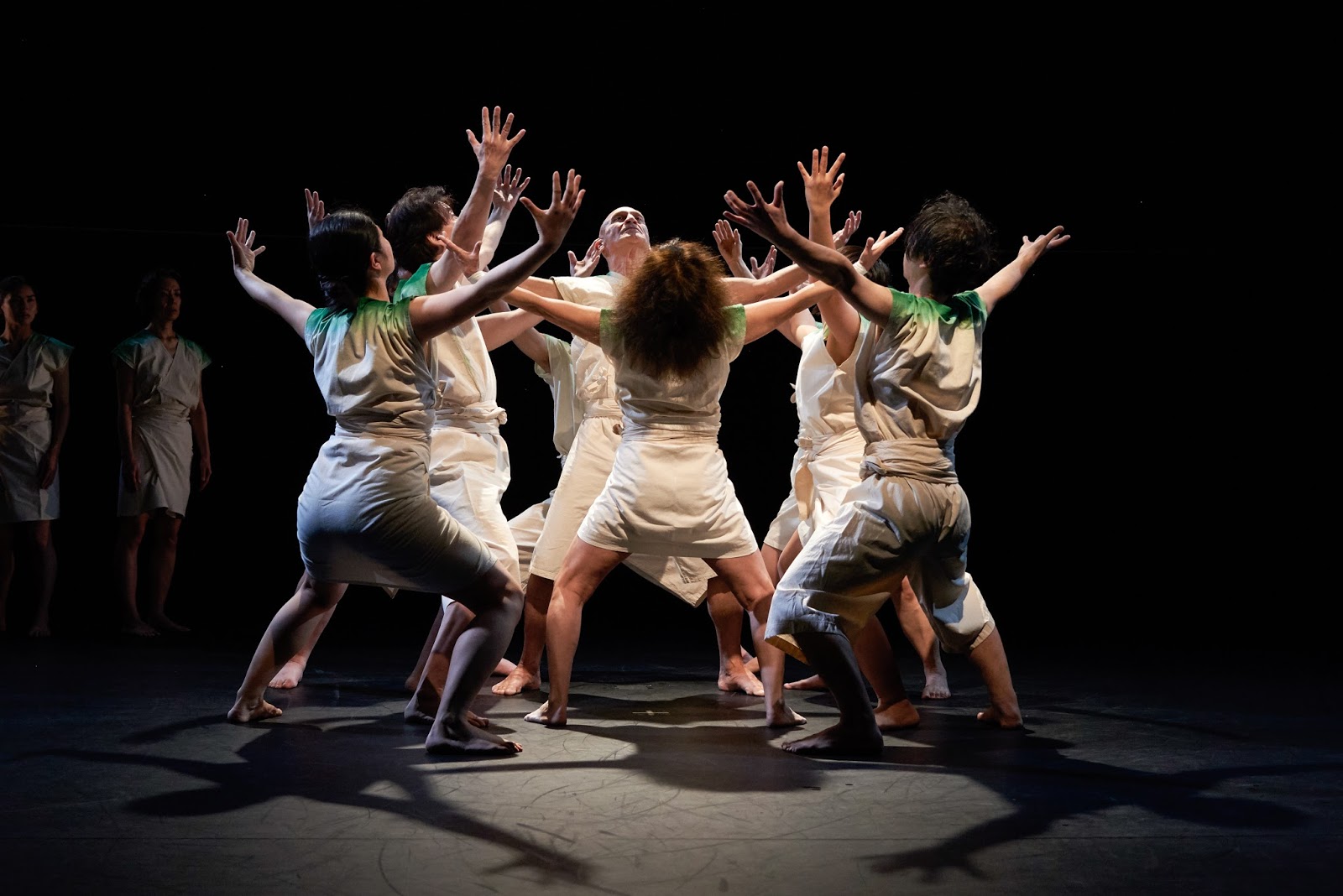
LIGHT, Part 44 (Bamboo Forest), a work from 2016 making its US premiere, opened the evening, danced here by Takei and eleven others. About this work, Takei has written:
To me, a bamboo forest is a mystical place. In it something is born, grows, and then vanishes. I am not trying to express anything in particular in "BAMBOO FOREST." It is simply that bamboo, whether it is giant or small, enchants and entices me. I follow it into its world.
And so she does, and so do we, something that we come to understand as the work concludes after a full hour of watching dancers mass, split apart, reorganize themselves into separate organic segments each with its focus, drive and rhythm, turning the single stage space into a tapestry of distinct and changeable dimensions, a living, breathing, regenerating forest. The work--with a minimalist set by Renta Kochi and rich music by Seiichiro Sou--deals with nature's cycles in which we, as mortal beings, partake.

Takei has been bringing to the stage her magnum opus LIGHT--in its numerous autonomous sections, now up to 45--since the late 1960s. She's an impressive elder and shows no sign of any interest, or need, to slow down or break focus.

Kei Takei's Moving Earth Orient Sphere continues tonight and Saturday night with performances at 8pm. For information and tickets for this and other Lumberyard in the City Winter Festival shows at New York Live Arts through February 10, click here.

New York Live Arts
219 West 19th Street (between 7th and 8th Avenues), Manhattan
(map/directions)

Subscribe in a reader

Wednesday, January 24, 2018

COIL: Dean Moss premieres "Petra" at Performance Space New York

Dean Moss fuses a notorious Fassbinder character
with headless, blood-spurting Hindu goddess Chinnamasta
in his new work, Petra, at Performance Space New York.
(photo courtesy of COIL Festival)


APAP might be long gone, but COIL keeps on coiling, offering new chances to take the measure of Performance Space New York, this new--or, I should say, renovated and blandly re-branded--East Village entity. There's not a bit bland, though, about the current PSNY occupant, Dean Moss, and his newest interdisciplinary piece, Petra. Here's this world premiere production has been described:
A masochistic autobiographical meditation on desire, Petra examines race, sex, and power through the lens of service and unrequited love. Directed by Dean Moss, with music performed live by Composer Samita Sinha, and inspired by the Rainer Fassbinder film “The Bitter Tears of Petra von Kant”, Petra merges the imagined and real lives of its all women immigrant cast, drawing parallels between theirs, his, and the film’s queer, anxiety-laced explorations of ambition, subjection and dispossession. Simultaneously, (taking inspiration from “She whose head is severed” - a Hindu goddess associated with self-sacrifice, spiritual awakening, and the power of the erotic - Moss questions the institutional processes of diversity management, highlighting not only its aspirational goals, but also its self-serving strategies, the implementation of which both support and undermine projects not unlike his own.
I remembered it was mischievous Moss--invited into Parallels, Ishmael Houston-Jones's 2012 Black avant-garde platform for Danspace Project--who raised eyebrows by titling his curated program Black Dance though his selected artists were actually Korean-American, Latinx and white. Petra's adoption and adaptations of characters and visual and narrative elements from Fassbinder's film provide a striking framework for Moss's agenda. Here he battles assumptions and restrictions in arts support and presenting that, as he sees it, can manipulate and hamstring creativity.

Much of Petra contains clues about how Moss feels about his complicated place as a Black artist in a white-dominated downtown performance community where, nevertheless, he has gained recognition and respect. He surrounds his imperious alter-ego, Petra (theater artist Kaneza Schaal), with efficient minions--dancers Mina Nishimura, Sari Nordman and Paz Tanjuaquio. (The women represent different cultural backgrounds: Schaal is of Rwandan ancestry; composer/performer Samita Sinha is Indian; Nishimura, born in Japan; Nordman, in Finland; Tanjuaquio, in the Philippines.) Moss's three "Marlenes"--Nishimura, Nordman and Tanjuaquio--snap to fulfill the stately, glamorous Petra's every barked order. They quietly submit as she towers over them, pulling one after another into a smothering slow dance. The way Schaal clasps and carefully positions that first head (Tanjuaquio's) at her bosom tells us everything we need to know about power imbalance. Sinha, glittering in gold, is Petra's much-desired "Karin," everything an artist’s ego longs for and is often denied. You can't always get what you want.

The numerous Fassbinder parallels can be fascinating, but the work turns far more pointed as it winds down with a solo for Tanjuaquio with Sinha leading three audience members in a vocal chorus. Their text, intoned in unison, rolls out familiar lines of institutional interrogation meant to discern an artist's or cultural project's degree of attention to programming diversity and community engagement. Tanjuaquio's dance--saying nothing particularly translatable to the linear, anxious mind--pushes ever onward. The dancer skims right over the surface of this score just as, I suspect, Moss wants us to know he will always prefer to do.

Concept, Direction, Choreography, Audio/Visual Design: Dean Moss

Performing Collaborators: Mina Nishimura, Sari Nordman, Kaneza Schaal, Samita Sinha and Paz Tanjuaquio

Video Collaborators: Julia Cumming, Cassie Mey, Marya Warshaw and Asher Woodworth

Lighting Design: Zack Tinkelman

Original Music: Samita Sinha

Petra continues with 7:30pm performances tonight through Saturday, January 27. For information and tickets for this and other COIL events, click here.

Performance Space New York
150 First Avenue (between 9th and 10th Streets, 4th Floor), Manhattan
(directions)

Subscribe in a reader

Saturday, January 20, 2018

Meet your doom--maybe--with Split Britches at La MaMa

Above: Lois Weaver
Below: Peggy Shaw
Split Britches brings Unexploded Ordnances (UXO)
to La MaMa for its US premiere.
(photo: Matt Delbridge)


Unexploded Ordnances (UXO), a US premiere from famed lesbian theater duo Split Britches (Lois Weaver and Peggy Shaw), takes inspiration from Stanley Kubrick's political satire Dr. Strangelove (1964). It works from a similar wackadoodle take on the threat of nuclear disaster within reach of itchy Twitter--I mean, trigger--fingers. A top-flight general (Shaw) is stationed by a desk and computer monitor where he keeps track of time and apparently takes calls from gal pals. Weaver, referred to by Shaw as "Madame Mr. President Sir," initially slumbers at a far curve of circled "Situation Room" tables. They communicate via landline phones, although sometimes the phone rings, it's not Weaver, and Shaw breaks into randy old pop songs.

The situation at La MaMa, then, is less tense than Shaw's tracking of the countdown clock might suggest. Yes, the show itself must finish by the end of sixty minutes, but Billy Ward and the Dominoes's "60 Minute Man" is one of those randy songs, and there seems to be plenty of time for studly Shaw to bop out to that. Yes, something must be done about the impending doom we're trying to track on confusing overhead monitors, but there's lots of time to field a council of elders from among the oldest of us in attendance. And, no, although lined up with other greyheads, I failed to make the cut.

Directed by Weaver and written by the pair with Hannah Maxwell, the show contains clever text aligned like precision-cut puzzle pieces (best delivered by saucy Shaw) and room for whatever unpredictables the elders might bring to the table. (One woman seemed obsessed with the mysterious whereabouts of one Tiffany Ariana Trump, offspring of Marla Maples and POS...oops, I mean, POTUS. Now that I think about it, Tiff does seem to have been out of the public eye for a suspiciously long time...hmmm.)

Unexploded Ordnances (UXO) is more chuckle-provoking and captivating than Kubrick--well, of course! it's lesbian!--with the additional benefit of encouraging the audience to determine not only how the play will go but also, you gotta hope, how the rest of our lives will go. Folks came up with some really good stuff!

Part of The Public Theater's now-closed Under the Radar Festival, and originally scheduled to end last weekend, Unexplode Ordnances (UXO) fortunately continues tonight, Saturday, at 8pm and Sunday at 4pm. For information and tickets, click here.

La MaMa -- Ellen Stewart Theatre
66 East 4th Street (between Bowery and Second Avenue), Manhattan
(map/directions)

Subscribe in a reader

Friday, January 19, 2018

Kyoung's Pacific Beat presents "PILLOWTALK"

JP Moraga and Basit Shittu,
the stars of Kyoung H. Park's PILLOWTALK
(photo: andytoad)

If PILLOWTALK were a streamable series, I would so binge-watch it. This short two-hander written and directed by Kyoung Park (Kyoung’s Pacific Beat) has that all-essential factor that gets me every time--people I can give a damn about. That would be Buck (JP Moraga), an Asian-American journalist just fired from the job he hates anyway and who avoids telling this news to his super-practical husband Sam (Basit Shittu), a Black man and former competitive swimmer now working for a bunch of Republicans, the only job he says he was able to find. From beginning to end, and even through the inevitable tension and dissension, Moraga and Shittu subtly radiate the genuine, consistent humanity and appeal in their characters. The romance of Buck and Sam, two contemporary Brooklynites, reflects true complexity and sweet affection in equal measures. I believe in them and root for them.

Co-presented by Park's company and The Tank for The Exponential Festival, the show delves into issues of racism--even inside relationships between people of color--as well as economics, gentrification and political strategy. Most notably, Park probes the issue of how the fight for marriage equality might have robbed queer marginality of its unique, revolutionary bite. His tight, energized writing, deftly linking political and personal issues, contains no waste material. It's all hard at work all the time, and keeps both the actors and us viewers on our toes.

Setting up in the smaller of The Tank's two spaces contributes to our sense of the couple's vulnerability. The tiny black box space and its ingenious, minimalist decor (by Marie Yokoyama) suggest the cramped existence of real-life New Yorkers similar to Sam and Buck. When challenges emerge in this marriage, the men retreat to an even narrower slot of territory on opposite sides of the space, or one might flee the space entirely. Their apartment's un-cozy spatial constraints are as real a worry as the external, invading pressures from community and society. But we also feel the spirit of love in the air. And that's underscored by the final sequence, a pas de deux choreographed by Katy Pyle (of Ballez fame).

Moraga, whose character longs for a new career as a ballet dancer, more clearly resembles someone with ballet training (those feet, that line). I don't know about Shittu, and neither man's bio reveals a history with dance. But Pyle's work as the creator of the inclusive, queer-friendly ballez approach to classical dance upends what we expect, re-purposing and opening up all of ballet's strengths, beauty and fun to people of all genders. Her sequence for Sam and Buck strips away all the external and internal static and reveals what matters and what endures at the heart of this relationship.

Live music: Helen Yee
Sound design: Lawrence Schober
Scenic and lighting design: Marie Yokoyama
Costume design: Andrew Jordan
PILLOWTALK’s Long Table Series is curated by Shannon Matesky and Kyoung H. Park and each event will follow 15 minutes after each listed performance date. Last Long Table:
LOVE’S POWER/MICROINVISIBILITY (Thursday, January 25, 8pm) sheds light on the aggressions and invisibility of QPOC love. What are the spiritual and material dimensions of QPOC love? What are our acts of radical love? Facilitated by Stephanie Hsu with Guest Speakers Nic Kay, Kirya Trabor and more to be announced.
PILLOWTALK continues through Saturday, January 27. For information and tickets, click here.

The Tank
312 West 36th Street (between 8th and 9th Avenues), Manhattan
(directions)

Subscribe in a reader

Wednesday, January 17, 2018

"THIS" is what again? Adrienne Truscott at American Realness

Adrienne Truscott in THIS
(photo: Paul Goode)

Adrienne Truscott brought her adaptable THIS show to American Realness 2018 at Abrons Arts Center's Playhouse, and I caught that final performance on the night also marking AR's finale. The APAP conference, too, drew to its close Tuesday morning, although there are APAP-targeted festivities (PSNY's COIL shows; Under The Radar's added week for the great Split Britches duo) still going strong this week.

So, what exactly is THIS? And who exactly is Truscott?

The answer to both seems to be: A LOT. Also, probably, IT DEPENDS.

The woman has worked through numerous genres--from dance to writing to circus to cabaret and stand-up comedy--and THIS draws liberally from her history. Which is what makes it such a fun, elusive and magical this.

At Abrons, it started on a raw stage--look at that rough wall, that corrugated gate, the metal ladder in the corner, the stained paint cloth and other unidentifiable stuff littering the floor--with a rambunctious comic who might or might not be Truscott opening for Truscott, who is who we thought we had come to see and believe we're seeing but now might or might not be seeing because she says she's opening for Truscott who has worked really hard on what we're about to see. Anywho....

After issuing a warning about a blackout we're supposed to imagine that doesn't happen when she says it does but then happens when we think it won't, the unidentified opener is dropping sex-related jokes to varying degrees of success. ("Comedy and abortion have something in common.... Timing is everything.") Timing is important, too, to a stage
magician's sleight of hand, which is what THIS turns out to be. Anything can appear and disappear when we least expect it--elements of decor; running narratives that abruptly stop and run away and...wait...run back, then vanish again so you don't know where they were supposed to be taking you; a mechanical bird that flies prettily until...oh, no...it doesn't; and a performer who sometimes hides behind scenery even as she continues to talk to us.

What to make of it? It's such a...such a...thing, this THIS, and the audience I sat among--mainly young, I noticed--loved it hard and answered it with a big roar.

If you did not see this THIS but you happen get another chance to see THIS, I suspect you will see a somewhat different THIS. But, no worries. You will see Truscott--trust--and she is always worth it, no matter who shows up onstage.

Writing and performance: Adrienne Truscott
Direction: Ellie Heyman
Sound/video/set design: Carmine Covelli
Light Design: Mary Ellen Stebbins

Closed. For general information on American Realness 2018, click here.

Subscribe in a reader

Tuesday, January 16, 2018

American Realness: "We Wait In The Darkness" by Rosy Simas

Rosy Simas in her solo We Wait In The Darkness
(photo: Ian Douglas)


Rosy Simas Danse
We Wait In The Darkness (New York premiere)
co-presented by Abrons Arts Center and Gibney Dance for
American Realness 2018 at Abrons Arts Center

Recent scientific study verifies what many Native people have always known, that traumatic events in our ancestors lives are in our bodies, blood and bones. These events leave molecular scars adhering to our DNA. Our grandmother’s tragic childhood can trigger depression or anxiety in us, but we have the ability to heal these DNA encodings and change that trait for future generations.
--Rosy Simas 

For people of the Black African diaspora, too, these words from Minneapolis-based dance artist Rosy Simas (Seneca, Heron Clan) ring true, and I must begin with gratitude to Simas for work that illustrates the body as truth-teller and healer. We, too, are a people nurtured by connection to ancestors with tragic histories in this hemisphere, and many of us express reverence for ancestral heritage through powerful spiritual and artistic practices that are, in their way, forms of anti-colonial resistance and justice-making.

Simas's 50-minute solo, We Wait In The Darkness--with its soundscape by composer François Richomme--uses visual, textual, kinetic and sonic mediums to affirm and reclaim the strength of ancestry and environment. By employing this sensory overlapping and overload, viewers grasp what it must be like to uncover the memories one's body holds--some sweet, some painful, some subtle or slow to emerge, some earthshaking--and to tap its wisdom.

Over one end of the stage hangs Simas's long, white paper model of a DNA strand. Towards the center back a white, puff-sleeved dress with a long, old-fashioned dirndl skirt dangles. Along stage left, Simas has suspended a series of white paper panels textured like fine quilts. Panels also capture film imagery, often hazy, glimmering and ethereal, that allude to place--and sometimes people--without specific identification for the benefit of those outside Seneca culture. This poetically elusive quality renders the work as ritual rather than documentary, gives it a spaciousness rather than containing it as the story of a particular individual--although we do hear a voiceover of actual letters of Simas's grandmother, as read by her mother, and we also hear words in the Seneca language gruffly whispered as Simas dances. So, precious, protected mystery exists but also a certain porosity and generosity to help all of us begin to understand the possibility and path of healing.

Theater of both the vivid and the indistinct, then. As Simas sits with her naked back to the audience--spine and arms deeply flexing, stretching and reaching, snaking and twisting--I recall my first realization, when I practiced energy healing, that the back shares more information, without a person's conscious intervention and manipulation, than the front of the body. Throughout the dance, even when she finally dons that white dress, Simas shows us a body of focused, determined will, sure of itself, sure of its mission, sure of the ultimate fulfillment of that mission. We come to understand the evocative sound and visual imagery--drawn from earth and waterways of Seneca land--as its sacred source. And we also contemplate what it meant, for indigenous people, to be literally torn from that grounding, nourishing source. Her body speaks as it moves, and it is saying: I will this. I call this back. The spirits of the land respond in Richomme's mesmerizing, commanding weave of sound.

Near the end of the piece, projections of schematic diagrams suggest maps with numbered sections, a landscape reduced to arbitrary parts for some entity's benefit. Again, nothing is identified, verbally or visually, yet the implications are clear. An environment we just experienced so powerfully in sight and sound, now lies butchered. Simas brings out a sheet of white paper marked with this diagram, solemnly ripping each section from its matrix and placing each strip in a carefully-chosen position along the edge of the floor. She also rips away more of these sections before descending into the audience and gifting them to several of us.

I received number 12. Although I have no idea what territory--real or metaphoric--that it might represent, I will preserve and treasure it.

Letter reader: Laura Waterman Wittstock (Simas’s mother)
Letters: Clarinda Waterman (Simas’s grandmother)
Lighting design: Karin Olson and Carolyn Wong
Set and film design: Rosy Simas

Closed. American Realness 2018 concludes this evening. For further information, click here.

Subscribe in a reader

Thursday, January 11, 2018

Performance Space New York opens with Heather Kravas

New logo
for the rebooted, rebranded PS 122

The new lobby for Performance Space New York (renovated Second Coming of historic PS 122) might be the East Side equivalent of the entranceway to The Kitchen. There's almost identical warmth and appeal--which is to say, absolutely none. At least, the lobby at Chelsea's New York Live Arts often offers something creative to gaze at and the chance to take a load off while you wait.

On opening night for PSNY's COIL Festival--on now through February 4--I could not wait to get out of that lobby and up to the 4th-floor studio for the New York premiere of visions of beauty by Heather Kravas. Now that space has possibilities--generously broad with an impressively high ceiling and row of tall windows. It will be interesting to see how a variety of artists re-imagine, re-shape and activate it, just as it will be welcome to have this influential venue back online in my neighborhood.


visions of beauty
(photo: Julieta Cervantes)

Kravas's vision felt like an apropos place to begin again. Its minimalism and quirky, glacial pacing and moments of matter-of-fact nudity seemed like flashbacks to the sort of thing I remember experiencing here in decades past when it was still cramped-and-funky PS 122. Its quietude, its stillness, seemed intentionally therapeutic. The re-arrangements of wedges of nine dancers in various, alternating, far-flung pockets of space seemed intent on messing with our ability to claim them--the way an audience can "herd" a bunch of performers, as entertainers, in our minds. Instead, they evaded us. They slowed us down and made us wait and gave us an uncompromising atmosphere in which to wait. The last show I'd seen--at The Joyce--did the polar opposite of that, expertly, and it was an ongoing struggle for me to keep my eyes open for Kravas, something else I remember from certain moments and certain artists at the old PS 122.

Though described as "anti-spectacle," the hour does contain one fantastic passage in which dancers create one long, highly-active braid of interlocked bodies along the floor, supporting and shifting under one another. Something oddly meditative and a tad creepy and all the more fascinating for the understated way it brings those qualities together.

visions of beauty was created in collaboration with performers Andrew Champlin, Tarek Halaby, Michael Helland, John Hoobyar, Michael Ingle, Joseph Kipp, Cecilia Lisa Eliceche, Kayvon Pourazar and Saúl Ulerio.

Original music: Dana Wachs aka Vorhees
Song: Peter Schilling
Piano: Hank Mason
Lighting design: Madeline Best

visions of beauty continues on the following schedule:

Thursday, January 11, 8:30pm
Friday, January 12, 9:30pm
Saturday, January 13, 6:30pm

For information and tickets for this and other COIL events, click here.

Performance Space New York
150 First Avenue (between 9th and 10th Streets), Manhattan
(directions)

Subscribe in a reader

Saturday, January 6, 2018

Under The Radar: The furious diaspora of "Panorama"


Above: Perry Yung
Below: Maura Nguyen Donohue
in Panorama at La MaMa Downstairs
(photo courtesy of La MaMa)


Panorama
presented by La MaMa and Motus as part of The Public Theater's Under The Radar Festival


We can look at the word panorama in two ways: One offers an immediate, seamless view of an entire field of vision--a landscape, say, or a seascape; the other breaks that view into its components, revealing a piece at a time, gradually delivering the whole. In the case of Panorama--an evening created by Enrico Casagrande and Daniela Nicolò, directors of Italy's Motus Theatre Company, with actors of the Great Jones Repertory Company at La MaMa--numerous components scroll or zoom into view, overlap, masquerade as one another, tumble together, bombard the senses and wreak dizzying, amusing, endearing confusion. The whole, we might conclude, is far more interesting than any single part, though the parts can also be fascinating.

How you look at the panorama of Panorama is part of the puzzle and the fun, with live players before you and a number of video monitors showing recorded or live action with actors playing themselves or adopting the biography of someone else in the cast or taking over live from where they began presenting themselves on screen in intimate close-ups. It's eye-popping and colorful and only grows more so--all the way from distracting to hallucinogenic--as the allotted 80 minutes roll out.

The fabric of this panorama interweaves threads of diverse cultures, genders, sexual orientations and life histories--some exceedingly dramatic--of being uprooted, replanted in unfamiliar territory and, of necessity, reinventing one's self. Through vivid performances and visual excess, the show celebrates theater as model for how we all might survive and thrive--"inclusive and 'migrant'...a real space of welcoming and freedom." It charms us into feeling and understanding the method of its madness as further laid out in the company's program notes:
Panorama puts to the test every attempt at irrevocably fixing people, nationalities, genders, professions in hierarchical and unchangeable categories. It is a furious diaspora.
Furious, yes. Self-indulgent, yes--often and without reservation. And yes, ultimately, a panorama of joy.

Performers: Maura Nguyen Donohue, John Gutierrez, Valois Mickens, eugene the poogene, Perry Yung and Zishan Ugurlu; on video: Billy Clark, George Drance, Gian Marco Lo Forte, Onni Johnson, Julia Martin, Matt Nasser, Patrick Ssenjovu, Shigeko Suga, Christopher Wild and Mia Yoo

Dramaturgy: Erik Ehn and Daniela Nicolò
Music: Heather Paauwe
CultureHub and Seoul Institute of the Arts Production Team 
Video Design: Bosul Kim, Sangmin Chae and Billy Clark
Set Design: Seungho Jeong
Illustration and Animation: Bosul Kim 
Technical Direction: Yarie Vazquez 
Production Assistant: Youngsun Lim

Panorama continues through Sunday, January 21 with performances Wednesdays through Saturdays at 7pm, Sundays at 2pm. For schedule and ticket information, click here.

For schedule and ticketing information of other events in The Public Theater's Under The Radar Festival, click here.

La MaMa (The Downstairs)
66 East 4th Street (between 2nd Avenue and Bowery), Manhattan
(map/directions)

Subscribe in a reader

Saturday, September 30, 2017

Kronos Quartet brings "My Lai" to BAM Next Wave

Tenor Rinde Eckert (left) as Hugh Thompson, Jr.
and musician Vân-Ánh Võ in My Lai
(photo: Richard Termine)

On the morning of March 16, 1968, U.S. army soldiers fired upon more than 500 unarmed civilians--elders, children, infants, women, some raped and mutilated--in the South Vietnamese hamlets of My Lai and My Khe. More innocents would have been slaughtered in this Vietnam War atrocity--since known as the My Lai Massacre--were it not for the witness and persistent intervention of a young American helicopter pilot, Hugh Thompson, Jr. His three descents into the chaos, though futile as attempts to halt the killing, ultimately saved lives, including, on his final landing, a young boy rescued from his dead mother's arms.

For Thompson's courageous efforts and his official reports of the massacre, he at first became a pariah in Nixon's America, as much a non-surprise as it is heartbreaking. His story inspired a concise, deeply affecting opera, My Lai, now in its New York premiere run at BAM Harvey Theater for BAM Next Wave. It was composed by Jonathan Berger with a libretto by fiction writer Harriet Scott Chessman for Kronos Quartet, tenor Rinde Eckert and Vân-Ánh Võ, a master performer of traditional Vietnamese string and percussion instruments.

Running at 70 minutes, the work suggests the dissonance between cultures--the flare-ups and gusts of Western strings set against Vân-Ánh Võ's measured, airy and delicate tones. Sounds converge and diverge; their players become factions physically separated by Eckert and the set the way Thompson's chopper, on its second descent, kept murderous soldiers from reaching potential victims. The set at the center of it all depicts a sterile hospital room: ceiling-to-floor white curtains, a couple of chairs, a table covered in prescription bottles. The curtains serve as screens for the ghostly shadowplay of helicopter blades and the gleam of wind-blown grasses. Here Eckert gives voice to an aging Thompson consumed by ugly memories and dying of cancer. The heroic pilot died in 2006.

Once Eckert parts the curtain and emerges before us, haunted and restless, the work maintains tight focus on him; the singer maintains his own tight grip in a performance of exacting force and endurance. He is almost never not singing, compulsively remembering, compulsively reporting, dreaming, desiring escape from the body, desiring, ironically, to share with his remembered young son the beauty of flight. He hallucinates his testimony as a game show.

Once you land, there's no turning back.... You can't just hover.

At one point, the bewildered Thompson asks, "How has this happened?" It's a question with no one good answer--or far too many. It resonates and disturbs as much today, in the Age of Trump, as then, in the Age of Nixon.

Kronos Quartet:
David Harrington (violin), John Sherba (violin), Hank Dutt (viola) and Sunny Yang (cello)

Direction, set design: Mark DeChiazza and Rinde Eckert
Video projection design: Mark DeChiazza
Lighting design: Brian H. Scott

My Lai has one final performance, tonight at 7:30pm. For information and tickets, click here. For information on other BAM Next Wave events, click here.

BAM Harvey
651 Fulton Street, Brooklyn
(map/directions)

Subscribe in a reader

Saturday, September 16, 2017

#PUNK it out, Africa! Nora Chipaumire at FIAF

Nora Chipaumire, above,
and below, with Shamar Watt at far right, in #PUNK
(photos by Elena Olivo)


#PUNK is the first part of a triptych titled #PUNK 100% POP*NIGGA, a live performance album that confronts and celebrates three sonic ideologies: punk, pop, and rumba, explored through the radical artists Patti Smith, Grace Jones, and Rit Nzele. -- from program notes for #PUNK

Nora Chipaumire--a Zimbabwe-born dancer with intensity to rival any other performing artist plus, I see, the ability to land herself an interview on CNN--has made her sinewy body more than the instrument of her forthright ideas. It is a force to be reckoned with and, like her incisive mind, a force that will roll up on you the second you merely think about messing with it.

In #PUNKcompany nora chipaumire's new piece for Crossing the Line 2017 at French Institute/Alliance Française, she's joined by Shamar Watt, native of Jamaica, who danced in her sensational and controversial trio, portrait of myself as my father, for BAM's Next Wave 2016. His participation in this new work makes it a duet, a fact that does not appear in the press release that I was issued, just as his bio does not appear in the program (although his name, as performer with Chipaumire, does). I don't know what all this means but, just like the unusual set-up of space and audience for the show, the presence of this killer dancer turned out to be an exciting surprise.

So, they're doing punk now...but with an African twist because Black. And because punk energy is pure joy and indomitability, and that's how Chipaumire sees today's Africa and, likely, the world's future.

The space evoked a humid, airless dive with just a few chairs for folks who needed them--regrettably, nobody advised me about this--and, otherwise, just standing room in front of the performers' territory and above it in a low balcony (where I hung out). Notable faces in the crowd signaled this as that show that everyone in contemporary dance knows they've got to be at (if not in Brooklyn at Bausch).

We had to be on our feet, most of us, because Chipaumire and Watt were all about turning this evening into a rave-up with fans clapping and whooping. "Come up! It's a motherfucking party!" cried Chipaumire as some of us took a second too long to step up to the balcony. We then hastened to comply just as we would all go on to comply with everything the two exhorted us to do.

The performance itself amused me for the way it relentlessly lashed together typical moments of lift-off and climax in rock music performance without delivering anything in between. Chipaumire and Watt always seemed to be startin' somethin' and goin' nowhere in particular, but givin' it all they got. Repeatedly calling out New York! Are you ready??? Counting up 1, 2, 3, 4!!! Or Uno, dos, tres, quatro!!! Literally reminding us, now and again, that they're introducing introductions. Declaring "I am a world-class African nigger" (Chipaumire) or goose-stepping (Watt) to rev up (or scandalize) the crowd.

In #PUNK, Chipaumire riffed on Patti Smith's iconic lyric "Jesus died for somebody's sins but not mine" from "Gloria." She changed the "somebody's" to "your," which makes perfect in-you-face political sense in #PUNK's context, and she kept threatening to go back to Africa and telling us what she'd do when she got there.  "Watch me!" she cried, and I kept hearing James Brown's yowl.

"Watch me! I'm in Africa now!" And, yes, she seemed to have flung every cell of her body home in an altered state. You don't want to cross this woman.

Or Watt. Both dancers were in full command of their lunging, twisting bodies and voices despite the extreme demands of the work (particularly on those strained voices) over the hour or so. I could hardly believe that Chipaumire had anything left for the (lengthy) post-performance conversation moderated by choreographer Ralph Lemon and joined by Congolese dancer Faustin Linyekula, who has three premiere works featured in Crossing the Line.

Two choice moments from that conversation:

Chipaumire:

"I'm a particular kind of Black body. I'm an African body. We hold things differently. I'm acting out against everything but more about having love, joy, having the freedom to act out, having the time to act out."

"The joy. People know how to live. They're there [Zimbabwe] partying all night, and there's a lesson in that. Life is short. You could die tomorrow. It should be worth it."

Linyekula:

"Maybe joy is another way of acting out your rage. I'm here to stay. Maybe this body will be crushed, but there will be other bodies."

"[Euro-centered thinkers] will have to wake up and realize that the world has moved on. We are creating our own world on our own terms. Africans are experts in precarity and re-inventing ourselves."

#PUNK has closed. For information on other Crossing the Line events--now through October 15--click here.

Subscribe in a reader

Saturday, August 5, 2017

Arnold sisters tap, make dreams at Lincoln Center OOD

Chloe Arnold (left) and Maud Arnold
(photo: Vaughn Dabney)

In the field of tap, dancer-choreographers Chloe Arnold and Maud Arnold stake out territory in a place of contemporary sound and attack, aiming to take the art of tap to folks whose tastes run to music styles like R'n'B, rock, funk, rap and Latin pop. Did you make it to last evening's Lincoln Center Out-of-Doors performance of Where Dreams Are Made in Hearst Plaza, featuring the Arnold sisters and their Apt. 33 troupe? If so, you heard, among other things, Ed Sheeran's "Shape of You," Sean Paul's "So Fine," John Legend's "Ordinary People" and "Glory," Beyoncé's "Run the World," Mark Ronson's "Uptown Funk," Andra Day's "I Rise Up," Eminem's "Not Afraid," Jay Z's "Empire State of Mind" and a trio of Prince bestsellers. You also heard, from one song to the next, the troupe layering on a fairly uniform staccato, hard-heeled, hard-charging tap in their rangy, loose-limbed style. Power tap for the people!


Apt. 33 re-envisions Eminem's "Not Afraid" in Charles Renato's 2016 video, featuring is That Asha.

Where Dreams Are Made seemed overly segmented, each bit limited by the length of its popular song and encouraged to lock itself within a certain forceful register (even if, as in "Ordinary People," the song seemed to call for a more vulnerable approach). The sisters' in-between patter advocated more love and unity and sisterhood/brotherhood and exhortations to affirm ourselves as "amazing." I can appreciate that; the Arnolds absolutely do physical and psychic upbeat like nobody's business. Their entire project is the dance equivalent of an energy drink. But as a fan of tap (and, maybe, because I'm an introvert), I also have a longing for some of the other things tap has always done well--softness, juicy lyricism and fine, adroit detail, soulful reflection and nuance, sound that goes on walkabout, winding us through diverse terrains where new, unprecedented things await discovery. I love, sometimes, to hear "I love you" whispered, not always a shout.

Where Dreams Are Made has concluded, but you will find a world of interesting, free events at Lincoln Center Out of Doors, now through August 13, by clicking here.

Subscribe in a reader

Friday, August 4, 2017

Tribute to Bollywood premieres at Lincoln Center's Damrosch Park

Scene from Bollywood Boulevard: A Journey through Hindi Cinema
with Proma Khosla (left), Manav Gulati (center) and Pranav Patel (right)
(photo: Kevin Yatarola)


Bollywood came into my life after an injury left me unable to do much more than prop up my wrenched body in a somewhat less painful way and watch Netflix. I started mainlining as much Shah Rukh Khan as I could find, first intrigued by a news story about the Indian superstar's repeated detentions by immigration authorities at U.S. airports. (“Yes, it always happens. Whenever I start feeling arrogant about myself, I always take a trip to America,” he joked.) And I stuck with Bollywood not only for its charming, multi-talented "King Khan" but also out of helpless fascination with a form of entertainment that gave everything you could possibly ask for...and gave some more...and then some.

A storyline long enough--often up to three hours with an announced intermission!--and twisty enough you get lost in it and forget your troubles. Everything from slapstick and farce to tragedy, rollercoaster romance to action/adventure. Insight into social realities of family, friendship, class and religious conflicts, traditional values vs. modern desires, women's empowerment--check out the great Chak De! in which Khan coaches a women's national field-hockey team--and more. And big, fanciful music and dance production numbers to rival Hollywood, Broadway, MTV and YouTube combined. Most if not all of this often in a single film! I learned early to not fight the thing, just kick back and let Bollywood work its magic. I am grateful to Netflix and Bollywood for my healing.

To a lesser degree, I'm grateful to Lincoln Center Out-of-Doors for last night's celebration of Bollywood history, tradition and personalities--Bollywood Boulevard: A Journey Through Hindi Cinema--a world premiere presentation at Damrosch Park Bandshell. It was a lovely night with, thankfully, just a half-hearted sprinkling of New York summer rain. Produced by Heena Patel and Rushi Vakil and choreographed by Rohit Gijare, the 90-minute show briskly surveyed Bollywood music hits, dance styles and iconic performers through several decades of development. It was exuberantly performed, colorful and entertaining-- wonderfully nostalgic too, I'm sure, for audience members of the Indian diaspora.

For non-Indian and relative newbie fans like myself, though, too much breezed by (for example, the names of individual songs and films briefly posted in the upper left corner of the video screen, referring to--I could not tell--either the previous song or the one just starting). The tribute to identified "game-changers" like A. R. Rahman, Bappi Lahiri and the trio of Shankar–Ehsaan–Loy sent me right to Google this morning to find out more about these gentlemen whose images appeared behind the stage as their songs, varying in style, were played and sung. Aside from feeling a bit swept away by all of this stimuli and its pace--not an uncommon thing with Bollywood--I enjoyed the dancers, musicians and vocalists and surrendered to the condition of just not having enough information at hand. I think LCOOD is often like that, and we all have fun with it anyway.

On Tuesday, regrettably, I had missed India’s Identities through Bollywood Cinema: How Bollywood Sees Us, the festival's panel tracing Bollywood's role in "uniting people from different religious, ethnic, linguistic, economic, and class backgrounds," its "multitude of voices." But I will try to make up for it on my own, in coming weeks, with a dedicated new round of Netflix research.

Dancers:

Aliyaa Islam, Aria Dandawate, Avinash Gabbeta, Barkha Patel, Bindi Patel, Geatali Tampy, Heena Patel, Manav Gulati, Minal Mehta, Payal Kadakia, Poonam Desai, Pranav Patel, Proma Khosla, Rhea Ghosh, Rohit Gijare, Rohit Thakre, Sean Kulsum

Musicians:

Achal Murthy (bass), Varun Das (drumkit), Niranjan Nayar (guitar), Rohan Prabhudesai (keyboard), Sanjoy Karmakar (percussion), Harini (Rini) Raghavan (violin)

Vocalists:

Harini (Rini) Raghavan, Harshitha Krishnan, Krishna Sridharan, Neel Nadkarni

Bollywood Boulevard: A Journey Through Hindi Cinema has concluded, but you will find a world of interesting, free events at Lincoln Center Out of Doors, now through August 13 (OMG, Bonnie Raitt!!!), by clicking here.

Subscribe in a reader

Thursday, January 12, 2017

APAP SEASON CHOICES: "Blind Cinema" by Britt Hatzius

Blind Cinema
(photo: Britt Hatzius)

In 'Blind Cinema' the audience sits blindfolded in a darkened cinema. Behind each row of audience members is a row of children who in hushed voices describe a film only they can see. The children watch the film for the first time, and each performance involves a new group of children all aged between eight and eleven.
--from program notes for Blind Cinema 

I'm not sure why the job had to be done by kids, but Blind Cinema--offered by the film, video, sound and performance artist Britt Hatzius in this year's COIL Festival--is certainly one of the more curious events this APAP season. Presented by PS 122 and SVA Theatre in partnership with East Village Community School (from where the youngsters hail), this forty-minute experience feels like a combination of torture, mind-altering experimentation and goofiness. Years later, you'll be able to say, "I did that," but what exactly "that" was or if it was necessary might remain open to question.

Intentionally or not, my experience of Blind Cinema began in the SVA Theatre's lobby, standing around on line forever waiting to enter the cinema as staff members wordlessly wandered back and forth, possibly counting us. From the noise of people's chattering and the extended wait, energy drained from every fiber of my being. When we were finally admitted to the hall, it was further dispiriting to be forced into the front row abutting the edge of a high platform stage. I don't know about the legroom for the rows behind us but, in the front row, our knees and feet jammed pretty close to that platform. And we had no choice. As we entered, we were ordered to fill the rows all the way across, and I had the great good luck of being one of the first folks in that front row. Add blindfolds to this look and an audio cone that must cover one of your ears, and Blind Cinema is not a good move for anyone with claustrophobia.

The cone helps you hear your assigned movie viewer/whisperer. I hope my fellow audience members found their cones helpful. My ability to hear my young attendant came and went--partly because the child wasn't always very clear-spoken; partly because when you darken a room and cover my eyes, my body gratefully cries sleep time!!! and hijacks the situation. This is actually a healthy thing though inconvenient for this particular sample of performance art.

For me, Blind Cinema was a truly surreal experience, a matter of letting go of understanding WTF was being said; why some people in distant rows, who were not children, were giggling when I could find nothing funny; what was happening on the platform stage where certain noises coming towards us suggested potential danger; and, overall, the ability to stay conscious. I don't think I actually ever fell asleep, but I did go into that liminal "tween" state. When I was most conscious and actually catching words, I was also worrying about how my neck and shoulder were scrunching up as I struggled to maintain connection to the cone. I was, simultaneously, worrying about the narrative I'd lost and getting to a place where I didn't give a damn what I heard or could not hear.

But, okay, maybe Hatzius would find every bit of that well aligned with her purpose as described on PS 122's website:
Through Blind Cinema, Britt Hatzius examines ideas around language and interpretation along with the potential for discrepancies, ruptures and (mis)communication.
Blind Cinema concludes this afternoon with a performance at 5:30pm. For information and tickets, click here.

SVA Theatre
333 West 23rd Street (between 8th and 9th Avenues), Manhattan
(map/directions)

Free email subscription
to InfiniteBody

Copyright notice

Copyright © 2007-2023 Eva Yaa Asantewaa
All Rights Reserved

Popular Posts

Labels