Search This Blog

Showing posts with label Metropolitan Museum of Art. Show all posts

Monday, September 9, 2019

Days of Black Future Past: Black Rock Coalition at The Met


Above: Sandra St. Victor
Below: Shelley Nicole
Black Rock Coalition: The History of Our Future
Metropolitan Museum of Art
photos: Paula Lobo

"Black music has been the taproot of every significant movement in rock music. Sadly, the vast majority of Black artists in rock have been erased from the historical narrative or relegated to footnotes."
--Darrell M. McNeill
When you imagine venues to host one of the badbadbadass-iest rock concerts of all times, do you think of New York's Metropolitan Museum of Art?

Mmmhmmm.

Well, think again, because you missed Black Rock Coalition: The History of Our Future, a MetLiveArts show designed to demonstrate that Black people not only did rock first but they did it best, do it now and have no intention of stopping. Under Darrell M. McNeill's creative and musical direction, the famed Black Rock Coalition Orchestra and featured guests rocked that house last night with a steady roll. All walls and pedestals should be checked for damage.

Named for BRC Orchestra's 1991 album, the two-hour show started off with the pumping Sly Stone hit "Dance to the Music." That funk functioned here like it did when it was new back in 1967--a sure-fire commercial success for David Geffen's CBS Records and, in 2019, an icebreaker like no other. Though the predominantly white Met Museum audience needed the initial permission to dance to the music, as the evening sped along, folks required little prompting to get up on their feet.

The stage of the Grace Rainey Rogers Auditorium was packed, side to side and front to back, with instruments and artists including a revolving cast of standout featured performers--among them, Nona Hendryx, Toshi Reagon, StewCarl Hancock Rux, Living Colour's Vernon Reid and Corey Glover and, led by a commanding Sandra St. VictorThe Family Stand reunited. Yoruba chants and drumming, spoken word, jazz vocals, traditional work songs, gospel tunes, rock and roll and straight-up rock presented a stream of Black genius, all telling a story of determination, improvisation, spiritual depth and lust for life in the face of a long, long stretch of rough times under white supremacy. Times are still rough; the music persists and continues to do its work.

"So what is rock and roll?" Hancock Rux asked, "We begin with juke joints, and women loving women...." He went on to say it's rooted in "trying to find our way home."

Each performance--like vocalist Everett Bradley's unquestionable authority on both "Dance to the Music" and Louis Jordan's "Choo Choo Ch'Boogie"--felt like a sturdy home and one connected, at the foundation, to every other home. Places of rest and reflection, generous nourishment, everyday miracles and jubilation. Hendryx, above all others, took all my heart with witchy renditions of the jazz classic "Afro Blue" and, later, an unexpectedly expanded and capacious "Swing Low, Sweet Chariot." She enters a song at unusual angles, spies just the right, clear path, then guides you through as intensity builds. Reagon quietly took up and met the challenges of Curtis Mayfield's bleak "When Seasons Change" with agility of voice and soul. Stew, with David Barnes on harmonica, updated Bo Diddley's "I'm A Man," making a statement on toxic masculinity from the White House to the church house, from FOX News to NPR. And it was just pure fun to watch Glover rock out again to "Cult of Personality," the show's closer.

An historic one-night only event. So, if you didn't catch it, bummer! But if you love rock, you can still check out Play It Loud: The Instruments of Rock & Roll, at the Met through October 1. Plan your Met visit here.

*****

Featured Artists:

Nona Hendryx
Fantastic Negrito
Vernon Reid, Corey Glover (Living Colour)
Toshi Reagon
Stew (The Negro Problem)
The Family Stand
"Captain" Kirk Douglas (The Roots, Hundred Watt Heart)
Carl Hancock Rux
Ronny Drayton

Black Rock Coalition Orchestra:

Darrell M. McNeill (bass)
LaFrae Sci (drums)
Howie Robbins (keyboards)
Elenna Canlas (keyboards)
Marcus Machado (guitar)
Marvin Sewell (guitar)
Gordon "Nappy G" Clay (percussion)
V. Jeffrey Smith (saxophone, flute)
Don Byron (clarinet, saxophone)
Bruce Harris (trumpet)
JS Williams (trombone)
Sophia Ramos (vocals)
Shelley Nicole (vocals)
Bruce Mack (vocals)
Everett Bradley (vocals, percussion)
Kelsey Warren (vocals)
David Barnes (harmonica)
Mikal Amin (vocals)

******

DISCLAIMER: In addition to my work on InfiniteBody, I serve as Senior Curatorial Director of Gibney. The postings on this site are my own and do not necessarily reflect the views, strategies or opinions of Gibney.

******

Subscribe in a reader

Friday, January 18, 2019

In step with Joséphine: Julia Bullock at The Met

Soprano Julia Bullock
(photo: Kevin Yatarola)

Julia Bullock
Perle Noire: Meditations for Joséphine
The Great Hall
Metropolitan Museum of Art
January 16-17

The two-page, finely-written program notes Julia Bullock contributed for her production, Perle Noire: Meditations for Joséphine, performed on the stairs of the Metropolitan Museum's Great Hall, takes me back to a practice I abandoned a couple of years ago--saving programs from all the shows I see. I no longer save them much beyond the year of their season, but this one, this one, will live with me, just as the life, struggles and example of Joséphine Baker clearly live with Bullock, a Black opera singer of profound insight and commitment to social justice.

Bullock--the Met's 2018-2019 Artist in Residence--starts her notes by quoting famed New Yorker writer Janet Flanner whose references to Baker's "caramel-colored body" and "lovely animal visage," the "dawning intelligence" of her look, along with Baker's apparent failure to have "heard of Mozart" are like textbook examples of white supremacist arts criticism. Dropping this nightmare on the page, Bullock then proceeds to hail Baker for achieving superstar--and super-paid--status during Jim Crow when her level of success was unimaginable for any Black performer. Further, for anyone obsessed with the image of caramel-colored Baker dancing in a costume made of bananas, Bullock notes Baker's role in the French Resistance and our own Civil Rights movement, and even the way the entertainer turned her simplistically-eroticized image--her skin turned into a costume, as she says, her body a "shattered object" that wants a home, wants to be owned--into one of self-defined, self-determined Black power and woman power.

The essay--which goes on to detail a creative process encouraged by director Peter Sellars with a team of remarkable collaborators--ends in a proud, uncompromising affirmation of the complexity of human nature, Baker's and Bullock's as well. Both women aim to rip our stereotypes right out from under us.

Is it possible to not only save program notes forever but stand up and give them a rousing cheer?

Bullock's soprano has depth and edge; it draws you into a resonant cave. When she first comes into view, high on the Great Hall's grand staircase, she stands stockstill, an icon draped neck to toes in formal black, her hair a dark-russet 'fro which will eventually be lit to halo-ing effect. Remote and rigid, she seems an apparition from the grave, her face, seen from a distance below, a cloudy blur that does not resolve into recognizable features.

That will change. Bullock does descend, at times, to a mid-point landing to join the work's composer Tyshawn Sorey (percussion/piano) or to the lower steps where members of International Contemporary Ensemble (ICE) craft a sinuous and textured sonic fabric for her plainspoken testimony as Baker, channeled by writer Claudia Rankine. "One day, I realized I was living in a country where I was afraid to be Black," Bullock says, as Baker. And she calls the US "barbarous."

It's haunting, confusing, disturbing when she reveals that her dancing was actually a form of running. Would that mean fearful escape? Or would it mean resistance? Or some combination? How are we to understand this Joséphine (or this Julia who identifies so closely with her)?

The long-ago familiar--a dancing of the Charleston, a warbling of "Bye Bye Blackbird"--are rendered with an insistent, high-strung dissonance. Bullock's training in dance becomes clear immediately, but the entirety of the performance rests on her skillful ability to move various energies of feeling through her body--from the initial, regal dignity to mischief to brooding quiet to unnerving thunderclaps of anger and power.

Creative team:

Julia Bullock, soprano
International Contemporary Ensemble (ICE):

  • Alice Teyssier, flute
  • Ryan Muncy, saxophone
  • Rebekah Heller, bassoon
  • Daniel Lippel, guitar
  • Jennifer Curtis, violin 

Conceived by Peter Sellars
Tyshawn Sorey, composer, percussion, and piano
Zack Winokur, director
Claudia Rankine, text (featuring the words of Josephine Baker, adapted by Julia Bullock and Zack Winokur)
Michael Schumacher, choreographer
Mark Grey, sound design
John Torres, lighting design
Carlos Soto, clothing design

Perle Noire: Meditations for Joséphine concludes this evening with a performance at 8pm. Seating is very limited and likely sold out, but for information, click here.

Metropolitan Museum of Art
1000 Fifth Avenue (enter at 81st Street main entrance), Manhattan
(map/directions)

******

DISCLAIMER: In addition to my work on InfiniteBody, I serve as Senior Curatorial Director of Gibney. The postings on this site are my own and do not necessarily reflect the views, strategies or opinions of Gibney.

******

Subscribe in a reader

Sunday, September 10, 2017

Faustin Linyekula's "Banataba [new work]" at Met Museum

Dance artist Faustin Linyekula
is Crossing the Line's Mr. September.
(photo courtesy of FIAF)

Banataba [new work]'s world premiere at The Metropolitan Museum of Art yesterday afternoon launched a major series of events featuring acclaimed Congolese dancer-choreographer Faustin Linyekula as part of French Institute Alliance Française' annual Crossing the Line festival which runs through October 15. This month, Linyekula will also present events with FIAF's co-presenters NYU SkirballDancing in the Streets and 651 ARTS in partnership with several other organizations (catch up on all of it here). Clearly, it's the September of Linyekula...and of widespread collaboration.

Commissioned by MetLiveArts and inspired by the museum's Kongo: Power and Majesty exhibition (2015), Banataba [new work] is performed in the Met's Spanish Renaissance Vélez Blanco Patio. It employs visual, kinetic and verbal storytelling as we ponder the meaning of objects created in native cultures and appropriated by museums. An hour-long duet for Linyekula and his enchanting collaborator Moya Michael (South Africa), it includes video and photographic elements representing the forested earth, the waters and the people of Linyekula's homeland.

The confined yet fixed, linear setup of the space--several rows of audience seating facing forward; video projected on the not-so-broad base of a statue or against the wall; headshots of unsmiling villagers gazing directly into the camera--works against a possibility of effectively immersing observers within these visual elements. At the same time, it's also possible that the choreographer chose separation rather than an easier connection and familiarity. After all, this piece appears to be about his ultimate decision to withhold and protect a precious discovery.

Much of the live performance involves the toting and gingerly careful transfer of a cloth-wrapped parcel from dancer to dancer, each either gazing at the other or slowly, gracefully bending and turning away with the mysterious object cradled in his or her arms. We listen to Linyekula chanting, singing or (sometimes near inaudibly due to the room's muddying acoustics and his sweet, soft voice) relaying a tale about visiting his mother's village.

We watch the unwrapping and assembly of the parts of the wooden object on top of a platform and the way this revelation makes the dancers jerk, tremble and eventually shake violently. While it becomes clear that this object--which the dancers will labor to reassemble with poignant yet also comical difficulty--is not the actual one Linyekula saw in his village, it stands in for it. Eventually, it stands--quite literally--and they glide it forward, close to the edge of our front row. Arms stretched out wide to each side, it gazes at us.

Aspects of Banataba [new work] suggest human bodies as tuning forks, dowsing rods or formidable, spirit-inhabited objects of power (nkisi). And as supple branches on trees whose ancient roots continuously supply information and nourishment. Just as we need to understand the contextual significance of the crafts created and valued by a people, so too do we need to comprehend the people themselves within the living fabric of their own culture and environment.

Banataba [New Work] continues with performances today at 12pm and 3:30pm. Seating is limited. For information and ticketing, click here.

Gallery 534, Vélez Blanco Patio
The Metropolitan Museum of Art
1000 Fifth Avenue, Manhattan
(map/directions)

Subscribe in a reader

Monday, December 12, 2016

Alan to the Max at The Met Museum

Alan Cumming in Max and Alan
at The Metropolitan Museum of Art
(photo: Stephanie Berger)

A tycoon, a trapeze artist, a nightclub owner, a sailor. German Expressionist Max Beckmann saw himself as an actor on the stage of life and often painted himself in disguise. Tony Award-winning Alan Cumming has created this personal musical work drawing on his own experience as an émigré to New York, channeling an artist who fled his native land after he was famously denounced as a "degenerate" by the Nazis. Beckmann died just sixteen months after arriving in New York, suffering a fatal heart attack while on his way to The Met. This MetLiveArts commission is inspired by the artist's all-too-brief time in New York. --
from The Metropolitan Museum of Art website

Cumming with Beckmann's Self-Portrait in Blue Jacket (1950)
(photo: Stephanie Berger)

I have never had the good fortune to see actor Alan Cumming perform in a cabaret--or in Cabaret, sadly. So, I can't say for sure, but if he lets loose in more intimate spaces the way he let loose in Max and Alan, his one-night-only performance at The Metropolitan Museum of Art's Grace Rainey Rogers Auditorium, he should be declared a vital national energy resource. We need him now--and not only because, politically-speaking, Cumming always fights the good fight.

Responding to the Met's wonderful Max Beckmann in New York show (on view through February 20), Cumming brought a startling portfolio of songs performed with the vibrant, versatile trio of Lance Horne (piano), Eleanor Norton (cello) and Alon Ilsar (percussion). His selections evoked a life lived head-on despite risk, conflict or doubt. The Scottish émigré clearly, often amusingly, identifies with Beckmann: "We quite like degenerate things in Scotland," he quipped.

In his statement for the show, Cumming wrote:
And of course we are bound by our connection and connected by our bond, to the era of the Weimar Republic, that supernova moment when art and sex and satire and politics all sidled up alongside each other and sparked so impossibly brightly for a few electric years. He was there. He was in it. I am merely a disciple, a conduit by proxy.
Kurt Weill, expected guest at Cumming's party, kept company with Miley Cyrus ("Wrecking Ball") and Kate Bush ("This Woman's Work"). Friedrich Hollaender's wistful "Falling in Love Again," approached with a rare delicate touch, was there along with Jerry Herman's button-bursting gay anthem, "I Am What I Am," from La Cage aux Folles. Between songs, Cumming offered insights into Beckmann's paintings, his loves, his world.
A song of love is a sad song, hi-lili, hi-lili, hi-loA song of love is a song of woe, don't ask me how I know.
It all culminated in an encore, the ominous "Mad World" (Tears for Fears), with the singer taking Horne's place at the piano. That was to be expected. In early November, Cumming had written a brooding piece in his blog on the prospect of our election ending disastrously.  Now, like all of us, he had much on his mind.

As a singer, Cumming is ever the masterful actor, using face and body as channels for a prodigious force called from I know not where, simultaneously blazing bright and blazing dark. Even the suddenly flashed, dimpled grins possess the gathered tension you see in his arms and hands as he plunges his whole being into lyrics and, for godsake, delivers them. The voice just whips out and lashes. You reel back, expecting to go away exhausted by his entire effort. Instead, you end up curiously exhilarated.

Or, at least I did. After the show, I subway-ed downtown to my Santacon-invaded East Village, feeling mentally sharp and strengthened for battle.

Thank you, Alan, so very much.

If you like what you're reading,
subscribe to InfiniteBody!

Friday, April 29, 2016

The Metropolitan Museum of Art announces new MetLiveArts season

Tony Award-winning actor Alan Cumming
will perform Max and Alan, his evening-length musical work
inspired by German Expressionist Max Beckmann.
(photo: Steven Trumon Gray)
Mali's legendary master singer-musician Boubacar Traore
will perform in December.
(photo: courtesy of World Music Institute)

The Metropolitan Museum of Art's 2016-17 season of live performances, newly renamed MetLiveArts, was announced last evening. The lineup features music, theater and dance events, the latter represented by the indefatigable Monica Bill Barnes and Anna Bass, whose latest project with artist Maira Kalman, The Museum Workout, aims to both introduce you to art works and get your blood pumping each morning of its run, one hour before the museum officially opens.

Monica Bill Barnes and Anna Bass
will perform and lead The Museum Workout
for a troupe of early-bird participants at The Met.
(photo: Paula Lobo)

Introduced by Thomas Campbell (Met Director and CEO) and Limor Tomer (General Manager of Concerts and Lectures), the announcement event previewed The Museum Workout and offered a lively performance by chamber music group PUBLIQuartet and a Q&A with Nate DiMeo, creator of The Memory Palace podcast. DiMeo--MetLiveArts's Artist in Residence for the 2016-17 season--will spend his year crafting ten podcasts inspired by an exploration of the Met's American Wing.

Describing himself as "culturally omnivorous," DiMeo explains that his passion for history is guided by an intense interest in people.

"Abraham Lincoln is really just a dude doing real things in the world. And the Met is a place that makes history, tells people a story about what's valuable and valued in art." His series will be available on The Met's Web site as well as on The Memory Palace.


New York's adventurous PUBLIQuartet,
will be MetLiveArts's 2016-2017 Quartet-in-Residence.
(photo: Paula Lobo)

"In the 2016–17 season we will unleash the power of the Museum's collection to make sense of our world by challenging performing artists to stretch the boundaries of their craft and genre—playing with our pre–conceived notion of what performance is, what a museum experience can be, and what to expect when we go to The Met," Tomer says.

A question of how to change both performers and audiences guided Tomer's development of these new projects. One fun way was to commission Monica Bill Barnes & Company, long noted, as Timor joked, for "bringing dance where it does not belong." Just ask NPR's Ira Glass (This American Life). We all know dance definitely does not belong on radio--or on national tour with an acclaimed radio and podcast star. And yet....

With recent reports of emergency belt tightening at the Met, it's clear that Campbell faces challenges more pressing than finding "something shiny" to wear to take part in The Museum Workout.  Still, the expansive MetLiveArts initiative seems a positive move towards heightening interest in the museum across artistic disciplines and boosting accessibility without sacrificing quality.

Get more information on the full schedule of MetLiveArts events here or call 212-570-3949. Tickets are also available at the Great Hall Box Office, which is open Monday-Saturday, 11 am–3:30 pm. Tickets include admission to the Museum on day of performance.

If you like what you're reading,
subscribe to InfiniteBody!

Thursday, March 17, 2016

Talks on "Dreams, Magic and Desire" at The Met: Part 2

Sir Edward Burne-Jones: 
The Beguiling of Merlin (1872-77)
Lady Lever Art Gallery

This morning, I attended "The British Invasion," the second of Alison Hokanson's excellent presentations on Dreams, Magic and Desire at The Metropolitan Museum of Art. Her talk, this time, focused on Britain's Pre-Raphaelites--exemplified by painters Dante Gabriel Rossetti and Sir Edward Burne-Jones--and their direct influence on the later Symbolist movement. (See my post from last week's talk about Belgium Symbolist Fernand Khnopff.)

Again, Hokanson led us through the factors that gave rise to Symbolism in many European nations--primarily the intensely nationalistic urge to break from the dominance of France-centric academic art, realism and Impressionism, and the desire to explore inner worlds and mystical realms. Symbolism, she said, was not a specific technique but "a range of principles," "a state of mind" valuing individual expression.

As the Symbolists took inspiration from the earnest, elaborately symbol-laden work of the Pre-Raphaelites, that movement looked even further back to paintings of the medieval and early Renaissance eras, citing their "immediacy, purity, authenticity" all that was "full of life and heartfelt." Burne-Jones belonged to the second wave of Pre-Raphaelites, artists devoted to an even more idealized depiction of nature, humanity, myth and mind.

Beauty of form grew in value for these artists, but beauty as "a way to guide the spirit" in a world lately upended by industrialization, commercialization, scientific discovery and political upheaval. The movement also embraced the decorative arts in furnishings, book illustration and objects of everyday use.

"The British Invasion"

Taking as a starting point the Met’s masterpiece The Love Song by Edward Burne-Jones, this talk highlights the appeal that the work of the Pre-Raphaelites in England had for the Symbolist generation in Northern and Central Europe. From Brussels to Munich and Vienna, artists drew on British models to develop modern styles that differed radically from the French trends that dominated the art world. Their work, as one critic put it, “rendered the profundity of life and a melancholy attitude of beauty.”

Sir Edward Burne-Jones:
The Love Song (1868-77)
The Metropolitan Museum of Art

Hokanson's talk centered on The Love Song--the romantic, atmospheric Burne-Jones masterpiece in the Met's collection--tracing its influences back to Botticelli, Giorgione and Titian. A gifted communicator, she made her feelings for this work most clear by adding a recorded chanson to our visual experience of this painting's overtly depicted and subliminal music. It was a sublime moment.

File:Sir Edward Coley Burne-Jones Flamma Vestalis.jpg
Sir Edward Burne-Jones:
Flamma Vestalis (1896)

Hokanson ended her discussion by noting the trauma of World War I and its sweeping effect on the arts in Europe. The Symbolist movement fell away, supplanted by emerging forms for a brutally altered world.

*****

For information on future art talks at the Met, click here. To learn about all other special programming at the Met, click here.

*****

Special note for dance fans:

David Dorfman Dance will take part in tomorrow's lineup celebrating the official opening of The Met Breuer with performances all day long, free with museum admission or membership. Click here for information.

If you like what you're reading,
subscribe to InfiniteBody!

Saturday, March 12, 2016

Talks on "Dreams, Magic and Desire" at The Met


Above: The Silver Tiara
Fernand Khnopff (1911)
The Museum of Modern Art

Below: Self-portrait, Fernand Khnopff (1879)
Willems Collection, Brussels


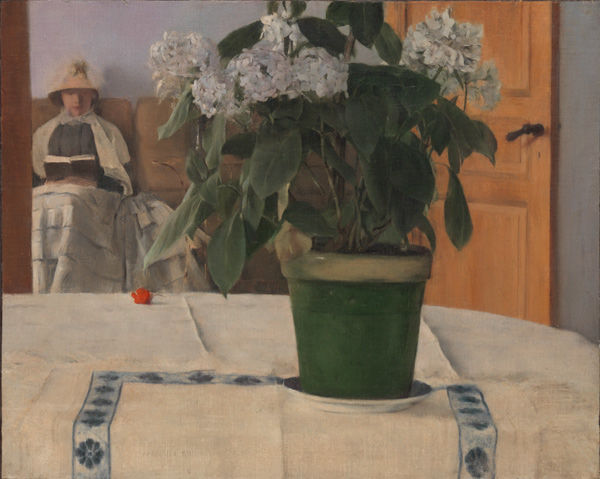
On Thursday, the Metropolitan Museum of Art presented a talk by Alison Hokanson (Assistant Curator, European Paintings) on Symbolism with a focus on the work of Belgian painter Fernand Khnopff. In discussing the broad and enigmatic Symbolist movement, with its concern with "desire, the unconscious, human mortality, timelessness and the inner self," Hokanson acknowledged that it had long been dismissed by most art scholars as "an artistic dead end, not sufficiently sophisticated or forward-thinking."  Now that assessment is under revision. A prime example of this new consideration: The Met's own recent acquisition of Hortensia, an interior innovative, for its time, in Khnopff's confident experimentation with perspective and foregrounding.


Fernand Khnopff's Hortensia (1884)
The Metropolitan Museum of Art

Hokanson is a clear, illuminating presenter, and if you missed this first talk from her Dreams, Magic and Desire series, I highly recommend catching the second--"The British Invasion"--on Thursday, March 17 (11am-Noon).
Taking as a starting point the Met’s masterpiece The Love Song by Edward Burne-Jones, this talk highlights the appeal that the work of the Pre-Raphaelites in England had for the Symbolist generation in Northern and Central Europe. From Brussels to Munich and Vienna, artists drew on British models to develop modern styles that differed radically from the French trends that dominated the art world. Their work, as one critic put it, “rendered the profundity of life and a melancholy attitude of beauty.”
Click here for ticket information.

The Grace Rainy Rogers Auditorium at
The Metropolitan Museum of Art
82nd Street and Fifth Avenue
(visitor information including map and directions)

If you like what you're reading,
subscribe to InfiniteBody!

Wednesday, March 25, 2015

Confirming Adams: Attacca and The Francesca Harper Project

John Adams "Confirmed" Dances
Attacca Quartet
l-r: Luke Fleming, Amy Schroeder, Keiko Tokunaga and Andrew Yee
(photo: Lisa-Marie Mazzucco)

Limor TomerMetropolitan Museum of Art's Curator of Performance, was admittedly starstruck to be onstage with composer John Adams last evening at the museum's auditorium. For his part, Adams playfully disputed her description of his work--"I don't really think of Bach when I think of myself...I'm more inspired by country fiddling and R. Crumb comics"--while praising Attacca Quartet, there to present John Adams "Confirmed" Dances, selections from his chamber works for strings

Mentioning past collaborations with Shen Wei and Trisha Brown, Tomer noted the museum's intent to work more often with dance artists. And, indeed, in this concert, Attacca's music would be paired with The Francesca Harper Project and guests from Dance Theater of Harlem and Howard University.

Marred only by a technical glitch that briefly interrupted the performance of John's Book of Alleged Dances (1994), the concert proved why the young musicians--Luke Fleming (viola), Amy Schroeder (violin), Keiko Tokunaga (violin) and Andrew Yee (cello)--have won multiple awards. Their needle-fine sensitivity, clear, distinct polyrhythmic layers and blistering speed--this last, especially in the driven, early moments of String Quartet, a piece from 2008--more than live up to Adams's word for Attacca: "jaw-dropping."

In John's Book of Alleged Dances, the dances Adams had in mind were, yes, just in mind--"alleged," he has said, because "the steps for them had yet to be invented." Enter Francesca Harper with her background spanning Forsythe, Broadway and DTH to "confirm" them. She opened with a restless solo Bradley Shelver made for her, set to Adams's "Judah to Ocean." Her charismatic presence--a tall, pliant woman in a tomato red dress--flared through across the stage, taking command. But her approach to Alleged Dances for the dazzling, superheroic Eriko Iisaku and her dancers went much further and was more intriguing. Show-off images that, mindful of Adams, never take themselves too seriously; lush, gleaming beauty prone to being off-kilter, even bizarre; an elastic, athletic, aggressive rush that, coming from a troupe of mostly women, can look...well, jaw-dropping. I much prefered this disruptive Harper to the more conventional sculptor of String Quartet, danced by the guests from DTH and Howard. She posed hard challenges to her own dancers in Alleged, and they confirmed that they are up to the task.

******
Seven Words

Hear Attacca Quartet perform a string quartet arrangement of Haydn's Seven Last Words of Christ on the Cross with video by Ofri Cnaani at the Metropolitan Museum of Art's Grace Rainey Rogers Auditorium on Thursday, April 2, 7pm.

For information and tickets, click here.

Metropolitan Museum of Art
1000 Fifth Avenue (street entrance at East 83rd Street), Manhattan
(directions)

Sunday, January 4, 2015

Metropolitan Museum of Art explores "Viewpoints: Body Language"

"The idea of launching your body back, without seeing, is liberating but also terrifying."
--Francesca Harper, dancer

How does the sculpted body communicate? Hear from Met experts, leading authorities, and rising stars, each with a unique perspective on the language of gesture, facial expression, and pose.

Hear diverse viewpoints from curators, educators, musicians, theater actors and directors, neuroscientists, and a deaf American Sign Language user. Watch videos of dancers and choreographers interpret the body's expression. Share your viewpoints on social media. We'll repost selections on Twitter, Instagram, Facebook, and Pinterest.

Body Language features twenty works of sculpture from three departments: European Sculpture and Decorative Arts, Medieval Art, and the American Wing.
Click here to begin your exploration of the Metropolitan Museum of Art's Viewpoints: Body Language.

Friday, February 21, 2014

Dancing, dancing machines: "Twinned" at the Metropolitan Museum

As specific sites for site-specific dances go, you can't get much classier than the Metropolitan Museum of Art after dark--site-specifically, The Charles Engelhard Court with its surround of sparkling, glassed-in balconies. Last evening, in this dramatic setting, contemporary music ensemble Alarm Will Sound (directed by Alan Pierson) and Heginbotham Dance (directed by John Heginbotham) premiered Twinned, their collaboration to compositions by Edgard Varèse, Aphex Twin and Tyondai Braxton with charming transitions between sections by Raymond Scott.

Each set of performers engaged--a little--in the other's art form. At times, musicians could be found standing solemnly or lying supine beside or beneath their instruments or scampering about as if their instruments, or music itself, were forms of contraband or weaponry; a dancer might stand behind a music stand, waiting for his moment to strike a gong or noisily crumple sheets of clear, glinting plastic. This whimsical overlapping of roles, at best, suited the playfulness of the electronic scores; at its less than best, it seemed tame and a bit silly. But it did help de-stuffy-fy an event that--at $60 a ticket, certainly--could have come off as stuffy but did not.

The Varèse Intégrales opened on a rising woodwind note; a percussive flourish of drums, bells, chains, tambourine, clackers; a shock of brass, with musicians alerting us to their presence all around the court. The space was seized, the capture announced to all.

Past the Varèse, light projections of chains of 1s and 0s splashed the container of the court. Musicians beat a temporary retreat to their separate half of the performance space, and two dancers, dressed in black-and-white Op Art leotards, stepped forward. Peppy movements carried the jagged, electric look of their costumes's prints. They trotted, flapped and twisted their limbs, and rigidly twerked like mechanical targets or clockwork figures, joined by two other dancers and finally by the wonderful John Eirich, luminous and airy in a long, cream-colored skirt. Under dramatic lighting by Nicole Pearce, the dancing looked well-placed among the court's sculpture and architecture.

In Twinned's conclusion, the new Fly By Wire, set to a Tyondai Braxton first presented by Alarm Will Sound in 2012, the dreamy/ borderline nightmarish undertone of previous sections broke into a clever, full-on horse race with dancers jockeying for position. Dancers certainly can make music, if they choose. But the skill of the Heginbotham dancers made me glad that, most of the time, they stuck to their own side of the fence.

Dancing by Winston Dynamite Brown, John Eirich, Lindsey Jones, Courtney Lopes, Weaver Rhodes, Sarah Stanley and Andrea Weber

Alarm Will Sound: Erin Lesser (flutes), Alexandra Sopp (piccolo), Christa Robinson (oboe, English horn), Campbell MacDonald (clarinet, saxophone), Elisabeth Stimpert (clarinet, bass clarinet), Michael Harley (bassoon, contrabassoon, voice), Matt Marks (horn), Jason Price (trumpet), Mike Gurfield (trumpet), Michael Clayville (trombone), Timothy Albright (bass trombone), Joe Barati (bass trombone), John Orfe (piano, keyboard), Chris Thompson (percussion), Luke Rinderknecht (percussion), Yuri Yamashita (percussion, keyboard), Mellissa Hughes (voice), Courtney Orlando (violin, voice), Caleb Burhans (violin, electric guitar), Nadia Sirota (viola), Brian Snow (cello), Miles Brown (bass)

Nigel Maister (staging direction for Intégrales)
Maile Okamura (costumes)

Alarm Will Sound in a performance of Cliffs by Aphex Twin
Bowling Green State University, March 28, 2012 
arranged by Caleb Burhans
staging by Nigel Maister

For more information on special events at the Metropolitan Museum of Art, click here.

Monday, February 4, 2013

Through the eyes of Met museum curators

The Metropolitan Museum of Art--under the imaginative leadership of its Director and CEO, Thomas P. Campbell--has launched 82nd & Fifth, an online video series in which each of one hundred curators discuss "a work of art from the Met's collection that changed the way he or see sees the world."

"One work. One curator. Two minutes at a time."

Six episodes are now posted and will be followed by two episodes weekly, every Wednesday at 11am—through December 25, 2013.

Click here for information and here to sign up to receive announcements of each new episode.

Monday, October 1, 2012

The Met's art through the eyes of Kalup Linzy


presents

Artists on Artworks with Kalup Linzy
Friday, October 19, 6:30–7:30pm

See the Met's collections through the eyes of Kalup Linzy, a Brooklyn-based performance artist.

Tickets—free, but required—will be distributed 30 minutes prior to the talk.


About Kalup Linzy:
Artspace interview
New York Times feature

Fifth Avenue at 82nd Street, Manhattan


Friday, June 8, 2012

Cirène: Multimedia Fairy Tales

The Metropolitan Museum of Art presents

Cirène: Multimedia Fairy Tales

Saturday, June 16, 3pm
Violinist Colin Jacobsen, cellist Eric Jacobsen, dancer Maile Okamura, percussionist Shane Shanahan, and painter/animator Kevork Mourad reimagine timeless tales from the Arab lands and craft them into presentations of dance, music, live painting, and animation. Magical images are projected behind the performers and spring to life in unexpected ways.

This concert is presented in celebration of the opening of the New Galleries for the Art of the Arab Lands, Turkey, Iran, Central Asia, and Later South Asia.
Click here for more information and tickets.

The Grace Rainey Rogers Auditorium
Metropolitan Museum of Art
Fifth Avenue at 82nd Street, Manhattan
(directions)

Sunday, February 26, 2012

Art Roundup: A Stein is a rose; radical cameras

Fans of Gertrude Stein, make your pilgrimage to the Metropolitan Museum of Art to view The Steins Collect: Matisse, Picasso, and the Parisian Avant-Garde, an immersive introduction to the prophetic taste of Stein, her brothers Leo and Michael and her sister-in-law, Sarah. Picasso, Renoir, Manet...all of that's fine, but what really lifted me were the images of the writer herself--photos, paintings, sculpture infused with her presence and the energy of how she was perceived by her contemporaries. The Steins Collect opens to the public on Tuesday, February 28 and runs through June 3. For information, click here.

Detail, Pablo Picasso, Portrait of Gertrude Stein, 1906
Metropolitan Museum of Art

The Met will also host a Gallery Workshop on Art and Writing: Making Creative Connections, led by Claire E. Moore, assistant Museum educator on Friday, March 30, at 6:30pm.
Explore the synergies between the artists and writers who were part of famed collector Gertrude Stein's Paris as you listen to inspiring literary excerpts, view works in the exhibition The Steins Collect: Matisse, Picasso, and the Parisian Avant-Garde, and respond through writing.
At the Met's Carson Family Hall, Uris Center for Education. Fee: $35. For more information or to purchase tickets, click here.

Also highly recommended:

The Radical Camera: New York's Photo League, 1936-1951 at The Jewish Museum, an exhibition of documentary photography-- most often treating social issues and conditions--that can surprise and inspire today's viewers by its fine aesthetic vision. The Radical Camera continues through March 25. For complete information, click here.

Friday, January 27, 2012

The Arab contribution to Western music

presents

The Arab Contribution to Western Music

Thursday, February 9, 6pm

Without the brilliant, sophisticated music that informed the courts of Cairo, Baghdad, and Damascus, European music as we know it today would be quite different. Arabic music traveled west with Jewish troubadours and took root in Moorish Spain, lecturer and author Nimet Habachy will explain during this event. Refreshments will be served.
With musical examples from both worlds performed live by Simon Shaheen, the renowned violinist and oud player, we trace the influence of music of the Arab world to Mozart's Magic Flute and The Abduction from the Seraglio.
 Tickets: $25 (unreserved seating)

The Bonnie J. Sacerdote Lecture Hall
Uris Center for Education
Fifth Avenue at 82nd Street, Manhattan

Copyright notice

Copyright © 2007-2023 Eva Yaa Asantewaa
All Rights Reserved

Popular Posts

Labels