Welcome to Artists Reach Out: reflections in a time of isolation. I dreamed this series of interviews out of grief for my work both as a documenting arts writer and curator of live performance. In this time of social distancing, we are called to responsibly do all we can to safeguard ourselves and our neighbors. It is, literally, a matter of life and death.
But there's no distancing around what we still can share with one another--our experiences, thoughts, wisdom, humor, hearts and spirit. In some ways, there are more opportunities to do so as we pull back from everyday busyness out in the world and have time to honor the call of our inner lives.
So, let me introduce you to some artists I find interesting. I'm glad they're part of our beautiful community, and I'm eager to engage with them again (or for the first time) in years to come.
--Eva Yaa Asantewaa, InfiniteBody
Tatyana Tenenbaum
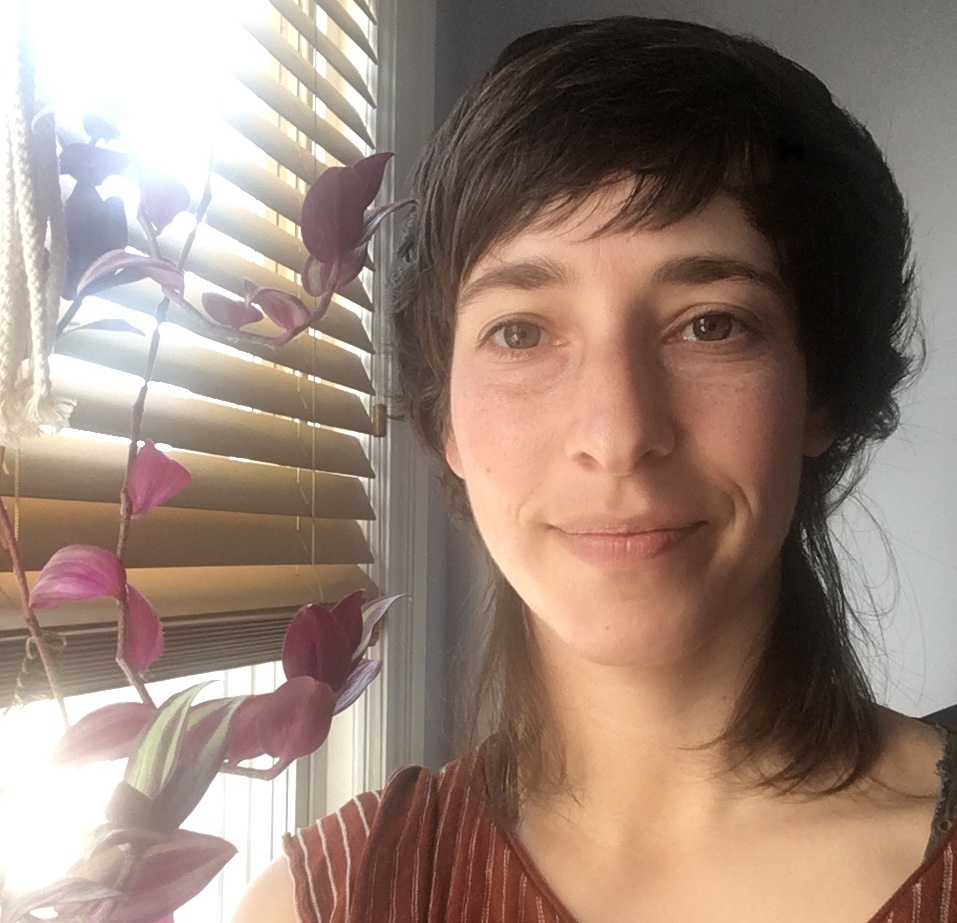 |
| Tatyana Tenenbaum (selfie courtesy of the artist) |
Choreographer/composer Tatyana Tenenbaum works with breath, voice, fascia and musculature to excavate spaces of power and transformation. Weaving embodied aleatory with deconstructed song, she has created numerous original interdisciplinary works for her own group, as well as collaborated with other artists as a sound designer and performer. Tenenbaum was a 2017-18 Movement Research AIR and recipient of commissions from The Chocolate Factory Theater, Danspace Project and Temple University, among others. She has worked with artists Yoshiko Chuma, Daria Faïn, Jennifer Monson, Emily Johnson/CATALYST, Levi Gonzalez, Juliana May, Andy Luo & lily bo shapiro, Hadar Ahuvia, and Okwui Okpokwasili and Peter Born. Together with Lydia Bell and Jasmine Hearn, she co-organized the collective terrain/s mini-platform on voice and choreography at Danspace Project. In conversation with Peter Sciocioli and Pyeng Threadgill, she co-instigated the Sounding Body workshop series at Movement Research. www.tatyanatenenbaum.com
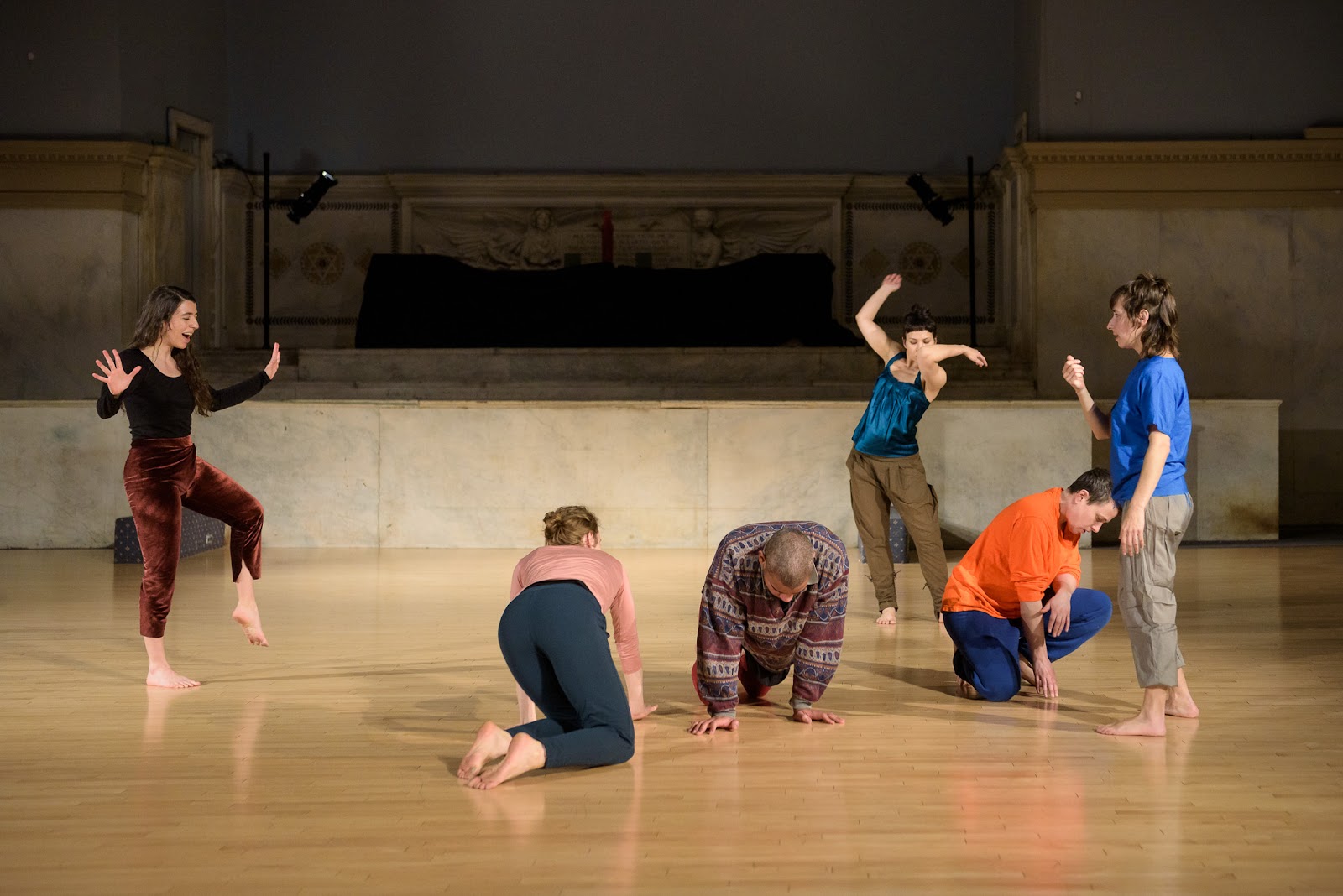 |
| Tatyana Tenenbaum and collaborators Rebeca Medina, Emily Moore, Pareena Lim, Jules Skloot and Saúl Ulerio (photo: Ian Douglas) |
Do you have a current or planned project whose progress is affected by the pandemic?
Yes, and no. This period of isolation actually coincided with an intentional moment of pause and tilling of my ongoing creative practice. I have been creating and facilitating collaborative group work--pretty consistently for the last 12 years. Both personally and financially, it was necessary for me to pause and nourish my practice in new ways. One of the undercurrents that has supported my work since 2014 is my relationship with artist Hadar Ahuvia. Descendants of twin diasporas (Hadar’s Jewish family settled in Palestine around the same time my Jewish family immigrated to the US), we have served as special eyes and ears for one another’s work. More recently we’ve begun to co-author text, music and lyrics, and to articulate a more expansive collaboration around folklore, ritual, memory, song and dance. Nicky Paraiso invited us to present work for La MaMa Moves! in June, but everything is up in the air. In the meantime, we are continuing our dialogue remotely.
Briefly, tell me about how you got involved in the arts and in your particular practice.
I was excited to read Kayvon Pourazar’s response to your questions, and to find out that we both read David Abram! For me, I was studying music composition at Oberlin Conservatory of Music, which turned out to be a simultaneously life-changing and traumatic educational event. I grew up steeped in musical theater, so my musical training largely came through participating in high school musicals and listening obsessively to the music of Stephen Sondheim. Oberlin exposed me to the beauty inherent in atonal dissonance, timbral and rhythmic complexity. These experiences were profoundly embodied. However, I was encouraged by my (white) male professors not to trust my body anymore--as it contained my pre-existing habits--and to approach music-making as a largely cerebral and conceptual practice. I was young and impressionable, and this was devastating. Reading Abram reassured me that all language is embodied. A hunger to reunite myself with a corporeal knowledge of sonic vibration led me to dance, and to unfurl the practice I have been building for the past decade.
In a more specific way, what are you practicing? And what are you envisioning?
My practice engages the voice as a corporeal material; as magical; as medicinal; as inter-generational; as communicative. I am practicing listening to myself, to others, to my ancestors, and to the world around me. A desire to feel “interconnectedness” is something that quite literally comes into being when sounding. Vibration resonates the physical body, but its sound waves move perpetually outward to resonate the space around us. Sound does not exist in a vacuum. Sound is healing! Lately, I have been returning to a practice of songwriting. I have been returning to the music of Stephen Sondheim and writing songs to him. I released a short EP of songs shortly before this epidemic. In these songs I am tracing the lineages of secular Jewish thought and assimilation that have impacted me and my body. I am speaking to various “thought ancestors” in their flawed fullness, seeking resource: Sigmund Freud, Rodgers & Hammerstein…Lynn Riggs. Maybe they’ll hear me.
How does your practice and your visioning align with what you most care about?
I mentioned my collaborative work already. It’s something we don’t acknowledge enough: this intentional labor of collaborative making. It is the building and nurturing of trust, shared language and ethics that runs under the soil of a work. I am fortunate to have many long-running collaborative relationships and am now seeing babies being born in my process. This fall, thanks to the organizing of collaborator Rebeca Medina, I decided to jump on a chance to perform in Bogotá, Colombia. We were able to perform at DIY artist-organized festival Pliegues y Despliegues. I was nervous to share my work in South America, but it translated powerfully--both the aleatory / deep listening aspects of the work, and the embodied critique of musical theater--which we were told evoked larger echoes of US cultural imperialism. Performing in another hemisphere and showing up in our collectivity caused us to clarify intentions deep into our bones. Leveraging all my resources for this trip is part of what necessitated a personal “pause,” but I don’t regret it. Especially in light of the Covid-19 shutdown. Because it brought my work and its collaborative relationships many levels deeper.
How does your practice function within the world we have now?
I am still tuning in to answer that question…but I think, as we constantly re-tune our bodies and listen, the answers will come. It’s not going to happen quickly, and that’s okay. I think the world has been changing for some time. Many people cannot afford to go to dance class every day. Artists have been building these very virtuosic practices that can change and propagate themselves in many circumstances. We must keep our creativity alive as a daily effort, large or small (see self-care tip below). One thing that I have been thinking about, with all the incredible organizing going on with Covid-19-related relief $ for artists, is having some real conversations with myself about where I need to be. Where am I in relationship to precarity, privilege and inter-generational wealth? Where does my energy and voice need to be right now? This is real, this is not a rehearsal. One thing that this mini “shut-down” of the art market has made clear, is that we NEED to be in this together.
Briefly share one self-care tip that has special meaning to you now.
Less effort. Slow down and feel all the parts of the movement. I always tell my performers this when it’s the performance because I noticed that they would push too hard in performance and the whole thing would be out of tune…. I always say, “with your voices, pretend you're just marking it.” Then it will sound perfect. I am trying this attitude on for size in my daily life as I can. Thank you to the Feldenkrais Method (particularly Belinda He, my first magical teacher) for seeding this practice into my body over the years. I am still a beginner.
******
DISCLAIMER: In addition to my work on InfiniteBody, I serve as Senior Curatorial Director of Gibney. The postings on this site are my own and do not necessarily reflect the views, strategies or opinions of Gibney.
******
 Subscribe in a reader


