Search This Blog

Showing posts with label France. Show all posts

Wednesday, November 29, 2017

Films coming soon: Loïe and Isadora; the Afro-Andalusian influence in flamenco


French indie music star and actress Soko stars in The Dancer.
(above and below)


The biopic--which premiered at the 2016 Cannes Film Festival
and was first seen in New York at Lincoln Center Film Society's
Rendez-Vous with French Film Festival this past March--
receives its US theatrical release on December 1.
Lily-Rose Depp as a rivalous Isadora Duncan


The Dancer
directed by Stéphanie Di Giusto
(108 min/France/French with English subtitles)

With her first feature film, The Dancer, director Stéphanie Di Giusto helps us imagine what it must have felt like to see American fin-de-siècle phenom Loïe Fuller (1862-1928) mounting a stage, aswirl in billowing silk and saturating spotlights, a theatrical innovator of monumental spectacle. For her stubborn if put-upon Loïe, Di Giusto deploys the fascinating French indie singer/actress Soko--an early Malcolm MacDowell or Marc Bolan lookalike whose favored black bowler hat might also have you flashing back to Liza Minnelli (Cabaret) and Lena Olin (The Unbearable Lightness of Being) but just briefly. She's far more androgynous than that--one character euphemistically describes her to an ardent male admirer as "standoffish"--and her struggles around sexuality underlie what the director clearly sees as inability to cope with the heedless, cruel pace of a world about to race past her.

Our first sight of Soko shows her nearly smothered in yards of fabric. But, no, she's not performing her famous Serpentine Dance. Instead, she's being rushed by several running men from the stage to either a hotel room or a hospital room; I could not tell which. Although we later learn why, it's enough, in that first moment, to identify Loïe with calamity and vulnerability. The film rarely lets up from that initial impression of her.

Next, we flash back to her as a sturdily-built, gloomy Midwestern girl--a very emo Mary Louise Fuller--sharing rough beginnings with her French-born, alcoholic father. He quickly ends up dead, leaving her at the mercy of a religion-obsessed mother. The cinematography of these early scenes has a heavy, depressing murkiness that rarely lifts from the film even when it is actually better lit. A biopic about an artist who illuminated stages with eye-popping light and magic is taken up with an atmosphere of grim darkness. But, again, Di Giusto seems intent on showing Loïe in pain, insecurity and discouragement.

There's the brutal physical pain of maneuvering those yards and yards of fabric, a feat that leaves her gasping for breath. Despite diligent conditioning, Loïe's body breaks down, time and again, and performing at all becomes a risk. But there's also emotional pain throughout Di Giusto's story--from the loss of Fuller's father to the ultimate betrayal wrought by one Isadora Duncan (Lily-Rose Depp), a youngster more conventionally feminine, at once more graceful and choreographically adventurous in movement and more given to displaying her body before the male gaze.

Mélanie Thierry does fine, delicately nuanced work as Gabrielle Bloch, Fuller's compassionate champion at the Paris Opera. She gives their scenes life and reminds you of Fuller even when the dancer is elsewhere, because you feel how vividly present Fuller is in her thoughts.

Don't come looking for a documentary. As the film opens, we're told that it is "based on a true story." Bear that "based on" in mind, if you will, and grant Di Giusto a little running room with her creative narrative. I suppose an educational film about how the real-life Loïe Fuller first dreamt up the notion of turning silk costuming into both motile sculpture and extraordinary canvases for her unique lighting effects might satisfy some but not many. Actually, we don't get to learn a whole lot more about Isadora Duncan, significant pioneer in her own right, and Depp brings little of interest to her role.

I've long been drawn to both of these legendary artists. I really only perked up when Soko--well-trained by contemporary dance artist Jody Sperling, acclaimed Loïe Fuller specialist and choreographer for the film--dons her costumes and models the sort of transformational stagecraft for which Fuller became famous.

The Dancer opens in theaters Friday, December 1.

Also coming soon...

Gurumbé: Afro-Andalusian Memories
directed by Miguel Ángel Rosales
film screening and flamenco performance
Sunday, December 3, 7pm to 9:30pm
Gurumbé: Afro-Andalusian Memories, a feature-length documentary from anthropologist Miguel Ángel Rosales, explores the contribution of Afro-Andalusians to flamenco as the art form developed. Gurumbé (72 min, in Spanish with English subtitles) has won numerous awards in the festival circuit and it is currently premiering around the world.
Flamenco performance by dancer Yinka Ese Graves and live musicians

Roundtable with the performers and the director, moderated by
K. Meira Goldberg, author of Flamenco on the Global Stage and Sonidos Negros: On the Blackness of Flamenco (forthcoming, Oxford University Press)

TICKETS

La Nacional
239 West 14th Street, Manhattan
(map/directions)

Subscribe in a reader

Friday, October 6, 2017

What's Next? A solo for the great Germaine Acogny

Germaine Acogny is performing the New York premiere
of a work by Olivier Dubois of Ballet du Nord
at BAM Next Wave.

Sounds of a bassoon undulate like incense in the absolute dark of BAM Fisher's space. We're taking first, tentative steps into the mystery of Le Sacré du Printemps with choreographer Olivier Dubois of Ballet du Nord.

In this imagining of Stravinsky's rite, Mon élue noire (My Black Chosen One): Sacre #2, a 2014 solo for septuagenarian Germaine Acogny, Dubois first makes the audience wait in darkness through long stretches of music. We wait in the cloying aroma of tobacco from, as we later learn, a pipe gripped in the dancer's teeth. Intermittent flashes of light--a thin line vertical line--tease us. The music dials up uncertainty, tension, apprehension.

It's a while before we get a stable-enough look at Acogny and her setting--a platform in a black box that, over the course of the nearly 40-minute dance, confines her, sometimes elevating or partially obscuring her. She wears a black bra and slacks. One's immediate, disturbing thought: Dubois has turned her into a specimen for display.

Her close-shaved head emphasizes formidable features. She stomps the floor like a bull ready for battle. We continue to be stymied and tantalized by fugitive light and the afterimage that it leaves.

Talking to herself, laughing to herself, wrapping her head in black cloth and dragging it off, Acogny is a woman on the verge...of something. A woman to be admired at one moment and feared the next. One passage though, where she mimics the blare and clash of the music in voice and harsh movement, seems a weak offering, merely ordinary after the audacity of the work's initial staging. The regal and storied dancer looks merely petulant.

Were it not for the program's hair-raising quotes from writings by Aimé Césaire--one on the ravages of colonization, the other excoriating anyone who would stand apart, as a spectator, while the world burns--it might be tricky to figure out who Acogny might be, as dreamed up by Dubois, or read her actions said to be "drawn from the depths of her African soul."

In any event, any chance to see the influential Acogny perform here is a worthy occasion. Final performances are tonight and tomorrow, Saturday, at 7:30pm. For information and tickets, click here.

For more information on the 2017 BAM Next Wave festival, click here.

BAM Fisher
321 Ashland Place, Brooklyn
(map/directions)

Subscribe in a reader

Anne Wiazemsky, 70

Anne Wiazemsky, Film Star, Wife of Godard and Author, Dies at 70
by Sam Roberts, The New York Times, October 5, 2017

Subscribe in a reader


Saturday, September 23, 2017

Women and trauma: Munyaneza's "Unwanted" comes to New York

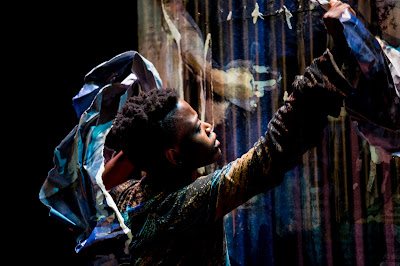
Above: Holland Andrews (left) and Dorothée Munyaneza
perform the New York premiere of Unwanted
at Baryshnikov Arts Center.
Below: Munyaneza
(photos: Maria Baranova)


When women rise to speak difficult truths, we are told to sit down and shut up. When Black women rise to speak difficult truths, we are told to sit down and shut up. When Black African women....

Now here comes Dorothée Munyaneza (Compagnie Kadidi) who, as a child, escaped conflict-torn Rwanda, speaking of what men do to women and girls in war, same as it ever was. This woman will not comply. She will tell terrible stories told and entrusted to her by Tutsi women survivors and their children. In Unwanted, she joins American singer Holland Andrews, raising lacerating banshee voices against genocide and rape, raising angelic voices to embrace all in need of comforting.

The two figures emerged like shamans from the grim darkness of the theater at Baryshnikov Arts Center where Unwanted had its New York premiere over, sadly, just two evenings. Audience members had reached BAC, walking streets with views of the imposing towers of a newly glittery midtown West. Taking the elevator up to BAC's third floor and entering the theater felt like being sealed deep in a cave with healers intent on confronting you with everything you try best not to see. And sounds--Andrews' looping electronic artistry--came to you from all directions and temporal dimensions.

Many observers, it seems, are surprised to find the multi-talented Munyaneza so grounded and assured in her physical presence, so sophisticated in her aesthetic vision. Unwanted is only her second work of choreography; she was the talk of last year's Under the Radar festival for her first, Samedi Détente. But she is clearly an artist who knows her mission, mind and powers. There's more to come from this one, and in singer-musician Andrews--who cites Aretha Franklin, Björk and Diamanda Galás among her dearest influences--she has a fierce partner of equal authority and efficacy.

Choreography, in this case, covers all the ways the body reacts and responds in an environment of impossibility and possibility. Munyaneza's head and torso sharply recoiling from the words she has just hurled into a microphone as if receiving an answering blow. Or her body flattening itself against the portrait of a woman affixed to a tall slab of corrugated tin, like the metal sheeting of a humble roof. Or her fingers feverishly clawing that same painted image into shards of paper waste, needing to destroy every patch, every trace, before she can rest. Or the performers' bodies mobilizing their entire force, lashing phallic clubs against the ground or rhythmically, violently pounding them into vessels. It is, yes, also the breath traveling from its home in the chest to receiving air, carrying histories of violation, humiliation, refusal and isolation. Channeling stories of women who tell themselves they are alive and look around, each day, for something to laugh about. It is in the story of that laughter which, surrounded by unquestionable sadness, still declares "I am here. I stand my ground."

Music: Holland Andrews, Alain Mahé, Dorothée Munyaneza
Visual design: Bruce Clarke
Set design: Vincent Gadras
Lighting Design: Christian Dubet
Costume Design: Stéphanie Coudert

Unwanted is closed. For information on other Baryshnikov Arts Center fall season events, click here.

Subscribe in a reader

Friday, June 30, 2017

The Guggenheim's journey into the mystic


Armand Point: The Annunciation or Ancilla Domini (L’Annonciation), 1895
Tempera on panel, 99 x 51 cm
Private collection, courtesy Sotheby’s
Photo: Courtesy Sotheby’s


Solomon R. Guggenheim Museum

presents


Open now through October 4


Ferdinand Hodler: The Disappointed Souls (Les âmes déçues), 1892
Oil on canvas, 120 x 299 cm
Kuntsmuseum Bern, Staat Bern
Photo: Courtesy Kuntsmuseum Bern, Staat Bern


"The world is too much with us," wrote William Wordsworth, critiquing new realities wrought in Britain's first Industrial Age. Nearly a century later, French Rosicrucian writer Joséphin Péladan (1858–1918) struck a similar note, creating space for artists seeking refuge from a swiftly-changing Europe through the embrace of classical myth, Biblical narratives, nature's elevating beauty and the more ethereal, spiritual climes of imagination. The Guggenheim's new show, Mystical Symbolism: The Salon de la Rose+Croix, curated by Vivien Greene, samples Symbolist works that appeared in Péladan's annual salon of international works in Paris over its six years, 1892-1897.


Installation view
Photo: David Heald
©Solomon R. Guggenheim Foundation, 2017


Greene's installation spaces these works in a way that would encourage the sort of concentration and contemplation Péladan surely intended to inspire. But with its wan religious iconography intertwined with pagan flourishes, inert androgyny and women relegated to either virginal or monstrous roles, most of this visual art will likely merit attention mainly for its historical, influential connections to other artistic mediums of the period. I glanced at and breezed by much of it--the familiar (Khnopff, Delville) and the unexpected, such as Charles Maurin's remarkably political painting, The Dawn of Labor--but did find myself lingering with one pencil-and-chalk work on paper.

Armand Point's April or Saint Cecilia (1896) depicts the martyred patron of musicians strumming her harp before a lush cascade of ivy. Point's chiseled modeling of the bones of Cecilia's articulated hands held my eyes once and again. We are meant to notice those bones. Although willowy and idealized in her femininity, Cecilia is neither flattened nor vague and evanescent, unlike so many of the good girls and femmes mystérieuses rendered in Symbolist allegory. She fully inhabits a defined, structured body. And like legendary Orpheus, a subject popular with the Symbolists, she expresses a transcendent power through music.

Audio introduction to the exhibit and related poetry readings: click

Related programming: click

Visitor information: click

Ticketing: click

Guggenheim Museum
1071 Fifth Avenue (between 88th and 89th Streets), Manhattan
(map/directions)

Subscribe in a reader

Sunday, March 6, 2016

That new French magic from CIE 14:20

Shadow puppeteer Philippe Beau and his avian friend
(photo courtesy of CIE 14:20) 

What quiets a theater packed with boisterous kids and parents? Phillippe Beau's shadow puppetry, for one thing. I speak with confidence, having heard that with my own ears at French Institute Alliance Française's Florence Gould Hall, one of several city hosts for the new Tilt Kids Festival. Launched by FIAF and the Cultural Services of the French Embassy, the festival offers a wealth of family-oriented arts, ideas and fun at venues like BAM Fisher, The Invisible Dog Art Center and, of course, Time Square's New Victory Theater. It runs through April 3.

Accompanied by the wonderful pianist Madeleine Cazenave, Beau performed a segment in the magie nouvelle (new magic) production, Cabaret de Magie Nouvelle, presented by CIE 14:20. The Parisian troupe also featured renowned sleight-of-hand magician, Yann Frisch. If you missed these two masterful performers, I'm sad for you. Don't let that happen again.

My attempt to recreate Beau's tricks in order to describe them better for you has proven futile (and might require hand splints). Let me just say that this digital magician does not only pull a rabbit out of the "hat" of his imagination but produces a complete menagerie of animals--a stag with magnificent antlers; a snarling wolf; a galloping, rearing horse; a cat with swishing tail, licking its fur and scratching its ear. A bird feeds its young, later teaching the fledgling how to fly. A lover plants a kiss on a shyer, somewhat startled partner. Even the Devil himself makes an appearance. I'm not sure why but, hey, if you can form a Devil shape with your shadow puppetry, why the hell not?

If your notion of shadow puppetry has always been something amateurish and cheesy, please, get over yourself. This is new shadow puppetry. (I might as well follow the French trend of "new circus," "new magic," "new whatever.") As practiced by Beau, it is a razor-sharp storytelling skill and damned awesome.

Cabaret de Magie Nouvelle has closed, but there's much more Tilt up ahead through April 3, from the visual to the gastronomic arts, co-curated by Lili Chopra (FIAF) and Violaine Huisman (BAM). For information on the festival's lineup, click here.

If you like what you're reading,
subscribe to InfiniteBody!

Copyright notice

Copyright © 2007-2023 Eva Yaa Asantewaa
All Rights Reserved

Popular Posts

Labels