Search This Blog

Showing posts with label trauma. Show all posts

Sunday, August 14, 2022

GUEST REVIEW: Choreographer Alexandra Beller Directs DE-CRUIT’s Macbeth Adaptation

GUEST REVIEW:

Choreographer Alexandra Beller Directs DE-CRUIT’s Macbeth Adaptation

by Kate Foster Vishniakova


The struggle is real. In 55 minutes, Make Thick My Blood at Theatre Row reveals what most productions of Macbeth ignore: the physical and psychological trauma a couple faces after the loss of a child.


The story usually told of Macbeth is one soldier ascending to the throne as king by killing its predecessor. Make Thick My Blood presents that story differently. There are two soldiers, not one. There are two crowns, not one. There are two struggles, not one. This is the story of two soldiers, a couple, carrying the dead weight of loss, fighting to fill the void that grief created, and reflecting back at each other the trauma they share.


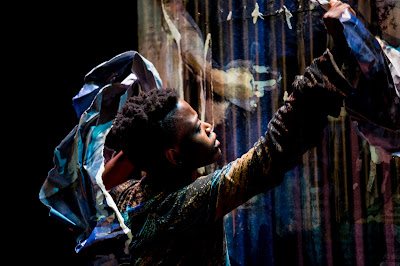
Dawn Stern as Lady Macbeth (photo: Ashley Garrett)


The audience enters into a small, intimate space. The stage is covered with a burlap tarp reminiscent of a bunker, but the calm music suggests the war is already over. Lady Macbeth (Dawn Stern) is center stage on the ground bowing down, shrouded in a dress of mourning. Macbeth (Stephan Wolfert) enters, and the two fall into a dance of simple, sharp movements. Shoulders drop into a slumber, he carries her as she tries to hold on, he crawls away, fighting the air, fighting the mind, fighting to the top, to only collapse, and repeat. What weighs them down is the bright red stain revealed on Lady Macbeth's white undergarment.


The light splashes the entire stage red, and we are at the top of the play. We see the Macbeths grapple with the loss of their child. 


Her body becomes the dagger he sees. When Lady Macbeth convinces Macbeth to murder the King, it is not only with her words, but with her body as the weapon. Maybe if he does this, they can finally move on and forget their loss.


When they ascend to the throne, they wear identical crowns. They turn to face each other; a haunting reflection where they see the dark damned spots of their past. They walk slowly hand-in-hand, bearing equal weight of the glory and consequences of their actions. Loss of a second life does not replace the first.


A baby's cry is knocking. Their inevitable deaths are soon to come.


Stephan Wolfert as Macbeth with Dawn Stern (photo: Ashley Garrett)


DE-CRUIT, founded by Wolfert and Stern, adapts Shakespeare's texts through the lens of trauma survivors. Make Thick My Blood is no exception. After their loss, Lady Macbeth is present in everything that Macbeth hears, sees, and does. It is in her body that they lose their baby, and it is from that point on that her presence and this traumatic memory never escape Macbeth's mind. 


What is refreshing is that this production could have focused only on the nightmare. But it focuses on the effort to wake up; the effort to move on from what no human can fully move on from: the loss of a loved one. The movement in this production, under the helm of Alexandra Beller, an award-winning choreographer in her directorial debut, successfully brings the full range of emotion felt by the couple to the surface. The adaptation and direction carved out space for empathy and relatability in a story that other productions typically leave out. The story of one couple's trauma reminds us that, in our bodies, we all carry the presence of past trauma and that it can manifest itself in unpredictable ways.


[CLOSED AUGUST 6, 2022]


******


Kate Foster Vishniakova (photo courtesy of the writer)


Kate Foster Vishniakova is a dramaturg working in international and intercultural theater. She trained with artists at the Moscow Art Theatre School, in Germany as a DAAD grant recipient, and with IUGTE–International University Global Theatre Experience. She is a research dramaturg with the Verbatim Performance Lab at NYU and an HR consultant at Orr Group. MA German, Wayne State University. MFA Dramaturgy, Columbia University.

Friday, September 7, 2018

World premiere of Geraldine Inoa's "Scraps" at The Flea

Roland Lane (left), Alana Raquel Bowers (bottom center),
Michael Oloyede (top center) and Tanyamaria (right).
the main cast members of Scraps at The Flea
(photo: Hunter Canning)

What we always hear: “Black Male Shot by White Police Officer.” What we never see: how loved ones struggle to cope amidst their anger and grief.
-- from program notes for Scraps

In its new Tribeca home and its fresh new season devoted to "Color Brave" programming, The Flea Theater comes out swinging with Scraps, a psychological drama by LA-based playwright and television writer Geraldine Inoa, directed by Niegel Smith. With a strategy similar to Jackie Sibblies Drury's recent Fairview (Soho Rep), another theater piece examining race in America, Inoa carefully grounds her audience in the familiar before hauling us into bizarre territory. Hard to tell, though, which one hauls with the rougher hand: Fairview's second and third acts seem more cleverly conceptual while Scraps goes full-out surreal nightmare with a menacing Greek tragedy-style chorus.

The 85-minute piece takes place in The Flea's tiny Siggy Theater on a shallow stage not even a leg-stretch away from the audience's first row, a set-up that will only become more engulfing and threatening as this tale of Black urban life and racist police violence proceeds. Inoa introduces us to four main characters--connected by race, culture, neighborhood and personal history--whose interactions become complicated by grief, resentment and fear.

All roles are played by members of the Flea's resident acting troupe, The Bats. We first meet unemployed Jean-Baptiste (Roland Lane) who deftly raps up a bleak, nearly Shakespearean take on the prospects for a Black man under white supremacy. Like his namesake, he's a voice of one crying in the wilderness, and a stern warning.

Inoa quickly--maybe too much so, too stereotypically--gives him a nemesis in the form of Calvin (Michael Oloyede), a London-based college student now home in Bed-Stuy for only a brief visit. Calvin, looking casually-sharp in a way that immediately ticks off Jean-Baptiste, has been able to avoid dealing with the police killing of an unarmed Black man they both knew. Calvin longs to get back in the good graces of Aisha (Alana Raquel Bowers), single mother and young widow of the slain man. Though none too pleased with Calvin either, the alternately sunny, bone-tired and volatile Aisha is susceptible. But her sister Adriana (Tanyamaria) carries the heaviest burden of all, a trauma she tries to conceal with good humor and toughness. Tries and repeatedly fails.

This quartet of skilled actors has energy to burn, particularly Bowers and Tanyamaria who, when they get going with their lines, leave us in the dust, hyperventilating, unable to catch up. Of all, even Jean-Baptiste, Inoa gives the women the best language. But all actors turn on extraordinary ferocity in the final, disturbing developments of the story, which I will not reveal here.

Where Sibblies Drury concluded Fairview with a panoramic view of white privilege, boldly implicating her audience, Inoa maintains focus on the tragedy of unhealed racial trauma passed from generation to generation.

Other cast members: Andrew Baldwin, Bryn Carter

Sets: Ao Li
Costumes: Andy Jean
Lighting: Kate McGee
Sound: Megan Deets Culley
Violence choreography: Michael G. Chin

Scraps continues at The Flea through September 24. For information and tickets, click here.

The Flea Theater
20 Thomas Street, Manhattan
(map/directions)

Subscribe in a reader

Tuesday, January 16, 2018

American Realness: "We Wait In The Darkness" by Rosy Simas

Rosy Simas in her solo We Wait In The Darkness
(photo: Ian Douglas)


Rosy Simas Danse
We Wait In The Darkness (New York premiere)
co-presented by Abrons Arts Center and Gibney Dance for
American Realness 2018 at Abrons Arts Center

Recent scientific study verifies what many Native people have always known, that traumatic events in our ancestors lives are in our bodies, blood and bones. These events leave molecular scars adhering to our DNA. Our grandmother’s tragic childhood can trigger depression or anxiety in us, but we have the ability to heal these DNA encodings and change that trait for future generations.
--Rosy Simas 

For people of the Black African diaspora, too, these words from Minneapolis-based dance artist Rosy Simas (Seneca, Heron Clan) ring true, and I must begin with gratitude to Simas for work that illustrates the body as truth-teller and healer. We, too, are a people nurtured by connection to ancestors with tragic histories in this hemisphere, and many of us express reverence for ancestral heritage through powerful spiritual and artistic practices that are, in their way, forms of anti-colonial resistance and justice-making.

Simas's 50-minute solo, We Wait In The Darkness--with its soundscape by composer François Richomme--uses visual, textual, kinetic and sonic mediums to affirm and reclaim the strength of ancestry and environment. By employing this sensory overlapping and overload, viewers grasp what it must be like to uncover the memories one's body holds--some sweet, some painful, some subtle or slow to emerge, some earthshaking--and to tap its wisdom.

Over one end of the stage hangs Simas's long, white paper model of a DNA strand. Towards the center back a white, puff-sleeved dress with a long, old-fashioned dirndl skirt dangles. Along stage left, Simas has suspended a series of white paper panels textured like fine quilts. Panels also capture film imagery, often hazy, glimmering and ethereal, that allude to place--and sometimes people--without specific identification for the benefit of those outside Seneca culture. This poetically elusive quality renders the work as ritual rather than documentary, gives it a spaciousness rather than containing it as the story of a particular individual--although we do hear a voiceover of actual letters of Simas's grandmother, as read by her mother, and we also hear words in the Seneca language gruffly whispered as Simas dances. So, precious, protected mystery exists but also a certain porosity and generosity to help all of us begin to understand the possibility and path of healing.

Theater of both the vivid and the indistinct, then. As Simas sits with her naked back to the audience--spine and arms deeply flexing, stretching and reaching, snaking and twisting--I recall my first realization, when I practiced energy healing, that the back shares more information, without a person's conscious intervention and manipulation, than the front of the body. Throughout the dance, even when she finally dons that white dress, Simas shows us a body of focused, determined will, sure of itself, sure of its mission, sure of the ultimate fulfillment of that mission. We come to understand the evocative sound and visual imagery--drawn from earth and waterways of Seneca land--as its sacred source. And we also contemplate what it meant, for indigenous people, to be literally torn from that grounding, nourishing source. Her body speaks as it moves, and it is saying: I will this. I call this back. The spirits of the land respond in Richomme's mesmerizing, commanding weave of sound.

Near the end of the piece, projections of schematic diagrams suggest maps with numbered sections, a landscape reduced to arbitrary parts for some entity's benefit. Again, nothing is identified, verbally or visually, yet the implications are clear. An environment we just experienced so powerfully in sight and sound, now lies butchered. Simas brings out a sheet of white paper marked with this diagram, solemnly ripping each section from its matrix and placing each strip in a carefully-chosen position along the edge of the floor. She also rips away more of these sections before descending into the audience and gifting them to several of us.

I received number 12. Although I have no idea what territory--real or metaphoric--that it might represent, I will preserve and treasure it.

Letter reader: Laura Waterman Wittstock (Simas’s mother)
Letters: Clarinda Waterman (Simas’s grandmother)
Lighting design: Karin Olson and Carolyn Wong
Set and film design: Rosy Simas

Closed. American Realness 2018 concludes this evening. For further information, click here.

Subscribe in a reader

Saturday, September 23, 2017

Women and trauma: Munyaneza's "Unwanted" comes to New York

Above: Holland Andrews (left) and Dorothée Munyaneza
perform the New York premiere of Unwanted
at Baryshnikov Arts Center.
Below: Munyaneza
(photos: Maria Baranova)


When women rise to speak difficult truths, we are told to sit down and shut up. When Black women rise to speak difficult truths, we are told to sit down and shut up. When Black African women....

Now here comes Dorothée Munyaneza (Compagnie Kadidi) who, as a child, escaped conflict-torn Rwanda, speaking of what men do to women and girls in war, same as it ever was. This woman will not comply. She will tell terrible stories told and entrusted to her by Tutsi women survivors and their children. In Unwanted, she joins American singer Holland Andrews, raising lacerating banshee voices against genocide and rape, raising angelic voices to embrace all in need of comforting.

The two figures emerged like shamans from the grim darkness of the theater at Baryshnikov Arts Center where Unwanted had its New York premiere over, sadly, just two evenings. Audience members had reached BAC, walking streets with views of the imposing towers of a newly glittery midtown West. Taking the elevator up to BAC's third floor and entering the theater felt like being sealed deep in a cave with healers intent on confronting you with everything you try best not to see. And sounds--Andrews' looping electronic artistry--came to you from all directions and temporal dimensions.

Many observers, it seems, are surprised to find the multi-talented Munyaneza so grounded and assured in her physical presence, so sophisticated in her aesthetic vision. Unwanted is only her second work of choreography; she was the talk of last year's Under the Radar festival for her first, Samedi Détente. But she is clearly an artist who knows her mission, mind and powers. There's more to come from this one, and in singer-musician Andrews--who cites Aretha Franklin, Björk and Diamanda Galás among her dearest influences--she has a fierce partner of equal authority and efficacy.

Choreography, in this case, covers all the ways the body reacts and responds in an environment of impossibility and possibility. Munyaneza's head and torso sharply recoiling from the words she has just hurled into a microphone as if receiving an answering blow. Or her body flattening itself against the portrait of a woman affixed to a tall slab of corrugated tin, like the metal sheeting of a humble roof. Or her fingers feverishly clawing that same painted image into shards of paper waste, needing to destroy every patch, every trace, before she can rest. Or the performers' bodies mobilizing their entire force, lashing phallic clubs against the ground or rhythmically, violently pounding them into vessels. It is, yes, also the breath traveling from its home in the chest to receiving air, carrying histories of violation, humiliation, refusal and isolation. Channeling stories of women who tell themselves they are alive and look around, each day, for something to laugh about. It is in the story of that laughter which, surrounded by unquestionable sadness, still declares "I am here. I stand my ground."

Music: Holland Andrews, Alain Mahé, Dorothée Munyaneza
Visual design: Bruce Clarke
Set design: Vincent Gadras
Lighting Design: Christian Dubet
Costume Design: Stéphanie Coudert

Unwanted is closed. For information on other Baryshnikov Arts Center fall season events, click here.

Subscribe in a reader

Wednesday, December 9, 2015

Claudia Rankine, at 92Y, on the psyche under racism

Claudia Rankine

Poet Claudia Rankine's multiple award-winning Citizen: An American Lyric (2014) artfully documents the experience of being Black and embattled by racist aggressions, both macro and micro. Some of these aggressions can be so very, very subtle as to make the person on the receiving end wonder if she is imagining things. In a society in deep, purposeful, willful denial about the legacy and continued pervasiveness of racism, Black people walk around with original trauma compounded, on the daily, in numerous ways that can tear at our overall well-being. Rankine brings all of this out in her book, and it was exciting to see this literary hero in person and hear her read passages from Citizen last night in an Unterberg Poetry Center event at 92Y.

Billed as "a conversation on art, trauma and social justice," the evening opened well with Rankine's introductory remarks and reading but took an odd turn as Cleonie White and Sarah Stemp, clinicians from the William Alanson White Institute for Psychiatry, Psychoanalysis, and Psychology, joined the author onstage. That might have seemed a reasonable pairing, given Rankine's concern for the way that racism threatens the health of individuals as well as societies. However, it turned awkward, particularly as Stemp delivered a long, labored statement before the increasingly restive audience.

Rankine betrayed no impatience, but the multigenerational, largely white crowd voiced displeasure several times, yelling "Ask questions!" at Stemp and even criticizing one another when, after something like 75 minutes, the floor was finally opened for their own questions. Even before the outbursts, though, you could sense an unhappy vibe around the hall. It felt less like a dignified literary event and more like a music gig where the crowd realizes it isn't getting what it came for.

At one point, Rankine mentioned the concept of "ethical loneliness"--that undercurrent of isolation--when you live in a society diametrically opposed to your ethics. Her observation was not only intellectual, it had a personal feeling tone that reached me. I got my pen out and made a note just as Rankine took matters further, adding how hard it is, in that situation, "if you don't have people...or you can't pay for people."

That got White's attention. She quickly responded that the Institute accepts sliding scale, a defensive rejoinder that seemed to come from out of nowhere. How had White envisioned this event, then? As a marketing tool?

I turned to the friendly woman on my right and whispered, "This is just not gelling. I don't know what's going on here." She agreed--"It's like they didn't communicate beforehand"--and made an early exit. I hung on but left a little bit into the audience Q&A.

So, what to tell you? Read Citizen: An American Lyric. Just read it.

For information on upcoming events at 92Y, click here.

92nd St Y
Lexington Avenue and 92nd Street, Manhattan
(map/directions)

Monday, November 25, 2013

Megan Kendzior calls us to "Witness"

Scenes from Witness by Megan Kendzior
Top photo by Crystal Edwards
Bottom photo by Victoria Sendra
Choreographer Megan Kendzior will present a new, full-length version of her ensemble work Witness, a Danspace Project commission, December 19-21. Although inspired by her visit to Auschwitz, Witness has broad and ongoing relevance. Kendzior considers it her form of protest against indifference. Its title can serve both as a noun and a command, a call to empathy and responsibility.

I began this piece in 2009 after I visited the Auschwitz concentration camp, and it has had many different incarnations. For this commission by Danspace Project, I created a new work under the same name.
It's a form of research that involves specific first-hand accounts of Holocaust experiences that we then translate through our bodies and our voices to provide an embodied historical depiction through the memory of one woman, referencing trauma in her past. She summons these other beings into the space.
I'm questioning the role of the spectator. With full respect and honor to victims of genocide and trauma, I want to continue to tell stories that challenge our current behaviors. I'm asking you to watch what's hard to watch and to go through it.

Witness will be performed at 8pm, Thursday-Saturday, December 19-21. On Friday, December 20, Kendzior plans to offer an afternoon performance of a shortened version including some of her young students from Harlem and a talk with one of the very few Latvian survivors of the Holocaust. For complete information and tickets, click here.

Danspace Project
131 East 10th Street (corner Second Avenue), Manhattan
(directions)

Saturday, November 16, 2013

Trio of poets to present "The Poetry of Survival" at CUNY


On Wednesday, November 20, poets Antoinette Bennett, Vaseah Dupree and Melinda Goodman will present the first in a series of mixed-media theater programs dedicated to survivors of physical, mental and psychic violence and for those who are close to them or care for them. This event is free (with RSVP) and open to the public.

The Poetry of Survival
November 20 (7pm–9pm)

Segal Theatre
The Graduate Center, CUNY
Depression, anger, shame, and hatred are some of the issues that many survivors have to deal with on a daily basis. It takes hard work not to be consumed with fear, flashbacks, and ingrained patterns of self-destruction. Additionally, some of us struggle with HIV, AIDS, addiction, and other physical and mental illnesses while trying to support ourselves and our dependents on very limited economic resources.
Ultimately, it’s not enough to just "survive" our childhoods. In fact, in order to really survive we need to thrive. Thriving means finding the flame inside ourselves and each other that makes us glad to be alive. The combined story of survival that these poets are bringing to the table is an inspiring celebration of life through written and spoken word in a multi-media theater presentation.
Writer Bios

Antoinette Bennett is a writer, artist, cancer survivor and PWA whose work is informed by the depth of her spiritual foundation. As a survivor of incest and the child pornography industry, Antoinette’s long journey has involved many years of crack addiction during which she lived in the tunnels of New York City and gave birth to eleven children. She has been a featured speaker at numerous conferences throughout the country and she is only three credits short of her MFA from The School of Visual Arts.

Vaseah Dupree is a spoken word artist and creative writer who grew up in Brownsville, Brooklyn during the height of the drug wars and the AIDS/HIV epidemic. She is a survivor of Urban America, sexual, physical, verbal and domestic abuse. While struggling to cope with the affects of the environment in which she grew up, Vaseah received her Associates Degree from BMCC and she plans on continuing her education.

Melinda Goodman is a poet, writer, and producer who has taught at Hunter College since 1987. She is a recipient of awards and/or fellowships from the Astraea Foundation, Columbia University, and New York Foundation on the Arts.

For your FREE ticket, please RSVP here.

For information, click here
or on The Poetry of Survival's Facebook event page here.

Segal Theatre
The Graduate Center, CUNY
365 Fifth Avenue (between 34th and 35th Streets), Manhattan

Monday, August 5, 2013

To heal, you have to move your body!

Restoring the Body: Bessel van der Kolk on Yoga, EMDR, and Treating Trauma (audio 51:23)
Krista Tippett, On Being, July 11, 2013
Human memory is a sensory experience says psychiatrist Bessel van der Kolk. Through his longtime research and innovation in trauma treatment, he shares what he's learning how bodywork like yoga or eye movement therapy can restore a sense of goodness and safety. And what he’s learning speaks to a resilience we can all cultivate in the face of the overwhelming events that after all make up the drama of culture, of news, of life.

Thursday, June 14, 2012

Susan Rethorst: A Choreographic Mind

I've just finished reading essays by a dancemaker who, while pressing words to fine use, celebrates quiet, visceral intuition over verbal, intellectual modes of being that are usually more highly prized. Susan Rethorst's A Choreographic Mind: Autobodygraphical Writings (Teatterikorkeakoulu: Kinesis 2, 2012) takes her readers deep into the sensibilities of an artist who chooses to embrace "not knowing, not quite controlling," honoring what her body tells her and what the dances she makes tell her, too.

The book presents two strands for us to follow: Rethorst's life-altering experiences in youth and her application of personal transformation to creative process. In a custody dispute, her father kidnapped her and her brother Johnny when they were quite young. Two years later, he kidnapped the boy again and, this time, she would not see Johnny until he was 21. I get the impression that while Rethorst must relate this disturbing history--which left her, into adulthood, disinclined to speak but inclined to watch people intently and read the subtle currents and language of bodies--she does so only to set the stage for a calm exploration of how dances are made, how they reveal and present themselves and how they might best be perceived by maker and witness alike.

Rethorst's discussions could benefit fellow choreographers; clearly, she hopes to share her ideas with young artists who frequently stumble over treacherous piles of shoulds and shouldn'ts--what this favored artist does, what that prominent critic appears to reject or champion, what Teacher says is the right thing to do, what's trendy among peers or presenters this season. To these artists, she offers her trust in the unconscious, the body, the ongoing conversation with the dance itself.

The mainstream dance critic, picking up this book, will feel his/her ears burn:

Basically, they tell you what they want to see, and how the piece before them does, or does not, answer to that. It is rare to hear people try to cut through their own taste to try to examine what the dance maker is doing with the form.
Elsewhere, she writes,

What it, the dance, is doing is a door to see what it is valuing, what its goals are, how it functions. Talk about dance is too often, in my opinion, full of implied lack, and the lacks reveal what the particular talker desires to get out of dance.
For someone who grew up not caring to talk much--and, in this and in Rethorst's talent for intuitive perception of people, spaces and things, I strongly identify with her--she certainly enlivens these pages with an impressive, persuasive voice. But, she advises, "don't take my word for it." (Word. There's that word, again....) Yes, your mileage may vary at times, but the journey will take you places you could never anticipate.

Copyright notice

Copyright © 2007-2023 Eva Yaa Asantewaa
All Rights Reserved

Popular Posts

Labels