Search This Blog

Showing posts with label feminism. Show all posts

Tuesday, March 3, 2020

Colleen Thomas: Woman power is persistent and global

Dance artist Colleen Thomas.
(photo: Lovin Ostenrik)

Joanna Leśnierowska (below) in light and desire
(photo: Miguel Anaya)


This year marks the centennial of the ratification of the 19th Amendment to the U.S. Constitution (August 18, 1920), which granted women citizens the right to vote. light and desire--a new, full-evening dance ensemble by Colleen Thomas and her multi-national team of collaborators--comes at a time when lack of respect for women’s political leadership is again a matter of concern and struggle. The piece will have its world premiere at New York Live Arts, March 25-28 (7:30pm), during Women’s History Month.


Colleen Thomas (US), director, performer
Ermira Goro (Albania/Greece), performer
Joanna Leśnierowska (Poland), performer
Ildikó Tóth (Hungary/Germany), performer
Rosalynde Le Blanc (US), performer
Carla Forte (Venezuela), film director, performer
Alexey Taran DP for film
Stacey-Jo Marine, lighting design
Rebecca Makus, mask design
Robert Boston, musician/composer featuring Jo Morris, voice

For further information and tickets, click here.

______________________________________________________

Yesterday morning, I met with Thomas at Gibney to learn more about light and desire. Read on for what she had to say about the concept and making of this timely piece on women's resistance and radical expression.

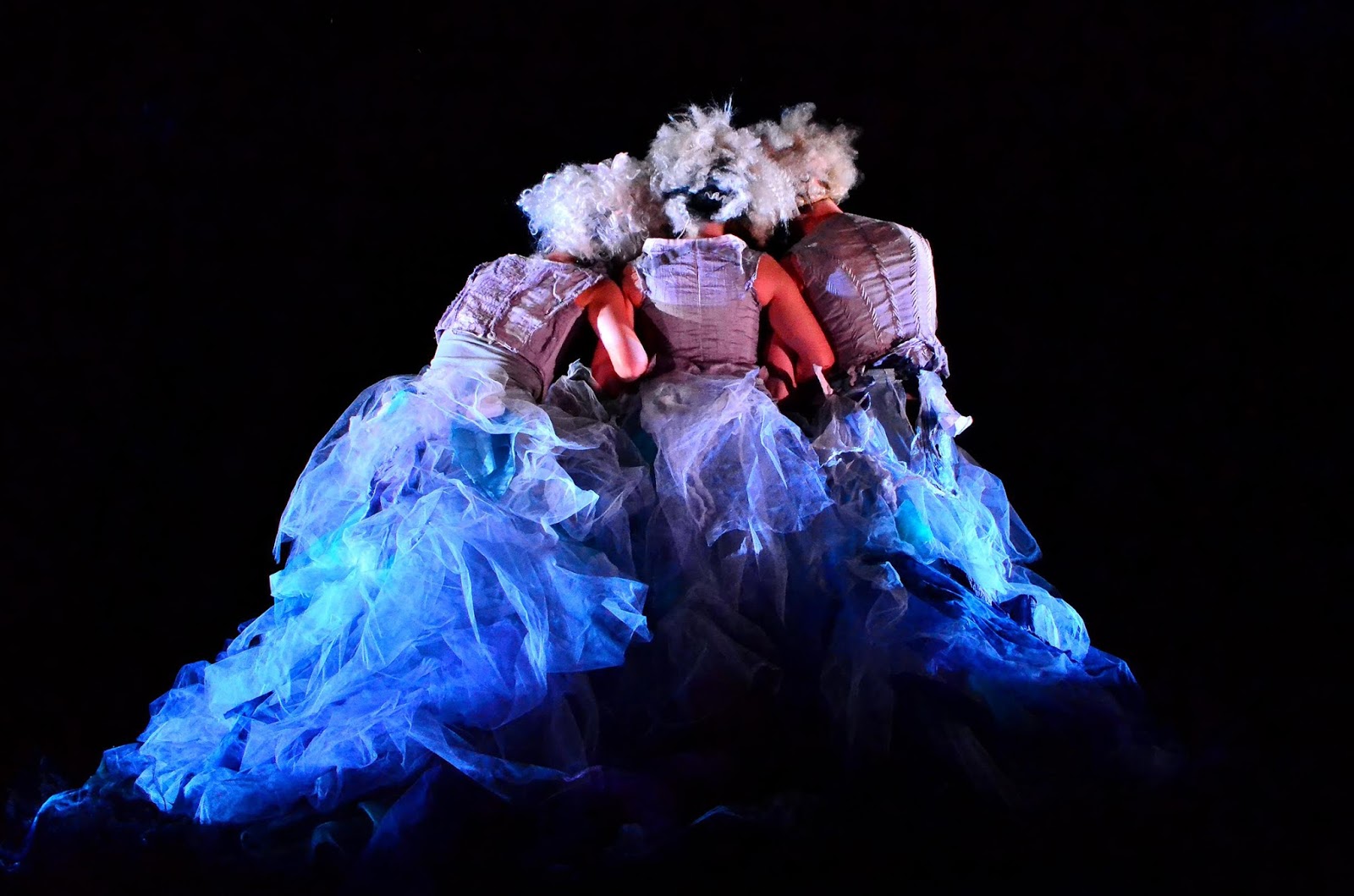
Some performers in light and desire,
by Colleen Thomas and her international collaborators,
premiering at New York Live Arts, March 25-28
(photo: Nadia Halim)

In 2016, I think I was very privileged--and unaware of my privilege--as an American. With the [presidential] election, I just couldn’t believe the misogyny. I sort of woke up to the misogyny that had always been in my world. Maybe I felt I wasn’t good enough, things weren’t happening for me, wouldn’t go my way or just would feel wrong. I’m not good enough, smart enough. It was all on me.


Seeing the way that people looked at the candidates in 2016, how people talked about Hillary Clinton’s personality, which had nothing to do with what her experience was.... Meanwhile, there’s this other person whose personality isn’t great either! But, no, people are talking about her. Even my women friends--smart and artistic, some of the most intelligent, aware people--said things like “I just don’t like her. I don’t know why.” There were other people, family members in other parts of the country, who said things like, “She’s a criminal.” 


I work in academia, I work in this world, and I collaborate with a man in a lot of my work. I just started to question: What is this bias and hatred?


Because of the election, I started talking to people, to women about it. We couldn’t stop talking about it. It was like Voldemort had arrived! None of us had slept. We were in shock. Thank God for New York and our community. But I started talking to people around the globe, people I had worked and toured with for many years. Most of them had worked with us here.

That’s where I woke up to my privilege: Oh, I think it’s so horrible here in America, but they’ve lived through having to move out of their own country to somewhere else where they felt they could have a life. They had personal stories about growing up in a new country. It was really interesting to work with and very cathartic in a way.


All of these women are just extraordinary people. I wanted to work with them because of their dancing and because of who they are, but they are all older now--we’re all older now!--they’re “successful,” whatever that means. We’ve got these jobs, we’re creating art, we’re chairs of departments, we’re successful women. And it’s just interesting to me because I’m not sure we feel that success.


How we feel our power was really interesting to me, how we moved through obstacles. I was interested in telling some personal stories about these women, hopefully something that other people also experience. It went from a political, angry place to “How do we heal? How do we move through? How do we get to this place where we can feel our power, go into our communities and support that?" At the beginning, I was focused on all the negatives: There’s no hope. There’s never going to be a woman president. It’s so deep. And [reflecting on the current presidential candidacy of Elizabeth Warren], we are physically exhausted. I am at the place now where I can’t even read the news.


The stories are an important part of the work. I always work with people’s personal history. That’s what’s real for me rather than having them do something that’s in my mind. Collaboration is so interesting.


There are five other women besides myself, and one--Carla Forte--is Venezuelan-born, a dancer and a documentary and feature filmmaker. She lives in Miami now, but I met her in Venezuela fifteen years ago, and we worked together, toured in different places together. I think she has lived in Miami--where I’m from--ten years now.


When Venezuela just sort of got crazy, she and her husband came here to America. I started off asking each artist how they moved through hard times, passed through their obstacles, and she started talking about being seen a certain way as a Venezuelan in America and even how her mother or their culture expected certain things.

I have a teenage daughter who’s going through a major transition. My husband said this one day--because he’s a man!--”I was a boy, and I went through puberty, and I could just do whatever I wanted.” And he was watching his daughter be seen a different way for that moment of transition where, all of a sudden, other people are seeing you differently, you’re seeing yourself differently, and there’s some kind of freedom that’s lost through how other people look at her. So he just had this epiphany. Really? (laughing hard) Now? At this age, you’re just realizing it now?


So, the piece has become about this idea of transitions, what happens in those moments in between change--slowing down those moments to see what those shifts are. We started with the idea of slowing down the film Carla created for the piece. When things are very, very slow, you can’t tell very clearly what’s happening. Singing can look like a scream...or a laugh. You’re not really sure. That became really interesting to me, the transitions in all forms--women getting older, women moving through hard times, transitions of getting to power, transitions of giving up. Do you give up and move out of your country because it’s so bad there?


Carla talked about her mother wanting her to be a kind of woman like Miss Venezuela--beautiful with the makeup--and she wasn’t. She talked about people in Miami calling her whore because she’s Spanish-speaking. And I talked to people like Ildikó Tóth who lives in Germany, and she said she never felt objectified or anything like that. She said, “I just always dressed like a boy.” Ermira Goro, she lives in Greece now, and she danced with us as well and was here for many years, and then she went on to DV8 [Physical Theatre, a London-based troupe]. She talked about when she moved from Albania to Greece and living with a friend, not having her family there. Everybody seemed to have stories that pertained to their moms and, because I was interested in my daughter’s changes, there's a little flicker of mom stuff in there.

Joanna Leśnierowska is not primarily a dancer; she’s a curator, dramaturg and designer, born in Poland, running a festival. Doing body research with her was really interesting. She’s just so real. She connects to what the truth of the movement is right away, even though she questions, “I’m not a dancer. Should I be doing this?”


I was getting so inspired by my students at Barnard [College] and by [climate change activist] Greta Thunberg, by all these young people who are active out there trying to make change, and they’re like “You guys fucked it up, and we need to do something.” There’s a lot of work I watch my students do that I’m sort of amazed. The idea of having a chorus in the piece, bringing these [local community] people in, was a representation of the inspiration and hope they bring to what’s happening now. 


At first, I wanted a lot of women to take the stage and just stand there, make the audience feel uncomfortable. I was so angry! But then I started workshopping with them. I hope that when I get to do this piece in other places, I will get to workshop with women in these communities. The workshop--working with them through improvisation and talking about their own experiences--it was different because they are a lot younger [than the main cast]. There’s power afforded to us because we have some experience, and we feel strength from the places that we’ve moved through. But the hope that I feel is in working with these young people, talking with them about when they’ve felt erased or objectified or passed over and how they got up and kept going.

These are all my alums of different ages. I have such a personal connection to everybody in this cast. We rehearsed the other day, and I cried after they ran this one section. I realized I know their stories, you know?


The mood I feel, through them, is support--for me, for this piece--and comraderie, community, kind of like the Buddhist sangha. I feel the strength through them. They’re not giving up. They are in a place where they believe they can make change and, just like the masks they wear in the piece, the grotesque becomes beautiful. All of these dancers are able to be vulnerable, which is not always pretty. They have nothing to prove.

That’s the other thing. Maybe that comes with being over 50: I’m done trying to be something. We’re all trying to share this experience with the audience. It gets ugly and uncomfortable, but then, somehow, we work through it--I hope! (laughing hard)


-- Colleen Thomas

See light and desire at New York Live Arts, 219 West 19th Street (between 7th and 8th Avenues), Manhattan (map/directions). For further information and tickets, click here.

******

DISCLAIMER: In addition to my work on InfiniteBody, I serve as Senior Curatorial Director of Gibney. The postings on this site are my own and do not necessarily reflect the views, strategies or opinions of Gibney.

******

Subscribe in a reader

Tuesday, November 7, 2017

Dance as an Act of Resistance: Feminist Magazine interview


Valecia Phillips, host of Feminist Magazine (KPFK 90.7FM), interviews me and interdisciplinary dance artist, educator and Avest Award winner taisha paggett on the role of the body and dance in today's urgent activism and resistance.


Feminist Magazine is a weekly radio show: Intersectional feminism, news, views & culture. Grassroots to Global, stories you hear nowhere else, from all kinds of kickass feminists making change.

More ways to listen to this episode:

On Stitcher Podcast

At KPFK Archives (available for 90 days)

On Feminist Magazine Homepage (The episode will be available until November 14. Look for the box on the far right called LISTEN TO THIS WEEK'S SHOW.)

Subscribe in a reader

Thursday, September 21, 2017

Native feminist troupe Spiderwoman is 40! Party!!!

Spiderwoman Theater's Gloria Miguel (Kuna/Rappahannock)
with daughter Monique Mojica
(photo: Nicky Paraiso)
Spiderwoman's Muriel Miguel (Kuna/Rappahannock) at left
with Oneida-Oswegan songwriter Lacey Hill
who performed at the celebration.
(photo: Star Black)


On Tuesday evening, La MaMa's Ellen Stewart Theatre hosted a warm, down-to-earth gathering of family, friends, colleagues and fans of Spiderwoman Theater in tribute to the renowned troupe's 40-year milestone. Founded by three intrepid sisters of Kuna and Rappahannock lineage--Gloria Miguel, Muriel Miguel and the late Lisa Mayo--Spiderwoman is fundamental to the development of New York's avantgarde and feminist theater movements. With forthright, woke politics of resistance and bawdy, boisterous humor, the Spiderwomen have long been revered role models for generations of artists on the downtown scene like Taylor Mac, Peggy Shaw, Lois Weaver, Alessandra Belloni and Carmelita Tropicana who participated in the celebration and benefit.

The fun evening was capped by a dance party presided over by First Nations electronic group A Tribe Called Red.

Musicians Ian Campeau, Tim 2oolman and Bear Witness of
A Tribe Called Red working the after-party
(photo: Star Black)
SiverCloud Singers
(photo: Star Black)
On screen, Spiderwoman's Lisa Mayo (1924-2013)
remembered at La MaMa
(photo: Star Black)
Laura Ortman of the all-Native Coast Orchestra
and Brooklyn's Stars and Fleas
(photo: Star Black)
Above: choreographer Elizabeth Streb
with Carey Lovelace (Loose Change Productions),
co-producer of the Spiderwoman benefit
Below: Zach Morris and Tom Pearson, co-artistic directors of
award-winning Third Rail Projects theater troupe
(photos: Star Black)


Subscribe in a reader

Saturday, July 15, 2017

D'Lo bears witness--and gets laughs--at Dixon Place

Dixon Place presents comic performer D'Lo
in To T, or Not to T,
a highlight of the 2017 Hot! Festival,
DP's annual celebration of queer arts and culture.
(photos: Ryan Harper Gray)
Bearing witness is the only way I know to be alive. -- D'Lo


From the outset, D'Lo literally trampolines and pogo-sticks into our hearts and, if you haven't seen him perform before--and I hadn't--you figure that's cute. But where will he go after this wacky first impression?

To T, or Not to T--a Dixon Place commission for this summer's Hot! Festival--hooks in and never lets you go. Just over an hour in length, this one-trans show is, by turns, hilarious, tender and sharp. D'Lo's so talented and smooth, he makes it all look effortless, but you know a hellawork went into getting all this material to line up and flow this well.

To T, or Not to T traces D'Lo's experience being raised as a girl in a Tamil-Sri Lankan family in Lancaster, California ("aka Sri Lancaster, California") and gradually coming to terms with his true gender identity. He has now been on testosterone for two years. Right there, that's a whole lot of content. Heavy-going, you say? Oh, no. Not one bit.

What gives D'Lo and his narrative so much lift and embraceable charm is how strongly it is rooted in his observation of and complete delight in his family--a family that wrestled with challenges but ended up cheering him on in the most heartwarming way. Which makes me think: Despite the idiot in the White House and his delusional supporters, we're actually living a moment in America where D'Lo's relatives and friends could easily find themselves the subject of a quality tv sitcom. And I would watch it. Every last episode.

To T, or Not to T continues tonight and July 21-22, all performances at 7:30pm. For information and tickets, click here.

For a full Hot! Festival schedule (through August 4), click here.

Dixon Place
161A Chrystie Street, Manhattan
(map/directions)

Subscribe in a reader

Thursday, December 8, 2016

"What Will Be Different?": Who do I stand with?

It has been a month since the US presidential election and--as we watch the president-elect steadily arm himself for assault on every aspect of our society's progress, any hope that our democracy might be a true guiding light in the world--many of us continue to struggle to process, on mental, emotional, even visceral levels, just what has happened.

Last Monday, New York Live Arts opened its doors for a gathering, Open Spectrum: What Will Be Different?, conceived by marketing consultant Brian Tate and curated by Tate and NYLA's Associate Artistic Director Janet Wong in alliance with MAPP International.

The forum examined issues of concern to women, a demographic with complex effects upon the course of this election. Program notes set forth the following questions:
The election is over. Now the future awaits, and the lives of women--of us all--will be transformed. What shifts of policy and culture can we expect for women under President Donald J. Trump? How should we respond as citizens to advance the cause of justice and equal opportunity for women from today forward? To meet that challenge, how will we ourselves change?
[I take full responsibility for that strikeout, by the way.]

Tate noted three other questions to guide each of as we each find our best response to the challenge of this time:
What do I stand for?
Who do I stand with?
What am I ready to do?
It was the second question that interested me most as I looked around the studio and noted the striking predominance of white women of professional/upscale appearance. And although there were some dance artists in attendance, this apparently was not an event with much draw for the dance community. Although the excellent panel featured notable performing artists (Adrienne Truscott, Susana Cook), cultural scholars and critics (Catharine R. Stimpson, Margo Jefferson) and Brooklyn Museum chair and arts activist Elizabeth A. Sackler along with human rights activist Rana Abdelhamid in a venue historically grounded in the art of dance, it was fascinating that the crucial role of the arts and of artists scarcely came up for consideration.

Cook's experience of growing up under military dictatorship in Argentina offered insight into how the unacceptable gradually transforms itself into the norm. It would have been good to hear more about how Argentinian artists, forced to work under the radar, managed to carry on their struggle. Jefferson--one of the panel's most searching speakers--cited King Lear:
The weight of this sad time we must obey. Speak what we feel, not what we ought to say.
And yet what hung over the room was a sense of shock, grief and apprehension still so raw that perhaps everyone, artists included, are still figuring out how to balance that weight and how to shape feelings into effective action.

The question was raised: Who are our models for responsible civic engagement? From the perspective of the arts and artists, the answers called out were revealing: Cecile Richards, president, Planned Parenthood Federation of America; activist and scholar Angela Davis; German Chancellor Angela Merkel; filmmaker Ava DuVernay, my first choice; and Sylvia Rivera, the late trans-activist veteran of Stonewall, whose name was not familiar to most of the audience. I kept thinking, a downtown arts audience would know Rivera's name right away.

Who do we stand with?

Future Open Spectrum gatherings will address the post-election concerns of other demographic groups, including people with disabilities, Black youth and immigrants. For information, contact New York Live Arts here.

See the video of Open Spectrum: What Will Be Different? here.

Get your free email subscription
to InfiniteBody.

Thursday, October 13, 2016

"Ship of Fools" docks at HERE Arts Center

Scenes from Ship of Fools
at HERE Arts Center
(photos: Josiah Shelton)


Last evening, HERE launched its 2016-2017 season with Ship of Fools, a multidisciplinary production created by visual artist and puppeteer Jessica Scott with Anonymous Ensemble.  After some delay, we were waved into the tiny Dorothy B. Williams Theatre, filling seats atop what would prove to be our very own "ship of fools"--a platform slowly rotating us past various scenarios of puppetry, dance, music-making and video installation tucked along the perimeter of the space.

My first, innocent step onto this seating area made me fear I was having vertigo--or a heart attack! I stepped, immediately and inexplicably pitching sideways, somehow managing to keep my feet and reach an empty chair. Something probably jostled the platform--maybe even just my stepping onto it--but I didn't figure that out until, during the performance, the platform suddenly began to revolve. That realization would have been reassuring had this turning not felt unpleasant. So this is my trigger warning. But go. You'll eventually get used to the sensation and experience some striking artistry along the way.

Scott plunges us into a shifting terrain that evokes both mental instability and the irrational fear and exploitation of what she calls "women as a dark continent."
From France’s famous all-female asylum Saltpetriere, to the Mary Laundry’s of old England, the overwhelming incidence of modern female depression, to the recent attacks on women’s reproductive rights, diagnosing femininity has forged our modern psychology and politics sewing a seed of an insidious fear: a conviction that the fault line between woman and world lies not in the constructions of popular culture but instead somewhere rooted our inherent femaleness.
--from publicity for Ship of Fools 
Scott and her collaborators turn the theater into a combination wax museum, puppet theater, fun house and house of horrors brought to life by her performers--Kate Brehm, Liz Davito, Jacob Graham, Takemi Kitamura, Sarah Lafferty, Georgie Tisdale and Jessica Weinstein. We're trapped in a compelling nightmare--equal parts elusive imagery, numinous beauty, amusing absurdity, disorientation and looming terror. I must resist the temptation, here, to open this box of surprises, but I particularly enjoyed one famous, unmistakable article of clothing that undergoes a wardrobe malfunction of epic proportions. Its construction and puppet-like manipulation are just a taste of the wild imagination and detailed, painstaking craft on display in Ship of Fools.

The production does have some sluggish, awkward moments--including a few text passages spoken by the otherwise wonderful vocalist Liz Davito. But, no worries. This ship just keeps on turning, always delivering you to something new to discover.

Co-direction, puppetry, costume and set design: Jessica Scott
Co-direction, text and projection design: Eamonn Farrell
Original compositions: Alex Klimovitsky
Lighting design: Ayumu "Poe" Saegusa
Sound design: Gavin Price
Live music and vocals: Liz Davito

Ship of Fools runs through October 22. For schedule and ticketing information, click here.

HERE Arts Center
145 Sixth Avenue, Manhattan
Enter on Dominick Street, one block south of Spring Street.
Get your free email subscription
to InfiniteBody.

Tuesday, March 1, 2016

Revolution revisited: WOW pioneers celebrate now


Left: Carmelita Tropicana
Right: Claire Olivia Moed (at left) and Peggy Shaw
(photos: Eva Yaa Asantewaa)

Moments after the thought crossed my mind, Lois Weaver spoke it: "This is like the high school reunion I always dreamed of!" Then she held up a book to show to the merry, over-spilling crowd of, mainly, lesbians of a certain age (like mine) last night at Dixon Place. Co-edited by Holly Hughes, Carmelita Tropicana and Jill Dolan and published by University of Michigan Press, Memories of The Revolution: Celebrating the first ten years of the WOW Café  features "scripts, interviews, photos, and critical commentary documenting the riotous beginnings of this long-lived experimental theater space for women" founded in 1981.

Last night's gathering was pretty riotous, too, with many shrieks of recognition, hugs, laughter and gratitude for the way WOW nurtured community and encouraged DIY spirit and free expression. This funky, spunky theater space launched some notable careers including performance artist Hughes, poet Eileen Myles and Tony-winner Lisa Kron (Fun Home's book and score). "Coming to WOW," Kron said, "changed everything about my life."

Running close to three hours, the show featured numerous WOW favorites, such as the Split Britches team of Weaver, Peggy Shaw and Deb Margolin (performing their goofy West Side Story/Yiddish theater mashup) and the Five Lesbian Brothers (Moe Angelos, Babs Davy, Dom Dibbell, Peg Healey and Kron), reigniting crushes that we had on all these charming and inspiring performers back in the day. One of the strongest moments, though, was a serene one--Sharon Jane Smith, quietly singing and playing her mandolin, drawing her audience closer and closer.

It's heartening to know that, despite the challenge of surviving in a changing New York, WOW Café still carries on (click here). But it's a little sad to have to give this particular event and its audience a hashtag: #WOWSOWHITE. For the most part, it appeared that younger women and people of color found other things to do last night. Maybe that had something to do with the demographics of the cohort celebrated in Memories and reflected in last night's lineup. Or maybe it was the ticket price (which, to be fair, included a copy of the book).

*****

Don't miss the next Memories of The Revolution event--"Memories of The Revolution: Locating Lesbian Culture in the Age of Queer"--a panel discussion tomorrow, March 2, at 6:30pm at New York University's Bobst Library.
The panel, composed of WOW alumnae in dialogue led by theater historian and critic Alisa Solomon and performance studies scholar Ann Pellegrini, will address the impact of feminist and lesbian voices on the downtown New York culture of the 80s and 90s, and discuss the legacy of WOW for current generations. Karen Finley will introduce the event, and Jessica DelVecchio will open it by performing songs from the period.
Other participants include Alexis De Veaux, Gwendolen Hardwick, Holly Hughes, Lisa Kron, Eileen Myles and Carmelita Tropicana.

RSVP to
with your name and title/date of the event.


Bobst Library
New York University
70 Washington Square South (at LaGuardia Place), Manhattan
(map/directions)

*****

Help keep WOW Cafe Theater open for future generations of women and trans artists: CLICK!


If you like what you're reading,
subscribe to InfiniteBody!

Saturday, September 26, 2015

The maximal A.O. Movement Collective

Above, Lillie De and below, Ariel Speedwagon
in scenes from ETLE and the Anders
(photos: Alex Escalante)


You know how it is when you first open a sci-fi or fantasy novel and, right away, you're plunged into a world teeming with characters, creatures, exotic place names, complicated back stories, unfamiliar languages, ideas and values? It can be jarring, overwhelming. You need a little time to acclimate.

The ETLE Universe--a massive project shaped by feminist and queer thought, three years in the making by Sarah A.O. Rosner and her A.O. Movement Collective--reminds me of that experience. I have dipped into just one portion of it--ETLE and the Anders, a performance set in Clinton Hill's Loft 172. To use a Rosner term of choice, it is maximalist.

My best guess is that ETLE and the Anders is a schematic of what it might look like, sound like and feel like to have any number of universes rushing at you all at once. And I believe Rosner and her collaborators take this to be necessary training for a coming world that awaits our evolution--or maybe a world that's already here, waiting to be noticed.

I don't feel moved to describe most of what happens in this piece. Go have your own experience, please. But here are some things I'm still thinking about.

It would be limiting to call ETLE and the Anders a dance work, just as it would be limiting to ignore the way ETLE universality encompasses everything from dance to gaming to fashion to photography to shopping to porn. (That's right, thanks to ETLE, Rosner's bio now reads: "choreographer, pornographer, and radical arts businessman....") Nevertheless, bodies and movement carry the main charge and main interest in ETLE and the Anders--some of the most diverse, unconventional, in-your-face bodies in professional dance and some of the most prodigious energy. Rosner thrills us with the momentum and sound of these bodies rushing through air and making contact with the floor. When her dancers run the ring of their space, the breeze hitting the audience is pretty damn maximal.

They execute movements and movement patterns in a big, open way. Heroic. Also somewhat predatory. Not afraid of being large and in charge. Not afraid of the body. Not afraid of any body. They jabber and shout. They build and deconstruct imagery with a speed that will make you question whether you saw what you just saw, and they fracture your ability to attend to any one thing at any one time. Destructive of boundaries, expressive of multiplicity, they require that you release your own hold on form and focus and certainty.

The mysterious ETLE--unseen but referenced as "she" and "her," and maybe those pronouns should be capitalized--appears to be driving what will turn into sacred erotic ceremony, centered in the stately Anna Adams Stark. Coordinating Anders efficiently arranged the audience closer to peer through the transparent windows of a vinyl enclosure.

Here, performer Lillie De--who also serves as the collective's manager, we're told--guided our way. With De in the spotlight, I felt the tone shift, and a handle present itself to me. I needed a handle, a way into this work. It seemed to come in the note of irony she introduced.

But even that irony quickly fell apart. No sooner did De draw chuckles from some of us than orgasmic ecstasy buffeted and wrenched her.
Each time we hurl our bodies through space, we have shifted the universe.... Our bodies are time machines...."
Let yourself go! Let your Future Self in!
Suddenly, dancers sailed past us, naked or nearly so. Inside the clear vinyl enclosure, Ariel Speedwagon--dressed in a long, medieval tunic, arms stretched out from her sides--revolved and whirled to the martial cadence of Idgy Dean's live percussion. For a brief moment--everything ETLE flares, shimmers and becomes something else--wary dancers patrolled the enclosure, baseball bats in hand, tough attitudes in place. Baseball bats seem kind of old school for sci-fi, don't they? But the sight of them was both amusing and entirely convincing. We get the message. I have never seen a better protected ceremonial site.

ETLE and the Anders is a fascinating experience, but I won't pass judgment on it in isolation from a web of manifestations that I won't have the chance to experience. See for yourself. The ETLE Universe continues, through October 10, with three weeks of performances, parties, screenings, workshops and much more. For a schedule of ETLE and the Anders performances and a guide to the entire ETLE universe of events and resources, click here.

*****

ETLE and the Anders performers: Lillie De, Anna Adams Stark, Aya Wilson, Ariel Speedwagon, Eli Steffen and Tara Aisha Willis with Tony Carlson, massima selene desire, Benedict Nguyen, and Jax Jackson. Music by Idgy Dean. Costumes by Walter Dundervill and Jeff Poulin. Lighting by Vincent Vigilante. Video and installation by Andre Azevedo + Caitlin Rose Sweet. Set designed by Sarah A.O. Rosner and created by Abigail Lloyd

Loft 172
166 Classon Avenue, Brooklyn
(map/directions)

Tuesday, August 18, 2015

Writers Danticat and Brown on feminism and Caribbean diaspora

Danticat
Edwidge Danticat
(photo: Jonathan Demme)


presents


Thursday, September 17, 6:30pm

Barnard alumna Edwidge Danticat and novelist Victoria Brown come together in the second event in the series, Caribbean Feminisms on the Page. This series places distinguished writers in conversation with emerging authors to discuss issues including feminism, diaspora, and method.
Free admission. 
For information, 
click here.

Edwidge Danticat is a 2009 MacArthur fellow and is the author of several books, including Brother, I’m Dying, which was a 2007 finalist for the National Book Award and a 2008 winner of the National Book Critics Circle Award for autobiography. This year, she will publish a picture book, Mama’s Nightengale, and a young adult novel, Untwine.

Victoria Brown is the author of Minding Ben (released in paperback as Grace in the City), a novel about a teenager from Trinidad working as a nanny in New York City. She has an MFA in Fiction from Hunter College. Her writing has appeared in The Guardian, NBC news, New York Magazine, The Sunday Salon Fiction Zine, and Babble. She teaches in the English Department at LaGuardia Community College, and is currently at work on her second novel.

Event Oval, Diana Center
Barnard College
3009 Broadway, Manhattan
(map/directions)

Wednesday, February 4, 2015

Women Make Movies hosts NYC premiere of "I AM A GIRL"


Exclusive NYC Premiere of I AM A GIRL

Women Make Movies, Girl Be Heard, Gathr Films, and Duggal Visual Solutions invite you to the exclusive screening of the Women Make Movies award-winning documentary, I AM A GIRL

Thursday, February 5

Bow Tie Chelsea Cinemas
260 West 23rd Street, Manhattan

6pm Cocktail Reception
6:45pm Film Premiere
8pm Girl Be Heard Performance
8:15pm Talkback


Filmmaker Rebecca Berry will be in attendance for Q&A! Rapper and I AM A GIRL film subject Breani Michele will perform her original and empowering raps after the screening.

All proceeds will go to support Girl Be Heard's social justice theatre company that puts global issues affecting girls center stage by empowering young women to tell their stories.  The film will have a huge impact across the nation through cutting-edge education curriculum created by Girl Be Heard, which allows teachers to engage students on critical human rights issues raised in the film. To watch the trailer click here, and to buy a DVD please visit the Women Make Movies website. For all other inquiries, please send us an email at orders@wmm.com.

About the Film:

A compelling, insightful, and inspiring exploration of what it means to grow up as a young woman in the 21st century, I AM A GIRL follows the first-person stories of six young women in Cambodia, Papua New Guinea, Cameroon, Afghanistan, the USA, and Australia. The documentary, which was nominated for several Australian Academy Awards, explores obstacles that so many young women face around the world such as poverty, teen pregnancy, mental illness, sex trafficking, and access to education.

About Women Make Movies:

For over 40 years, WMM has transformed the landscape of filmmaking for women directors and producers, bringing the issues facing women around the world to screens everywhere. Now, with more than 550 films in our catalog, including Academy®, Emmy®, Peabody and Sundance nominees and award winners, WMM is the largest distributor of films by and about women in the world. Women Make Movies. By Women. About Women. For Everyone. Please visit the WMM website for more information.

Monday, December 8, 2014

New book pays tribute to feminist author Merlin Stone

Cover of Merlin Stone's When God Was A Woman (1976),
a formative work of the Women's Spirituality movement

Merlin Stone Remembered: Her Life and Works
by David B. Axelrod, Carol F. Thomas, Lenny Schneir and Merlin Stone
(Llewellyn Worldwide, Ltd., 2014; 384 pages)
ISBN: 9780738740911

reviewed by Eva Yaa Asantewaa, InfiniteBody
also posted to hummingwitch

Merlin Stone's research into ancient Goddess civilizations and spiritual beliefs (as author of When God Was A Woman and Ancient Mirrors of Womanhood) and her prodigious creativity on the feminist scene of the 1970s and '80s, touched the lives of many women and our male allies. When I was a producer and host at WBAI, New York's Pacifica radio station, I interviewed Stone (World Watch: Goddess at Dawn, May 1988) and, in 1990, had the honor of speaking on a panel with her, Spiderwoman Theater's Gloria Miguel and other feminists working in non-mainstream spiritual traditions and the arts. Later, Stone invited me to assist with a new audio project. We began to meet, but our work was interrupted and never completed. In declining health, she passed in the winter of 2011.

We're now at a time when young women often distance themselves from the feminist label; when the public discourse, even among feminist activists, relegates spirituality to oblivion; and when the religious dictates of patriarchy demonstrate their disastrous effects on a civic and global level. I was excited to learn that Llewellyn Worldwide planned to bring out a book on Merlin Stone's life and contributions. Surely, Stone would speak to our condition once again, offering alternative perspectives and motivation.

Merlin Stone Remembered--a rough patchwork assembled by admiring colleagues and family members--is not, by any stretch of the imagination, the book I'd hoped to read. Ideally, that book might be researched and written by an independent scholar, not a committee intent on unnecessarily and redundantly pleading The Case for Merlin Stone's Greatness. It would offer both a deep, detailed, coherent, reasonably objective portrait of this unusual and unusually determined woman, born Marilyn Claire Jacobson in Brooklyn in 1931. It might give us an engaging account of her many travels throughout the Mediterranean and Near East, to the extent that adequate documentation exists, and a professional assessment of her life's work. At least the introduction by noted ecofeminist Dr. Gloria F. Orenstein takes pains to put Stone in the context of other pioneering, if often controversial, authors such as Helen Diner, Monica Sjoo, and Marija Gimbutas.

The book's collaborators take a preemptive tack, defending their inclusion of a memoir by Stone's companion, Leonard ("Lenny") Schneir. A professional poker player and dealer in gambling memorabilia, Schneir lived with Stone for decades, seeing her through her final illness and death. By all accounts, the relationship was a happy one and, for Schneir, instructive and transforming. Apparently, though, the book team ran into some unidentified women's objections to the idea of Schneir adding his story to Merlin Stone Remembered.

I would never take issue with Schneir having a say here merely because he is male. But I suspect that you, like me, might find yourself hurrying through the lengthy, at times self-indulgent narrative about his journey before and with Stone--and, definitely, you will want to move past the poems. Greater care should have been taken with the overall structure and balance of this book.

Schneir's participation is not the book's only flaw, merely one out of many. Throwing together excerpts from Stone's interviews, bits of her published and (perhaps, justifiably) unpublished work, and repetitive essays like David B. Axelrod's "reflection on the poetic genius of Merlin Stone" and another by Schneir with Axelrod, entitled "The Importance of Merlin Stone" argues that this is a case of opportunities not only missed but willfully refused.

Instead of illuminating substance, we get filler: Stone's honorary doctorate certificate from The California Institute of Integral Studies, her birth certificate, pages of photos not selected to add anything to our understanding of the woman. One section reproduces numerous examples of fan mail from her readers, but I doubt that, even in the Internet Age, this author needs Yelp-style testimonials. What follows these letters? Another essay: this time, "The Legacy of Merlin Stone."

Here's how I want to remember Stone: as the woman who, in a talk with Michael Toms, subtly noted a difference between "planetary consciousness" and "planetary conscience." As a white woman troubled by racism, an observer of psyches and societies who saw fear at the root of repression. As a writer, sometimes pedagogic in tone but broadminded in her vision of feminism and of spirituality. A writer whose informed, complex, inspiring work was everything this book is not.

Eva Yaa Asantewaa, InfiniteBody
also posted to hummingwitch

Copyright notice

Copyright © 2007-2023 Eva Yaa Asantewaa
All Rights Reserved

Popular Posts

Labels