Search This Blog

Showing posts with label Danspace Project. Show all posts

Tuesday, August 11, 2020

Before we begin tonight's program...


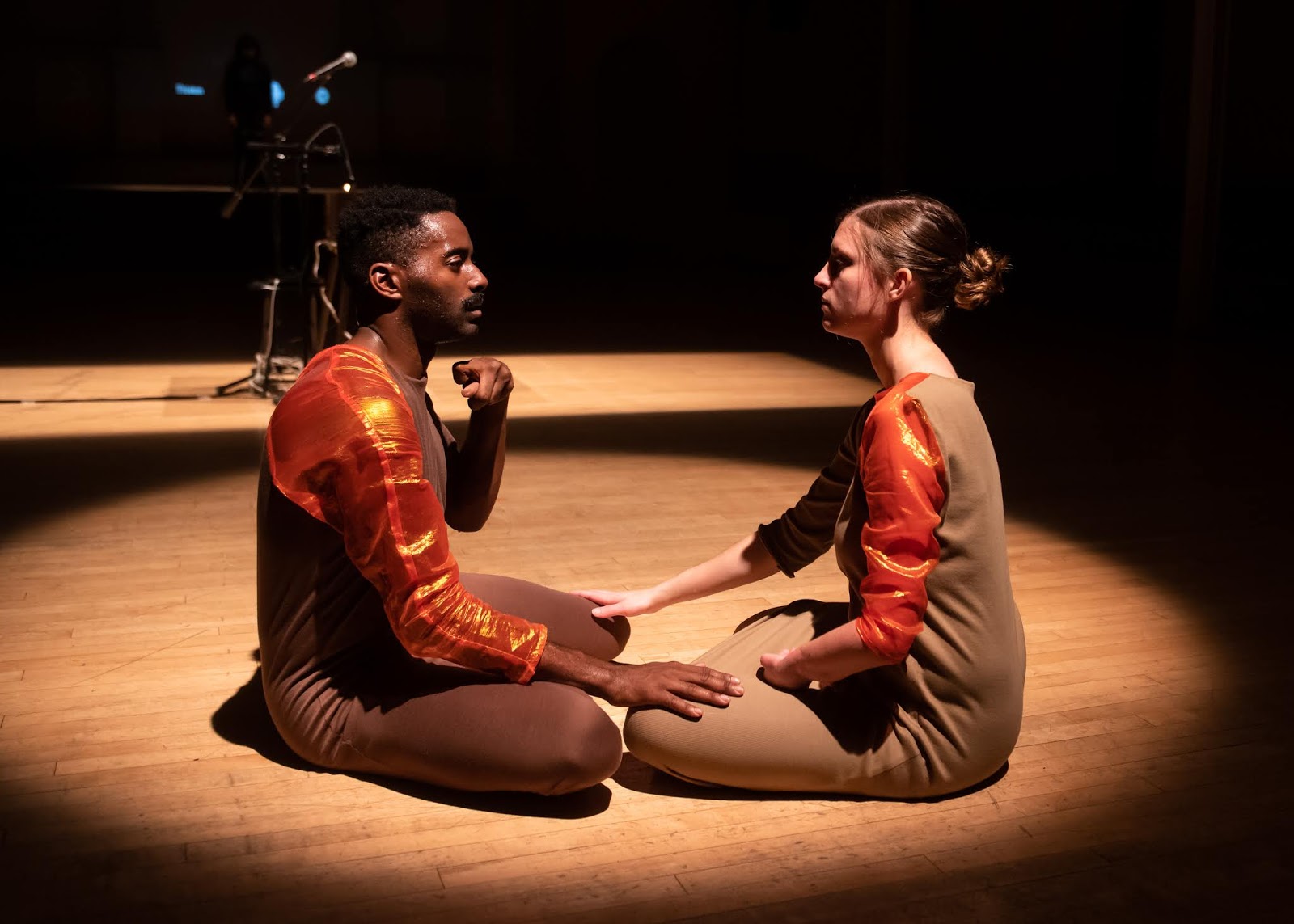
Reggie Wilson/Fist & Heel Performance Group
in Wilson's ...they stood shaking while others began to shout
Danspace Project in St. Mark's Church-in-the-Bowery
(photo: Ian Douglas)


Before we begin tonight’s program...


by Eva Yaa Asantewaa


Hello. My name is Eva Yaa Asantewaa (she/her/hers), and I am a non-disabled, medium-dark-skinned Black cis queer woman writer and editor and curator and counselor and mentor and atheist spiritualist mage of African-Caribbean immigrant heritage and of a certain age. I am certain that age, at this time of reckoning, is nearly 68--now just over fifteen days away. I have almost no hair, having clipped it off, nearly to the scalp, several times during this barber-less pandemic shelter-in-place, and I’m wearing a light layer of drugstore lotion and matte black eyeliner and mascara and a little bit of eyebrow pencil in a dark, greyish brown. I miss wearing dangly earrings and glossy red-brown lipstick; neither pair well with surgical masks. I am coming to you, remotely, from the light clutter of my snug and cave-like home office and also wearing an olive-green t-shirt with an image of Snoopy from Peanuts on it. The shirt is really old, a hand-me-down—maybe I should say “hand-me-over”—from my wife who had cut off the sleeves and neckband and overlapped and sewn the shoulders to make the armholes more fitted and the shirt a bit smaller across the chest, and her stitches are tiny and even. Hello. My name. Snoopy is seated in front of a bulky old computer monitor and surrounded by bits of text from the early days of the Internet (like "alt.schulz" and "FTP sites"), and the two of us--Snoopy and I--are greeting you from unceded and, in fact, stolen Lenni Lenape land just a stone’s throw away from St. Mark’s Church-in-the-Bowery which, like a lot of things on stolen indigenous land, was built and maintained by the labor of African ancestors and where, during services held by the biblical god’s own goodly Christians, these ancestors were relegated to the balcony. I’ve sat up there. In the balcony. No, not back in the day. Though, maybe yes, if you believe in reincarnation. Which I actually think I don’t. But, no. More recently. I’ve watched Ni’Ja Whitson and their dancers from up there, through the posts of the balcony’s railing, as they performed Oba Qween Baba King Baba below for a preview audience of LGBTQIA+ folx like me. I looked down, watching a universe erupt across the warmth of a broad wooden floor. I’ve sat below and looked up, past the railing to watch Reggie Wilson’s troupe dance a passage of ...they stood shaking while others began to shout near stained-glass windows. Woman of African-Caribbean immigrant heritage. Hello. St. Mark’s Church. Among other things. Is a danspace. A constellation of spaces for the arts flickers around here in lower Mannahatta island, with star-spaces in any direction you look--walkable, if you are walking, flyable if you are a crow or a jay, though pigeons and mourning doves seem to rule the territory now. I miss the crows. I miss the jeering jays. I no longer see them or hear their corvid harshness near the trees of St. Mark’s. I am certain of my age and that, someday, I will miss the pigeons and the mourning doves, too. I am certain. This local, time-limited self I have been given pleases me. Like Audre Lorde, I treasure each identity even as I know I am a vast, capacious, timeless spiritual being having a human experience. The specificity of that human experience is the craft. That specificity is the key for the lock. The unique key for any lock, so many locks. What then, hello, if we all think of our bodies as conjurations of the Mighty Dead? So different, then...Hello. My name is...from that idea of reincarnation. Hello...I am...here, in this time, a unique key, turning in so many locks in this time of locks. Before we begin tonight’s program, I want to give an acknowledgement, acknowledging the jays I used to hear and their parental vigilance, and the red-tailed hawks who now hunt Tompkins Square Park and their august strength. I want to acknowledge the grief we humans cause and the grief we carry. I want to acknowledge that pain lives quietly, or not so quietly, inside nearly everything we make and do and, for some of us, it is the lightning bolt and jolt and juice carrying us through to the end of days. I want to acknowledge that breath is work. Hard and worthy work. At this time of reckoning.

(c)2020, Eva Yaa Asantewaa


******

DISCLAIMER: In addition to my work on InfiniteBody, I serve, at Gibney, as Senior Director of Artist Development and Curation and Editorial Director. The postings on this site are my own and do not necessarily reflect the views, strategies or opinions of Gibney.

******

Subscribe in a reader

Friday, June 12, 2020

Singing with spirits

On Saturday, February 22, 2020, I was joined by Okwui Okpokwasili and David Thomson in leading an opening ritual for Danspace Project's platform, Utterances from the Chorus, conceived and curated by Okwui and Judy Hussie-Taylor.

As the audience settled into seats in St. Mark's Church in-the-Bowery's parish hall, David and Okwui began to hum and vocalize as I read an invitation. It opened with a question derived from Okwui's exploration for the new platform which, regrettably, was interrupted and scrapped as the coronavirus pandemic shut our city down.

Here, I offer a new version of this invitation. As we now struggle with multiple traumas--the pandemic, the economic crisis, the murder of our Black kin--and dedicate our lives to justice, may you find this ritual healing, strengthening and motivating.

I invite you to perform it privately or in groups, as you find it useful.

Eva Yaa Asantewaa, InfiniteBody


Eva Yaa Asantewaa
(photo: D. Feller)


Okwui asked:

What does it mean to weave a collective song?


And so, let us ask:


What does it mean to weave a spirit song on Lenape land? 

What does it mean to sing with the African souls?


What does it mean to be guided?

What does it mean to be activated?


Today, charge this space with the energy of sound.


Seek and find your name inside your cells,

inside your veins,

inside your bones.


Sit or stand with the energy of your name circling inside you until you hear its song.


Bring that energy out into this space on the flow of breath and flow of melody.


What is your name?

Sing your name.

Sing your true name.


Find a melody that transports your name into this space.


Keep singing your name into the space.

You can get loud with it.

You can get soft.


You may pause if you’d like to rest,

and you may resume at any time.


You may raise your votive candle above your head at any time, and that gesture will mean whatever it wants to mean.


You may extend your votive candle in front of you at any time, and that gesture will mean whatever it wants to mean.


Feel and sing or chant the name of ancestors of your family blood or ancestors of your mind.


Find the melodies that transmit their names into this space--loud or soft.


Keep singing their names into this space.

Keep singing their names into this space.

Keep singing their names into this space.


Return at any time to the song of your own name.


Sing. Sing out.

Sing. Sing it out.

Keep singing.

******

DISCLAIMER: In addition to my work on InfiniteBody, I serve, at Gibney, as Senior Director of Artist Development and Curation and Editorial Director. The postings on this site are my own and do not necessarily reflect the views, strategies or opinions of Gibney.

******

Subscribe in a reader

Saturday, February 1, 2020

How strange: Melinda Ring's engagement at Danspace Project

Cast of Strange Engagements
(photo: Melinda Ring)

Strange Engagements
by Melinda Ring
Danspace Project
January 30-February 1

Dance fans flock to see some contemporary work like a dance version of that old quip: "I would pay to hear her read the telephone book!" (Yes, kids. Once upon a time, there was something called a telephone book, and some of us professed to be willing to listen to extraordinary actors reading it, page after page...oh, never mind.) There are dancers whose technical acuity and smart, sensitive presence make almost any work an occasion. Melinda Ring has the blessings of one such team for Strange Engagements, which ends its Danspace Project run this evening.

Laurel Atwell, Paul Hamilton, Rainey White, Sam Kim and Talya Epstein--lit in various degrees of revealing starkness or sedating cool by Kathy Kaufmann--start out in a sort of hunched-over huddle before activating silent space with quirky, stretchy, wrenching and swirling movement and sounds made by the slap of a palm or a foot on the floor or the occasional eruption of a few words. What Ring and her folks accomplish most securely, I believe, is our growing awareness of rhythm even when there's no audible music to guide us. Rhythm can be seen and felt even in the absence of the sonic impact of feet on the floor or the sharp clapping of hands.

This is an abstract journey with fine, strangely-engaging dancers--strange attractors, maybe, displaying clear patterns within what a lazy gaze might deem to be chaos--and that might be enough. However, I was sometimes vexed by Hamilton's deployment in all of this. He's Ring's only Black dancer and only male dancer--a tall, dark-skinned Black man whose showiest behavior in the piece looks aggressive and, at times, could be interpreted specifically as sexually aggressive. (You can't tell me Kim slapping him on the butt while he writhes over her is abstract.) Is this deliberate? Is it unintended and accidental? All I know is you can't put your one man, your one Black man, in a mix like this and surface movement like this and not expect it to raise a few eyebrows. I found it distracting because it made me pull away and start analyzing Hamilton's presence--a strange engagement, indeed.

Danspace Project
131 East 10th Street (and Second Avenue), Manhattan
(map/directions)

******

DISCLAIMER: In addition to my work on InfiniteBody, I serve as Senior Curatorial Director of Gibney. The postings on this site are my own and do not necessarily reflect the views, strategies or opinions of Gibney.

******

Subscribe in a reader

Wednesday, November 13, 2019

can you can you: Jerron Herman and Molly Joyce at Danspace Project

Jerron Herman and Molly Joyce
in Breaking and Entering at Danspace Project
In deep background below: ASL Interpreter Kathleen D.Taylor
(photos: Ian Douglas)


Breaking and Entering
by Jerron Herman and Molly Joyce
at Danspace Project
November 12, 15-16

Breaking and Entering, a collaboration between two well-regarded disabled artists--Jerron Herman and Molly Joyce--creates an intriguing relationship among its players and with its audience. Early on, we're introduced to American Sign Language Interpreter Kathleen D. Taylor whose signing rings with a robust, dancer-ly flow.

Uh-oh, I thought at first sight of her hands in motion, knowing all too well my tendency to gaze long at ASL interpreters whose particular style draws me in. What if I look at Taylor and miss important things that Herman might be doing?

No chance of that, really, since Herman is not exactly someone you can miss. Moreover--and curiously--Taylor soon gets relegated to deep backdrop, removed to the upper reaches of St. Mark's Church's altar steps for the rest of the piece. Thinking back on that now, I realize that distancing, blurring any initial, vivid connection to Taylor, might be by complicating design.

The words accompanying the work's three movements--entitled "Compliance," "Defiance" and "Emergence"--suggest a negotiated relationship with others, perhaps with viewers, perhaps with parts of the performers' own bodies.

Herman, who bills himself as "an interdisciplinary artist, primarily working in dance," is a snazzy performer with hemiplegic cerebral palsy which has caused him to devise ways to work balance and propulsion differently. His energy in the space is wrenching, surprising and always thrilling. Composer/musician Joyce, disabled in an accident, often moves with Herman, sings high and sweet, and plays a vintage toy piano set up in the middle distance between far-off Taylor and the audience. Their textures are so different, they make me think of their performance space as a painting canvas generous enough to make room, at once, for the roughest impasto and a silky brush.

The evening ends in an invitation to the audience to join the artists on the floor and dance to a DJ's fifteen-minute set. Disability activist and scholar Kevin Gotkin dj'ed last evening; Michael Hammond and JIJI will do the honors on Friday and Saturday, respectively.

Text: Marco Grosse, Molly Joyce, Jerron Herman
Sound: Michael Hammon
Costumes: Gerald and Cynthia Herman

Breaking and Entering continues with performances this Friday, November 15, and Saturday, November 16, at 8pm. Besides ASL interpretation, audio description is also provide for each performance. Each concludes with a fifteen-minute dance party for the artists and audience. For information and tickets, click here.

Danspace Project
131 East 10th Street (and Second Avenue), Manhattan

******

DISCLAIMER: In addition to my work on InfiniteBody, I serve as Senior Curatorial Director of Gibney. The postings on this site are my own and do not necessarily reflect the views, strategies or opinions of Gibney.

******

Subscribe in a reader

Friday, November 1, 2019

Sam Kim's "Other Animal" opens at Danspace Project

Sam Kim
(photo courtesy of the artist)

Other Animal
by Sam Kim
Danspace Project
October 31-November 2

When entering St. Mark's Church for Sam Kim's solo performance of Other Animal, you'll be directed towards one of two sections of chairs or cute floor cushions, all in a straight line spanning the width of the floor, facing and perfectly aligned with the church's distant altar space. When I was there last night, a few people took seats over on the carpeted risers along the side of the floor, as you're usually permitted to do, but ushers quickly redirected them to this linear set-up. Eventually, Kim made her first appearance, and the reason for this control of our angle of view became clear.

Kim entered the space from one of the sanctuary's doors, dressed in leopard-print leggings, a long white shirt and a loose wool coat in a bold, checked pattern. For a quite lengthy stretch of her 50-minute solo, she merely sauntered, assertively strode or simply hastened across the floor, unconcerned about her watchers, repeatedly disappearing somewhere behind us and through another of the church's doors. In the beginning, I was curious to know what she was doing outside my range of view and tried to crane my neck to see.

Impossible. I turned my whole upper-back, discovering that she was actually leaving us. I didn't notice more than maybe one or two other people checking on what was going on behind us, and I think they might have been content to just hear doors close and re-open, to see Kim when she was in view, to watch her exit and return through the two visible doors facing us. I wonder how many caught that momentary apparition up on the right-hand balcony.

Now you see her, now you don't. What's that about? And do you care? Why should you?

Kim's own don't-care look and sullen demeanor (butchy, I thought) actually endeared her to me, and I began to care. I'm not sure why I would or if I should, but I did. She had won me over, and it put me in a very good place to appreciate how she went on to labor in, fill and ironically dominate the space.

Watching Kim's performance felt like finding oneself inside of a restless but also persistent, generative mind. The video animation work of experimental filmmaker Stacey Steers seemed to swell and spill from that same source--a thick, unruly blossoming of imagery, possibly organic but largely indecipherable, weird though inexplicably appealing. It bloomed in sections of the altar-area's wall, eventually overtaking its entire arch.

"I'm messy," her movements and way of being seemed to say. "Kind of beautifully messy. I'm here. I claim it. Sometimes staggering, sometimes slumping, sometimes soft of step. Holding myself together. Letting myself go. Slipping uphill (the altar risers) and rolling down. No matter how awkward it all looks, how difficult, how stop-and-start the effort."

A muted, warm pool of light sometimes draped Kim's body in the overwhelming space of St. Mark's Church like a gesture of compassion. That light also looked as if it might be seeping from within her, softly brightening wherever her body landed.

She passed me as she left the space for the final time, and I would have tipped my hat--had I been wearing one--to a masterful performer, secure in herself and her vision.

Lighting design: Kathy Kaufman
Sound and projection design: Chloe Alexandra Thompson

Other Animal continues nightly through Saturday, November 2, with performances at 8pm. For information and tickets, click here.

Danspace Project
131 East 10th Street (and Second Avenue), Manhattan

******

DISCLAIMER: In addition to my work on InfiniteBody, I serve as Senior Curatorial Director of Gibney. The postings on this site are my own and do not necessarily reflect the views, strategies or opinions of Gibney.

******

Subscribe in a reader

Saturday, October 19, 2019

From sea to shining sea with Kayla Farrish

A still from The New Frontier
(photo: Alexander Diaz)

The New Frontier (my dear America) Pt. 1
Kayla Farrish/Decent Structures Arts
Danspace Project

I admire the energy burst and largeness and hearty ambition of Kayla Farrish and her premiere at Danspace Project--The New Frontier (my dear America) Pt. 1. The title hints at what will come: "Here I am, a Black woman, a Black woman dance artist, and I'm going to wrap my mind around what it means to take over this venerable performance space for essentially two hours (even with a 15-minute intermission between two "acts," rare for a Danspace Project show), and I'm bringing in my talented folx to grab up and slice through this space like human buzzsaws. I'm going to show you that anything can happen here in this American space. And, by the way, this is only Pt. 1."

Even before the piece starts, it starts. I took my seat and saw dancers scattered and drifting around as a recording of Sinatra singing "My Way," his anthem to a lifetime of self-assertion. Some decidedly non-official US flags rested on the floor. The intermission is populated by an "intermission entertainment" (a fine solo performed by Dorchel Haqq to the Sammy Davis, Jr. recording of "Mr. Bojangles") and, later, dancers, with homey informality, going about the work of arranging props, set and lights for Act 2.

Resembling less the legendary American melting pot than a full washing machine on spin, The New Frontier includes a soundscape that, along with Frank and Sammy, might touch down now in dreamy Debussy realms or terrains of Nina Simone or hip hop. And a film--set to premiere as its own entity in 2020--fills in gaps between live dancers with looming images of other performers on a beach. That's a smart way to tame the intimidating volume of St. Mark's Church.

Containing multitudes, The New Frontier is, itself, a quilt stitched from two earlier Farrish projects--With grit From, Grace in Act 1; Black Bodies Sonata in Act 2--her film, and the writings of James Baldwin, Audre Lorde and others.

If expanse and dynamic variety are a large part of what makes America (more properly called the United States) America, they are also what makes this interdisciplinary piece off-balance, hard to figure out and, ultimately, less effective as a work of dance theater than it might have been. As a viewer, I sought meaning and coherence and had to settle for individual bits and pieces that drew me in--like a fantastic second-act duet, by turns wheeling, churning, swooning and sensitive, between Farrish and Kar'mel Small performed near a fan-blown stretch of fabric that evokes everything from a silky bed to a rushing stream. Compelling narratives suggest themselves here--nothing terribly obvious, just enough to make us take notice and care. While I enjoyed the skills and gusto of the dancers throughout the evening, I would have liked to care as much about all of The New Frontier as I did about this duet.

Farrish's vocal projection in her spoken parts would benefit from coaching, especially to overcome the challenges of St. Mark's Church and occasional competition from other sound. It was discouraging to miss so much of the delivery of her opening monologue (written by Nik Owens) and other texts throughout the evening. Even so, the implied correlation, here, between the seductions of the American Dream and the seductions of social media feels undercooked and awkward. It felt both necessary and unnecessary to try to tune it in, both sad and a relief to let go and tune it out.

Live performers: Kayla Farrish, Dorchel Haqq, Emilee Harney, Kar’mel Small, Mikaila Ware

Film collaborators and crew: Alexander Diaz, Kayla Farrish, Dominica Greene, Kerime Konur, Rebecca Margolick

Lighting: Carol Mullins
Costume collaboration and design: Athena Kokoronis

The New Frontier (my dear America) Pt. 1 concludes its run this evening, Saturday, with an 8pm performance. For information and tickets, click here.

Danspace Project
131 East 10th Street (and Second Avenue), Manhattan

******

DISCLAIMER: In addition to my work on InfiniteBody, I serve as Senior Curatorial Director of Gibney. The postings on this site are my own and do not necessarily reflect the views, strategies or opinions of Gibney.

******

Subscribe in a reader

Friday, April 26, 2019

Imprinting (Dan)space: Tendayi Kuumba and Samita Sinha

Left: Tendayi Kuumba (photo: Angie Vasquez)
Right: Samita Sinha (photo: Aram Jibilian)

A shared evening of new work by Tendayi Kuumba and Samita Sinha
Danspace Project
April 25 and April 27, 2019

collective terrain/s is a collective research process into sounding in the body. How does the body open up possibilities for voice and resistance? What resonances in the voice and body exist beyond language?
 --from Danspace Project

As part of an evening organized by collective terrain/s, composer and vocalist Samita Sinha--with numerous collaborating vocalists of cultural diversity--creates a force field of sonic energy to surround an audience informally positioned at the center, not the perimeter, of the performance space. Infinity Folds is vocal music in motion, a lovely, luscious gift that makes you the focus of a meditative sonic bath and massage, your aura tingling. It's marvelously coordinated as the circle of vocalists shape and move breath--moans and drones, trills and low roars--into the outer air, using softly-adjusted bodies as tuning devices. You absorb the circling and circling soundscape that builds, pulses, overlaps, presses towards listeners and then ebbs, flares in spots, sometimes drops away entirely. Set in the sacred and justice-conscious space of St. Mark's Church, this loving ritual feels and sounds so right. You might never want it to end. [Performed by Regina Bain, Rina Espiritu, Fana Fraser, Yingjia Lemon Guo, Chaesong Kim, Risha Lee, Okwui Okpokwasili, lily bo shapiro, Samita Sinha, Sheena Sood and Helen Yung]

Somewhere in the midst of U.F.O.:(Unidentified Fly Objects), made and performed by Tendayi Kuumba in creative collaboration with Greg Purnell, an intermittent projection flashes against an upper corner of the church's wall. It images a patch of cloudy sky lit up by the glow of lightning. Kuumba's formidably quirky self-presentation gives way to something simply majestic, and you realize: this unpredictable, kinda scary woman is lightning. Folding, writhing, recoiling, she lights up the night with pure energy coursing through every stretch of her without impediment. The piece--accompanied by Purnell, seated at a desk, working a soundboard and providing a strong, rumbling ostinato--also features Kuumba's vocals. In body and voice--and soul--she is jazz.

We already whole, she sings. Even through the rain/somehow we always maintain.

We already home.

Purnell sings with her.

Can't break my soul.

Now hear that!

Choreography: Tendayi Kuumba
Creative concepts, lighting, dramaturgy, set design and songwriting/musical composition created with collaborator Greg Purnell

collective terrain/s is organized by Lydia Bell, Jasmine Hearn and Tatyana Tenenbaum. To learn more about collective terrain/s's activities and the series' publication--designed by collective please--click here.

A shared evening of new work by Tendayi Kuumba and Samita Sinha concludes tomorrow (Saturday) with a performance at 8pm. For the best effects, come a bit early to get a prime seat in the center, though you can also sit along the church's risers. For information and tickets, click here.

131 East 10th Street (at Second Avenue), Manhattan

******

DISCLAIMER: In addition to my work on InfiniteBody, I serve as Senior Curatorial Director of Gibney. The postings on this site are my own and do not necessarily reflect the views, strategies or opinions of Gibney.

******

Subscribe in a reader

Saturday, November 10, 2018

Coates and Phuon--and Mullins!--light up Danspace Project

Left: Emmanuéle Phuon
Right: Emily Coates
(photo: Pascal Lemaitre)

Emily Coates and Emmanuèle Phuon share an evening of new work. The two choreographers share aesthetic lineages, through working with Mikhail Baryshnikov’s White Oak Dance Project and Yvonne Rainer.

Emmanuèle Phuon’s Bits & Pieces (Choreographic Donations) looks backward and inward, narrating her personal journey through dance via Cambodia, France, New York, and Brussels with the help of 5 choreographers: Patricia Hoffbauer, David Thomson, Elisa Monte, Yvonne Rainer, and Vincent Dunoyer. Their choreographic donations intersect in an eclectic collage of sounds, dances, childhood wounds, anecdotes, and memories from Phnom Penh to New York, with an open return.

A History of Light, Emily Coates’ new project with MacArthur recipient Josiah McElheny, looks backward and outward: tracing a history of light, by intertwining dance aesthetics and scientific knowledge, and the unique history of the universe through the stories of women who have pushed art, science, and technology ahead. Twentieth century cultural and scientific references inform the work’s content and form.
--from publicity for "Emily Coates & Josiah McElheny / Emmanuéle Phuon: A Shared Evening"

So, backward and inward, backward and outward, all in search of what is unseen or unacknowledged. A particle of light. The story that light can tell. The life of a dancer. The brilliance of a scientist ignored because she happens to be a woman. The subtle strands of connection within dance lineages and webs of influence. The struggles of refugees and of those who devote their lives to helping them. A passionate Black composer less well known to most of us than her world-famous husband. A lighting designer without whom this work--and Phuon's--would be missing a large part of its magic. Our world rushes forward with little awareness or valuing of any of these.

Both artists sharing an evening at Danspace Project--Emily Coates and Emmanuéle Phuon--radiate mature elegance and intelligence in every move as they serve as witnesses and reporters for us.

Coates is the former New York City Ballet dancer whose book on physics and dance, co-authored with CERN particle physicist Sarah Demers, comes out in January 2019. Demers appears as a narrator--though, unfortunately, challenged by audio issues last evening--in A History of Light. Sculptor Josiah McElheny, both integrates his work into the piece and plays a physical role in its scenario, further breaking down borders between disciplines. I especially enjoyed his simple, clear demonstration of relative distances in the cosmos and the profound sense of our planet's humble presence in a cosmos mostly made of dark matter.

"Why are ballerinas always dying?" Coates asks after her own "dying" in front of a filmed Dying Swan sequence. That irritable question lingers in the air, untouched.

Conceived/created by Emily Coates and Josiah McElheny
Performed by: Emily Coates, Sarah Demers and Josiah McElheny
Music direction and composition: Will Orzo
Lighting design: Carol Mullins

If, in some strange turn of events, I was forced to see only one more dancer for the rest of my life, I wouldn't linger over that choice. I'd select Emmanuèle Phuon whose performance, Bits & Pieces (Choreographic Donations), is an embodied, seamless memoir collage with a long, varied personal narrative about unfolding as an artist and person, contributions from several dance colleagues, and musical tastes as diverse as John Cage, Tina Turner and Eric Satie. Like Coates, Phuon makes room for a non-dance collaborator--her amazing sound wizard, Zai Tang--to physically and vocally stray into the dance. Although there was a point at which the thread seemed to be stretching out a bit too long, I ended up feeling sad to have to tear myself away from an artist--a human--I could watch and listen to forever. I wished, in that moment, for young artists everywhere to witness Phuon--her specificity of gesture and story-like pacing, her foxy sense of humor, her claiming of pleasure and freedom in movement despite the damaging messages she, as a vulnerable, developing artist, absorbed along the way. Her presence says victory to me.

Concept: Emmanuèle Phuon
Performed by: Emmanuèle Phuon, Zai Tang
Dramaturgy and Direction: Vincent Dunoyer
Choreography: Vincent Dunoyer, Patricia Hoffbauer, Elisa Monte, Emmanuèle Phuon, Yvonne Rainer, David Thomson.
Sound Design: Zai Tang
Lighting Design: Carol Mullins

Emily Coates & Josiah McElheny / Emmanuéle Phuon: A Shared Evening concludes tonight with an 8pm performance. For information and tickets, click here.

131 East 10th Street (at Second Avenue), Manhattan

******

DISCLAIMER: In addition to my work on InfiniteBody, I serve as Senior Curatorial Director of Gibney. The postings on this site are my own and do not necessarily reflect the views, strategies or opinions of Gibney.

******

Subscribe in a reader

Saturday, September 29, 2018

"What Remains": Claudia Rankine and Will Rawls collaborate

from What Remains,
a new work by Claudia Rankine and Will Rawls,
premiered this week at Danspace Project
(photo: Julieta Cervantes)

“One thing about being black in America—you have to curtail your movements, to live in such a way that what the white gaze projects upon blackness will not end your life,” says Rankine to The New York Times. “So you’re always thinking, can I walk at night?…Can I have my cell phone out? If it glitters, will someone think it’s a gun? At what point can I just be?”
Adds Rawls, “One never just happens to be black, even in the most abstract dance…Whiteness in our society — and this is something Claudia talks about, too — is the space that produces the conditions and terms against which all other lives are measured and enabled or disabled. Dance doesn’t escape those power dynamics.”
-- Danspace Project publicity for What Remains

At what point can I just be?

A few years ago, I read poet Claudia Rankine's Citizen: An American Lyric and felt immediate, grateful identification in her detailing of both the overt and the deceptively subtle aggressions Black people endure, every day, in our society. Racism--within white, patriarchal supremacy--is the American condition, something that does not go away because a Black president gets elected. In fact, as we certainly recognize now, such an unexpected shock to the system only wakes and further enrages the persistent many-headed Hydra.

Upon hearing that Rankine, as writer, would team up with dance artist Will Rawls, I knew, at once, that we should not expect anything as straightforward as Citizen. Rawls--winner of the 2017 Bessie for Outstanding Emerging Choreographer--comes from that sector of dance that embraces the oblique, the abstract, the elusive, that leaves pin pricks and cracks and often big gaping holes in the fabric of a work for the light--and, ultimately, the viewer's mind--to get in.

What Remains--co-presented by Danspace Project and French Institute Alliance Française for FIAF's Crossing The Line Festival--would not be Citizen. And I'm going to be danged honest and tell you that part of me rolled my eyes when I thought about that. The other part of me, though, was chill and is now glad all of me got there.

Rawls has a dream team of collaborating performers for this work--Jeremy Toussaint-Baptiste (also his sound designer and composer), Leslie CuyjetJessica Pretty and Tara Aisha Willis. Draped by designer Eleanor O'Connell in funereal black and haunting St. Mark's sanctuary with its stained glass windows also shrouded in black, they have been described as "a resonant, ghostly chorus."

What they most appear to be are embodiments of the undead spirit of resistance. Nimble, resourceful and unruly, they rise from unshapely, ungainly lurching and stumbling and gentle, quiet harmonizing to steadily refine and define themselves, both physically and vocally, over a solid 70 minutes of un-curtailing their movements. There are musical surprises in this séance that delighted the hell out of me and an ingenious synergy of space, darkness and scattered lighting that transforms the church into mutating dreamscape. I won't spoil any of this for anyone lucky enough to get in to see the final show tonight.

Yes, if you were to have a house haunted by not one but a whole batch of brilliant Black artists--pent-up spirits reclaiming their time at the mic or piano bench--I imagine you might have something like Rawls and Rankine's What Remains. Something more tickling than scary...at least to a Black woman like me. I can imagine some people might find all of this deeply frightening.

Creative Consultant: John Lucas
Production design: David Szlasa

What Remains concludes tonight with a show at 8pm, with no late seating. Tickets are sold out, but a wait list starts at the door beginning at 7:15. For information, click here.

Danspace Project
St. Mark's Church
131 East 10th Street (at Second Avenue), Manhattan
(map/directions)

Subscribe in a reader

Saturday, September 22, 2018

The sign reads: Danspace Project at Times Square!

Laurie Berg (front, right) and dancers
perform -scape- in Times Square
(photo: Nicky Paraiso)
Inspired by Times Square’s history as the home of Broadway musicals, vaudeville, dance halls, and vernacular dance forms that emerged throughout the 20th century, Danspace Project has partnered with Times Square Arts to commission three new, site-specific dance works by esteemed New York City artists. -- from publicity for Danspace Project in Times Square

Congratulations to the folks at Danspace Project!

As directed by Prof. Google, I got off the R train at 49th Street and exited at 47th, not quite sure where I'd find this "Duffy Square" and you. But then--wow!--a mainstage with big sign:


You all really have come a long way. Well, let's see. That would be nearly forty blocks, six subway stations?


Front: Ana "Rokafella" Garcia
Back, from left: luciana achugar,
Gabriel "Kwiikstep" Garcia and Laurie Berg
at the crossroads of the world
(photo: Ian Douglas)

And what a great night for outdoor performance. Refreshingly cool. A happy swirl of tourists speaking a multitude of languages (all variations on Uh...what? What are they doing?) and lifting phones to capture the unexpected moment. Starting around 6pm, Laurie Berg's dancers snaked through the gathered crowd, occasionally dropping out of view, their genial dancing accompanied by the rumble of trains beneath the grates.

Berg's -scape- has an easy-breezy feel that, at the same time, feels defiant of the towering advertisements that color and dazzle and overpower and absolutely define the area. In the middle of all of this, the ensemble seems to say, are us. Notice us. Notice yourselves. Turn your captured gaze away from the ads for a minute, and see us dancing.

The piece concludes with the troupe climbing the square's big staircase to the top where they sit, neatly spaced across the top step, and run a long, long, arcane string of semaphoric gestures and rhythmic, synchronized movements. They know they can't rise as high as the bright lights of Broadway and the corporate messages those lights train down on helpless humanity, but they can seize their own moment and send their own "message" that doesn't have to mean any one particular thing because, after all, this is Danspace Project.

-scape- performers: Jodi Bender, Laurie Berg, Melanie Greene, Madison Krekel, Kyle Marshall, Tonya Sisco, Anna Adams Stark

Costume Design/Concept: Liliana Dirks-Goodman, Jaime Shearn Coan, Laurie Berg
Costume Printing: Print All Over Me
Sound Design: Rena Anakwe
Glasses: Everything Branded
Gloves: Tyler James Designs

Along the way from -scape- and luciana achugar's 7pm performance of New Mass Dance, some of us stopped to watch some non-Danspace dancers work their own street dancing project, the kind you're more likely to see everyday. Then it was on to Broadway Plaza (at 44th Street), where I only knew I was in the right place when I noticed a woman steadying herself as she mounted one of those short, thick steel posts that act as a security barrier. Sure enough, it was achugar, assisted by a pair of those "barefoot" running shoes molded around each toe. And then I noticed several other people, a few of them also perched on posts, dressed like her in denim and the running shoes.

New Mass Dance came off as a ritual at the crossroads--the crossroads of the world, that is, as Times Square has long been called. The ensemble eventually drew a rapt crowd, but it was amazing to see how oblivious most passersby remained at the outset, never breaking stride, even those who bothered to snap a picture.

achugar built things up from a simple group circle with clasped hands pumping up and down to raise energy to a Busby Berkeley-style star pattern of synchronized (though markedly diverse) bodies to a writhing tangle of hedonists. At one point, after gazing around at the Ernst & Young ad and the Hard Rock Cafe facade and the like, I suddenly remembered how the dancer Eiko Otake's body has intervened in all kinds of places. achugar's piece, though lacking Otake's gravity and poignancy, did feel like an intervention. But I doubt last evening's strollers and watchers got achugar's intended, embedded connections to 1930s labor demonstrations, left-wing dance agitprop and resistance.

New Mass Dance performers: luciana achugar, Oren Barnoy, Rachel Berman, Malcolm-x Betts, Michael Mahalchick, Rebecca Wender, Sarah White

I regret I missed Full Circle Souljahs, the street dancing/club dancing troupe directed by Ana "Rokafella" Garcia and Gabriel "Kwikstep" Dionisio, back at Danspace Project's mainstage where they performed Behind the Groove: Times Square Edition. It had been a long evening for me, most of it spent on my feet. Close to the souljah's 8pm start time, I wound through Times Square's public space enticements--wow!--heading back to the subway.

Full Circle Souljahs: Odylle “Mantis” Beder, John “Flonetik” Vinuya, Nasir “Kid Break” Malave, Mark “Styleski” Mack, Raymond “Spex” Abbiw, Richard James
FC Hardrocks: Deana Richline, Jennifer “Beasty” Acosta, Janice Tomlinson, Sharmaine Sheppard
Lite feet by Noahlot: KR3Ts
Krumping: TJ Rocka and the Nu Knynnes
Logo design: Shiro
T-shirts: Eric Michael
Kuduro choreography: Manuel Kanza

Danspace Project at Times Square, presented in partnership with Times Square Arts, continues tonight and Sunday evening, beginning at 6pm. For information and directions, click here.

Information on the individual works can be found at these links:

-scape- (6pm at Duffy Square)

New Mass Dance (7pm at Broadway Plaza)

Behind the Groove: Times Square Edition (8pm at Duffy Square)

Subscribe in a reader

Saturday, March 24, 2018

Wilson's Fist & Heel troupe concludes Platform 2018

Choreographer Reggie Wilson
of Reggie Wilson/Fist & Heel Performance Group
(photo: Antoine Tempé)

My old friend Reggie Wilson put a "post-African/Neo-Hoodoo"* curse on me last night at Danspace Project.

Let me explain.

I'd been taking notes during his opening, hour-or-so Powerpoint talk--the initially-rambling preamble to his troupe's performance of …they stood shaking while others began to shout. Friday's talk, amusingly illustrated and delivered, touched on Wilson's perennial sore point--what he perceives as the chasm between the World of the Written Word and the Land of the Body Moving in Space and Time; the way colonized thinking devalues the power of bodies to communicate knowledge to other bodies. Only a man as accomplished and lovable as Wilson could get away with lecturing his audience on how to look at and analyze his (or anybody's) dances right before rolling out his newest one.

There was--for practical reasons as well, I think, symbolic ones--a break between talk and dance. During that brief turnover, I quickly and roughly jammed my notebook and a fairly new ballpoint pen into my crowded shoulderbag and turned to chat with friends and colleagues. When the houselights lowered for the dance, I reached to retrieve notebook and pen only to find the pen entirely dismantling in my hand, one small piece of plastic flying off onto the darkened floor.

I thought of many things at once:

God, I hope nobody's seeing this and laughing at me.

Oh, boy! Reggie and Tere O'Connor (who once admonished critics to stop writing notes and just look) would get a kick out of this!

I can only ever make out 5% of what I wrote in the dark anyway. So, fuck it.

Then, and only then, was I able to let go.

Reggie's curse.

His rich and complex platform--Dancing Platform Praying Grounds: Blackness, Churches and Downtown Dance--concludes, this weekend, with the beautiful Fist & Heel Performance Group ranging all over St. Mark's space including, quite vividly, the balcony to which enslaved African people were once relegated. His talk inspired a laser focus on that claiming of space and the variety of ways Wilson takes the measure of it, populates it, creates drama with it, brings warmth to it and affects those of us who watch.

If you get a chance to see …they stood shaking while others began to shout--inspired by rhythmic Black Shaker, Yoruba, Black Baptist and Spiritual Baptist worship traditions and a luscious collage of Black music--I think you will appreciate how all of this craft creates a sturdy container for deep, enormous feeling. (That feeling is the neo-hoodoo secret sauce, quietly simmering away underneath it all, unmistakably permitted and, to me, unmistakably Black.) I think you will find space for emerging feelings of your own, and I would imagine--I would hope--that you would not necessarily need to be Black to find and feel them. Certainly, Wilson's multi-racial, multi-ethnic, multi-generational dancers and vocalists--Hadar Ahuvia, Rhetta Aleong, Yeman Brown, Paul Hamilton, Lawrence Harding, Raja Feather Kelly, Clement Mensah, Gabriella Silva, Annie Wang and Michelle Yard--suggest this. Each performer brings palpable individuality--a generously-welcomed selfness--to Wilson's movements, arrangements and scenarios.

This seems a most significant retention from all of Wilson's many years traveling the African diaspora to witness how Black people evoke and fill ourselves with Spirit: the idea that one might come to that work through the door of one's own struggle and dignity and pleasure, in a way that has one's own signature, and that there is room for you just as you are. The strong traditions--of song, of movement--hold space for us to do what we need to do as we find family.

[*Wilson has long referred to his choreographic aesthetic as "post-African/ Neo-Hood Modern Dance."]

Tonight's 8pm show--already sold out--ends the Wilson platform. A wait list will be taken at the door beginning at 7:15pm. No late seating. For information, click here.

For full information on Dancing Platform Praying Grounds: Blackness, Churches and Downtown Dance, click here.

Danspace Project
St. Mark's Church-in-the-Bowery
131 East 10th Street (off Second Avenue), Manhattan
(map/directions)

Subscribe in a reader

Friday, March 16, 2018

Danspace Project presents Reggie Wilson's Platform 2018

Left to right: Beth Gill, Jonathan Gonzalez, Miguel Gutierrez,
Angie Pittman and Edisa Weeks--artists who participated in
The Dossier Charrette in Reggie Wilson's platform at Danspace Project.
(Photo courtesy of Danspace Project)

Reggie Wilson’s Dancing Platform Praying Grounds: Blackness, Churches and Downtown Dance (Platform 2018 at Danspace Project) is laden. It is complex. It is stuffed with history and geography and architecture and cultures and ancestral energies and choreography and ideas and imagery and walking around neighborhoods and...stuff. As Black as one of my Bajan family’s festivities--the full range of meat and fowl, desserts and drinks, music and dancing and that one eccentric cousin holding court, as always.

How to take it in? How to make sense? How to interact and respond? Choose to sit on the outskirts and gaze from a critical distance? Or follow your curiosity, your empathy, your bravery, throwing yourself into the deep? Sink or swim, baby!

Maybe it’s wiser to break off a piece, here or there, to work with or be worked over by. You’ll have so many from which to choose.

During part of last Saturday’s Bell & Water: a symposium--for which I performed a brief spiritual ceremony to open the afternoon--Wilson and his Danspace Project associates offered a guide to “How to Navigate the Platforms.” This concluding panel presented an overview of Executive Director/Chief Curator Judy Hussie-Taylor’s groundbreaking curatorial initiative and a rundown of what to expect from Wilson’s current platform programming and its engaging catalogue. What it did not do--what perhaps could never be done--is extend a comforting, reassuring hand to anyone who might need to have things defined and neatly arranged for quick, easy consumption.

I’m thinking, this morning, about Wilson’s post-show conversations with his artists and how, each evening, he insists on passing around the dossier commissioned from historian Prithi Kanakamedala to inform and possibly inspire the platform’s artists and how that document--which I have never held in my own hands--somehow always fails to make it all the way from one end of the audience to the other. I don’t know why Wilson insists in having people try to hand it around in the allotted time. Maybe to demonstrate that it--written down and lasting, central and centering--really exists? That there is an intellectual blueprint, if you want to call it that? Is that really necessary? To glance at a page or two for a few moments--though, clearly, people have been taking longer--before passing it to the guy to your right?

I’ll take the radical view that Wilson--who has said, any number of times, that he’s resistant to the way our Westernized worship of the written word demotes other ways of knowing and communicating--might relax a little and consider stepping back from this practice as well as from the practice of post-show discussions entirely.

Stop right there. Don’t be horrified. And make no mistake: I love Wilson and am a huge fan of his from way back. This is not a criticism. But after seeing each of a couple of the performance events in this platform, I would have been immensely grateful for complete silence--and even private time for recovery--so strong was the impact. I also sensed some hesitation and reticence in some of the artists as they attempted to answer questions and in most of the audience folks as they were asked for questions. Maybe everyone needed time for more than a few breaths to re-group, re-ground and let the energies and ideas inside the works settle in. Settle in and continue the work that the best of dance can do.

Or maybe it’s just me. Maybe post-show talks are totally cool. But these seem forced. I don’t want to hear about and be directed by...so much...not just yet. But, you’ll say, you’re the woman who says she sat down and read the catalogue from cover to cover. Yes, in my own time, and in my own space, in privacy, so I could concentrate and take in and sift stuff. And the catalogue is a verbal as well as visual collage--mirroring what’s best about the platform format--and I could have read and gazed upon those pages in any order I desired. This time, I just chose to be all compulsively Virgo about it.

Go see the performances. There’s electricity and surprise and vivid performance--thinking now of dancemaker/performers like Jonathan Gonzalez, Angie Pittman, Ni’Ja Whitson and Same as Sister/Briana Brown-Tipley and Hilary Brown--and a real feeling of works with open, organic life which will continue to bring out new things to share and ponder. Works not only glancing at once at history and into the future but gazing from the vantage points of multiple temporal, cultural and personal dimensions. Just find a portal that looks interesting and jump right in.

For full information on Dancing Platform Praying Grounds: Blackness, Churches and Downtown Dance, click here.

Danspace Project
St. Mark's Church-in-the-Bowery
131 East 10th Street (off Second Avenue), Manhattan
(map/directions)

Subscribe in a reader

Friday, February 23, 2018

Tatyana Tenenbaum's "Untitled Work for Voice"

Cast of Tatyana Tenenbaum's
Untitled Work for Voice
(photo: Liz Charky)
Choreographer/composer Tatyana Tenenbaum
performs in her work.
(photo: Simon Courchel)

I'm fairly sure I saw Shirley Temple's ghost at St. Mark's Church last night. Long, diaphanous curtains descended from the sanctuary's balcony and draped along the side risers. The faint, spectral image of Hollywood's tapdancing white child star shimmered over the sheer fabric and against the wall near the entrance. At least, I think it was Shirley, her spirit briefly hovering--a blessing? a warning?--before Tatyana Tenenbaum premiered a new, hour-long ensemble piece, Untitled Work for Voice, for Danspace Project.

As the title indicates, the work involves not only movement but vocalization and, indeed, blends the two so much that it becomes clear that, for Tenenbaum, one's entire body, not just one's vocal chords, speaks and sings. I've read an interview where she talks about having lived from the neck up, a way of being she connects to her Jewish heritage (self-described, in her program notes, as white and assimilated). Untitled Work for Voice might offer a series of fitful attempts to break through, not by circumventing her situation but by mining it for any tool that might serve her purpose.

We sometimes hear a single word pronounced as if by dissection: courage rendered as kohr-raj-geh. We watch dancers dryly launch jazz dance (sort of) movement phrases and halt them before the payoff. There are moments of call-and-response that seem, at once, meaninglessly secular; because we are trained to expect beauty and sacredness in this format, we hear sacred beauty. Three of the dancers carry out and rattle thunder sheets--a theatrical device to simulate an awesome force of nature in a place where it is not.

An auburn-haired apparition in a white gown dotted with green pompoms softly mewls and sings and turns and twists in the air. Who or what is she?

Sentences might fragment, or start and get rethought and reset: "We had a fight...no, it wasn't a fight. We had an argument." Each element seems like a desperate grasp or stab at something. And dancers confidently intone made-up lyrics to Glenn Miller's, "A String of Pearls," a World War II swing hit best known as an instrumental. The actual lyrics--I Googled this morning to check--are something else again.

Untitled Work for Voice--perhaps "untitled" because how to settle on something that might keep shifting?--did not seem to be building towards anywhere or anything. But--to my surprise and, admittedly, my relief-- it really did with a swirling, gradually expansive solo for dancing, singing Jules Skloot.

Breakthrough.

Created and performed by Marisa Clementi, Pareena Lim, Emily Moore, Skloot and Tenenbaum
Costume design: Claire Fleury
Lighting design: Kathy Kaufmann

Untitled Work for Voice continues tonight and Saturday with performances at 8pm. There is no late seating. For information and tickets, click here.

Danspace Project
St. Mark's Church-in-the-Bowery
131 East 10th Street (off Second Avenue), Manhattan
(map/directions)

Subscribe in a reader

Monday, October 30, 2017

Trisha Brown: a loving community offers thanks


Leah Morrison


A bouquet of images from

Bird/Woman/Flower/Dare Devil: 
Trisha Brown
A Community Memorial


Saturday, October 28, 2017

at Danspace Project

organized by Iréne Hultman Monti and friends


All photos 
by Ian Douglas


Ralph Lemon (above)
Tere O'Connor (below)

Trisha Brown, Lemon said, was "our feral dancing goddess."
"...shifting from a fireball to a whisper in a second," said O'Connor.


"Be your most gracious self." -- Trisha Brown
Sam Miller
Stacy Spence
Yvonne Rainer
"In rehearsal, you want to be as correct as possible.
In performance, it's a whole other ballgame."
--Trisha Brown

Stephen Petronio
Iréne Hultman

Subscribe in a reader

Copyright notice

Copyright © 2007-2023 Eva Yaa Asantewaa
All Rights Reserved

Popular Posts

Labels