Search This Blog

Tuesday, July 7, 2020

Artists Reach Out: Gabrielle Civil

Dear friends,

Welcome to Artists Reach Out: reflections in a time of isolation. I dreamed this series of interviews out of grief for my work both as a documenting arts writer and curator of live performance. In this time of social distancing, we are called to responsibly do all we can to safeguard ourselves and our neighbors. It is, literally, a matter of life and death.

But there's no distancing around what we still can share with one another--our experiences, thoughts, wisdom, humor, hearts and spirit. In some ways, there are more opportunities to do so as we pull back from everyday busyness out in the world and have time to honor the call of our inner lives.

So, let me introduce you to some artists I find interesting. I'm glad they're part of our beautiful community, and I'm eager to engage with them again (or for the first time) in years to come.

--Eva Yaa Asantewaa, InfiniteBody


Gabrielle Civil


Gabrielle Civil in
Experiments in Joy
(photo: Dennie Eagleson)


Gabrielle Civil is a Black feminist performance artist, poet, and writer, originally from Detroit MI. She has premiered fifty original performance art works around the world including in Puerto Rico, The Gambia, Ghana, Canada, Zimbabwe, and Mexico where she lived as a Fulbright Fellow. She is the author of the performance memoirs Swallow the Fish (2017) and Experiments in Joy (2019) and was lead contributor to Experiments in Joy: a Workbook (2019). A 2019 Rema Hort Mann LA Emerging Artist, she teaches creative writing and critical studies at the California Institute of the Arts. The aim of her work is to open up space.


Gabrielle Civil
(photos: above, Fungai Machirori. Below: Starr Rien)


Do you have a current or planned project whose progress is affected by the pandemic?

The project of living has been affected by the pandemic. The project of teaching, breathing, being, and being connected to loved ones. The project of keeping time. It’s been almost three months since these questions arrived, and I can’t believe how long it has taken me to respond--except that everything takes longer now. Things feel both sped up and slowed down. In my house, I swim through pools of time: dog paddling or trying to hold off a crashing wave but sometimes floating in memory or hope. Lately, I’ve been riding the swell of the Mississippi River from the headwinds of Minnesota all the way down to the crumbling confederate shores....

Briefly, tell me about how you got involved in the arts and in your particular practice.

Maybe it was reciting a speech for MLK Day at church as a kid in a pink velveteen suit with a hat. Or poring over the “Sugar Plum Tree” in Childcraft Vol. 1 Poems & Rhymes (which I still have on my shelf). Or hearing my mother recite "Dreams" (Hold fast to dreams....) by Langston Hughes while she cooked in the kitchen. I’m not sure, but I know that literature, art, and performance have always been juicy to me.

In college, I trained as a poet. And I loved readings and open mics and slams and spoken word events but after a while, I grew restless.... I craved new cadences, new ways to circulate language in space. Despite my limited performance background--I had never seriously danced or acted on stage--I craved activating my body. In my book Swallow the Fish, I talk about turning to performance art as a way to make a different kind of poem, as a way to embody poetry itself. I move from figures of speech to figures of the body and back. That’s still the heart of my practice today.

In a more specific way, what are you practicing? And what are you envisioning?

Right now, I am practicing performance / writing. My new book, the déjà vu, is about experiential echoes and Black feminist double vision. It’s due at the end of the year, so I’m practicing imagining, crafting and believing in my wild ideas! I’m practicing dreaming and trying to show up for a new, better world that might crack through this time. I’m practicing preparing.

I’ve got a rad performance residency at Automata in LA later this summer where I’ll activate the idea of living objects. In the fall, I’ll actually teach a class with this title on Black material culture, so this embodied exploration will be key. I’m practicing serious patience. I’m writing this half way through a 14-day self-quarantine in Michigan. Once I’m done, I’ll get to see my parents in Detroit and I will hug human beings for the first time in months! I am envisioning that hug with my entire body!

How does your practice and your visioning align with what you most care about?

I love reading writing teaching performing art-making listening learning connecting Black people body hugging books poetry archives liberation and joy. My practice and visioning are about all of those....

How does your practice function within the world we have now?

It’s got to go deeper. The dual moment of pandemic and uprising is unprecedented and foretold. Creativity and imagination are the way forward—plus a lot of bravery. Hold fast, slow down and transform.

******

DISCLAIMER: In addition to my work on InfiniteBody, I serve, at Gibney, as Senior Director of Artist Development and Curation and Editorial Director. The postings on this site are my own and do not necessarily reflect the views, strategies or opinions of Gibney.

******

Subscribe in a reader

Friday, July 3, 2020

Artists Reach Out: Mariana Valencia

Dear friends,

Welcome to Artists Reach Out: reflections in a time of isolation. I dreamed this series of interviews out of grief for my work both as a documenting arts writer and curator of live performance. In this time of social distancing, we are called to responsibly do all we can to safeguard ourselves and our neighbors. It is, literally, a matter of life and death.

But there's no distancing around what we still can share with one another--our experiences, thoughts, wisdom, humor, hearts and spirit. In some ways, there are more opportunities to do so as we pull back from everyday busyness out in the world and have time to honor the call of our inner lives.

So, let me introduce you to some artists I find interesting. I'm glad they're part of our beautiful community, and I'm eager to engage with them again (or for the first time) in years to come.

--Eva Yaa Asantewaa, InfiniteBody


Mariana Valencia


Mariana Valencia
(photo: Charlotte Curtis)


Mariana Valencia is a New York based choreographer and performer. Her work has been presented by Danspace Project, American Realness, AUNTS, The Chocolate Factory Theater, Performance Space, the Portland Institute for Contemporary Art (OR), The Hirshhorn Museum and Sculpture Garden (DC), The Museum of Contemporary Art (Chicago), and internationally in England, Norway, Macedonia and Serbia. Valencia is a Whitney Biennial artist (2019), a Bessie Award recipient for Outstanding Breakout Choreographer (2018), a Foundation for Contemporary Arts Award to Artists grant recipient (2018), a Jerome Travel and Study Grant fellow (2014-15), and a Movement Research GPS/Global Practice Sharing artist (2016/17). She is a founding member of the No Total reading group and she has been the co-editor of Movement Research’s Critical Correspondence (2016-17). She has held residencies at Chez Bushwick, New York Live Arts, ISSUE Project Room, Brooklyn Arts Exchange, Gibney, Movement Research and at the Portland Institute for Contemporary Art (OR). Valencia has worked with Lydia Okrent, Jules Gimbrone, Elizabeth Orr, Kate Brandt, AK Burns, Guadalupe Rosales, Em Rooney, robbinschilds, Kim Brandt, Morgan Bassichis, Jazmin Romero, Fia Backstrom and MPA. In 2019, she published two books of performance texts entitled Album (Wendy's Subway) and Mariana Valencia's Bouquet (3 Hole Press). Valencia holds a BA from Hampshire College in Amherst, MA (2006) with a concentration in dance and ethnography.


Mariana Valencia in Air (2020)
(photo: Jeenah Moon)


Do you have a current or planned project whose progress is affected by the pandemic?

Yes. I've had about nine national and international engagements postponed to 2021-23 but, in my mind, that feels like 2034-35.... No one ever knew the future; projections feel silly now. Our community of dance artists, choreographers, tech and venue staff is undergoing a huge strain.

On a personal level, I'm not sure what the horizon holds, but I'm staying resourceful. Some institutions and organizations have offered me small video projects which I'm grappling with because the medium is not live, and I don't "make" video art. It's like asking a therapist to stop talking in session, but they can still meet with their patients. A big "HOW?" looms over me.

Briefly, tell me about how you got involved in the arts and in your particular practice.

I learn through example and by doing; I'm an observer. I grew up watching my family dance at social gatherings; I learned to dance. I was taught to cut and sew garments; I make some of my costumes. I was taught to memorize poetry at a young age, so I have skills in memorizing my scripts. I learned to build things, so I craft the sets in my shows from scratch and ready-made compositions. This learning from example and doing is what has revealed to me the art that I make, and it has helped me re-frame and devise the layers of my performances.


Above and below:
Mariana Valencia in Air (2020)
(photo: Maria Baranova)


In a more specific way, what are you practicing? And what are you envisioning?

I'm practicing a daily mode of survival, one hour at a time, and it gives me a short scope of what is possible, since the possibility of what I've known is a bit impossible to envision in the future. I make the bed, cook, read, organize the spices, move the crystals and rocks from one surface to another. I take long walks. I Windex the mirrors.

Seeing these tasks through lends a sense of home, it honors where my body lives and moves and that care for me is similar to the care I give to my projects. So I'm grateful to blend the home/work space daily. I'm re-imagining the 40-hour work week, in particular how the 40-hour work week has impacted when and where I've presented my work.

Why are shows at night? Because we work during the day. Why do shows cost money? Because the arts have been established as a market that isolates entire communities from "it" within Capitalism. These shortcomings have given a price to the art I make, my time, my value.

I'm rethinking how I will continue to move through my community while questioning the scaffold that has stifled us/me. I'm feeling hopeful about this thinking; the need for each other and community has never felt so deep. I've been thinking about staying active and present so that I don't have to feel reactive and chased.

How does your practice and your visioning align with what you most care about?

I care about the people that I love, and that makes me think about love at-large and how if we all feel love for someone or something,  then the love web is wide and connected. I've been ruminating inside of the web and navigating it from this viewpoint and essentially, the goal is the path, and the path has many encounters, so let's honor each other.

How does your practice function within the world we have now?

My work has been focused onto the personal/political and the abstraction of these subjects for some time now. I now imagine my work on some sci-fi frequency (on video because of the pandemic) of just me doing things that bring me joy, that frame me as I am in my daily tasks. If I make who I am visible as "I am," then maybe I don't have to keep railing about how "in the margin" I've been made to live.

I define who I am. I also often erase that vision and, instead, envision this daily "me" on video with a really clear political statement that continues to shine a light on the ugly, the unfit and the underserved-- so, as is my custom, it will probably be a blend.

Briefly share one self-care tip that has special meaning to you now.

Do a day at a time. Don't try hoarding past or future time by dwelling and planning. Listen to right now and be with that. Reaction is different from action. Action gives me meaning, reaction shows me a deficit, a lack and a certain late sense of arrival.

******

DISCLAIMER: In addition to my work on InfiniteBody, I serve, at Gibney, as Senior Director of Artist Development and Curation and Editorial Director. The postings on this site are my own and do not necessarily reflect the views, strategies or opinions of Gibney.

******

Subscribe in a reader

Friday, June 26, 2020

LA's BlakTinx choreographers featured in video series


The June 2020 BlakTinx Dance Festival: Dancing on the Edge
was presented online by Bootleg Theater.


At some early (now forgotten) point during the confusion of the past few months of our troubled planet, a thought surfaced. Unbidden and, from that moment on, completely unexplored, it was composed of three simple words:

I miss choreography.

I thought it and...yeah...left it right there.

I think I realized how unpopular it might be in the "new normal" of EXCITEMENT!!! over EVERYTHING THAT DANCE CAN BE!!! now that it can't be what it once was, which--as we all know--was terrible. Absolutely terrible.

I'm not even going to try to argue what about dance might not have been so terrible. Because now that the fact of its terribleness is up in our faces, we can finally do something about it, right? No more procrastination.

All I can tell you is that, of the tons of content emerging online since the pandemic first divided us from one another, I have consumed a lot of virtual theater and music, many thoughtful conversations and informative panels and...a smattering of dance. Of that dance, what I've most enjoyed--although not completely--happened to be recordings of full productions of works from prior months and years. I am still waiting for up-to-the-minute made-for-Zooms to knock me out of my desk chair.

I still love you all, but these virtual solos-in-place; these housebound duets danced safely with your significant other, these whimsical improvs, these trippings of the light fantastic around your backyard are giving me an ache for something I'm apparently not supposed to continue to yearn for because there were, I'm hearing, all these problems with it.

So, come on, Eva. Get happy.

I thought about this I miss choreography thought again when I was watching the YouTube video series Dancing on the Edge, the 2020 edition of Bootleg Theater's BlakTinx Dance Festival that presents work by Los Angeles-based Black and Latinx choreographers, all alumni of the festival from years past. I had accepted Bootleg's request to view and review the four-part series out of curiosity about a dance community largely unfamiliar to me, a New Yorker, and because the brief new and archival works were all by Black and Latinx artists, twenty-five strong, responding to this double-whammy of social distancing and social uprising.

These compilations--a resilient adaptation to the extreme realities of our times--turned out not to be the best way to get to know these artists, the legacies that shaped them, their histories in the field, the contexts in which they regularly work and the meaning they may hold within their respective communities. I'm also wondering if enough time has passed for any artist to deeply process all that has happened since coronavirus began its deadly spread and since George Floyd's death awakened a passionate movement. Have they had time to dive and return with something not obvious but truly incisive and unique to them?

With all that in mind, and after having watched Dancing on the Edge  without sufficient background, I'm not going to review these works--which is to say, I'm not going to white-supremacist this thing.

Catch my drift?

I'll give you the BlakTinx Theater Festivals channel links for your own exploration:

Program 1: https://youtu.be/Le-9yWLPz2o

Program 2: https://youtu.be/CkRS_eIDSzw

Program 3: https://youtu.be/lSJfVjtJWcA

Program 4: https://youtu.be/fdNjj_3BnQE

And let me just point out some items that most captured my imagination. Someday, I might make it out west to learn more--that is, if we're ever safely back to seeing dance in the flesh.

From Program 1:

Add Water & Stir (excerpt from a 2017 performance)
Brigette Dunn-Korpela
B.Dunn Movement/Dance & Theatre Company
www.bdunnmovement.com

Ghostly 1950s white housewives swan around ghostly domiciles and stir bowls of mysterious ingredients, literally sidelined by Dunn-Korpela's bustling troupe. While the white-folks imagery quickly gets relegated to a small oval in one corner of the screen, dancers of color churn through and own the space in a physically-demanding piece that references the deaths of Emmett Till, Tamir Rice and Eric Garner.

Como los Pájaros
Andrea Ordaz
A.Ordaz Dance
http://www.andreaordaz.com/

Super-short, lyrical video featuring the body of a dancer in a flowery blouse and wind-blown hair sliding over a dark grey sky with bright, scattered clouds. In program notes, Ordaz sites Puerto Rican poet Willie Perdomo's The Crazy Bunch:

How to describe that sound when the birds flutter like a deck
         of cards being shuffled? Where to find your uplift &
         hallelujah, hosanna & hero, campana & chorus?

Although severely restricted by narrowed space and limited time, Ordaz manages to convey a flight of freedom.

From Program 2:

Baile de Cuarentena
Briseyda Zárate
https://briseydazarateflamenco.wordpress.com
https://instagram.com/briseydazarate

One of a few festival entries centered in the art of flamenco, Baile de Cuarentena (quarantine dance) approaches pandemic apocalypse with a mask but no filters. Also, no costuming and no heavy footwork that might disturb Zárate's downstairs neighbors. You can feel the energy of frustration along with determination to keep flamenco--and hope--alive.

Time up the River
Alan Pérez
film: Christopher Lopez
@alan.lperez

Shelter-in-place can be unsafe for LGBTQ+ folx forced to share space with homophobic/transphobic families. Choreographer Pérez took that reality as the premise for this duet with Robert Gomez dancing in a tight spot of liminal domestic space with some mirrors for self-reflection and a bit of light from the outside world.

From Program 4:

What the Hell is Going On
Rubí Danielle Morales 
Videography: Crystal Morales 
IG: rubi_so_oh
FB: https://m.facebook.com/rubi.morales.37?ref=bookmarks

Hemmed in by the stark angles of a kitchen space, Morales responds with similar starkness and angularity of movement in this disturbing solo before a restless, intrusive camera.


Dancing on the Edge choreographers:

Anthony Aceves
Bernard Brown
Sofia Carreras
Joshua Estrada-Romero
Regina Ferguson
Kassy Francis
Michelle Funderburk
Primera Generación
Nancy Rivera Gomez
Vannia Ibargüen
Irishia Hubbard
Brigette Dunn-Korpela
Keilah Glover-Lomotey
Amber Morales
Rubi Morales
Andrea Ordaz
Yarrow Perea
Alan Perez
Dorcas Román
Eluza Santos
Stacey Strickland
Maura Townsend
Shantel Ureña
Sadie Yarrington
Briseyda Zárate

For more information about LA's Bootleg Theater, click here.

******

DISCLAIMER: In addition to my work on InfiniteBody, I serve, at Gibney, as Senior Director of Artist Development and Curation and Editorial Director. The postings on this site are my own and do not necessarily reflect the views, strategies or opinions of Gibney.

******

Subscribe in a reader

Monday, June 15, 2020

Artists Reach Out: Nelida Tirado

Dear friends,

Welcome to Artists Reach Out: reflections in a time of isolation. I dreamed this series of interviews out of grief for my work both as a documenting arts writer and curator of live performance. In this time of social distancing, we are called to responsibly do all we can to safeguard ourselves and our neighbors. It is, literally, a matter of life and death.

But there's no distancing around what we still can share with one another--our experiences, thoughts, wisdom, humor, hearts and spirit. In some ways, there are more opportunities to do so as we pull back from everyday busyness out in the world and have time to honor the call of our inner lives.

So, let me introduce you to some artists I find interesting. I'm glad they're part of our beautiful community, and I'm eager to engage with them again (or for the first time) in years to come.

--Eva Yaa Asantewaa, InfiniteBody


Nelida Tirado


Nelida Tirado
(photo: Antonio G. Gamboa)


Nelida Tirado hailed  “magnificent and utterly compelling” (The New York Times) began her formal training at Ballet Hispanico of New York at the age of six. Barely out of her teens, she was invited to tour the US with Jose Molina Bailes Espanoles and work as a soloist in Carlota Santana’s Flamenco Vivo, soloist/ dance captain of Compania Maria Pages and  Compania Antonio El Pipa, performing at prestigious flamenco festivals and television in Spain and throughout France, Italy, UK, Germany and Japan. She has performed in Carmen with the Metropolitan Opera of NY, World Music Institute’s Gypsy Caravan 1, Noche Flamenca and was featured flamenco star in Riverdance on Broadway and touring companies.

Ms. Tirado was recipient of the 2007 and 2010 BRIO Award for Artistic Excellence, and opened with her company Summer 2010 for Buena Vista Social Club featuring Omara Portoundo for the Celebrate Brooklyn! Festival.  Some highlights include HarlemStage E-Moves,  Amores Quebrados at the Repertorio Espanol, Valerie Gladstone’s Dance Under the Influence 2011 and 2012 in collaboration with the Flamenco Festival USA and collaboration with jazz great Wynton Marsalis at Harvard University and the 2016 premiere of her solo show Dime Quien Soy in the Flamenco Festival NY. She was currently the recipient of the 2017 Rosario Dawson Muse Fellow through BAAD!, featured in Dance Magazine’s “25 to Watch," 2018/2019 recipient of Gibney’s Dance in Process Residence and will be seen in the Warner Brother’s film adaption of Lin Manuel Miranda’s In The Heights, premiering Summer 2021.


Nelida Tirado
(photo: Chasi Annexy)


Do you have a current or planned project whose proress is affected by the pandemic?
Yes, all of my work has been put on pause which includes performance, teaching, arts-in-education work and one particular project I was excited about. May 2019 I was able to immerse myself into a project (thanks to a generous grant from Gibney as a DIP, Dance in Process artist) that kept presenting itself to me in various ways/places and experiences. The premiere of the work would have been this year.

Initially I was frustrated by what I thought was a standstill of time but, ultimately, it has appeared to be pivotal and given me more fuel to revisit the work and make adjustments. The pandemic has given me the time I wouldn’t normally have to reflect and stay still which has brought immense clarity. Briefly, tell me about how you got involved in the arts and in your particular practice. Dance and music was always a normal practice at home with family and in my culture. After a kindergarten graduation show, my teacher was impressed with my ability and suggested that I be enrolled in formal dance classes. That was the beginning of my mom’s journey to find what she thought was important--to learn Bomba/Plena, the traditional dance/music of my country to keep me connected to my cultural roots since I was born in New York City. However, during those years, that wasn’t easy to find. She opted instead to enroll me in a local dance program that offered classical ballet and Spanish dance from Spain. I continued with that program and the following year was bumped into the larger school of what is Ballet Hispánico. I continued my studies there, from 6 to 18 years old, following their curriculum at the time of ballet/Graham/classical Spanish dance/flamenco/Dunham technique, later leading me into the Apprentice Company without fully being aware entirely of what I was learning and its connection to me personally. And though it took me years to find which focus I would choose, Flamenco spoke to me more than any other form.

I loved the rhythms. I loved the feeling of beating my feet on the floor and being loud but was too young to find my voice. Then came an important phase in my life where I underwent significant difficulty on a personal level, and I dived into my art as refuge. I had a lot to say, but I found my power inside and out through Flamenco. As I kept searching, I was also able to make the connections with myself, my culture, my environment to Flamenco, and it has been life to me. In a more specific way, what are you practicing? And what are you envisioning? In specific way, I am doing a lot of self-care practice which includes meditation, journaling, yoga/running and flamenco practice but, more so, I’m practicing being still and reflecting. Being still was difficult at first but has been necessary for me to remain grounded and calm amidst this uncertainty. Being still has also helped envision with clarity what I want and need to commit to at this present time. How does your practice and your visioning align with what you most care about? My practice is essential to who I am in the physical, psychological, and spiritual level. It is who I am as an artist onstage and that wellness is important to be able to continue to create, connect and reach audiences authentically and genuinely. As an artist of Puerto Rican heritage, I also need to keep showing up entirely as a worker and defender of an art form from Spain that is not always fully embraced in the general dance world, even less from a non-Spanish voice because of a lack of information or general misconceptions. Owning my authenticity is me confidently and unapologetically letting go of who the audience thinks I should be, owning my cultural reference/environment and experience of what has shaped me and committing to the art form honestly and wholeheartedly. How does your practice function within the world we have now? That’s a great question, and I’m eager to see how it will play out. There definitely is a need to be connected and see each other just as there is a burning desire to stomp out our quarantine emotion. So, we’ll see. Briefly share one self-care tip that has special meaning to you now. I’ve always loved slow morning rituals but even more now. Quiet mornings, long coffee, meditating, being outdoors connecting with trees, the greenway where I live, sitting still and just breathing fill my heart and quiet my mind.

******

DISCLAIMER: In addition to my work on InfiniteBody, I serve, at Gibney, as Senior Director of Artist Development and Curation and Editorial Director. The postings on this site are my own and do not necessarily reflect the views, strategies or opinions of Gibney.

******

Subscribe in a reader

Friday, June 12, 2020

Singing with spirits

On Saturday, February 22, 2020, I was joined by Okwui Okpokwasili and David Thomson in leading an opening ritual for Danspace Project's platform, Utterances from the Chorus, conceived and curated by Okwui and Judy Hussie-Taylor.

As the audience settled into seats in St. Mark's Church in-the-Bowery's parish hall, David and Okwui began to hum and vocalize as I read an invitation. It opened with a question derived from Okwui's exploration for the new platform which, regrettably, was interrupted and scrapped as the coronavirus pandemic shut our city down.

Here, I offer a new version of this invitation. As we now struggle with multiple traumas--the pandemic, the economic crisis, the murder of our Black kin--and dedicate our lives to justice, may you find this ritual healing, strengthening and motivating.

I invite you to perform it privately or in groups, as you find it useful.

Eva Yaa Asantewaa, InfiniteBody


Eva Yaa Asantewaa
(photo: D. Feller)


Okwui asked:

What does it mean to weave a collective song?


And so, let us ask:


What does it mean to weave a spirit song on Lenape land? 

What does it mean to sing with the African souls?


What does it mean to be guided?

What does it mean to be activated?


Today, charge this space with the energy of sound.


Seek and find your name inside your cells,

inside your veins,

inside your bones.


Sit or stand with the energy of your name circling inside you until you hear its song.


Bring that energy out into this space on the flow of breath and flow of melody.


What is your name?

Sing your name.

Sing your true name.


Find a melody that transports your name into this space.


Keep singing your name into the space.

You can get loud with it.

You can get soft.


You may pause if you’d like to rest,

and you may resume at any time.


You may raise your votive candle above your head at any time, and that gesture will mean whatever it wants to mean.


You may extend your votive candle in front of you at any time, and that gesture will mean whatever it wants to mean.


Feel and sing or chant the name of ancestors of your family blood or ancestors of your mind.


Find the melodies that transmit their names into this space--loud or soft.


Keep singing their names into this space.

Keep singing their names into this space.

Keep singing their names into this space.


Return at any time to the song of your own name.


Sing. Sing out.

Sing. Sing it out.

Keep singing.

******

DISCLAIMER: In addition to my work on InfiniteBody, I serve, at Gibney, as Senior Director of Artist Development and Curation and Editorial Director. The postings on this site are my own and do not necessarily reflect the views, strategies or opinions of Gibney.

******

Subscribe in a reader

Artists Reach Out: MurdaMommy

Dear friends,

Welcome to Artists Reach Out: reflections in a time of isolation. I dreamed this series of interviews out of grief for my work both as a documenting arts writer and curator of live performance. In this time of social distancing, we are called to responsibly do all we can to safeguard ourselves and our neighbors. It is, literally, a matter of life and death.

But there's no distancing around what we still can share with one another--our experiences, thoughts, wisdom, humor, hearts and spirit. In some ways, there are more opportunities to do so as we pull back from everyday busyness out in the world and have time to honor the call of our inner lives.

So, let me introduce you to some artists I find interesting. I'm glad they're part of our beautiful community, and I'm eager to engage with them again (or for the first time) in years to come.

--Eva Yaa Asantewaa, InfiniteBody


MurdaMommy


MurdaMommy
(photo courtesy of the artist)


MurdaMommy is a dancer, musician, actor, and innovator in the film, fashion, and gaming industries. As a lesbian artist and a teen who experienced homelessness, she brings her life experiences into her practice and teaches the dance form Chicago footwork to people who live on the South and West sides of Chicago. In 2019, she was recognized by SWAN Day Chicago, celebrating Black women in dance.

MurdaMommy has performed across the U.S. In Chicago, she mentors and connects with all generations through performance and workshops, including programs within Cook County Juvenile Temporary Detention Center and Stateville Correctional Center.

As a musician, her style complements her choreographic and movement approach. She is currently working on her first official E.P. She recently created the short film I Am Queen, based on the women of Chicago footwork culture. She is also collaborating on Juke Town, an online multiplayer game where characters can practice footwork, socialize, and complete missions.

For more information (including classes and #TakeOffFridays), visit www.murdamommy.com.

IG: murdamommy

FB: www.facebook.com/TheRealMurdaMommy

YouTube: MurdaMommy Chicagofootwork


(photos: Wills Glasspiegel)


Do you have a current or planned project whose progress is affected by the pandemic?

This process and state we are in has affected me and my projects, but on a minimal level. As an independent artist, certain movement classes and workshops that were scheduled have been canceled, along with a residency and even performances. I think with all of the unknowns, it’s all a matter of regrouping and adjusting to society. With times of uncertainty, creativity visits the mind to help regroup old plans and thoughts and reinvent them in today’s time. In a lot of ways this pandemic has evened the playing field within the dance industry; I have been dealing with limited income and opportunities for my entire dance career, and have needed to be creative in reaching people with my art. It’s something I am familiar with.

I am also part of the Dance/USA Fellowships to Artists program and, as a fellow, I have received professional and financial support, which has helped me for the past year and during this time.

Projects that I have curated recently are #TakeOffFridays: a series and giveaway that is meant to get people up and dancing and--even more so--let off pinned-up stress and anger. Each Friday for 5 weeks straight, there will be a song uploaded for the audience to dance to and record to. Each track can be downloaded for free, or a donation of the person's choice will also be accepted. At the end of the 5 weeks, the full album will be available for purchase or free. All donations will go towards food and PPE equipment to be distributed among the local urban community that I am in and that is being affected the most during this time. Another aspect of #TakeOffFridays is the fact the people will also have a chance to win $100 each week just for dancing.

I also have a 4-week movement class series that will be running during the same time as #TakeOffFridays. This class series is called Take Flight, a Chicago footwork beginners movement class that will be aired on Thursdays during the month of June via Zoom. This beginners class will also be FREE with an optional donation. Any donations received through this series will help go towards a food drive and distribution of PPE throughout my community.

Not only did I want to create a fun experience during these times, I want to give a little relief to someone else who might be in need. Musically, I also wanted to create a sound as a backdrop of how this time is feeling and how it can correlate with your vibration and frequency at that time, space, and moment.

Get more information at: www.murdamommy.com

Briefly, tell me about how you got involved in the arts and in your particular practice.

I began my love for footworking at a young age, around 6 or 7 years. But my dancing and my love for the arts started even younger than that--from winning local Park District dance competitions or drawing freehanded in my spare time, to writing poetry which later transformed into music, merging poetry into rap. I got my first taste of Chicago footworking from going to the Bud Billiken Parade (the largest and longest running African American Parade in the US), from Elma & Company, a local television show, and from going to juke parties that were in the neighborhood.

As I became older, I had a friend named Lazerick who used to footwork all the time, and he would show me moves from time to time. Unfortunately, he became a casualty and another young African American male slain by police. At that moment, my journey of footworking began. I set out to be an elite Footworker--to become one of the best--and I haven’t put my shoes down since.

In a more specific way, what are you practicing? And what are you envisioning?

Currently, I’m practicing on how to connect to people many different ways, whether it’s through vibrant music or the silhouette coming from my legs. I do have a greater vision but, as of the moment, I want to take it slow--one step at a time.

How does your practice and your visioning align with what you most care about? How does your practice function within the world we have now?

I think my practice of Chicago footwork can help the world by allowing dancers to become free within their movements, due to the form’s aggressive style and up-tempo beats. It is a dance form that shows people how to control and release anger and sorrow, while also having fun doing it.

Briefly share one self-care tip that has special meaning to you now.

A good self-care tip that is meaningful to me is to always care for my health first. Obtain rest. Even though everything in the world is going virtual, take some time away from social media, and get in tune with your roots so your message through dance can be as pure the roots it originated from.

******

DISCLAIMER: In addition to my work on InfiniteBody, I serve, at Gibney, as Senior Director of Artist Development and Curation and Editorial Director. The postings on this site are my own and do not necessarily reflect the views, strategies or opinions of Gibney.

******

Subscribe in a reader

Monday, June 8, 2020

Artists Reach Out: Sydnie L. Mosley

Dear friends,

Welcome to Artists Reach Out: reflections in a time of isolation. I dreamed this series of interviews out of grief for my work both as a documenting arts writer and curator of live performance. In this time of social distancing, we are called to responsibly do all we can to safeguard ourselves and our neighbors. It is, literally, a matter of life and death.

But there's no distancing around what we still can share with one another--our experiences, thoughts, wisdom, humor, hearts and spirit. In some ways, there are more opportunities to do so as we pull back from everyday busyness out in the world and have time to honor the call of our inner lives.

So, let me introduce you to some artists I find interesting. I'm glad they're part of our beautiful community, and I'm eager to engage with them again (or for the first time) in years to come.

--Eva Yaa Asantewaa, InfiniteBody


Sydnie L. Mosley


Sydnie L. Mosley
(photo: Jamie McLean)


Sydnie L. Mosley​ is an award winning artist-activist and educator who is interested in creative work that is both artistically sound and socially aware. ​She produces experiential dance works with her collective SLMDances. Through their choreographic work, the collective works in communities to organize for gender and racial justice. Her evening length dances The Window Sex Project and BodyBusiness, their creative processes and performance experiences are a model for dance-activism. ​​​Her dances have been performed extensively throughout New York City and she was listed by TheRoot.com as one of twenty-five “Up and Coming: Young Minority Artists and Entrepreneurs.”​ Sydnie was recognized by NYC Mayor Bill de Blasio and First Lady Chirlane McCray for using her talents in dance to fuel social change.

Currently, SLMDances is engaged in a multi-year residency through Lincoln Center Education as the Manhattan Community Artists in Residence toward the development of their newest work, PURPLE. They also received LMCC Creative Engagement funding to support The Window Sex Project: Community Workshops (2017 + 2019), and PURPLE (2020).

Other support includes: CUNY Dance Initiative (2016 + 2017 Artist in Residence), Dancing While Black Artist Fellowship (2015-2016), and The Field Leadership Fund (2015-2017). The Performance Project @ University Settlement (Artist in Residence 2015-2016). She is a 2013 alumna of the Create Change Fellowship with The Laundromat Project, and the Gibney Dance Institute for Community Action Training. In 2011, she became the inaugural Barnard Center for Research on Women Alumnae Fellow.

​A versatile dancer, Sydnie is a part of the 2017 Bessie Award winning cast of the skeleton architecture, or the future of our worlds curated by Eva Yaa Asantewaa. Sydnie danced with Christal Brown's ​INSPIRIT, a dance compan​y (2010-2013) and has continued to appear as a guest artist for Brooklyn Ballet since 2009.

​As a dance educator, Sydnie's technique classes pull together orientations from the African diaspora, attention to the architecture of traditional modern dance, and the language of Laban/Bartenieff Fundamentals grounded in the use of breath, voice, and personal choices. She has been an Adjunct Lecturer with the Barnard College Dance Department, led guest artist residencies at colleges across that nation including Oberlin College, Washington University in St. Louis, and in 2012 designed Barnard’s Dance in the City, Pre-College Program which she continues to teach.

She graduated from Barnard College in Dance and Africana Studies and earned an MFA in Dance Choreography from the University of Iowa.​​​​

Sydnie resides in Harlem, New York City. When she isn’t dancing, she is writing, listening to music, and cooking.


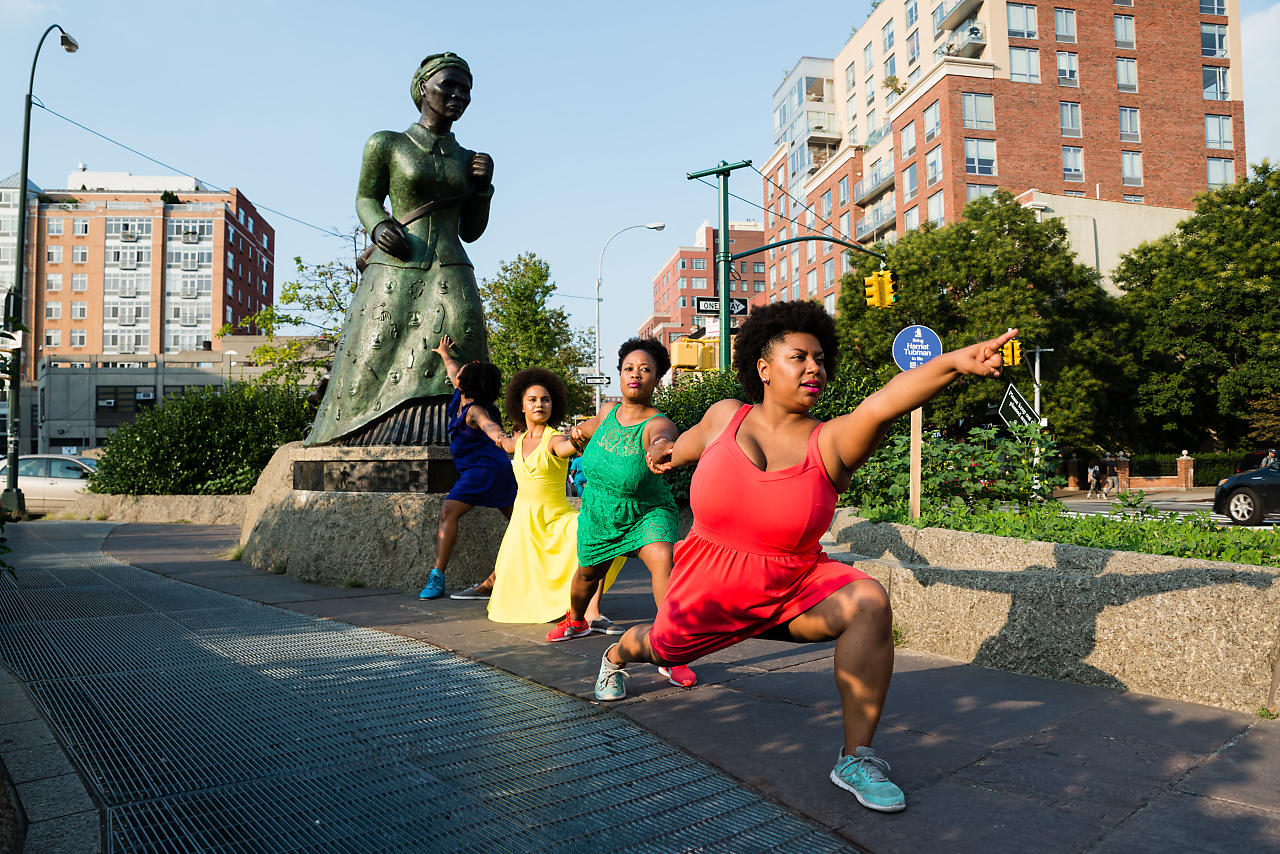
SLMDances in Direction from Harriet
(photo: ShocPhoto)

Sydnie L. Mosley in Body Business
(photo: Kearra Gopee)


Do you have a current or planned project whose progress is affected by the pandemic?

Kind of. SLMDances has been in a long term research and development process for PURPLE. PURPLE is a multi-project universe that illuminates the power of “deep sisterhood for social change” through storytelling and movement. Among its projects-in-progress there are: a community-engaged oral history project with elders, a stage work for an intergenerational ensemble of twelve artists, and the development of a series of solos on veteran performers (that language borrowed from you, Eva!).

The thing is, PURPLE is actually a life practice. So although we are no longer able to meet in person with our elder friends or be in a studio movement practice, the way that we continue to work together is practicing the work and moving it forward.

Briefly, tell me about how you got involved in the arts and in your particular practice.

The first dance I choreographed was to a Langston Hughes poem performed in the center aisle of an AME sanctuary dressed in kente cloth. I was 7. I come from: making up lip synch dances to En Vogue with my sister, cousin, and God-sister; pink tights and sequined tutus in mirrored studios; summers at the American Dance Festival four-week school; choreographing for and running my grade school dance companies; and moving in and out of linoleum community center floors.

At 17, I decided I wanted to run my own dance company. I used my college and graduate school educations--including classroom, work study job, and internship experiences--to learn everything I possibly could about my craft and the field in New York City. From laying the marley to composition to technique to company management.

I also come from formative experiences that affirmed my Blackness, my identity as a woman, my trust in community. That taught me how to lead, organize, and hold space.

By the time I got to making my first evening-length work, I was figuring out how to connect my history advocating and creating space for my communities with choreography and production.

In a more specific way, what are you practicing? And what are you envisioning?

I am practicing stillness. I am practicing surrender. I am practicing listening. I am practicing being cared for. I am practicing writing. I am practicing advising. I am practicing healing. I am practicing wellness. I am practicing joy. I am practicing being who I am becoming.

How does your practice and your visioning align with what you most care about?

Everything I do is in alignment. I care the most about Black people, Black women and girls, artists with marginalized identities, dance as a field--wellness, thriving, and liberation for all. The act of growing the SLMDances collective, dance by dance, organizational iteration by organizational iteration is my practice. We are guided by our core values: Dreaming, Activism, Community, Transparency, Humanity, Learning. This is our framework, compass, and rubric for accountability.

How does your practice function within the world we have now?

My practice LOVES the world we have now. My practice is affirmed by the world that we have now. The SLMDances COVID-19 pivot is not really a pivot. Our continued rehearsal ritual, as we call it, has been grounding, with most of us tracking time in the past thirteen weeks by SLMDances Day or non-SLMDances Day. Even though we are meeting virtually, we are still moving together, still breathing together, still checking in, and still creating together.

The collective organized a professional development series with guest facilitators sharing their expertise in topics ranging from theater devising techniques to trauma-informed facilitation to plant medicine to financial wellness. We are tending to our own wellness by being together, acquiring information together, brainstorming together. We are sustaining relationships with our elder community partners by making phone calls and connecting them to resources where and how we can.

Briefly share one self-care tip that has special meaning to you now.

Give yourself permission. This is an idea we have talked a lot about in developing SLMDances’ most recent work PURPLE. As the world has turned upside down, it has become increasingly important to be kind to yourself and give yourself grace. Be gentle and release expectations. We are grieving, we are shocked and upset, we are losing grasp of everything we thought we knew. Give yourself permission to feel your feelings, to not work, to rest, to eat, to dance it out. What we once knew has gone. You have permission to be new.

******

DISCLAIMER: In addition to my work on InfiniteBody, I serve, at Gibney, as Senior Director of Artist Development and Curation and Editorial Director. The postings on this site are my own and do not necessarily reflect the views, strategies or opinions of Gibney.

******

Subscribe in a reader

Copyright notice

Copyright © 2007-2023 Eva Yaa Asantewaa
All Rights Reserved

Popular Posts

Labels