Search This Blog

Saturday, November 9, 2013

Toshi Reagon reflects on "Naked Soul" at the Rubin

As a follow-up to my post on the Naked Soul concert by Toshi Reagon and Juliette Jones at The Rubin Museum (read it here), I got permission from Reagon to share her beautiful notes from Facebook on her image and music selections and her overall experience at the Rubin.

She writes:

I had a heart opening experience at the Rubin Museum of Art. It was a thrill to sing in the a beautiful rosewood room with excellent acoustics. I am so used to creating dynamics with my voice and a microphone- it was a work out to sing off mic a whole show. I loved it. I worked with violinist Juliette Jones who jumped into every song with a soulful and sensitive creativity. Fierce! I was deeply moved by the good folks who decided to spend the time and money to be at that show. There was no loud sound to cover fidgeting, drinks, or small conversation. We all had to be really present. It was something else. This audience felt like they knew each other well, and sang so beautifully together. I am always humbled to see really old things survive in the 21st century. I as myself what will we leave for our people hundreds of years from now. Looking back could help us move forward in a brighter light.
Durga Mahishasuramadini
10th century
Tan Sandstone
I used usually 2 or 3 songs to cover the energy I felt from the pictures. I picked "Mountain top" for Maya because she gave birth to Buddha- she has a connection to life- and makes trees. She gave birth standing up- and she gave birth to someones who mission was known. So he is born grown. "Mountain top" is a rebirth song and the idea of standing on the mountain and standing down on the mountain made me think of this idea of being bigger than a mountain or grand enough to be there. So it is the idea of releasing power into the world and being powerful yourself that connected them.

I picked "Terrify Me" and "I hate I love" for Durga because they are both about having to deal with and vanquish problems you did not cause. They are both about a manipulative power structure that would never empower you to to be an equal creating chaos that you have to win in order for all to survive.

I picked "dream" for Rahula because it is the song about an end of life and everlasting life on the other side of death - it ends then we die no more. A guide is moving along side the person that is moving towards death- does not push or pressure but walks along side. Eventually the person finds death and welcomes by crossing the jordan river. How ever they are not gone from the ever. Rahula could be guiding us to a death and another life.

In good voice: Black women speak up, sing out

Melissa Harris-Perry
(photo: MSNBC/Heidi Gutman)
Yesterday, the stars aligned. And how!

In mid-afternoon, scholar, author and MSNBC host Melissa Harris-Perry sat down at The New School for a provocative conversation with scholar and author bell hooks. In the evening, singer-musician Toshi Reagon took to the stage at the Rubin Museum of Art with violinist/fiddler Juliette Jones for an acoustic concert of songs organized around images from the Rubin's collection of Himalayan art. Without question, November 8, 2013 was a Power Day in New York City.

bell hooks
If you missed the (poorly announced) free ticket distribution for the New School event, you could watch via Livestream (complicated sign-up, especially at the last minute, but not impossible). Social media exploded right before, during and after with expressions of frustration (What??? I didn't know you needed TICKETS to get in!!!) and increasing awe as hooks and Harris-Perry addressed, all too briefly, numerous issues, each of which could have launched a thick dissertation. From divergent perspectives on recent Black-themed films (12 Years A Slave, Django, The Butler) to sexual violence against Black women to the relative privilege of having light skin when working in corporate media, hooks and Harris-Perry showed a willingness to take space, give voice and honestly grapple with difficult questions. And difficult people: Ironically, perhaps inevitably, one man chose to waste limited Q&A time by delivering a lecture then shouting over hooks' attempt at a reply. It's useful, though--isn't it?-- whenever a fool helps you prove your point about the arrogance of patriarchy.

Both women invoked the late congresswoman/presidential candidate Shirley Chisolm of Bajan heritage (her slogan: "Unbought and Unbossed") as a role model and, accordingly, spent the ninety-minute session breaking every possible code of silence. I was most amazed by--and even concerned for--Harris-Perry who displayed an outspokenness about her role at MSNBC and a degree of personal vulnerability that I would not have anticipated. I felt hooks--twenty years the broadcaster's senior, as she made sure to note at the beginning of their talk--prodding and then leading Harris-Perry into deep waters but making sure to surround her with loving support. Just breathtaking.

Watch the archived conversation
 on Livestream here.
http://hulshofschmidt.files.wordpress.com/2012/02/toshireagon1.jpg
Toshi Reagon
(photo: Erica Beckman)

Introducing Toshi Reagon at the Rubin, Tim McHenry (Director of Public Programs and Performance) wondered aloud what had taken him so long to invite her. So now that that oversight has been rectified, I'm sure it won't take long to bring her back. McHenry's sold-out audience was not only appreciative but clearly smitten.

The Rubin challenges singer-songwriters in their Naked Soul acoustic concert series to peruse the collection and select three images to build a set list around. Reagon--who looks much like a delighted Buddha herself--clearly enjoyed her opportunity to learn about the legends of Himalayan deities and demons and recognized, in them, a way to talk about her ongoing concerns around social and environmental justice. The connection of her specific song lyrics to the sacred themes wasn't always obvious, but the delicate interplay of her high-flying voice, her bluesy guitar and Juliette Jones's sinuous fiddle work made their own sense and had grounded, and grounding, spirituality--always welcome. Her ease with the audience and her sense of humor were winning. Someday ask Reagon to tell you the story of the warrior goddess, Durga--one of her image choices. The Rubin really ought to hire her as a docent.

******

Future Naked Soul evenings will include appearances by Mary Gauthier (January 3), Susan Werner (Febuary 14), David Wilcox (March 14) and Shelby Lynne (May 30). For information and ticketing, click here.

Friday, November 8, 2013

Jack Mitchell, photographer, 88 [UPDATE]

Iconic photographer Jack Mitchell dies at 88
by Richard Conn, News-Journalonline.com, November

Jack Mitchell, Photographer of the Arts, Dies at 88by Bruce Weber, The New York Times, November 9, 2013

La MaMa's Puppet Series opens with "The Orphan Circus"

Quebec's Les Sage Fous troupe opened La MaMa's latest Puppet Series with a curious number called The Orphan Circus, directed by South Miller.
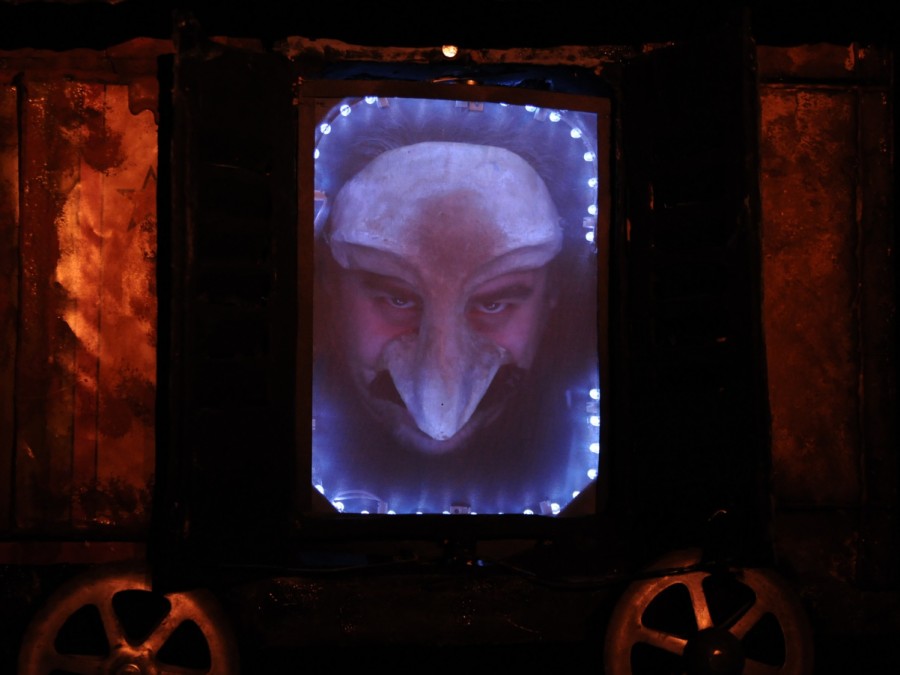
Monsieur P. T. Issimo, mysterious circus impresario
(photo by Cinthia Chouinard)


We begin this hour in the company of two rough-looking customers--actor/puppeteers Jacob Brindamour and Olivia Faye Lathuillière--who creep around a dark alley filled with corrugated gates, trash barrels, old oil cans and other debris. After our initial impulse to hug our belongings closer, we watch the pair go about recycling trash--"orphaned objects"--into treasure, asserting the siren-like beauty in a discarded, ratty-looking doll, training a fish skeleton to be a champion acrobat, and more.
Brindamour (l) and Lathuillière with friend(photo by Theo Cote)
Christian Laflamme's score, in its pleasantly jazzy way, belies the grim surroundings and the grotesque appearance of the puppets and says "New Age Magic Act." I got the point--see loveliness and wonder everywhere and anything is possible!--but never warmed up to these puppet characters or to the slight work itself. Perhaps something more meaningful and effective could have been done with the perfunctory contact between puppets and audience (first row only).

Brindamour and Lathuillière very skillfully control their puppets via little black sticks and strings, the dim lighting and our cooperative minds rendering those maneuvers nearly invisible. Yet the grand transformation these puppeteers seek to achieve is more announced than convincingly displayed.

The Orphan Circus repeats tonight and Saturday at 7:30pm and Sunday at 2:30pm. The La MaMa Puppet Series runs through November 24, including a curated "puppet slam" on Friday, November 15 at 7pm. For information and ticketing, click here.

La MaMa (First Floor Theatre)
74A East 4th Street (between Bowery and 2nd Avenue), Manhattan

A whole 'nother kind of pre-op: Watch this!

Thursday, November 7, 2013

Mindy Aloff celebrates the dance writing of Edwin Denby


NBCC Reads: Mindy Aloff Picks Edwin Denby
by Mindy Aloff
Critical Mass (National Book Critics Circle), November 6, 2013

Maria Hassabi premieres "PREMIERE" at The Kitchen

Choreographer Maria Hassabi (far left) with members of her troupe--
l-r, Robert Steijn, Andros Zins-Browne, Biba Bell and Hristoula Harakas
(photo by Marialena Marouda)
From Hassabi's PREMIERE
(photo by Paula Court)
The publicist wasn't kidding when he wrote, "The artist and The Kitchen would like for me to remind you that there is absolutely no late seating for this show, so please plan accordingly to be here before 8:00."

As soon as you pass through the set of doors into the performance space for Maria Hassabi's PREMIERE (co-presented by The Kitchen and Performa for Performa 13), you're trapped. With the action--yes, I will use that word--unfolding in front of you, the five performers arrayed between you and those doors, there's no unobtrusive way to get up and walk out. And, any number of times, you might think about walking out, think about fleeing the tedium and the cumulative heat of countless stage lights massed on either side of the performance space. The dancers' movements are incredibly slow and slight; the temperature in the airless room, elevated; and you are uncomfortably aware of everything going on within your own body.

Over ninety straight minutes that feel like ninety minutes indeed, you tilt forward, backward into your seat, list to one side or the other. Your eyes droop. You fan yourself with your program. You hear your neighbors similarly shifting, rustling, coughing. You catch one checking her watch. You check your own watch.

And yet you stay put. Not because you are a Performa type, because maybe you're not. Not because you're self-conscious and/or polite. But because the work--an endurance trial for performers and audience alike--is a knockout.

From Hassabi's PREMIERE
(photo by Paula Court)
You first experience PREMIERE as you enter the space, noticing the dancers rooted in place--Biba Bell and Hristoula Harakas standing, Hassabi, Robert Steijn and Andros Zins-Browne lounging on the floor--all motionless as they face the theater's doors. They maintain that tableau, inside the blaze of hot lights, with their backs to the audience as it settles in. When the last stragglers enter, Kitchen staff close the doors--the only indicator that the time has come to pay serious attention.

You watch for something--anything--to break loose. You feel relief and triumph to notice even just the flow of breath ruffling through a dancer's back, and you search for more of the same. Your outer and inner senses reach out. Despite yourself, you have already begun to live in this dance.

This persists over a long stretch until Harakas breaks the spell with a teeny, tiny twist of one foot. Bell also makes a minute slide or twist that slightly re-positions her body. In time, Zin-Browne's arm, which has been supporting him on the floor, slips backward an inch or so, and so does both of Hassabi's supporting arms. Glacial pace and subtlety in movement get the job done, though. You can look away for a while and look back to find the grouping changed in significant ways. It not only breathes; it evolves.

"Sound, here," I wrote in my notebook, "is color." I cannot say what I meant in that moment, but, so be it. The sole of Bell's ankle boot makes little crackles as it inches along the floor. In the otherwise silent atmosphere, that reaches us like amplified music. This approach to sounds, created by the friction between surfaces, recurs throughout the piece as dancers adjust their grounding. In one part of the dance, a crinkly sound initially seems to issue from one or more of the lights, like a sudden electrical problem. That distracts you until the volume of the noise strengthens and you get the joke. It's part of a recording as is a soft, high voice that appears somewhere and swiftly disappears.

Late in the piece, the blast of light reduces and then gets restored. Maybe you notice, for the first time, the oval pattern of dusty shoe marks--presumably from the audience, but it looks so perfect--that decorates the floor. Maybe you think, "Who's to stop me from napping for the remaining time? Really, who?" Instead, you continue to watch the dancers work their way 'round to their original tableau in which they face the doors through which you now may exit. In their end is their beginning.

Sound design by Alex Waterman
Lighting design by Zack Tinkelman and Maria Hassabi
Styling by threeASFOUR
Dramaturgy by Scott Lyall

PREMIERE continues at The Kitchen through Saturday evening with performances at 8pm. For schedule and ticketing information, click here.

The Kitchen
512 West 19th Street (between 10th and 11th Avenues), Manhattan
(map/directions)

******

More on The Kitchen

More on Performa 13

Copyright notice

Copyright © 2007-2023 Eva Yaa Asantewaa
All Rights Reserved

Popular Posts

Labels