Search This Blog

Showing posts with label disabilities. Show all posts

Monday, April 13, 2020

Artists Reach Out: Jerron Herman

Dear friends,

Welcome to Artists Reach Out: reflections in a time of isolation. I dreamed this series of interviews out of grief for my work both as a documenting arts writer and curator of live performance. In this time of social distancing, we are called to responsibly do all we can to safeguard ourselves and our neighbors. It is, literally, a matter of life and death.

But there's no distancing around what we still can share with one another--our experiences, thoughts, wisdom, humor, hearts and spirit. In some ways, there are more opportunities to do so as we pull back from everyday busyness out in the world and have time to honor the call of our inner lives.

So, let me introduce you to some artists I find interesting. I'm glad they're part of our beautiful community, and I'm eager to engage with them again (or for the first time) in years to come.

--Eva Yaa Asantewaa, InfiniteBody


Jerron Herman

Jerron Herman
(photo: Kirk Chambers)

Jerron Herman is a dancer working in New York City. He is also a Trustee for Dance/USA and an art/culture writer. He moderates discussions for artists and institutions, including a series he helped create named Access Check 2.0: Mapping Accessibility with the Shelley and Donald Rubin Foundation. Last year he premiered solo works at The Whitney Museum, Danspace Project, and Performance Space New York. He is currently developing Wired with Kinetic Light for a Fall premiere at The Shed. Jerron has been featured on CBS, Buzzfeed, and Great Big Story about his work in disability art.


Jerron Herman
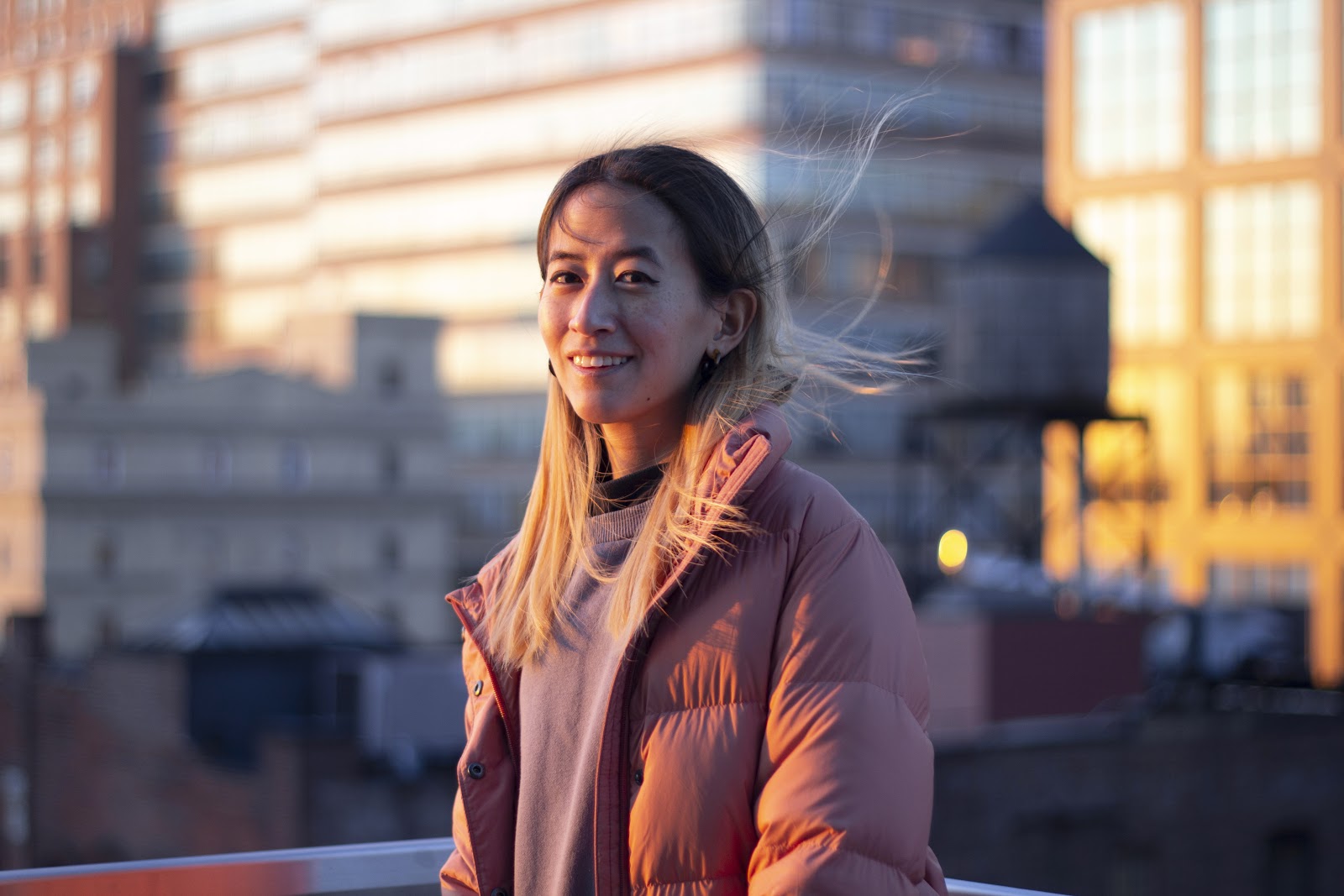
(photo: Mengwen Cao)


Do you have a current or planned project whose progress is affected by the pandemic?

Thankfully, thankfully, back in July I, joined the spectacular team of Wired, devised by Kinetic Light and artistic lead Alice Sheppard. Our premiere has been delayed. Having Disabled, Black, and Women leadership from the get, corroborated by Managing Director Candace Feldman, I immediately felt safe that hiatus didn’t have to look scarce and scary. We didn’t stop rehearsing, instead our method of work deepened to accommodate the time we had. We had more time.

Alternatively, April did promise a busy grind: I had been invited to do DanceNOW RAW at Joe’s Pub and a very exciting micro commission on Beethoven for National Black Theater/Carnegie Hall/NYPL LPA as well as a lab in Berlin and they all spoke to one of my burgeoning desires as a young solo artist. Still, though not in their original forms, I am discussing, working, and developing these projects.

Briefly, tell me about how you got involved in the arts and in your particular practice.

I was invited! I see it as the parallel to growing up--coming into the world, being nurtured by “parents,” teen angst, and then off to the real world. When I was 20, I was “discovered” by Sean Curran who organized an audition with Heidi Latsky, and she welcomed me into her company immediately. I danced with HLD for eight years and was also their Development Director for about three years. During this time, I learned the art as well as the business of art: I increased budgets, rehearsed and performed, sat on the Bessies Committee, joined Dance/USA, sat on funding panels, went to galas, met influential people.

I was definitely not your average dancer beyond the fact I was a Disabled Black Man. Meeting HLD was also the first time I was willing to embrace Disability--for, up until then, I hadn’t met my “people,” artists with disabilities, people who could elongate and vary and expand their prowess. Disabled people are just so damn cool and fierce. But I didn’t have a “practice” until about a year ago when I allowed my movement vocabulary to speak to a room on its own terms.

In a more specific way, what are you practicing? And what are you envisioning?

I have an affinity for language, possibly as a vestige of my initial love for writing. So, I’m practicing my look at definitions and criticizing their place in our society. I read how people want to do away with antiquated themes, and I question those themes’ usefulness. It stems from my understanding of the medical intervention I experienced as a child.

My diagnosis, Hemiplegia Cerebral Palsy, is so coded and largely uncorked that I see it as my duty to reveal its usefulness to art and critique. I know the diagnosis’ intention to limit me and instead see a supportive frame through which to describe particular functions of my body or simply register criticism of its primary use.

I believe this practice embodies the sense of freedom I want to examine in my work--the abandoned physicality that is virtuosic because of disabled embodiment, in command of its diagnostic roots. I’ve always understood the power of reclamation and think it’s a very effective strategy for life. So, I envision us looking at legacies and reassessing their authority. I don’t want to get rid of all old things, but let them participate differently.

How does your practice and your visioning align with what you most care about?

I care about “freedom from” a lot. It probably stems from my Pentecostal upbringing when we’d ferociously expel the Devil from a context, the principle being to counter a negative force because it was your right.

When we discuss marginalization in a secular setting, I rather think I’d like a Pentecostal bent to it--ferociously spitting hot words at that Devil of Supremacy or Violence but, to continue the metaphor, acknowledge the power and authority with which we expel; this ingrained nobility that posits a different, protected genius.

I want people to be free because spiritual, mental, physical bondage to anything, means our collective depression. It means less will be created or fully realized, and I don’t want that for the world. I became an artist because I loved artists. I found the work and process noble and worthwhile, and I am still in awe that I comfortably call this my community.

How does your practice function within the world we have now?

I believe true “process” is rare and requires a host of supports to enable it. I’ve been so fortunate to experience investment in my artistry that allows me to function without scarcity; I have contemporaries who are lauded for their brilliance and thought of as complex creators; I’m witnessing a thirst for authenticity from audiences and stages, so I feel emboldened to establish and check and experiment with a practice that would hinge on my understanding of myself.

And in the context of “now,” I believe our collective slow down disabuses our initial thoughts on product and industry so that complexity of form and more accessible features of art-making can be articulated comfortably. I guess I feel my rigor hasn’t changed, instead it’s channeled in the most effective way--toward movement and discourse to build and push us forward.

******

DISCLAIMER: In addition to my work on InfiniteBody, I serve as Senior Curatorial Director of Gibney. The postings on this site are my own and do not necessarily reflect the views, strategies or opinions of Gibney.

******

Subscribe in a reader

Thursday, April 2, 2020

Artists Reach Out: Christopher “Unpezverde” Núñez

Dear friends,

Welcome to Artists Reach Out: reflections in a time of isolation. I dreamed this series of interviews out of grief for my work both as a documenting arts writer and curator of live performance. In this time of social distancing, we are called to responsibly do all we can to safeguard ourselves and our neighbors. It is, literally, a matter of life and death.

But there's no distancing around what we still can share with one another--our experiences, thoughts, wisdom, humor, hearts and spirit. In some ways, there are more opportunities to do so as we pull back from everyday busyness out in the world and have time to honor the call of our inner lives.

So, let me introduce you to some artists I find interesting. I'm glad they're part of our beautiful community, and I'm eager to engage with them again (or for the first time) in years to come.

--Eva Yaa Asantewaa, InfiniteBody


Christopher “Unpezverde” Núñez

Christopher "Unpezverde" Núñez
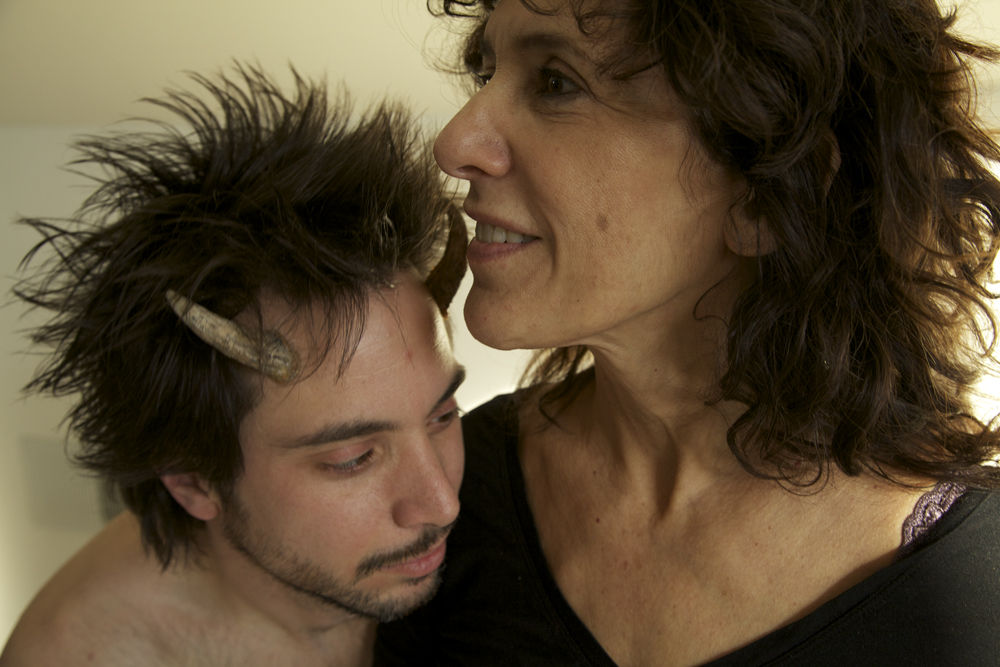
(photo: Ariela Muñoz)

(b. Costa Rica) Christopher “Unpezverde” Núñez is a Visually Impaired Choreographer, Performance Artist, Curator and Arts Educator based in New York City. In New York, his performances have been presented at The Brooklyn Museum (The Immigrant Artist Biennale), The Kitchen, Movement Research at The Judson Church, Danspace Project, The Leslie Lohman Museum for Gay and Lesbian Art, The New York Public Library for the Performing Arts, Dixon Place and Performance is Alive at Satellite Art Show (NYC and Miami). He  has performed internationally in countries like Peru, Dominican Republic, Nicaragua, Salvador, Guatemala, Costa Rica and The United States. His work has been featured in publications such as The New York Times, New York Magazine, The Brooklyn Rail, The Dance Enthusiast and The Archive: Journal of The Leslie Lohman Museum of Gay and Lesbian Art, a bi-annual journal. He has held residencies at New Dance Alliance (LiftOff, 2018), Battery Dance Studios (Space Grant, 2017-2019), The Kitchen (DAP, 2019) and Center for Performance Research (AIR, 2020). Núñez has collaborated with world-renowned artists such as Nacera Belaza (France), Christophe Haleb (France) and Mark Sieczkarek (Germany). Most recently, he performed in Dressing Up for Civil Rights by William Pope L, presented at MoMA, The Museum of Modern Art. Núñez holds a BFA in Science in Performing Arts from the National University of Costa Rica.


Photo by Rachel Rampleman
Courtesy of Performance Is Alive

Photo by Walter Wlodarczyk
Courtesy of The Immigrant Artist Biennale [TIAB]


Do you have a current or planned project whose progress is affected by the pandemic?

Yes. I was starting a series of workshops on visual impairment in dance and had a commission with a dance company under the same type of exploration that I had titled Dreamscapes for its creative nature beyond the visual experience we are used to in dance. Earlier this year, I also started a residency at the Center for Performance Research that focuses on transcribing movement into text and eventually to Braille for visually impaired dance makers and audiences.

Everything is on pause. Due to the nature of my work, being present in space is essential. Every day I think about how I can use technology to continue a process through the Internet but all this pandemic experience has exposed the disadvantage that we--people with visual impairment and the disabled community in general--experienced on a daily basis. Many cultural organizations, theaters, dance companies, and so forth, do not have accessible websites for the blind or low-vision people. This makes the job even more difficult if not impossible for many of us.

Briefly, tell me about how you got involved in the arts and in your particular practice. In a more specific way, what are you practicing? And what are you envisioning?

I was not born visually impaired. My visual impairment is the result of domestic violence. At the age of 5, I lost the vision of my right eye. I cannot distinguish volume or distance. As a result I experienced a lot of trauma. The doctor recommended my mom put me in dance classes to help me understand space, its depth, and how to share it with other bodies. We were very poor but there were free classes in the public library. That’s how I started to dance. Dance was and is therapy for me. I have learned to survive thanks to it.

When I started dancing professionally people advised me not to talk about my disability because nobody wanted to work with disabled dancers. But all the work that I had done in isolation in the studio on spatial perception, proprioception, and embodied  imagination began to infiltrate my choreographic practice.

My practice involves accessibility tools for blind people such as audio description, wayfinding, dance through touch, Braille, among others. Tools that I used in the privacy of my creative process. But, over time, I understood that my creative process is also my art, my beginning and my final product. I decided to share it with the audience. Let people understand how a visually-impaired dancer works. I decided to be honest and find beauty and poetry in what makes us different.

How does your practice and your visioning align with what you most care about?

What matters most to me is justice. My practice is inclusive and invites all audiences. Aside from my visual impairment, I identify as queer and lived undocumented in the United States for four years. I know invisibility and how to survive on a wide spectrum within it. But I recognize now that this social revolution we are experiencing invites us to talk openly about our experiences in favor of justice and to keep fighting for the space that is owed to us.

How does your practice function within the world we have now?

I like to think of this answer in reverse: How does the world we have now function within the practice I have?

My practice is a form of revolution and activism that invites people to see the world from a different perspective. Jonathan Burrows describes my sentiment very well in his book A Choreographer’s Handbook as follows: Audiences like uncompromised work. People with disabilities make incredible efforts every day to adapt to a world that is not intended for us.

I’d like to think that my work is uncompromised but intended for everybody. The many layers that compose it open up space for negotiation between disabled and non-disabled people.

******

DISCLAIMER: In addition to my work on InfiniteBody, I serve as Senior Curatorial Director of Gibney. The postings on this site are my own and do not necessarily reflect the views, strategies or opinions of Gibney.

******

Subscribe in a reader

Friday, March 27, 2020

Artists Reach Out: Yo-Yo Lin

Dear friends,

Welcome to Artists Reach Out: reflections in a time of isolation. I dreamed this series of interviews out of grief for my work both as a documenting arts writer and curator of live performance. In this time of social distancing, we are called to responsibly do all we can to safeguard ourselves and our neighbors. It is, literally, a matter of life and death.

But there's no distancing around what we still can share with one another--our experiences, thoughts, wisdom, humor, hearts and spirit. In some ways, there are more opportunities to do so as we pull back from everyday busyness out in the world and have time to honor the call of our inner lives.

So, let me introduce you to some artists I find interesting. I'm glad they're part of our beautiful community, and I'm eager to engage with them again (or for the first time) in years to come.

--Eva Yaa Asantewaa, InfiniteBody


Yo-Yo Lin

Yo-Yo Lin
(photo: Zack Filkoff)

Yo-Yo Lin is a Taiwanese-American interdisciplinary media and performance artist who explores the possibilities of human connection in the context of emerging, embodied technologies. Through an on-going exploration into ‘soft’ illness data, body sonification, and impairment-generated dance, she is researching and developing methodologies in reclaiming and processing chronic health trauma. Her latest solo performance the walls of my room are curved premiered last winter at Gibney. Recently, Yo-Yo co-facilitated a four-part movement workshop series “Modes of Embodiment: An Expressive Toolkit for Chronically Ill and Disabled Bodies” at Movement Research. Born and raised in Los Angeles, Yo-Yo now lives and works in New York City. More info at www.yoyolin.com.

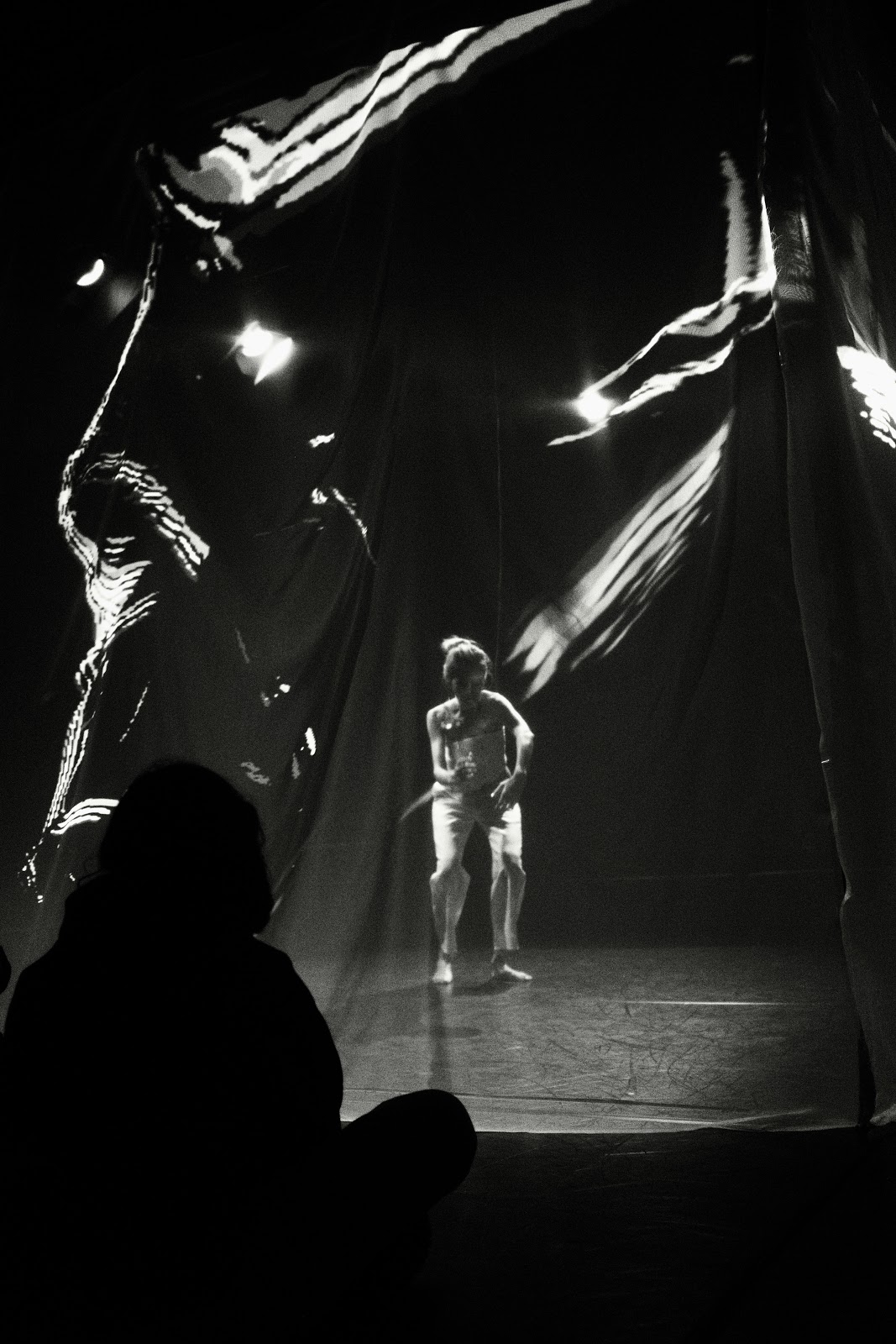
Yo-Yo Lin's the walls of my room are curved
(photo: Steve Dabal)

Do you have a current or planned project whose progress is affected by the pandemic?

I had planned on showcasing the performance the walls of my room are curved at two gallery openings this spring, both of which are now postponed indefinitely. the walls of my room are curved is a movement-generated sonic performance of the body living with a connective tissue disorder. The performance uses several microphones attached to my moving body, capturing the live sounds of creaking and crackling bones and joints as they shift, transfer, extend, and rotate. As I dance, an electronic musician samples, processes, synthesizes the sounds of my body into a musical score in real-time. I also have a group show currently up at the Jewish Community Center, entitled Rituals, that is now closed as well. Curated by Ezra Benus, the show addresses living experiences of illness and disability in abstract, ritualistic forms. I had planned on doing a durational performance based off of my data-tracking framework called The Resilience Journal but am now re-imagining it to be done remotely.

Briefly, tell me about how you got involved in the arts and in your particular practice.

I began with drawing and painting, then started making my drawings move. I was interested in moving images as a sculptural element--often taking these moving images and projecting them onto different surfaces. This led me into using real-time technologies--tools that would allow me to live-manipulate the visuals, map them onto 3D shapes, and sync with body movement. Naturally, live performance was the venue for these explorations. I often work collaboratively with musicians, dancers, and other performing artists in turning their visions into reality. As of recent, I’ve been combining my media art based practice with an emerging performance practice. I’ve been doing research into somatics, internal arts (including Tai Chi), and illness/ disability aesthetics in dance.

In a more specific way, what are you practicing? And what are you envisioning?

I am practicing a revealing and re-valuing of realities. Living with an invisibilized illness has prompted me to question the realities of my body in relation to time and space. I am discovering that illness is relativity. Notions of how the ill bodymind can be generative sources for creative expression--in visuals, sound, tactility, shape, space, movement--has coupled with my explorations in time-based media art and technologies, creating works that seek to make the invisibilized not just visible but felt, embodied, and honored in its complexity. These works span from ‘soft’ data visualization to soundscapes made from bone sounds, to impairment-generated dance scores, to extended reality nightlife spaces. These explorations sometimes echo the complicated relationship between the body and technology, often precarious, discomforting, and transformative all at once. But ultimately, these works reveal a yearning for a deeper understanding and vision of the self, reflected back in its wholeness.

How does your practice and your visioning align with what you most care about?

My practice belongs to a lineage of immigrant, ill/ disabled QTPOC womxn artists, all of whom have created art from necessity and with what they had. I find that “necessity” has produced the most honest, provocative art. I have been recently practicing with this idea in mind, unlearning the excess in technology-based art, acquainting myself with my body and the living planet, and holding space for grief and pleasure. I have been doing this not alone but with many others--creating and facilitating spaces for looking inward, safer discussions, and collective growth. Last fall, dancers Lara Marcin, Pelenakeke Brown and I facilitated a four-part movement workshop series entitled, “Modes of Embodiment: An Expressive Toolkit for Chronically Ill and Disabled Bodies” at Movement Research, where we sought to create an access-centered dance-making space. We dream of continuing to create communal space to honor the trauma in the bodyminds we own and building tools and methodologies to do so.

How does your practice function within the world we have now?

My practice continues to function, perhaps ever more urgently, in the world we have now. I see the able-bodied workforce employ techniques that chronically-ill and disabled folks have long asked for and use as a form of access. Suddenly what was deemed “impossible” to do for a disabled person--such as tele-communication, healthcare benefits, paid leave, virtual events--are suddenly possible. I would like to dwell in this reality we live in right now, to hold space for the grief, fear, and anger we feel as chronically-ill and disabled folks in a time where we see ableism in full-force. I also call upon the wisdom we have developed over generations of mutual aid, resilience, and crip magic. For us, illness is nothing new. We’ve been on our own before. In my practice, I hope to further highlight the generative nature of illness by utilizing tools I have to my disposal while in quarantine, and taking this time to rest, listen, and serve the most impacted.

If you can, please donate to: https://www.gofundme.com/f/crip-fund.

******

DISCLAIMER: In addition to my work on InfiniteBody, I serve as Senior Curatorial Director of Gibney. The postings on this site are my own and do not necessarily reflect the views, strategies or opinions of Gibney.

******

Subscribe in a reader

Monday, August 5, 2019

Disabled Arts on Camera, Part 2: "Vision Portraits" by Rodney Evans

Dancer Kayla Hamilton,
one of four artists featured in Vision Portraits
(photo: Kjerstin Rossi)
Writer Ryan Knighton telling his story at The Moth
(photo courtesy of Vision Portraits)

(2019, USA/Canada/Germany; 78 min.)
written and directed by Rodney Evans


The documentary Vision Portraits introduces us to four dedicated artists whose lives, careers and creative approaches have been profoundly impacted by diminished or lost sight. They include art photographer John Dugdale, our beloved dance colleague Kayla Hamilton, Canadian writer Ryan Knighton and the award-winning filmmaker himself, Rodney Evans, best known for his 2004 narrative feature, Brother To Brother.


filmmaker Rodney Evans
(photo: Kjerstin Rossi)

We visit with these appealing and thoughtful people, the stories and glimpses of the work of the first three interspersed with the story of Evans's attempts to reverse the degeneration of his vision from Retinitis pigmentosa. Evans also wants to share with us how impairment affects vision through occasional images simulating fuzzy or dim sight, narrowed visual range or--as in the case of Dugdale--a nonstop internal light show of spectacular colors and effects.


Self-portrait of photographer John Dugdale

Dugdale's photography, achieved with assistants who adjust lens focus, is deeply poetic, melancholic and moving. When a stroke befell him at the age of 30, taking all but a crescent-like sliver of his sight, he told his mother "What makes you think I'm not going to be taking pictures anymore? I'm going to be taking pictures like crazy now!" I am grateful for that indomitable spirit; the work is so beautiful.

It was also fun to get to know a little about Knighton (author of the memoir Cockeyed), who considers his blindness to be a door onto "a different way of living, a different point of view." His blindness opened a portal to deeper honesty and a wicked sense of humor. If you watch this documentary for no other reason, you will value it for the concise yet uproarious story of the trip he took with his brother to a snake rodeo in Texas. It's a safe bet you'll never set foot at a snake rodeo in Texas or any other state but also a safe bet you'd enjoy hanging out with these guys.


Vision Portraits opens in New York City at Metrograph on August 9 and in Los Angeles at Laemmle Royal on August 23.

******

DISCLAIMER: In addition to my work on InfiniteBody, I serve as Senior Curatorial Director of Gibney. The postings on this site are my own and do not necessarily reflect the views, strategies or opinions of Gibney.

******

Subscribe in a reader

Saturday, April 29, 2017

Family life, fantasy life: Tamar Rogoff at La MaMa

Cover of Cherry Ames, Student Nurse (1943),
the first volume in Helen Wells's popular novel series for girls.
(from Collection of the Museum of Health Care)

Core cast members of Grand Rounds, a world premiere by Tamar Rogoff
Center: Cadence Rotarius
At left: Morgan Sullivan, Glen Heroy, Cyndy Gilbertson
At right: Jake Szczypek and Emily Pope
(photo: Asya Danilova)

In the 1950s world of
Grand Rounds, a 10-year-old inspired by the adventures of Cherry Ames, nurse and amateur sleuth, turns her perceptive gaze on the rituals of family life. What goes on behind closed doors and on the radio is fodder for her scientific reckonings. Rogoff invites audiences to sit bedsides to share the intimacy that propels her protagonist on a rescue mission of her own. 
-- from publicity for Grand Rounds

Core cast in rehearsal for Grand Rounds
(photo: Asya Danilova)


"They are the greatest cast I've ever worked with," said choreographer/director Tamar Rogoff after her world premiere of Grand Rounds at La MaMa's Ellen Stewart Theatre.

Well, they are certainly an interesting cast with individual backgrounds in everything from clowning for the Big Apple Circus to living with Parkinson's Disease. Working with all kinds of folks--even those without training in performance--is nothing new for the adventurous Rogoff. But while the unusual diversity of this cast, as well as their individual skills and all-in commitment, gives the work strength, none of that feels like enough. Even the expansive staging falls short of moving Grand Rounds from a curiosity to a consequential work of art.

Before seeing the show, I checked up on its title:
Medical Definition of grand rounds:  rounds involving the formal presentation by an expert of a clinical issue sometimes in the presence of selected patients (Merriam-Webster Dictionary)

Grand rounds: A formal meeting at which physicians discuss the clinical case of one or more patients. Grand rounds originated as part of residency training wherein new information was taught and clinical reasoning skills were enhanced. Grand rounds today are an integral component of medical education. They present clinical problems in medicine by focusing on current or interesting cases. They are also sometimes utilized for dissemination of new research information. (MedicineNet)

You could say Rogoff brings her "patients" 'round to us--though, instead of hospital beds, we get a close-up view of beds in a family's home. The beds suggest a modest home and the relationships within.

Rogoff grew up the daughter of a doctor, and her research and work have led her to an understanding of the dual nature of her mission as an artist--transformation and healing. In this new work, she foregrounds a child--a stand-in for herself, one would assume--whose attraction to the Cherry Ames books, popular from the 1940s through the 1960s, leads her to examine family life with the avidity of a smart young sleuth. The happenings here are her "grand rounds," too.

To start, some of the audience members are made to sit on cardboard boxes for sitting shiva in traditional discomfort--clever, that--positioned around the performance space so that we face one of several makeshift beds. The characters--a young girl, her parents, her grandparents--will shift from bed to bed. But, at first, we don't know that. So, as dancers in front of you perform a long series of movements in and around a bed, you might find your interest drifting away to catch what's happening elsewhere, particularly when the noise over there distracts you.

But when I saw Grand Rounds last night, we only learned from Rogoff's Q&A that she had wanted each of us to stay focused on the bed directly in front of us. Since these initial performances rotate among the beds and repeat, she explained, we eventually get to see everything that each character does--the young soldier/brother handily slipping right beneath his bed and repeatedly lifting it like a set of weights, the grandparents coyly approaching each other and dancing to swing music, the parents (superb Emily Pope and Jake Szczypek) in stylized and tense, faintly erotic conflict.

So, are we mourners? Are we doctors on grand rounds? Or are we--each of us--that little blonde girl who shows up everywhere to eye, or maybe imagine, influence, remember--what happens in each instance? The answer could be any or all of these things, but the problem, as I see it, is that it ultimately does not matter. Intimations of mortality--for instance, in the doleful soundscore, in the eventually overused shiva boxes--lead to events too predictable, and to drawn out, to land with emotional force.

And what of the rest of the staging, a sort-of fantasy placed at a remote distance from all of us and perched high on the theater's usual seating risers, where hospital scenes with cutesy doctors, student nurses and a patient could have been excerpted from a Broadway musical?

Neither here nor there: I had some Cherry Ames books when I was a child. I don't remember a thing about them except having once thought, "Why don't I have Nancy Drew books like everybody else?"  This slight resentment that might or might not have been justified. I have no idea. We can talk, another time, about how my seamstress mother and aunt chose to adorn me relative to what every other girl was wearing at the time.

Grand Rounds continues through May 14, Wednesday to Saturday at 7pm; Sunday at 4pm.  For information and tickets, click here.

La Mama (Ellen Stewart Theatre)
66 East 4th Street (between 1st and 2nd Avenues), Manhattan
(map/directions)


Subscribe in a reader

Saturday, April 22, 2017

Dancer Kayla Hamilton up close at BAAD!

Dance artist Kayla Hamilton
(photos: Travis Magee)


She moves through the world with a chronic illness that has left her with sight in one eye, loss of peripheral vision, double vision, blurred vision, and difficulty seeing in low light.
 --from publicity for Nearly Sighted by Kayla Hamilton


My experience of Nearly SightedKayla Hamilton's solo performance at BAAD!, actually started before I reached the theater. Coming off the #6 train at Zerega Avenue, I ran into a group of people--including some I knew--heading for the show, all in good spirits. We walked together past the churchyard and, once inside BAAD!, were warmly greeted by more people we knew. While we waited for Hamilton to perform, we watched a wonderful video compilation of interviews and studio scenes with the much-loved choreographers, all Black and women, who contributed work to this evening--Francine E. OttNia LoveChristal BrownCrystal U. Davis and Jaimè Dzandu. Fond co-workers and at least one grateful student of Hamilton spoke up during the post-show discussion. Yes, that kind of evening. More like a family gathering than most anything you'll find at your typical New York dance concert.

Clearly, Nearly Sighted is the place to be. And you're lucky if you can get a ticket. Yes, BAAD! is not the largest venue in town, but even so.

For the suite of dances, which is surprisingly short--maybe 45 minutes at most--Hamilton has woven together material from the choreographers as well as video artists Sammie Amachree and Drake Creative.  Each member of the audience is encouraged to wear an eye patch through most of the performance, giving us a small taste of how Hamilton's vision disability alters her perception of and relationship to her surrounding environment. To work with this, I left my distance glasses off and, given the intimacy of the space, did not need them. I adjusted to the eye patch over time.

If you've ever seen Hamilton dance, you know she brings presence, passion, momentum and juicy fluidity. In her program notes, she calls herself "thick."

"Thick not as in muscular, but thick thick." She adds, "I rarely get to see a thick-bodied disabled person on stage...."

She is a thick spinning top, a thick blossoming flower, a thick burst of fire, a system of thick coursing energy. She is also Black and female all day and embodies Nia Love's words: "It's the way that you stand, the way you sit...the notion that all that you are is all that's right and powerful and good. That's dignity." Her work is a healing gift.

Nearly Sighted was two years in the making. It was fun to talk in our small discussion groups about it and hear Christal Brown tell us none of the choreographers had previous exposure to the finished work. They had no idea how Hamilton would turn their individual material into a this tapestry. The performance, then, was a revelation for everyone.

Nearly Sighted concludes this evening with a performance at 7:30pm. It is sold out, but if you want to try for a last-minute, unclaimed ticket, click here for information.

BAAD!
The Bronx Academy of Arts & Dance
2474 Westchester Avenue (Westchester Square), Bronx

Subscribe in a reader

Sunday, April 2, 2017

92Y presents Overturning Expectations: Dance and Disability

Alice Sheppard
(photo: Britten Traughber)

Edisa Weeks's Overturning Expectations: Dance and Disability, curated for 92Y Harkness Dance Center's Fridays At Noon series this past week, drew upon the ability of dance artists with disabilities to take up the charge of Artist in the full sense of the word--to question, make with rigor, challenge self and audience, and nurture awareness of possibilities.

The event opened with two film screenings--choreographer Heidi Latsky's heady, striking Soliloquy (2015), featuring dancers of varying ages and abilities, and Karina Epperlein's short documentary, Phoenix Dance (2006), a profile of the late Homer Avila. If Latsky's film underscores the awesome force and sensuous beauty of dancers, Epperlein--through Avila, who lost a leg and hip to a rare form of cancer--shows us what goes into making a dancer, any dancer. Love, determination and discipline. Watching the one-legged Avila take daily class, watching his nimble work with duet partner Andrea Flores and choreographer Alonzo King, you revise your expectations of both the human body and the mind. Avila--whose spreading cancer took him from us at age 48--educated his audiences and colleagues well.

Dance artists Jerron Herman (Phys. Ed) and Alice Sheppard (So, I will wait and Trusting If/Believing When) might be polar opposites, at least by evidence of their respective solos. Herman's piece leans towards the athletic side of things. He is a dancer with Cerebral palsy's spastic condition, dystonia, noticeable in one arm and hand. Phys. Ed's repetitive nature--maybe a tad too lengthy and repetitive--has a down-to-earth, pedestrian feel despite his forceful jerking and jackknifing. Sheppard's solos here were infused with meditative, classical lyricism, her arms and torso arching and flexing into space above and around her wheelchair. Rather than an impediment to graceful movement, her wheelchair was both partner and a source of ability. Like Avila, she redirected our thoughts to the potent bodily and psychic strengths that make dance possible.

For information on upcoming Fridays at Noon programs at 92Y--including Moving Forward: Women Choreographers East and West, April 28--click here.

92nd Street Y
1395 Lexington Avenue (between 92nd and 93rd Streets), Manhattan
(map/directions)


Subscribe in a reader

Thursday, March 23, 2017

See "Enter the Faun" on WORLD's America ReFramed

"I grew up totally mixed up between art and medicine."
-- choreographer Tamar Rogoff

"To be able to feel the floor with my whole foot is an amazing sensation.
That's so new to me."
--performer Gregg Mozgala

Above and below:
Gregg Mozgala and Tamar Rogoff
appear in the documentary film, Enter the Faun
(photos: Andrew Baker).

Enter the Faun, directed by choreographer Tamar Rogoff and Daisy Wright, will receive its US television premiere next week on America ReFramedWORLD's independent documentary series. The film explores the rigorous and intimate process between Rogoff, an artist deeply engaged with the body's intelligence and diverse neuro-capacities, and Gregg Mozgala, an actor and playwright with cerebral palsy as the collaborators prepared his first foray into dance--her 2009 work, Diagnosis of a Faun. It is a persistent questing beyond fear and panic to a memorably sensuous performance.
Challenging the boundaries of medicine and art, as well as the limitations associated with disability, Tamar and Gregg opened the door to new and endless possibilities. His transformation was so radical that even before Tamar could understand its ramifications, she knew she needed to document it and share it.
Mozgala partners dancer Emily Pope-Blackman.
(photo: Harvey Wang)
Postcard
Photo: Harvey Wang
Drawing: Robert Eggers
Design: Olivia Klaus, Orange Static

Check local listings for the March 28 US premiere screening on WORLD (8pm EST).

Starting Wednesday, March 29, Enter the Faun will be available for free streaming for audiences across the US on WORLD. It is also available for purchase here.

Read about Mozgala's work with Rogoff in "Learning His Body, Learning to Dance" by Neil Genzlinger, The New York Times, November 24, 2009.

And follow this link to my Dance Magazine review of Tamar Rogoff Performance Projects' 2009 La MaMa premiere of Diagnosis of A Faun. I wrote that Rogoff "shows us people testing and achieving balance through moving away from what’s safely familiar—physically, intellectually, emotionally—into something new."

Subscribe in a reader

Sunday, March 5, 2017

This ability: "Our Configurations" at Gibney Dance


Top: Alice Sheppard and Laurel Lawson of Kinetic Light
(photo: Scott Shaw)
Bottom: Marc Brew of AXIS Dance Company
(photo: Andrea Testoni)

In a dance concert, what would be more surprising ? What Marissa Perel asks her first two able-bodied "consensual submissives" to do in (do not) despair solo while she exercises her agency to speak to her audience? Or how she treats her third submissive?

How about this: What's more in your face? The way choreographer Sonya Delwaide moves her two performers, keeping you aware of dancer Julie Crothers (AXIS Dance Company) phocomelia, a genetic disorder affecting one of her arms? Or the fact that the two women, Crothers and Alivia Schaffer, remain finely, intimately attuned to each other at each point of their duet, Dix minutes plus tard (Ten Minutes Later)?

And what of the partnership of Kinetic Light's Alice Sheppard and Laurel Lawson (to bend a bough and Broken Intent)? Is it more mindblowing to watch these dancers use streamlined wheelchairs as if these objects were STREB action gear? Or is it the way both women switch on their vulnerable flesh, their minds and their passions throughout a demanding encounter, showing us what it means to claim space, to claim life?

Our Configurations, an evening at Gibney Dance: Agnes Varis Performing Arts Center, reworked how we think about and look at disability in dance and performance. It raised questions of audience preconceptions--what do we expect and feel entitled to see?--and the privilege of the able-bodied to decide what is or is not noteworthy and virtuosic in performance.

Virtuosity, the product of disciplined labor, is worthy of respect, no one denies. In the post-show Q&A moderated by Hentyle Yapp, Sheppard declared, "Why wouldn't we have virtuosity? We put in the hours like everyone else." (Absolutely noted!) But for Perel, a queer artist living with pain, making art is "an act of resistance against normativity," an upending of expectations. So virtuosity needs to be "a new set of choices" not projected by viewers or critics but conceived by artists themselves. "Crips to the front," Perel declares. "People with disabilities taking up space in dance contexts."

I came away from Our Configuration with my own energies flying. Like AXIS artistic director Marc Brew (of Remember When, his visual and expressive feast in dance and film), I felt eager for this evening to open the way for "more, more, more."

The Winter/Spring 2017 season at Gibney continues with The Bureau of the Future of Choreography's presentation of 1776. Click here for more information.

Get your free email subscription
to InfiniteBody.

Saturday, January 7, 2017

APAP SEASON CHOICES: Dana Michel

Dana Michel performs Mercurial George
in this year's American Realness festival.


The Black Canadian dance artist Dana Michel--who made a big splash at home and here in New York in 2014 with her solo Yellow Towel--is back with a new solo, Mercurial George, at Abrons Arts Center for American Realness.

She has described the hour-long piece as an act of “wading through the hairy rubble of a preliminary anthropological dig” asking “What is the smell of a plethora of someones that you have been avoiding your whole life? What do you do with the body?” A seeming extension of Yellow Towel, with its genesis in racial stereotypes, Mercurial George implies the release of an authentic identity not imposed by others.

This is pertinent for exploration. Identity and marginal otherness--from immigration status to religion to gender--are battlegrounds with renewed real life-or-death stakes in the current moment. And Michel is a curious, fearless explorer, eccentric and mercurial indeed in her body language, fascination with the odd prop oddly used, and tendency to randomly mumble or declaim. She opens dimensions of mind and body that we usually declare unseemly and diseased and seems to say, "Look what else is here."

It's an interesting task and an interesting approach, requiring a performer who can submerge her calm, charming persona and grab hold of a viewer, no matter how resistant, for the space of an hour. Not easy. Go take a look and see what else is there.


Mercurial George
(photos: Ian Douglas)


Here's a mini-interview with Dana Michel
on the occasion of her January 2014 presentation of Yellow Towel
for American Realness.
(And here is my review of that show.)


Mercurial George will be presented again on Monday, January 9 at 4pm and Tuesday, January 10 at 7pm. Run Time: 55 minutes. For information on this and other American Realness events, now through January 12, click here.

Abrons Arts Center
(Experimental Theater)
466 Grand Street (at Pitt Street), Manhattan
(map/directions)

Free email subscription
to InfiniteBody

Thursday, May 12, 2016

Movement Research presents "Body Disrupt" at Abrons

Mat Fraser as The Beast
(with Jonny Dixon and Jess Mabel Jones)
in the 2014 production of
Beauty and the Beast at Abrons Arts Center
(photo: Sheila Burnett)

Below: Julie Atlas Muz as Beauty
(photo: Sin Bozkurt)


Artists with disabilities and artists whose work disrupts normative notions of what constitutes a dancing body will come together in conversation.
 --about Body Disrupt, a Movement Research Studies Project panel

Body Disrupt
--a panel convened and moderated by dance artist Kathy Westwater at Abrons Arts Center for Movement Research--left my head buzzing, not so much with a bunch of questions or final answers but rich points of departure. In that way, I found it satisfying--again, not in the sense of finality or feeling sated but in the sense of deliciousness. Each panelist--Wendy Whelan, Petra Kuppers, Julie Atlas Muz (representing her husband and creative collaborator, Mat Fraser), Marissa Perel, Cathy Weis, and Westwater herself--offered a different history, pathway, insight and flavor. I consider them all guides who lead you to a good place and leave you there with confidence that you're smart enough to push on forward in your own way.

Westwater introduced the event by talking about how her engagement with somatic practices left her at variance with their emphasis on organizing the body. In her dance practice, she said, she was "pursuing a disorganized body, trying to understand what that was."

"Why am I trying to organize my body?" she asked. "I'm an artist. I want to express the body I have." Indeed, she turned to physical "disorganization" as a stimulus for a choreography of exaggerated dis-alignment that, she says, "never stops being interesting to me."

As the panel wrapped up, Westwater revisited this language and reworked it--referencing, instead, "different organizations of bodies."

As a dance writer, I found that revision at once enjoyable and useful. It made me remember a question someone recently posed to me: "What do you look for when you go to see a dance?" My response was perhaps different from what another writer might offer: I go to engage with what's there, whatever it might be, not to look for something predeterminied. In other words, if I expect anything, it's the possibility of something different, and I've signed up for engagement with it. While that's no guarantee that I will get it or like it, it's a protective against simply failing to respect its right to exist.

Westwater and Whelan, it turns out, are old friends from youth. Even so, Whelan's presence on this panel was surprising and proved refreshing. After all, her stellar career, though evolving, has been rooted in classical ballet technique, far from Movement Research's approach to dance. But here's the thing: At age 12, Whelan was diagnosed with scoliosis (curvature and rotation of the spine) and spent months in a chin-to-hip body cast while bravely resuming her rigorous ballet training. Treatment helped, but it did not wipe away her innate sense of difference. At times, the ballerina had to endure fault-finding by members of my profession for the look of her body and her dancing.

Today, Whelan considers her condition a gateway to the truth of herself, beyond picture-perfect ballet conventions, and to the pursuit of more adventurous means of self-expression through the works of contemporary choreographers.

"I strive to be fearless," she says. "I'm never afraid to embarrass myself."

Kuppers--a German-born community performance artist and disability culture activist, now based in Michigan--impressed me with her playful approach to the world as a model of easygoing engagement based in perception and compassion. From Muz--performance and burlesque artist married to an actor with thalidomide-induced Phocomelia--I simply inhaled a renewed affirmation of my femme self and a voracious pleasure in the age-old, radical power of the Outsider. Perel spoke of disabilities and pain hidden from view--"I've been able to look like a dancer"--and, in particular, what dance critics fail to take into account when they encounter her work. A poet, installation artist, choreographer and critic, Perel says she works with forms of art that will give her agency. "I don't really care what they are." Weis, diagnosed with multiple sclerosis in decades ago and facing the loss of her marriage, regained her own agency through turning not only to dance but to stained glass and, especially, to video as an extension of herself, made on equipment that she could handle by herself.

Body Disrupt offered notions of disruption that can instigate not only the work of movement artists but also the work those of us who view, process, document and critique their art. These artists encourage each of us to define and relish in our freedom.

*****
Movement Research Studies Project presents a series of artist-instigated panel discussions, roundtables, performances and/or other formats that engage issues of aesthetics, philosophy and social politics relevant to the dance and performance community.

All Studies Project events are free and open to the public.

UPCOMING:

June 7, 6:30pm
Festival Spring 2016 Studies Project
Curated by Aretha Aoki, Elliott Jenetopulos, Eleanor Smith and Tara Aisha Willis

Gibney Dance Choreographic Center
890 Broadway, 5th Floor, Manhattan
(map/directions)

If you like what you're reading,
subscribe to InfiniteBody!

Thursday, March 20, 2014

Beautiful, beastly and renegade: Muz and Fraser at Abrons

Julie Atlas Muz as Beauty
At rear, Mat Fraser as The Beast,
flanked by Jonny Dixon (l) and Jess Mabel Jones
(photo by Sin Bozkurt)
Mat Fraser
with puppeteers Dixon and Jones
(photo by Sheila Burnett)
To be sure, the Playhouse stage at Abrons Arts Center is set up for a fairy tale--here, Beauty and the Beast--with an ornate, antique-y, rose-strewn set drenched in crimson light and gently breathing mist. And so, on a rainy evening perfect for storytelling, begins not one but two uncommon love stories. The familiar one we came for--in which a lovely daughter, having staved off family disaster by agreeing to go away to live in a beast-man's castle--gets charmingly, seamlessly interwoven with real-life details about the show's charismatic stars, Julie Atlas Muz and Mat Fraser.

Muz, former beauty queen and a multi-talented artist best-known for neo-burlesque, and Fraser, a British actor, writer and rock musician, are a married couple who met and fell in love when they were Coney Island sideshow performers and married to other people. Fraser, whose mom took Thalidomide for morning sickness, has the congenital deformation phocomelia with, in his case, missing forearms and thumbs. When these two artists dreamed up a collaborative project, "Beauty and the Beast" immediately sprung to mind. But because they are who they are--both kickass provocateurs, one whose visible disability has long been integral to his art--this "Beauty and the Beast" would have to be a "Beauty and the Beast" like no other.

And so it is.

A very sexy "Beauty and the Beast," indeed, with frequent, matter-of-fact nudity, erotic food play and joyous sexual simulation where even paper puppets get it on. And a hilarious "Beauty and the Beast" in which Muz's sharp talent for comedy--along with Jonny Dixon and Jess Mabel Jones's skillful, innovative puppetry--give extra dimension and brightness to every scene. And a tender "Beauty and the Beast" which, without hesitation, welcomes us into the love that this couple shares. I don't believe I have ever seen this much love (genuine love) in a work on stage.

So, if you think all that might be too much to handle, stay home...or, go anyway, take a chance and see if it changes you.

Directed by Phelim McDermott (Satyagraha, Shockheaded Peter) of the British theater troupe, Improbable

Beauty and the Beast runs through March 30. For information and tickets, click here.

The Playhouse
Abrons Arts Center
466 Grand Street (at Pitt Street), Manhattan
(map/direction)

*******

Of related interest

Access All Areas--Live Art & Disability (NYC edition), a free, all-day event looking at some of the radical approaches to the representation of disability by contemporary performance artists.

March 29, 10-6pm at Abrons Arts Center

For information, click here.

Copyright notice

Copyright © 2007-2023 Eva Yaa Asantewaa
All Rights Reserved

Popular Posts

Labels