Search This Blog

Showing posts with label social dancing. Show all posts

Wednesday, November 13, 2019

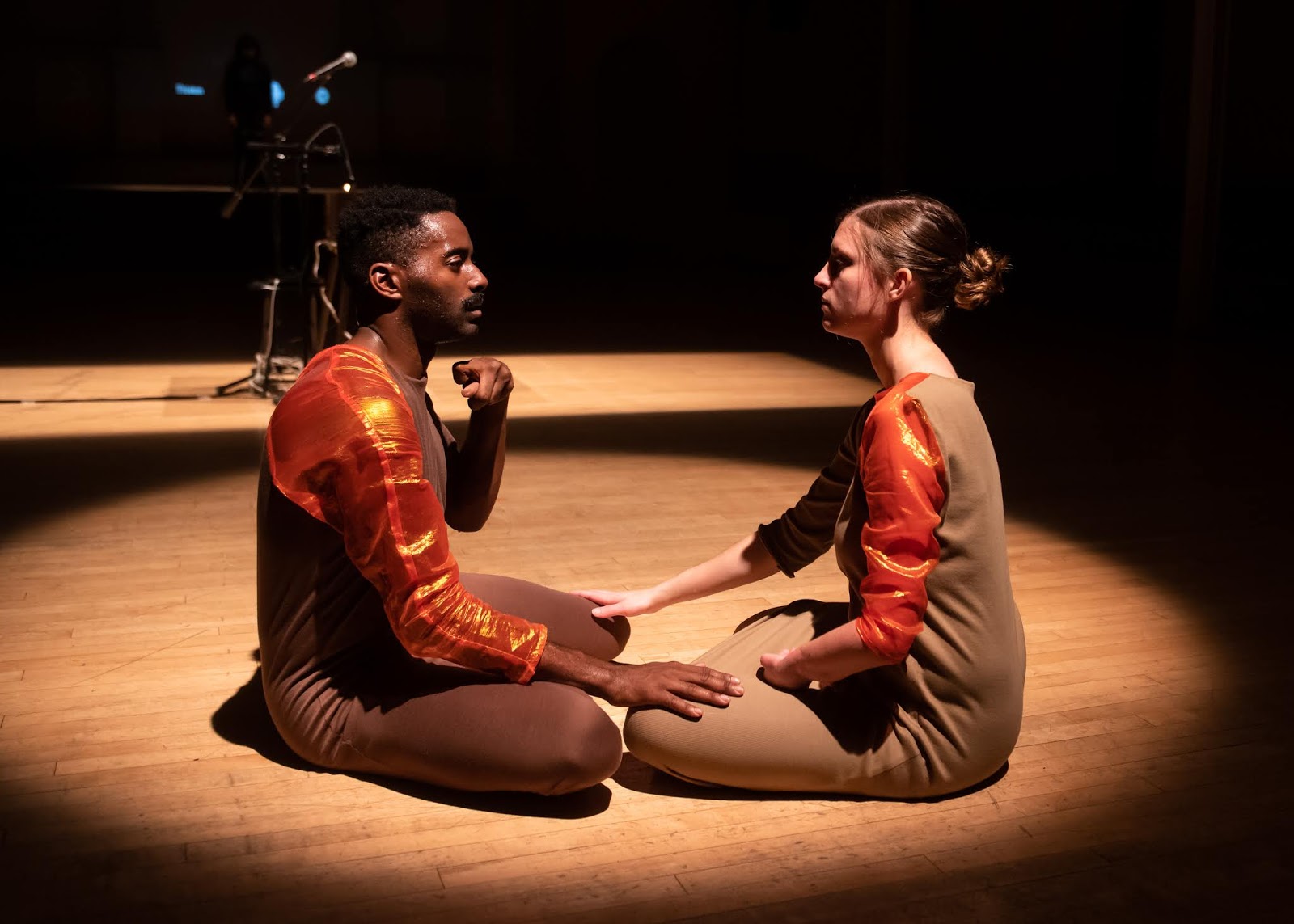
can you can you: Jerron Herman and Molly Joyce at Danspace Project

Jerron Herman and Molly Joyce
in Breaking and Entering at Danspace Project
In deep background below: ASL Interpreter Kathleen D.Taylor
(photos: Ian Douglas)


Breaking and Entering
by Jerron Herman and Molly Joyce
at Danspace Project
November 12, 15-16

Breaking and Entering, a collaboration between two well-regarded disabled artists--Jerron Herman and Molly Joyce--creates an intriguing relationship among its players and with its audience. Early on, we're introduced to American Sign Language Interpreter Kathleen D. Taylor whose signing rings with a robust, dancer-ly flow.

Uh-oh, I thought at first sight of her hands in motion, knowing all too well my tendency to gaze long at ASL interpreters whose particular style draws me in. What if I look at Taylor and miss important things that Herman might be doing?

No chance of that, really, since Herman is not exactly someone you can miss. Moreover--and curiously--Taylor soon gets relegated to deep backdrop, removed to the upper reaches of St. Mark's Church's altar steps for the rest of the piece. Thinking back on that now, I realize that distancing, blurring any initial, vivid connection to Taylor, might be by complicating design.

The words accompanying the work's three movements--entitled "Compliance," "Defiance" and "Emergence"--suggest a negotiated relationship with others, perhaps with viewers, perhaps with parts of the performers' own bodies.

Herman, who bills himself as "an interdisciplinary artist, primarily working in dance," is a snazzy performer with hemiplegic cerebral palsy which has caused him to devise ways to work balance and propulsion differently. His energy in the space is wrenching, surprising and always thrilling. Composer/musician Joyce, disabled in an accident, often moves with Herman, sings high and sweet, and plays a vintage toy piano set up in the middle distance between far-off Taylor and the audience. Their textures are so different, they make me think of their performance space as a painting canvas generous enough to make room, at once, for the roughest impasto and a silky brush.

The evening ends in an invitation to the audience to join the artists on the floor and dance to a DJ's fifteen-minute set. Disability activist and scholar Kevin Gotkin dj'ed last evening; Michael Hammond and JIJI will do the honors on Friday and Saturday, respectively.

Text: Marco Grosse, Molly Joyce, Jerron Herman
Sound: Michael Hammon
Costumes: Gerald and Cynthia Herman

Breaking and Entering continues with performances this Friday, November 15, and Saturday, November 16, at 8pm. Besides ASL interpretation, audio description is also provide for each performance. Each concludes with a fifteen-minute dance party for the artists and audience. For information and tickets, click here.

Danspace Project
131 East 10th Street (and Second Avenue), Manhattan

******

DISCLAIMER: In addition to my work on InfiniteBody, I serve as Senior Curatorial Director of Gibney. The postings on this site are my own and do not necessarily reflect the views, strategies or opinions of Gibney.

******

Subscribe in a reader

Sunday, June 3, 2018

One more to see: Rennie Harris gets funky at New Victory

Performers from
Rennie Harris: Funkedified,
a world premiere at New Victory Theater
(photo: Brian Mengini)


Two acclaimed Philadelphia dance crews--Rennie Harris Puremovement and The Hood Lockers--are tearing up the stage at New Victory Theater, now through June 10. If you love popping, locking, breaking and all things street dance, go see Rennie Harris: Funkedified.

The premise of this expert world premiere production is a remembrance of the funk music and dancing of the 1970s--think James Brown and Soul Train--that set Harris on his path to becoming one of the world's best-loved masters of hip-hop artistry. A marvelous five-piece band, led by guitarist Matt Dickey and drummer Doron Lev, brings the funk in a big, joyous way. Several cloth panels, hanging above the band like a quilt, capture projected imagery--some hazy, some abstract, some psychedelic--as well as Bob Steineck's luscious, saturated lighting as we hear Harris's musings on his cultural past. His voice--echoey and phantasmal--seems to emerge from out of a cloud or the depths of a dream--but the ingenious, passionate dancing and music speak for themselves.

The New Vic is a family-oriented theater and, at this Saturday matinee, most folks in the audience were small kids in booster seats sitting quiet and polite throughout the show. I kind of longed for an audience of Black teens who'd know just what to do with what we were seeing and hearing! It took a while for any heads to start bopping to the fantastic music--and they were adult heads. I just hope there were youngsters in the audience checking out, in particular, Puremovement soloist Leigh “Breeze-Lee” Foaad whose fluidity, range and poignancy should prove a powerful inspiration.

Rennie Harris Puremovement: Shafeek Westbrook, Katie Cruz, Joshua Culbreath, Phil Cuttino Jr., Tatiana Desardouin, Leigh “Breeze-Lee” Foaad, Mai Lê Hô-Johnson and Yuko “Uko Snowbunny” Tanaka

The Hood Lockers: Ricky “Glytch” Evans, Joshua “J Peazy” Polk, Andrew “Riot” Ramsey and Marcus “Epic” Tucker

Musicians: Shareef Clayton (trumpet), Matt Dickey (Music Director; guitar), Doron Lev (Music Director; drums), Nicholas Marks (keys), Osei Kweku (bass) and FKAjazz (saxophone)

Sound design/composition/production: Darrin Ross
Visual design: Jorge Cousineau
Lighting design: Bob Steineck

Rennie Harris: Funkedified runs through Sunday, June 10. For information and tickets, click here.

New Victory Theater
209 West 42nd Street (between 7th and 8th Avenues), Manhattan
(map/directions)

Subscribe in a reader

Friday, February 3, 2017

We always win: Marguerite Hemmings and friends at JACK

Marguerite Hemmings
(photo: Delwin Kamara)


Look and see. Black women make and hold space within dance for everything to come through.

The latest example of this is To Make Ready Again, an evening of performance and discussion offered by Jamaica-born dance artist Marguerite Hemmings, four dance colleagues, singer/musician Solo Woods and drummer Themba Mkhatshwa. It opened at JACK, the small Brooklyn venue famously decorated with crinkly aluminum foil; its run concludes tonight at 8pm.

Inspired by the writing of Ta-Nehisi Coates, JACK plans a year-long focus on exploring and expansively defining concepts of reparations in a program entitled Reparations365: From Memory to Movement (February 2017-January 2018). One primary insight already surfaced in community discussions is that monetary value cannot be placed on historic trauma, true justice and healing. It's hard to imagine and calculate in any realistic, satisfying way. Repair and restoration come not from the outside but from within vulnerable yet profoundly resourceful individuals and their communities.

Hemmings's we free multimedia series, of which To Make Ready Again is a part, draws from her knowledge of African diasporan street dance styles, social dancing, hip hop and dancehall, and her work, she says, centers around liberation. In TMRA, she's joined by powerhouse dancers--Courtney J. Cook, Jaimé Dzandu, Katrina Reid and Italy Welton--who whisper and conspire, laugh and vocalize, activating the space in ways both protectively intimate and boldly assertive. A loving circle, a sinuous warrior force, a reservoir of care and uncomplicated joy, they channel and filter even the male vocal energy of hip hop through grounded bodies. Their frequent broad stance roots them into the floor and earth below, freeing up torsos, shoulders and arms for hair-trigger action whenever, wherever necessary. They dance the ancestors through and make their mark on a world they wish to manifest.

Black women like Hemmings--a founding member of the emerging Black women and gender non-conforming collective The Skeleton Architecture--are dancing liberation and reparation. "Bring it down, and spread it all around." And remember, "We always win."

Lighting design: Nikita Maturine
Set design: Zunnania Anderson

To Make Ready Again concludes with a performance this evening at 8pm. For information and tickets, click here.

JACK
505 1/2 Waverly, Brooklyn
(map/directions)

Free email subscription
to InfiniteBody

Friday, January 27, 2017

Kick those blues: Glatzer's "Alive & Kicking" helps brighten our dark time


When it previews next month at the 45th Annual Dance on Camera, a festival co-presented by the Film Society of Lincoln Center and Dance Films AssociationSusan Glatzer's Alive & Kicking (2016/USA) is sure to be a crowd-pleasing highlight. An expansive yet intimate look at contemporary swing dancing, the 84-minute documentary celebrates this practice and its community of freewheelers with their rollicking swing dance camps and competitions. Swing dancers depend on a network of international competitions to display their talents and build teaching careers, the only way they can monetize their artistry. The film depicts swing dance as a healing force in a society that has lost touch with touch itself--except where touch involves a fingertip and a screen. Glatzer eagerly argues for swing dance as a low-risk way to foster openness and trust between people of all kinds, a natural bridge across divides of race, ethnicity, gender, religion and politics.

The earliest moments of the film made me worry that Glatzer would confine her focus to young white people reclaiming a historic dance phenomenon that originated in Harlem's Black community, the product of Black genius and skill. But I'm glad I hung in with Alive & Kicking. Not only does this film respectfully address the Black roots of swing dance in Harlem's Lindy hop, but this history is often spoken for by Black dancers themselves, and the film lovingly includes clips of Frankie Manning, Lindy hop's great authority and ambassador, who passed in 2009. Glatzer's interviewees also note the scarcity of young Black swing dance students and performers today. They recognize the need to make their community an attractive, accessible source of opportunities for Black students and performers, an issue contemporary tap dance has also faced.

And, like tap, swing dance has a strong tradition of improv, of connecting with a new partner at one of those fun gatherings and the creative surprises those moments can hold. "You're sharing your imagination with someone else," says one of the dancers, and Glatzer shows us examples of first-time interplay between skilled dancers leading to mutual awe, gratitude and something quite a bit like love.

Alive & Kicking screens on Monday, February 6 (8:30pm) with Kristen Lauth Shaeffer's animated short, 349 (3 min). There will be a Q&A with Susan Glatzer. For tickets, click here.

For information about the complete Dance on Camera 2017 schedule of screenings and public events, click here.

Walter Reade Theater
165 West 65th Street (north side, upper level), Manhattan
(map/directions)

Free email subscription
to InfiniteBody

Saturday, June 4, 2016

Upcoming US premieres for Carlos Saura's "Argentina"

Fans of Spanish director Carlos Saura's series of flamenco-related films should also enjoy Argentina (2015), a soulful love note to the music and dance of that nation. Shot in Buenos Aires, the sensuous documentary bears family resemblance to Saura's Flamenco Flamenco (2010) in its minimalistic yet dramatic setting, chiarascuro lighting and sunset coloration, intriguingly voyeuristic camera work, close-ups of expressive, lived-in faces and diverse array of excellent performers.

The 85-minute film samples everything from indigenous folk music to extraordinary ballads with an existential or political edge. There are songs about friendship and generosity, songs about the pain we humans cause our earth. "The only thing more important than God," one lyric tells us, "is that no one should spit blood so that another can live better."

The dancing follows a similar mixture--regional social dances, carnival dancing, contemporary choreography. It's all Argentina.

I was moved by so much in this film but especially the photo montage honoring the late, great singer Mercedes Sosa--a progressive artist known as "the voice of the voiceless"--who Saura positions as inspiration to a classroom of youngsters charmingly attentive to her "Todo cambia" ("Everything Changes"). Everything, she tells us, will change--except for the love she holds for her land and its people.

Eighty-five minutes can only give us a taste but, in that short time, Saura does his best to help us understand what Sosa loved with all her heart.

See the trailer here, and the US premiere screenings at New York's Lincoln Plaza Cinema (June 17) and LA's Laemmle Royal (July 1), presented by First Run Features.

If you like what you're reading,
subscribe to InfiniteBody!

Tuesday, April 1, 2014

Frankie Knuckles, 59 [UPDATE]

Frankie Knuckles, house music 'godfather,' dead at 59
by Greg Kot, The Chicago Tribune, April 1, 2014

Frankie Knuckles, 'Godfather of House Music,' Dead at 59
Remembering the life and legacy of the man who birthed every aspect of electronic dance music culture
by Michelangelos Matos, Rolling Stone, April 1, 2014
(with audio and video)

Frankie Knuckles, 59, Pioneer House D.J., Dies
by Daniel E. Slotnik, The New York Times, April 2, 2014

Wednesday, November 13, 2013

"Check Your Body At The Door" and download this doc!

Check Your Body At The Door (2012)
now available for digital download


Available in six languages and in over 20 countries, including the United States, France, Germany, Italy and Australia
Check Your Body at the Door documents some remarkable underground House dancers and dancing in NYC’s golden decade, the 1990s. Featuring interviews and rare dance footage of the enduring legends of House dance, Check Your Body at the Door follows a group of master freestylists to the clubs, at their jobs and in their everyday lives. Filmed at the clubs, and in a studio against a white background or in silhouette and light pools, this one-hour documentary reveals the virtuosity of this eclectic urban dance style. In 2013, House is a music/dance craze practiced worldwide. Check Your Body at the Door is a significant historical record that contextualizes a wide variety of House dance forms and answers: What did house dancing look like? Who were the dancers? Why did they dance?
According to Executive Producer Sally R. Sommer the idea for Check Your Body at the Door began in 1982 at David Mancuso’s “Loft” where she first went with dancer Archie Burnett. As a dance journalist and social dance historian Sommer saw “amazing artists dancing in the dark.” At the time, club footage only glamorized torsos bouncing to loud music under multicolored lights. “I saw more. I wanted a film that featured dancers and illuminated the entire body in motion.”
Full Territory List: United States, Canada, United Kingdom, Australia, New Zealand, France, Spain, Germany, Italy, Denmark, Slovakia, Lithuania, Ireland, Malta, Bulgaria, Latvia, Norway, Cyprus, Sweden, Greece, Belgium, Hungary, Portugal, Poland, Slovenia, Czech Republic, Estonia

Friday, August 9, 2013

Rubén Blades at Lincoln Center Out of Doors


Rubén Blades
(photos above and below by Darial Sneed)

After four decades in music, just how big a superstar is Panama-born salsero (and actor, activist, lawyer, politician) Rubén Blades? Well, if you already know his work, you know the answer. But, if you don't, check out this note I received from the Lincoln Center press office the day following Blades' Wednesday night appearance at Lincoln Center's Damrosch Park Bandshell:
By the way, we just got the official head count from LC Security and it's 10,000+ -- -- that includes people in the official seating area, plus crowds in the back section of the park going all the way to the Koch Theater and spilling over a bit on to Josie Robertson Plaza.  There were also folks standing and listening from the sidewalk of West 62nd street, but these were not included in the count. 
Yes. Sure enough, despite threat of rain--a threat never made good on--there were people stretched back from the park's entrance barriers as far as my eyes could see. Many had been waiting there for hours. They were let in, a handful at a time, and then the trickle stopped--no more admitted. I had never seen anything like that at a Lincoln Center Out of Doors show.

Similarly, the line for the women's restroom was ridiculous, made bearable only by the way a spirit of solidarity and wicked humor tends to break out in these situations. After my more than half-hour wait, I just barely made it back to my seat to hear Blades well into his first number, "Plástico," with Roberto Delgado Orchestra, Panamanian musicians making their US debut.

Blades with Panama's Roberto Delgado Orchestra
(photo by Darial Sneed)
Getting their shots
(c)2013, Eva Yaa Asantewaa
Dancing had already broken out in the aisles with salsa dancers of different ethnicities exchanging partners and displaying intricacies of personal style--a delightful visual accompaniment to the stage show. With few moments of lilting effervescence, Blades' set hewed to a sober, steady roll--his vocals sliding over the disciplined brass, percussion and keyboards of the orchestra. No eye-candy or sonic flash whatsoever, just a baseline for a reliable Everyman storyteller and his tales of social and political realities--in songs like "Decisiones," "Caína," and "Amor," the last, written as his mother was succumbing to cancer--and his sharing of comfort and wisdom.

I want to share with you one of my earlier and most fervent Rubén Blades obsessions--"Cuentas del Alma," a Latin jazz piece from Escenas (1985). So much do I love this song--a curiously soaring reflection on abandonment and bitter loneliness--that I'm going to share two versions of Blades singing it with different bands. Here's the first.

For the second, you'll have to go here.

Lincoln Center Out of Doors continues through this Sunday, August 11. Click here to enjoy more wonderful--and free-shows.

Lincoln Center Plaza fountain
(c)2013, Eva Yaa Asantewaa

Wednesday, July 17, 2013

TIPDI: Go to adult dance camp this summer in New York City!

Artistic Director Paula Wilson invites you The International Partner Dance Intensive (TIPDI), a three-day, four-night multi-dance intensive for adult dancers, August 15-18.

"TIPDI," Wilson says "is 72 tracked/leveled classes in ballet, Argentine tango, salsa, modern, West Coast swing, and Afro-Haitian dance, taught by a world-class faculty, with social dancing every night, all geared towards adults. In a nutshell, it's a rigorous, friendly, conservatory-style dance training program for adults."

Click here for complete program and registration information.

Tuesday, July 19, 2011

Ortiz: On the (disco) beat

New York City dance journalist and critic Lori Ortiz talks about her first book, a cultural history of disco and its era.

Guillermo Canales and Kendra Jackson (photo by Lori Ortiz)
by Lori Ortiz
ABC-Clio/Greenwood, 2011


EYA: Your book--Disco Dance--is part of a series, The American Dance Floor, that includes Country & Western Dance, Latin Dance, Swing Dancing, Folk Dancing, Rock'n' Roll Dances of the 1950s, and an upcoming volume on hip hop. Some dance advocates have suggested that social dancing could be pathway to greater awareness and appreciation of concert dance by potential audiences in the US. Do you agree and see a valuable connection?

LO: Definitely, I do. When people have dance in their lives already, it opens them up to seeing dance, and vice versa. That is, seeing dance on stage can inspire people to get on the floor themselves, in classes or socially. Social and theatrical dance feed each other. Exposure to dance in any way shape or form can change things for a person. I, for example, took classes for many years and then started going to concerts and writing about them.

EYA: Yes, that's also the way I started, too: taking many classes, then wanting to write about dance! Let's look at the reverse, too. Are there valuable lessons for contemporary dance artists to learn from social dancing? Or, specifically, from the disco phenomenon and its culture?

LO: Ballet tradition came from social dance; ballets, for example those of Jerome Robbins, include waltzes.  Lots of contemporary dance artists bring club or social dance into their work. Neil Greenberg has a famous dance about disco. It's one I haven't seen, but I wish it would come back; the New York Public Library for the Peforming Arts has a video. Nicholas Leichter has a new dance to disco music. Sidra Bell, Karole Armitage, and many others have choreography that includes club dances associated with disco. Much of contemporary dance is about life...and that (especially for dancers maybe) includes social dancing. Disco may have been close to the hearts of dance artists who lived through the era. In our current, retro era, disco is still, or again, part of club culture...sans some of the bad stuff that went with it back in the day, hopefully.

EYA: The book surveys the rise of disco culture in New York, Philadelphia and San Francisco. What methods did you use to conduct your research?

LO: I inteviewed many dancers, DJs and clubgoers. I went to some of the revival scenes, Hustle festivals, and remembrance parties, and I met people from different cities at these gathering places. People at these parties were generous with me. I was lucky to research disco at a ripe point in time, around people with lucid memories. I was literally attending reenactments! I also saw about forty movies made in or made about the era. Of course I read the material out there, the great books and classic articles of the day as well as later research. I photographed the dancers. As a visual person, this helped me understand the movement better. I took a basic Hustle series at You Should Be Dancing and some introductory classes at Dancesport.

When I first started, in 2008, I found very little information. I found my first interviewees through HARO (Help a Reporter Out). Gradually, I found more information on the Web as the Web itself grew, and disco seemed to be coming back into favor.  It was most helpful listening to the music, frequenting the vintage record stores, and reading the liner notes. NYPL's performing arts collection had growing clippings folders. Schomburg Center for Research in Black Culture had books I couldn't find at the performing arts library. As the project continued, more and more You Tube and VH1 videos were posted. A complete Soul Train DVD came out.

Whenever I told people about my project, many had a disco story they were more than happy to share. I joined the circles of dancers in a peripheral place. I have to say that it was not all peaches and cream. There were also people who felt proprietary about their memories and practice and resented the intrusion. I met with resistance from some. I'd love to be out there with them dancing, but alas, I'm here typing.

EYA: Did your research lead you to new information or insights, anything that surprised you?

LO: I was surprised many times over. I was surprised at how beautiful the Hustle dance can look on those that have put in the work of perfecting it. I was surprised that there is a very organized contingent of Hustle dancers who continue to refine and perform it. Although these dancers, along with the general public, rejected the term disco, it didn't die. 

Journalist Lori Ortiz

EYA: Were you a fan of the music in the '70s? Did you go to the clubs? If so, is there anything that you miss about that time?

LO: John Travolta, aka Tony Manero, went to my high school. I was a Deadhead (I liked the Grateful Dead). After college I moved back to New York. No, as a painter just starting out, I did not go to Studio. People I knew curated art shows in Limelight and other clubs, I showed in them and went to the openings in the 80s. I don't miss that, but I'm grateful for any experience I had of it.

EYA: As with any pop music, you'll find some schlock as well as some unforgettable classics. When you were writing your book, did you pull out old LPs and cassettes?  Any personal favorites to share with us?

LO:  I had a Jackson Five album as a teen. I had nothing when I started this project. I had to collect it all anew. I loved it. It was very moving to hear Grace Jones sing "Tomorrow." Michael Jackson's "Billie Jean" is a major VH1 classic. That song is inseparable from Jackson's performance. I went to sleep and woke up with "Blame It On The Boogie" in my head. The video of Sheila Reid skating to Gloria Gaynor's "I Will Survive" is absolute legend. I'm truly grateful to Bobby Viteritti, Ronald Ramdell and Billy Carroll— DJs who spent hours sharing music and stories with me. I bought Disco Box with wonderful liner notes by Brian Chin. I highly recommend this encyclopedic Rhino set.

EYA: Disco music and culture came under attack in the late '70s. Talk about that period and the reasons that an anti-disco movement arose in the US.

LO: Drugs, AIDS, crime, greed on the part of the club owners and the music industry--these associations enveloped disco, to name a few of the reasons. The word started to leave a bad taste in people's mouths. New pop music came to take its place. It became embarrassing to like disco AND dangerous. There were death threats!

EYA: The disco phenomenon eventually receded, but you detail the ways in which it still influences popular music. Tell us about some of them.

LO: DJs like to sample disco classics in new songs. You could say that "turntabling" started with disco. The art of the DJ developed in the disco era. The party atmosphere, the romance, has not died. Lady Gaga, Horsemeat Disco, and other performers and groups are directly building on disco. The ways are a bit different, but disco is music made for dancing. There are people out there on the floor. The interchange, the mixing, the dancing never died.

EYA: What kinds of readers will most benefit from Disco Dance?

LO:
The series is a library reference for high school and college kids. But disco suffered from erasure, so there is still a lot for most people to learn about the era, the dancing, and the music.  I talk about the gay liberation movement. That may feel too basic to some readers but, for context, that story needed to be retold in the book. I couldn't assume that the reader knew about Stonewall. I came across a wonderful NYPL exhibit on it. I also found a collection of Saint posters at the Lesbian, Gay, Bisexual and Transgender Community Center here in New York. One was composed of Robert Mapplethorpe's photographs. That's in the book. I found a group of skaters in Central Park. A lot of this was discovery for me. Since there are so many facets within disco, more than likely, anyone who picks it up will find a lot they didn't know. No other book looks at disco dancing from this particular catch-all perspective.

*****

Publisher's information
Disco Dance on Amazon.com
ReadingDance.com, the Web site of Lori Ortiz

Save the date: Lori Ortiz, author of Disco Dance and publisher of ReadingDance will talk in a Galapagos Art Space "Get Smart" event,  August 11, 8pm, in DUMBO! (information and tickets)

Copyright notice

Copyright © 2007-2023 Eva Yaa Asantewaa
All Rights Reserved

Popular Posts

Labels