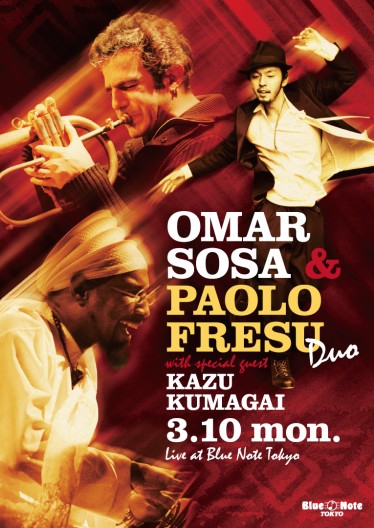
|
Kazu Kumagai
(photo by Leslie Kee) |
Kazu Kumagai: Catalyst of Tap
by Eva Yaa Asantewaa
It’s no small matter when a tap expert like Tony Waag, American Tap Dance Foundation’s Artistic and Executive Director, feels comfortable agreeing with
The Village Voice who hailed you as “the Gregory Hines of Japan.”
“Kazu Kumagai is not just a great tap dancer,” Waag says. “He is also a very kind, conscientious and devoted advocate for tap dance and knows how important the art form is internationally.”
Kumagai--who lives in Park Slope, Brooklyn with his wife Mari, a singer, and his four-year old daughter--happens to be one of my favorite dancers of any kind. After last year’s Tap City festival, where he appeared in Waag’s popular
Tap Internationals evening at Symphony Space, I noted that Kumagai “channels dissonance and passion, taking tap to a stormy place beyond the familiar sunshine,” and I included that solo performance,
Journey to the Soundscape, in my list of “most memorable arts experiences of 2013” (
InfiniteBody, December 24, 2013).
Born and raised with his older sister in Sendai–a moderate-sized coastal town, a little less than 190 miles north of Tokyo–Kumagai took an early interest in the arts. His parents owned what was then a rarity in Japan–a coffee shop, serving a Japanese clientele–and he played there, as a youngster, around what he calls “unusual people.” These were mainly artists, poets and musicians. But, then again, his parents were also, he says, “kind of unusual.”
“My father was the first person who started roasting coffee in Sendai, a pioneer in the café business, about 40 years ago.”
Kumagai saw his first film footage of tap dancers thanks to jazz musicians he met at the café. He started tap dancing himself at 15 but, he says, didn't have a session with a live musician until he came to New York at age 19.
Of all the arts, what drew him to dance?
“I think I liked physical movement. When I was 5 or 6, I saw Michael Jackson on TV, and that had a great impact on me. I loved how he expressed himself–not just singing but the whole energy. When he got the Grammy, he mentioned the great dancers that he was influenced by--Fred Astaire and Sammy Davis, Jr., and that was a first, small introduction for me. I wanted to tap, but I couldn’t find any tap class in my hometown. My mother called several schools, but there was no tap class. I kind of gave up.
“Then I started doing some martial arts and soccer, football. I was serious about those things. But when I became 15, I saw Gregory Hines's movie, Tap, on TV.
“I carried my passion for tap dancing since I was little and started looking again and finally found one school that included tap. It was impressive. Every student was older–maybe thirties or forties, most of them women.
“I was fortunate to meet a good teacher, in his twenties, who had studied in Tokyo and come back to Sendai. He also loved the style of Gregory Hines, but he couldn’t teach that style because no one wanted to do it at that time.”
Theatrical tap, such as we would see on Broadway, was more readily accepted.
“Students went for exercise but were not really serious about it. I was really serious from the beginning, and he saw that. We became close. I went there all the time, even when I had regular school. I just went to dance school!”
A new home
“My hometown was like.... Have you seen the movie Billy Elliott? A man was supposed to be a banker. Or you have to go to university. Now it’s looser. But when I was growing up, you had to have a certain image. Tokyo was more open, but Sendai was more suburban with an intense social pressure within neighborhoods. My sister went through a tougher time, being compared with other kids. But, somehow, I grew up more open. I was kind of lucky.
“I was in a strict school. One time I was in a meeting with my teacher, and I wrote which school I wanted to attend, and I wrote tap dancing as my hobby. The teacher really couldn’t understand what I was doing. ‘You’re not supposed to dance; you’re supposed to study.’”
The teacher gave him an ultimatum: quit dance or quit school. But then he asked him to dance “right now.” Kumagai did as he was told.
“He looked impressed, but he was a stubborn man. ‘You have to go to college, but maybe you can dance as a hobby because you can’t make a living as a dancer.”
Kumagai lacked role models for his dream. But through his determination, he would go on to serve as a role model for many up-and-coming dancers in Japan. The key? A decision to come to New York despite lack of any connections to the dance world here or much information about how he could get hooked up. He discussed the matter with his parents and told them that he felt ready to search for what he needed.
Acknowledging his love of tap, Kumagai's parents knew that Sendai could not support his goals. “I told them, ‘I’m going to college in the states.’”
He started with learning English in a language school on Long Island, not quite the New York City of his imagining. “Totally different from what I expected,” he says, laughing.
Moving into the city, then, and beginning studies at New York University, he started looking around for a tap school, finding ads for Steps and Broadway Dance Center, still not exactly what he had in mind. Little by little, he began to find his way.
“Charles Goddertz and Barbara Duffy showed me rhythm tap. I met Buster Brown--a legend in the field--when I was hanging out with other tap dancers in a restaurant, and we talked." At the time, Brown was launching his Sunday night tap jam at Swing 46, a jazz and supper club on Manhattan's West 46th Street.
"Gradually, I started finding the community," he says. "I went to National Tap Day and met Peg Leg Bates," who had been a celebrated tap dancer and Catskills resort owner. "I met Savion [Glover] on the street when Bring in 'da Noise, Bring in 'da Funk was running. 1996 was a great year. I was very lucky, a lot of things started to happen, an era of the rise of a new style of tap.
"Gregory Hines was doing a workshop, and I studied with him. I had met him at Fazil’s, a home for tap dancing, and he invited me to practice with him. That was amazing, and we became close. It was an adventure, discovering something new every day. We didn’t have cellphones or Internet back then, but it was much better!”
Young Kumagai's immersion in the New York scene did not permit time for much homesickness. He does remember crying for hours upon leaving Japan but, as soon as he landed in our city, he was ready for a new life. And, it seems, that new life was ready for him.
 |
Kazu Kumagai
(photo courtesy of Kaz Tap Studio)
|
“There was a workshop called Funk University, a workshop for new dancers for
Bring in 'da Noise, Bring in 'da Funk. Ted Levy was teaching, and he was amazing. It was basically for African American dancers because it was their history. But I went there because,” he says, laughing, “I didn’t know!”
“They were young African American dancers, but Ted saw me and gave me an opportunity to study. I started working with them at Fazil’s for three months, every day for seven hours, in the summer without any air-conditioning. But it was great education because it was so different from other schools. He showed not only steps but also history and culture. He spent so much time talking about how tap dancers carry years of struggle, and he sometimes cried because of the prejudice and the painful history.
“That’s when I discovered the meaning of the tap dancer. They danced from their own roots, and I am not from here. I felt a little distant, a little different, but they treated me the same, as a brother. Ted called me Sole Brother.
S-O-L-E!"
Although one of the show's producers felt it wasn't appropriate for Kumagai to be in the school and asked him to leave, Levy invited him to continue taking classes.
 |
Kazu Kumagai
(photo courtesy of Kaz Tap Studio) |
"Kazu is an amazing musician," says Derick K. Grant, famed tap artist and one of Kumagai's early teachers in New York. "He tends to work twice as hard to be accepted and taken seriously, and it has paid off. He learned as much about us--African Americans--as a people as he did about us as dancers, and that gave him a level of respect for our people and our journey that is unique."
In return, Kumagai was so warmly accepted by Grant and his colleagues that they bestowed a "Black" nickname upon him: Kenyon.
Kumagai, Grant says, took what he learned back to Japan and offered his homeland's dance students an alternative based in authenticity.
"Following his return to Japan in 2002, we started to get an influx of students coming from there who were well prepared and already sound in their foundation." Grant says. "There were
a lot of them, which led me to believe that he was inspiring many. That was great for us in tap. He was also very gracious in pointing students in our direction. I, and others like myself, had a great hand in the development of tap dance in Japan--something we are very proud of. Today, they are some of the strongest, most technically sound dancers in the world."
The artist who had persevered despite the lack of local role models not only became a brilliant one for his compatriots; he opened a pathway for them to get the kind of excellent training he had found in the US. Grant acknowledges that Kumagai's "new" style, while exciting the youth of Japan, put him at odds with established teachers there still promoting a lightweight, musical theater approach to the art.
Hank Smith, a tap performer-choreographer and educator, remembers Kumagai from the late 1990s as one of a number of Japanese dancers coming to Brown's jam at Swing 46. Something shifted, though, during the subsequent time Kumagai spent back home in Japan.
"I could tell he'd really developed, not only as a dancer but as a person," Smith recalls. "There was a maturity in his presence. Kazu just seems to be a committed artist and human being who uses his gifts to try and make a difference."
"Tap can be more than just hitting the wood as loud or as fast as possible," Smith says, citing Kumagai's solo work last year in
Journey to the Soundscape, an intense, expressive piece that embodied his feelings for his hometown and the Tohoku region where, in March 2011, an earthquake and tsunami caused devastation and massive loss of life.
 |
Devastation in Sendai, Japan, March 2011
Photo: Reuters/Yumiori |
When Michelle Dorrance--Bessie Award winning tap artist who also won a 2014 Alpert Award in the Arts--recently danced with Kumagai in Japan, he took her to visit Sendai. It was his way to share with a friend what he had seen and experienced at the time of Japan's disaster.
"It was important for me to share this feeling with her. I hope she will talk to other people about it. My goal is to make a bridge from New York to Japan, to Tokyo and Sendai. People are still suffering in Tohoku district, and I want more people abroad to know this fact."
His parents stayed on in Sendai during the crisis and, like many people who have made a home in a risky environment, want to remain there. Luckily, they live in Sendai's inner city, away from the heavily impacted coast, although they did have to go several months without gas. Another ongoing concern for the region and nation--the only country that has ever suffered the devastation of atomic bombing--is radiation leakage from damaged nuclear power plants.
"And still they want to keep the nuclear plants," he says. "It's hard to understand."
Kumagai, present in New York during our own crisis, 9/11, draws a saddening comparison between Japan and the US, noting that disasters can swiftly turn people and their governments away from the ideals of peace. Japan's historic non-nuclear weapons policy, imposed by the US after World War II, could end soon, he says, as tensions grow between the nation and its regional rivals in Asia. There isn't yet enough of a vocal, coherent movement to divert Japan's conservative government from a proactive buildup of nuclear arms.
Kumagai, as his career unfolds, chooses to remain mindful of his homeland and hometown. "A lot changed [for me] after March 2011," he says. "What happened in Sendai, it has become myself. As an artist, everything I do becomes dedicated to my hometown--also dedicated to the [tap] masters. These two things are now the most important to me, and I want to keep doing positive things."
The challenges of coming home
After Kumagai's initial, life-opening training in New York, the return in 2002 to Japan's limited scene did not flow easily.
"When I went back, not much was happening in the tap community. However, a conflict between old and new was happening both in the tap community and in Japan in general. They didn’t know what tap really was. It was difficult to readjust. There was no place to practice."
"I had to start from the beginning. I had a part-time job and did street performances. There were some good small jazz clubs, and I started dancing there, a small community in Tokyo where musicians get together. It’s growing in popularity. People hear a rumor and come to see us. At first, many artists were interested in tap: musicians, DJs who liked to have tap dance at their parties or in their performances."
Japan's great jazz trumpeter Terumasa Hino, who had learned tap from his musician/dancer father, caught one of Kumagai's performances and invited him to appear in his shows.
"He saw that, in the past, most Japanese tap dancers couldn’t work with jazz musicians because the style was different. However, he felt a connection with me and knew that jazz musicians and tap dancers share a culture. We toured together in 2004 and 2005."
The exposure from touring with a star of Hino's magnitude drew attention and offers from others in Japan’s music industry.
“I began dancing everywhere–from small hip-hop clubs to concert halls," says Kumagai. "I collaborated with many different kinds of artists.”
A growing appreciation for the intricacies of music affected how Kumagai saw himself as an artist.
"Jimmy Slyde, Buster Brown, Savion Glover, Dianne Walker, they all have their own sound," he says. "I was inspired by their sound, not so much by the visual. Image is important, but always I connect to the sound. For me, that is the greatness of this art form.
"The first time I saw Gregory in
Tap, dancing in the jail, he danced for himself. Not so much for performance. And that particular scene still influences me a lot.
"I've heard criticism that the way Gregory danced is not really beautiful, but to me, it’s so beautiful. Jazz musicians, when they play, it’s beautiful. Same as athletes like Michael Jordan. They don’t try to look nice. It’s not about their looks. They devote themselves to their art, and that’s a beautiful thing. I don’t try to impress with how I look. What I love about tap is that a lot of masters can show what’s inside through their dance.
"Tap is a language. When I go to Europe, I don’t speak to the audience, but they can understand. When I went to Senegal, we could communicate."
How to stay serene amid the busyness of business
"I tour a lot...Japan, Singapore. This month, I’m going to Milan. When I’m in Japan, I go to my studio [
KAZ Tap Studio] everyday and practice and teach classes. Here in New York, I go to American Tap Dance Center and practice. But before I do, I take my daughter to school, and that becomes my ritual–an everyday morning walk with her. It gives me a peaceful moment. So many things I can learn from my daughter.
"She dances a lot. She was in my most recent performance. The last night (of a three-night performance), I wanted her to be on stage somehow, because I was showing my life. I just wanted her to walk around, but she started dancing!" Kumagai chuckles at the memory. "It was real nice!"
Perhaps she'll join in again when he finally manifests his next big dream, an evening-length show for New York, his first--to which I say:
Right on, S-O-L-E brother! It's time!
SPECIAL UPDATE
The New York Committee to Celebrate National Tap Dance Day is proud to Honor Kazu for his talent and his contribution to the health and welfare of his tap community in Japan. Much like the late great Bill Bojangles Robinson, Kazu is helping people with his talent. He is helping them to over come the Fukashima Disaster with his tap dancing and teaching. I can't think of a more noble thing to do on his part and we hope that he gets the recognition he needs as it will up build what he has accomplished and continues to work at.
Norman Thomas Auditorium
Park Avenue
New York City
May 24th, 2014
7 pm - 9 pm
BIO
Kazu Kumagai was born in Sendai City, Japan. He started tap dancing at the age of 15 and came to NY at the age of 19. He trained in FUNK UNIVERSITY, the training workshop for the big hit Broadway musical
Bring in da' Noise, Bring in 'da Funk. He studied with Ted Levy, Buster Brown, Gregory Hines, Barbara Duffy, and Derick K. Grant.
Since then, he has performed in many New York City downtown clubs, such as The Knitting Factory, Tonic, and the Puppet Jazz Club.
From 2002 to 2010, he performed in Tony Waag’s Tap City, the New York City Tap Festival nine times and was dubbed by
The Village Voice as the "Japanese Gregory Hines." In 2006, he was selected as one of
Dance Magazine's "25 to Watch."
After Kaz went back to Japan in 2002, he made numerous solo appearances all over the country and collaborated with many artists and musicians, and appeared in several television commercials, such as SONY CYBERSHOT. He also performed in a MIHARAYASUHIRO fashion show in Milan, Italy, where he succeeded in opening up a new field of the arts. In 2008, he opened his first tap dance studio--KAZ TAP STUDIO--in Japan, and has subsequently taught throughout Japan including in his hometown of Sendai City, site of severe damage in the 2011 earthquake and tsunami.
Kaz dedicates his passion and love for the art of tap dance to the great masters such as his mentor Buster Brown, Jimmy Slyde, Gregory Hines and others, as well as to the people of Sendai and the Tohoku region where his family and friends live.
Visit Kazu Kumagai's Web site
here.

 Subscribe in a reader