Search This Blog

Showing posts with label violence. Show all posts

Friday, April 21, 2017

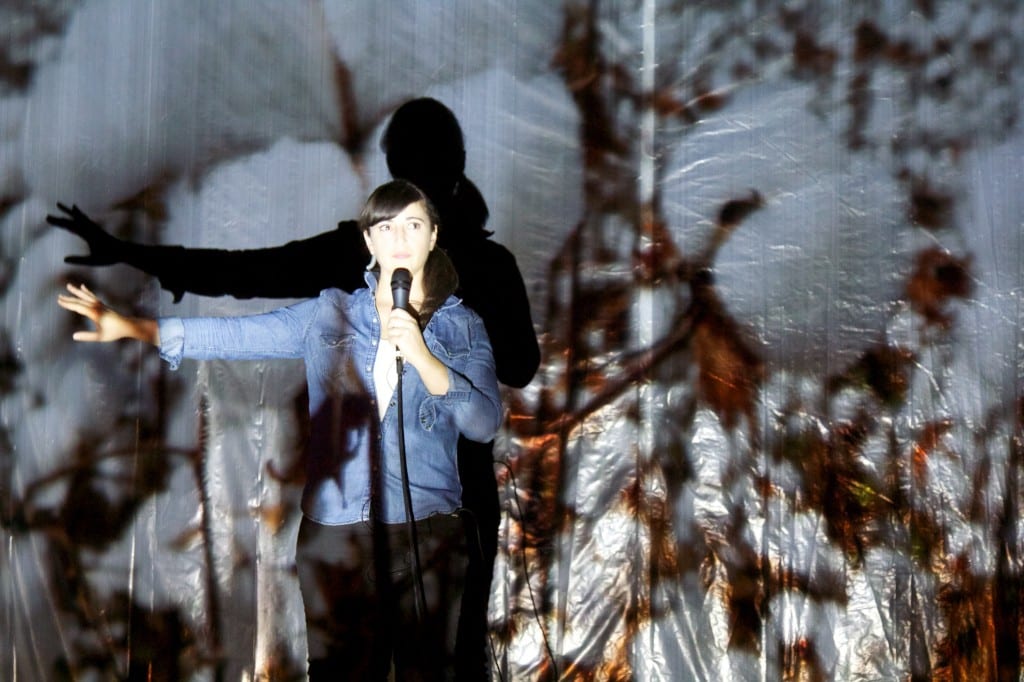
Shadow dancing: Okwui Okpokwasili at New York Live Arts

Katrina Reid (left) and Okwui Okpokwasili
in Poor People's TV Room
(photo: Paul B. Goode)

Follow me, follow me....

A gentle, haunting refrain concludes Okwui Okpokwasili's Poor People’s TV Room, shown now at New York Live Arts. The sweetness of that final plea cuts to the soul. The artist, with her multitude of tools and methods, draws us closer to a forgotten people and removes some of the false comfort of distance and ignorance.

For this complex, 90-minute piece, Okpokwasili drew impetus from the resistance of Nigerian women against British colonialism and, more recently, their organizing for the return of 300 girls kidnapped by the militant group, Boko Haram. Teaming up again with director/visual designer Peter Born, with whom she shares two Bessie Awards, Okpokwasili reshapes not only the stage space at New York Live Arts but the way in which the meaning of a potentially didactic history can be artfully conveyed through an assured blend of movement, text, song and imagery.

Born's set hacks a wedge of space out of the wide NYLA stage and litters it with things the eye works hard to identify or, if identified as they are used, resolve into an overall coherence. His lighting ranges from withholding to assaulting, mostly making us aware that there's so much we will not see, cannot interpret, might never reach. Like Okpokwasili singing "I am the face beneath the sand...," or a figure draped entirely in jet black cloth somehow twinkling from Born's harsh light, the visual space of the work tantalizes us with the possibility and impossibility of discovery. Or the unreliability of discovery.

For my part, I will long carry the image of a woman--Okpokwasili, it turned out--pressed into the far side of a wide stretch of translucent fabric, rising into elusive visibility like ectoplasm. I struggled with the violent mechanical sounds, which viewers readily feel within their own bodies. And I wondered at the tiny skitter steps of elder Thuli Dumakude, South African-born star of music and stage, and the precise, if arcane, gestures performed by the younger Black American artist Katrina Reid. Both bodies, at the epicenter of violent force, confront and defy the oppressive sound. Or so it seemed to me.

Poor People's TV Room is a robust creation transcending category for real and not just in the academic talk we've come to expect. But it's thrilling to know that an artist of the body, a dancer, envisioned and guided this achievement.

Performers:

Thuli Dumakude, Okwui Okpokwasili, Katrina Reid and Nehemoyia Young

Poor People's TV Room continues with performances April 21-22 and April 26-29, all at 7:30pm. For information and tickets, click here.

New York Live Arts
219 West 19th Street (between 7th and 8th Avenues), Manhattan
(map/directions)

Subscribe in a reader

Saturday, February 18, 2017

Re-membering Black lives with Taja Lindley


This Ain’t A Eulogy: A Ritual for Re-Membering (9:58) is a stunning film by Brooklyn-based visual and performance artist Taja Lindley, based on her solo healing performance ritual This Ain't A Eulogy (premiere: La MaMa's SQUIRTS, 2015). Co-directed with and edited by Ellen Maynard, the film was premiered on February 16 at the 5th Annual Black Artstory Month (Myrtle Avenue Brooklyn Partnership).

The film draws "parallels between discarded materials and the violent treatment of Black people in the United States," Lindley writes. "People in the African Diaspora have a long history of repurposing, remixing, and transforming oppressive systems into valuable cultural practices." Through the surreal, eye-catching artistry of her film, Lindley invites the viewer to "imagine how we can recycle the energy of protest, rage, and grief into creating a world where, indeed, Black Lives Matter."


Taja Lindley
Taja Lindley is a writer and artist based in Brooklyn, New York. She is the founder and Managing Member of Colored Girls Hustle, and a member of Echoing Ida and Harriet's Apothecary. Lindley considers herself a healer and an activist, creating socially engaged work that reflects and transforms audiences, shifts culture and moves people to action. She uses movement, text, installation, props, ritual, burlesque, and multi-media to create performances that are concerned with freedom, healing and pleasure. She is currently developing a body of work recycling and repurposing discarded materials. Her artwork has been featured at the Movement Research at Judson Church series, Brooklyn Arts Exchange (BAX), the Gallatin Arts Festival at New York University, WOW Café Theater, La Mama Theater, in living rooms, classrooms, conferences and public spaces. In 2014 she was a Create Change Fellow with the Laundromat Project and a participant in EMERGENYC, an artist activist program of the Hemispheric Institute of Performance and Politics at New York University. In 2015 she was a Fall space grantee at BAX. This summer (May-August 2017) she is an Artist in Residence at Dixon Place. Her writing has appeared in Rewire, EBONY, Feministe, Yes! Magazine and Salon. www.TajaLindley.com

Free email subscription
to InfiniteBody
Click here!

Friday, May 13, 2016

Spiderwoman: "Material Witness" to violence against women

Gloria Miguel of Spiderwoman Theater
in Material Witness at La MaMa
(photo: courtesy Spiderwoman Theater)

I leave the door open for the spirits to walk about freely.
I welcome all the guardians to our space.
--Gloria Miguel in Material Witness

I never saw Spiderwoman Theater's original Women in Violence--the first production by this legendary Native American troupe, premiered in New York in 1976. But, last night at La MaMa, I got a good look at its rambunctious offspring, Material Witness, a piece designed to reach out to today's young women. It aims to remind them, and all of us, that physical, sexual and emotional abuse has not been eradicated from Native communities and that silence about it remains a deadly force.

Material Witness is directed by Spiderwoman co-founder Muriel Miguel, co-written by its six-woman cast with Miguel, and co-presented with Aanmitaagzi, an indigenous, interdisciplinary troupe from Nipissing First Nation, Ontario.

The 90-minute work bears all the hallmarks of Spiderwoman--communal, community-minded theater, story-based exposition, rollicking physical humor often reminiscent of vaudeville and slapstick comedy, and strong musical drive. The 1976 tune from AC/DC, "Dirty Deeds Done Dirt Cheap"--its chorus cheekily woven into a narrative about deeds most dirty--meets up with Lady Gaga's "Til It Happens to You." But, of course. And its new generation--the radiantly charming and kickass Cherish Violet Blood, Penny Couchie (choreographer), Donna Couteau, Ange Loft and Tanis Parenteau--share the stage with veteran Spiderwoman Gloria Miguel who serves as witness to their struggles and stories, setting and holding the space for them, collaborating in their honesty and victories. The music is dance-club loud, Soni Moreno's costume and decor colors and combos are eye-popping, and the performers' energy rocks the house.

Let me issue a standard trigger warning:  Some stories related here can be uncomfortable for anyone, especially survivors of violence, to hear. But I must also leave you with this laughter trigger warning: Spiderwoman's commitment to humor as a disinfectant has not and will never quit.

Material Witness continues through May 29 with performances Thursday to Saturday at 7:30pm and Sunday at 2pm. Panel discussions are scheduled following certain performances. For information and tickets, click here.

74A East 4th Street (between 2nd and 3rd Avenue), Manhattan

If you like what you're reading,
subscribe to InfiniteBody!

Wednesday, March 9, 2016

My Eiko journal: Part 4

Eiko's A Body in Places
Tuesday, March 8 -- 7pm
Tonight is not necessarily about linking the work of Eiko and DonChristian but considering their perspectives side by side. Through this intergenerational conversation around institutionalized forms of violence and inequality, I hope we can reach a more nuanced and empathetic understanding of our present moment.
--Lydia Bell, co-curator of Danspace Project's A Body in Places

DonChristian in Remembering "Egg Box"
The rapper and painter was a guest artist
for Eiko's A Body in Places platform at St. Mark's Church.
photos (c)2016, Eva Yaa Asantewaa


Although he studied with Eiko at Wesleyan University, DonChristian--painter, rap/R&B artist and producer--does not claim to be, in his words, "a mover." For her part, Eiko eshews the label "professor," preferring to think of herself as "a working artist who teaches." However they identify themselves, the non-academic likely approves of the way the non-dancer surveyed the difficult realities faced by young Black men at risk in a violent America in his short solo Remembering "Egg Box".

DonChristian, a guest artist for Eiko's A Body in Places platform at Danspace Project, journeyed through Eiko's installation in St. Mark's sanctuary. Stooped and vibrating, he crept down the sanctuary steps, around its outskirts, among canvases hung to serve as video screens, past costumes and props from Eiko's various solos. These items laid down a pathway--or a gentle, atmospheric surround--with a touch of ritual magic to their presence.

DonChristian at St. Mark's Church
photos (c)2016, Eva Yaa Asantewaa


He surveyed as a barefoot youth pulling thick rope behind him, a rope tied around his waist and, with our history, there can be no mistaking the significance of Black Man + Rope.  He might be an Eiko-styled ghost-in-places or, at best, an escapee--the rope remaining, though.

A few surprising musical accents--Anita Baker's "Caught Up in the Rapture" and Antonio Carlos Jobim's "A Felicidade" from Black Orpheus--infuse the solo with an air of sensuality and tenderness. "Escape," then, suggests the slipping of imposed, internalized restraints that bind body and mind, the offer of a freer way for Black men to see themselves and interact in the world.


DonChristian,
circling back to the sanctuary steps,
claims a place of power.
photo (c)2016, Eva Yaa Asantewaa

I wished for better clarity of sound for DonChristian's vocals, but he and Eiko made their meanings clear later in the post-performance chat moderated by Danspace Project's Lydia Bell. Guest curator Shin Otake--son of Eiko and Koma, and DonChristian's friend at Wesleyan--also spoke of the interconnection of state violence and intimate violence: "No violent incident is isolated [but is] embedded, generation to generation, in our DNA." 

Eiko and DonChristian share an interest in getting at the root of this trauma, a wound central to the American origin story and so many stories around the world. "Her practice alone makes me want to work harder," he said. She taught him to "find the light, feel the light that's on your body." When he felt daunted by the invitation to create a responding solo for the platform, she encouraged him. "She told me, 'Make this work thinking that I'm your aunt.' She's an extension of my family."

Yes, and by the time A Body in Places concludes in a few more weeks, we'll all feel that way about Eiko.

*****

Read My Eiko journal: 

Part 1
Part 2
Part 3

*****

Eiko's A Body in Places platform continues at Danspace Project and other venues through March 23. There's so much going on in this platform's programming, that Danspace Project is actually offering consultation with a docent to help you get your bearings. Really. For detailed information, click here.

Danspace Project
St. Mark's Church in-the-Bowery
131 East 10th Street (at Second Avenue), Manhattan
(map/directions)

If you like what you're reading,
subscribe to InfiniteBody!

Friday, September 25, 2015

Adrienne Truscott: a fool in the king's court

Dance/performance artist Adrienne Truscott writes that when, in the early stages of exploring stand-up comedy, she booked her fledgling act on a lesbian cruise, she ran into a little trouble. A feminist telling jokes about rape to a staunchly feminist audience? What could possibly go wrong?

"It was an incredibly 'safe' space as a woman and an unpredictably conservative space for a comedian," she writes in her "Creator's Note" for Adrienne Truscott's Asking For It: A One-Lady Rape About Comedy Starring Her Pussy and Little Else.
No comic or anyone else for that matter wants to be told what they can or can't say, nor should they be. It is often a comic's job to utter the unutterable; that doesn't mean that they (we?) are beyond rebuke. Comedy is bold, powerful and supple but not unassailable. There is a difference between a fool and the fool in the king's court....
Now through October 3, you can watch this court fool perform a show that gives new meaning to the word chatterbox, a show where Truscott manages to be, at once, giddy and spot-on.

Hosted by Brooklyn eatery and comedy club The Creek and The Cave, co-presenting with The Chocolate Factory and Performance Space 122, Adrienne Truscott's Asking For It gives Truscott a platform to land important points about rape culture, victim shaming and right-wing hypocrisy while dissolving her audience in laughter. And there's even more educational value! Science nerds will enjoy detailed lessons in duck anatomy and gerbil crisis management. It all works, and while I'm still baffled by the gears in this machine, I'll note that if I told you a single joke out of context, that funniness might fall apart. The wholeness of Truscott's performance is the thing that works.

Truscott's exuberant persona is wildly nonstop, relentless, irresistible and, famously, naked in the netherparts region. Yikes! No wonder she likens this stand-up act to an act of rape!

The most real danger you'll face from Truscott, though, is the likelihood of getting smacked by a denim jacket ripped off and hurled from the stage--my face stung from a slight graze--in one of her acts of divestment. Let's just say, if Trickster Truscott were Salome dancing for Herod, she'd be working 70 veils, not seven.

What she's stripping at, though, is our tendency to avert our eyes and stay silent about things that upset the state of order. (It took a long time for some people to snap out of the Cosby Show trance, didn't it?) But there's absolutely no escaping when pussy's got something to say, damn it, and she will not be denied!

Adrienne Truscott's Asking For It runs tonight at 8pm and this Saturday at 7pm. It continues Wednesday-Saturday, September 30-October 3 at 8pm. For information, visit The Creek and The Cave's Web site here.  To purchase tickets, click here.

The Creek and The Cave
10-93 Jackson Avenue, Long Island City, Queens
(map/directions: scroll to bottom of page)

Friday, December 5, 2014

Roger Guenveur Smith brings "Rodney King" to BRIC

Portraits of Roger Guenveur Smith in Rodney King
(all photos by Patti McGuir)

When I reserved my ticket to review Rodney King--Roger Guenveur Smith's solo performance in its new run at BRIC House--I had no way to know that the Ferguson and Staten Island grand jury decisions would land a one-two punch and knock the breath out of people...at least, people of conscience. And send the bewildered and outraged into the streets. And put some of us suddenly at odds with friends whose hearts and minds we thought we knew.

The show, which first opened in Los Angeles in 2012 and had its New York premiere at the 2013 Under The Radar Festival, lasts just one hour. Trust me, you do not have the fortitude for anything more, for Smith lands blows of his own in this panoramic view of the interlocked tragedies of one Black man and one nation.

On March 3, 1991, Rodney King, a construction worker, was driving with two drinking buddies on a Los Angeles freeway. LAPD cops spotted his speeding white Hyundai and chased it for mile after mile, with more patrol cars and a helicopter joining the pursuit. King's car was eventually trapped on a residential street and all three men ordered out and brutalized by a swarm of cops. King suffered extensive injuries, including brain damage. Despite videotaped evidence of excessive force, a Simi Valley jury--before whom King was never allowed to testify--acquitted his assailants, leading to massive riots throughout LA and incidents of violent retribution.

Rodney King opens with a slurry stew of sounds, designed by Smith's longtime collaborator, Mark Anthony Thompson, from televised news crossed with a musical loop of famous words from a speech he delivered to tamp the unrest: "Can't we all get along?" It becomes an earworm you can't will away. The audience, anticipating Smith, listens and listens as the space, darkened except for a corded microphone lying on the floor inside a large white square of light, remains empty. That white light gradually blooms into the aqua of a swimming pool, like the pool where King, son of an alcoholic who drowned in a bathtub, met his own accidental end.

"Fuck you, Rodney King! You're a goddamn sellout!"

And it begins. Not a monologue so much as a votive offering of Smith's entire body--through fluid, powerful movement, through voice--to a heady, seamless, rhythmic poetry of storytelling with never a wasted gesture or moment.

"You were viral before viral was viral," Smith says, addressing his subject. "Everyone recording you and fastforwarding you." King's ordeal became "the first reality tv show." Smith imagines King watching the televised infernos ("This is for you, Rodney King!"), knocking back brandy to medicate the pain of witness, pulling on a non-threatening Cosby/Huxtable sweater to make a speech to help restore that strange state of "calm" the authorities tell us to respond with when insane things are done to us.

It is a tale tailor-made for a nation obsessed with media and multimedia. But, aside from Thompson's sonic bracketing, Smith has chosen simplicity of form to house complexities and contrasts, letting the supple partnership of voice and body be his channel. Every texture of Smith's narrative is set out in vivid tones, from King's giddy pleasure of surfing a wave to the explosive crack of a baton on facial bones. Smith's words and phrases tumble, pause, swirl, recede, loop around and reappear. Within the confines of his square of light, he conjures energies, impressions, facts, memories.

Smith, aptly, calls his method "jazz acting, where there's a head and a riff, and you come back to the head." (In the post-show Q&A, he also answered an admiring dancer's question by citing his intensive study of dance "in the Cornelius School. Don Cornelius. Every Saturday.") This is an important performance for this very moment--and beyond--but your chances to see it now are few. Rodney King continues only through Sunday on the following schedule: tonight at 7:30pm, Saturday at 7:30pm and 9:30pm, and Sunday at 4:30pm. For information and tickets, click here.

Smith greets his audience
after performing Rodney King at BRIC.
The actor also sat for a Q&A with writer Nelson George.
(photo by Eva Yaa Asantewaa)
Roger Guenveur Smith adapted his Obie Award-winning solo performance of A Huey P. Newton Story into a Peabody Award-winning telefilm. His history-driven work also includes Frederick Douglass NowWho Killed Bob Marley?Juan And JohnChristopher Columbus 1992The Watts Towers ProjectIn Honor of Jean-Michel Basquiat, and, with Mark Broyard, the award-winning Inside The Creole Mafia. For Spike Lee's Do The Right Thing, Smith created the stuttering hero Smiley. His astonishing range of film credits also includes Malcolm XHe Got GameGet On The BusEve's BayouAll About The BenjaminsHamletDeep Cover and American Gangster, for which he was nominated for the Screen Actors' Guild Award. He starred in the HBO series K StreetOz, and Unchained Memories: Readings From The Slave Narratives.
BRIC House
647 Fulton Street, Brooklyn
(map/directions)

Tuesday, November 25, 2014

maat

maat

night aware awoke
goes down
preordained
maat though
weighs the heart
in every stairwell
dark 
at every step
maat
with her spare scales
and her
interrogation a stairwell
everywhere
she 
asking are you
content
with your bargain
certain
you’ve gotten
value
for your harvest
for your trafficked soul
maat
invincible
invisible in
darkness
maat of a million
forms
a body a
dance against
invisibility
she
asking
are you
content now
are you

(c)2014, Eva Yaa Asantewaa

Tuesday, January 14, 2014

Polendo's Juárez in transition: "Never mention hope. Say 'I'll do it!'"


Theater Mitu's Justin Nestor
in Juárez: A Documentary Mythology
below: Aysan Celik

Bill Clinton got lots of mileage from the name of his Arkansas hometown-- Hope. But the people of Mexico's Ciudad Juárez--infamous for entrenched government corruption and murderous drug cartels--would prefer that their city be known for tough determination rather than anything as passive as hope. That's one message from Juárez: A Documentary Mythology, a play conceived and directed by Theater Mitu's artistic director Rubén Polendo (Rattlestick Playwrights Theater through January 19).

Drawn from numerous interviews--including conversations with folks in El Paso, right across the US border--Juárez might remind many of Anna Deavere Smith's award-winning documentary monologues. But here, the profusion of real-life personalities--factory workers, activists, artists, counselors, journalists, academics and more--are channeled through six white actors, all handsomely expressive in the spoken and sometimes sung material. Unfortunately, an aggressively didactic approach--text and visuals packed with statistics and touching upon complex issues--threatens to unbalance the delicate connection between a New York audience and the Mexicans and Texans whose lives and perspectives we learn about. Still, from the start, Polendo--a son of Juárez who has family there--wins our sympathy for a city he believes can be restored to the safety and beauty remembered from his youth.

Juárez is, the play says, "emblematic of what the rest of the world is going to look like." It is "a laboratory for the future." As Alfredo Corchado's recent article for The Dallas Morning News indicates, recovery will be no simple process. But Juárez: A Documentary Mythology offers one way to remind Americans that all our fates are bound together.

Performances by Denis Butkus, Aysan Celik, Adam Cochran, Ryan Conarro, Michael Littig and Justin Nestor

Rattlestick Playwrights Theater
224 Waverly Place, Manhattan
(map/directions)

Monday, November 25, 2013

Megan Kendzior calls us to "Witness"

Scenes from Witness by Megan Kendzior
Top photo by Crystal Edwards
Bottom photo by Victoria Sendra
Choreographer Megan Kendzior will present a new, full-length version of her ensemble work Witness, a Danspace Project commission, December 19-21. Although inspired by her visit to Auschwitz, Witness has broad and ongoing relevance. Kendzior considers it her form of protest against indifference. Its title can serve both as a noun and a command, a call to empathy and responsibility.

I began this piece in 2009 after I visited the Auschwitz concentration camp, and it has had many different incarnations. For this commission by Danspace Project, I created a new work under the same name.
It's a form of research that involves specific first-hand accounts of Holocaust experiences that we then translate through our bodies and our voices to provide an embodied historical depiction through the memory of one woman, referencing trauma in her past. She summons these other beings into the space.
I'm questioning the role of the spectator. With full respect and honor to victims of genocide and trauma, I want to continue to tell stories that challenge our current behaviors. I'm asking you to watch what's hard to watch and to go through it.

Witness will be performed at 8pm, Thursday-Saturday, December 19-21. On Friday, December 20, Kendzior plans to offer an afternoon performance of a shortened version including some of her young students from Harlem and a talk with one of the very few Latvian survivors of the Holocaust. For complete information and tickets, click here.

Danspace Project
131 East 10th Street (corner Second Avenue), Manhattan
(directions)

Saturday, November 16, 2013

Trio of poets to present "The Poetry of Survival" at CUNY


On Wednesday, November 20, poets Antoinette Bennett, Vaseah Dupree and Melinda Goodman will present the first in a series of mixed-media theater programs dedicated to survivors of physical, mental and psychic violence and for those who are close to them or care for them. This event is free (with RSVP) and open to the public.

The Poetry of Survival
November 20 (7pm–9pm)

Segal Theatre
The Graduate Center, CUNY
Depression, anger, shame, and hatred are some of the issues that many survivors have to deal with on a daily basis. It takes hard work not to be consumed with fear, flashbacks, and ingrained patterns of self-destruction. Additionally, some of us struggle with HIV, AIDS, addiction, and other physical and mental illnesses while trying to support ourselves and our dependents on very limited economic resources.
Ultimately, it’s not enough to just "survive" our childhoods. In fact, in order to really survive we need to thrive. Thriving means finding the flame inside ourselves and each other that makes us glad to be alive. The combined story of survival that these poets are bringing to the table is an inspiring celebration of life through written and spoken word in a multi-media theater presentation.
Writer Bios

Antoinette Bennett is a writer, artist, cancer survivor and PWA whose work is informed by the depth of her spiritual foundation. As a survivor of incest and the child pornography industry, Antoinette’s long journey has involved many years of crack addiction during which she lived in the tunnels of New York City and gave birth to eleven children. She has been a featured speaker at numerous conferences throughout the country and she is only three credits short of her MFA from The School of Visual Arts.

Vaseah Dupree is a spoken word artist and creative writer who grew up in Brownsville, Brooklyn during the height of the drug wars and the AIDS/HIV epidemic. She is a survivor of Urban America, sexual, physical, verbal and domestic abuse. While struggling to cope with the affects of the environment in which she grew up, Vaseah received her Associates Degree from BMCC and she plans on continuing her education.

Melinda Goodman is a poet, writer, and producer who has taught at Hunter College since 1987. She is a recipient of awards and/or fellowships from the Astraea Foundation, Columbia University, and New York Foundation on the Arts.

For your FREE ticket, please RSVP here.

For information, click here
or on The Poetry of Survival's Facebook event page here.

Segal Theatre
The Graduate Center, CUNY
365 Fifth Avenue (between 34th and 35th Streets), Manhattan

Copyright notice

Copyright © 2007-2023 Eva Yaa Asantewaa
All Rights Reserved

Popular Posts

Labels