Search This Blog

Showing posts with label painters. Show all posts

Monday, December 12, 2016

Alan to the Max at The Met Museum

Alan Cumming in Max and Alan
at The Metropolitan Museum of Art
(photo: Stephanie Berger)

A tycoon, a trapeze artist, a nightclub owner, a sailor. German Expressionist Max Beckmann saw himself as an actor on the stage of life and often painted himself in disguise. Tony Award-winning Alan Cumming has created this personal musical work drawing on his own experience as an émigré to New York, channeling an artist who fled his native land after he was famously denounced as a "degenerate" by the Nazis. Beckmann died just sixteen months after arriving in New York, suffering a fatal heart attack while on his way to The Met. This MetLiveArts commission is inspired by the artist's all-too-brief time in New York. --
from The Metropolitan Museum of Art website

Cumming with Beckmann's Self-Portrait in Blue Jacket (1950)
(photo: Stephanie Berger)

I have never had the good fortune to see actor Alan Cumming perform in a cabaret--or in Cabaret, sadly. So, I can't say for sure, but if he lets loose in more intimate spaces the way he let loose in Max and Alan, his one-night-only performance at The Metropolitan Museum of Art's Grace Rainey Rogers Auditorium, he should be declared a vital national energy resource. We need him now--and not only because, politically-speaking, Cumming always fights the good fight.

Responding to the Met's wonderful Max Beckmann in New York show (on view through February 20), Cumming brought a startling portfolio of songs performed with the vibrant, versatile trio of Lance Horne (piano), Eleanor Norton (cello) and Alon Ilsar (percussion). His selections evoked a life lived head-on despite risk, conflict or doubt. The Scottish émigré clearly, often amusingly, identifies with Beckmann: "We quite like degenerate things in Scotland," he quipped.

In his statement for the show, Cumming wrote:
And of course we are bound by our connection and connected by our bond, to the era of the Weimar Republic, that supernova moment when art and sex and satire and politics all sidled up alongside each other and sparked so impossibly brightly for a few electric years. He was there. He was in it. I am merely a disciple, a conduit by proxy.
Kurt Weill, expected guest at Cumming's party, kept company with Miley Cyrus ("Wrecking Ball") and Kate Bush ("This Woman's Work"). Friedrich Hollaender's wistful "Falling in Love Again," approached with a rare delicate touch, was there along with Jerry Herman's button-bursting gay anthem, "I Am What I Am," from La Cage aux Folles. Between songs, Cumming offered insights into Beckmann's paintings, his loves, his world.
A song of love is a sad song, hi-lili, hi-lili, hi-loA song of love is a song of woe, don't ask me how I know.
It all culminated in an encore, the ominous "Mad World" (Tears for Fears), with the singer taking Horne's place at the piano. That was to be expected. In early November, Cumming had written a brooding piece in his blog on the prospect of our election ending disastrously.  Now, like all of us, he had much on his mind.

As a singer, Cumming is ever the masterful actor, using face and body as channels for a prodigious force called from I know not where, simultaneously blazing bright and blazing dark. Even the suddenly flashed, dimpled grins possess the gathered tension you see in his arms and hands as he plunges his whole being into lyrics and, for godsake, delivers them. The voice just whips out and lashes. You reel back, expecting to go away exhausted by his entire effort. Instead, you end up curiously exhilarated.

Or, at least I did. After the show, I subway-ed downtown to my Santacon-invaded East Village, feeling mentally sharp and strengthened for battle.

Thank you, Alan, so very much.

If you like what you're reading,
subscribe to InfiniteBody!

Monday, October 24, 2016

The Met Breuer presents "Kerry James Marshall: Mastry"

Detail, Untitled (Studio), 2014
Kerry James Marshall
(photo: Eva Yaa Asantewaa)
Kerry James Marshall (American, b. 1955). Untitled (Studio), 2014. Acrylic on PVC panels. The Metropolitan Museum of Art, New York, Purchase, The Jacques and Natasha Gelman Foundation Gift, Acquisitions Fund and The Metropolitan Museum of Art Multicultural Audience Development Initiative Gift, 2015 (2015.366) © Kerry James Marshall
Kerry James Marshall at press preview
for Kerry James Marshall: Mastry at The Met Breuer
(photo: Eva Yaa Asantewaa)

Tomorrow, The Met Breuer opens its first monographic exhibition for a living artist--Alabama-born Kerry James Marshall. Open through January 27, 2017, Kerry James Marshall: Mastry explores over 35 years of the artist's dedication to telling complex stories of Black experience.

Detail, Bang, 1994
Kerry James Marshall
(photo: Eva Yaa Asantewaa)

At a press preview for the show--introduced by Met director and CEO Thomas P. Campbell and exhibition co-curator Ian Alteveer--Marshall spoke of imagery's power to inspire a more expansive sense of possibilities than we generally allow ourselves to imagine. His work positions Black people, for better or for worse, squarely in the fabric of America, just as he joyfully positions himself and his work within the stream of great Western and world art history.

Wall text at the exhibition describes Marshall's "defiant and celebratory assertion of blackness in a medium in which African-Americans have often been invisible." At the preview, he explained that curious word "mastry" as an act of undermining the authority of master over servant. In every work of Marshall's art, you can hear that "e" drop like a mic.

Detail, Memento #5 (2003)
Kerry James Marshall
(photo: Eva Yaa Asantewaa)

Marshall can do what he wants with the word "master" because, in its most positive meaning, it absolutely belongs to him. Large (as many of the paintings are) or small, vibrantly bright or pitch dark, narrative-based or abstract, austere or decorative, each one of his works has a formal and expressive confidence you will come to recognize as pure Marshall.

Overall, he renders skin tones slate black and darker in ways that appear stereotypical only to those too timid to imagine a Blackness that hearty and that sure of itself. I came to call it "royal black"--like royal blue or royal purple. A 2014 work called Untitled (Club People) stands as one of its best examples. It depicts a young couple out on a date, being completely themselves, free of whatever might constrict them at other hours. They are radiantly royal black.

The show also includes 40 works from the Met collection by artists who have interested and influenced Marshall. The list is long, diverse, uniting everyone from Albrecht Dürer to Willem de Kooning, from Andrew Wyeth to an anonymous mask maker of the Dan. But exploring Marshall's work itself with even a layperson's basic exposure to the visual arts can offer enjoyable discoveries.

In De Style (1993), for instance, a neighborhood barber resembles a Renaissance saint with modest halo, open fingers of his left hand raised in a gesture of benediction above his customer's head, the halo's orange lines and the razor's orange surface mirroring each other's life-giving energy. De Style exemplifies Marshall's interplay of illumined iconography and the everyday--mundane items like a trash bucket lined in black plastic; ample coils of hair littered around the barber's chair; snaking electric cords jammed into one overworked plug adapter. In The Lost Boys (1993), Marshall presents his own version of a kabbalistic Tree of Life, dark blue of leaf but bearing strangely glowing (radioactive?) fruit. Each of its seven sephirot reveal a bullet at its core. Other paintings symbolically reference Afro-Atlantic spiritual/magical traditions or evoke histories of oppression or resistance.

He makes space, too, for Black people to participate in leisure, suburban activities, to enjoy nature, to love one another, to float within visions of rose-colored American optimism--just like everybody else. At the press conference, Marshall quoted art scholar W. J. T. Mitchell--author of What Do Pictures Want?--"Images don't only express desires. They teach us how to desire in the first place."

Marshall's desire is to be radically present, to represent presence and to activate presence in others of his race. In person, he is a warm, charming speaker--so clearly reflective of the outgoing, self-assured nature of his art--and an ardent fan pleased to be honored by a museum he has long treasured. His show rewards extended study and will inspire return visits. I'm already checking my calendar for my next chance to go.

Thomas P. Campbell, Director and CEO
of The Metropolitan Museum of Art and
exhibition co-curator Ian Alteveer (below)
speak to the assembled press at The Met Breuer.


Kerry James Marshall: Mastry runs from October 25-January 27, 2017.  For exhibition and events information, click here. For museum hours and ticket information, click here.

The Met Breuer
3rd and 4th floors
945 Madison Avenue (at 75th Street), Manhattan
(map/directions)

Get your free email subscription
to InfiniteBody.

Thursday, March 17, 2016

Talks on "Dreams, Magic and Desire" at The Met: Part 2

Sir Edward Burne-Jones: 
The Beguiling of Merlin (1872-77)
Lady Lever Art Gallery

This morning, I attended "The British Invasion," the second of Alison Hokanson's excellent presentations on Dreams, Magic and Desire at The Metropolitan Museum of Art. Her talk, this time, focused on Britain's Pre-Raphaelites--exemplified by painters Dante Gabriel Rossetti and Sir Edward Burne-Jones--and their direct influence on the later Symbolist movement. (See my post from last week's talk about Belgium Symbolist Fernand Khnopff.)

Again, Hokanson led us through the factors that gave rise to Symbolism in many European nations--primarily the intensely nationalistic urge to break from the dominance of France-centric academic art, realism and Impressionism, and the desire to explore inner worlds and mystical realms. Symbolism, she said, was not a specific technique but "a range of principles," "a state of mind" valuing individual expression.

As the Symbolists took inspiration from the earnest, elaborately symbol-laden work of the Pre-Raphaelites, that movement looked even further back to paintings of the medieval and early Renaissance eras, citing their "immediacy, purity, authenticity" all that was "full of life and heartfelt." Burne-Jones belonged to the second wave of Pre-Raphaelites, artists devoted to an even more idealized depiction of nature, humanity, myth and mind.

Beauty of form grew in value for these artists, but beauty as "a way to guide the spirit" in a world lately upended by industrialization, commercialization, scientific discovery and political upheaval. The movement also embraced the decorative arts in furnishings, book illustration and objects of everyday use.

"The British Invasion"

Taking as a starting point the Met’s masterpiece The Love Song by Edward Burne-Jones, this talk highlights the appeal that the work of the Pre-Raphaelites in England had for the Symbolist generation in Northern and Central Europe. From Brussels to Munich and Vienna, artists drew on British models to develop modern styles that differed radically from the French trends that dominated the art world. Their work, as one critic put it, “rendered the profundity of life and a melancholy attitude of beauty.”

Sir Edward Burne-Jones:
The Love Song (1868-77)
The Metropolitan Museum of Art

Hokanson's talk centered on The Love Song--the romantic, atmospheric Burne-Jones masterpiece in the Met's collection--tracing its influences back to Botticelli, Giorgione and Titian. A gifted communicator, she made her feelings for this work most clear by adding a recorded chanson to our visual experience of this painting's overtly depicted and subliminal music. It was a sublime moment.

File:Sir Edward Coley Burne-Jones Flamma Vestalis.jpg
Sir Edward Burne-Jones:
Flamma Vestalis (1896)

Hokanson ended her discussion by noting the trauma of World War I and its sweeping effect on the arts in Europe. The Symbolist movement fell away, supplanted by emerging forms for a brutally altered world.

*****

For information on future art talks at the Met, click here. To learn about all other special programming at the Met, click here.

*****

Special note for dance fans:

David Dorfman Dance will take part in tomorrow's lineup celebrating the official opening of The Met Breuer with performances all day long, free with museum admission or membership. Click here for information.

If you like what you're reading,
subscribe to InfiniteBody!

Saturday, March 12, 2016

Talks on "Dreams, Magic and Desire" at The Met


Above: The Silver Tiara
Fernand Khnopff (1911)
The Museum of Modern Art

Below: Self-portrait, Fernand Khnopff (1879)
Willems Collection, Brussels


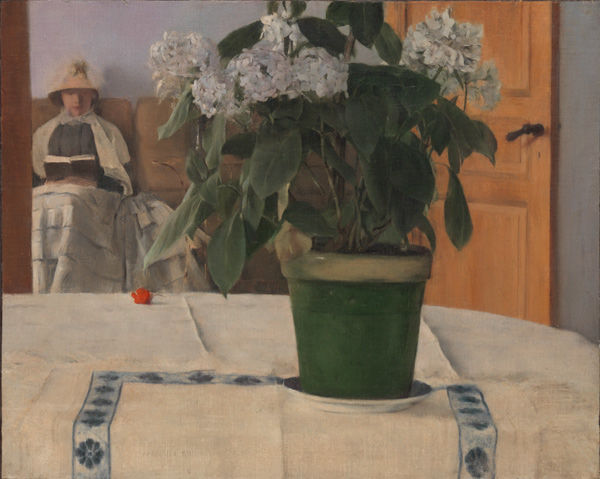
On Thursday, the Metropolitan Museum of Art presented a talk by Alison Hokanson (Assistant Curator, European Paintings) on Symbolism with a focus on the work of Belgian painter Fernand Khnopff. In discussing the broad and enigmatic Symbolist movement, with its concern with "desire, the unconscious, human mortality, timelessness and the inner self," Hokanson acknowledged that it had long been dismissed by most art scholars as "an artistic dead end, not sufficiently sophisticated or forward-thinking."  Now that assessment is under revision. A prime example of this new consideration: The Met's own recent acquisition of Hortensia, an interior innovative, for its time, in Khnopff's confident experimentation with perspective and foregrounding.


Fernand Khnopff's Hortensia (1884)
The Metropolitan Museum of Art

Hokanson is a clear, illuminating presenter, and if you missed this first talk from her Dreams, Magic and Desire series, I highly recommend catching the second--"The British Invasion"--on Thursday, March 17 (11am-Noon).
Taking as a starting point the Met’s masterpiece The Love Song by Edward Burne-Jones, this talk highlights the appeal that the work of the Pre-Raphaelites in England had for the Symbolist generation in Northern and Central Europe. From Brussels to Munich and Vienna, artists drew on British models to develop modern styles that differed radically from the French trends that dominated the art world. Their work, as one critic put it, “rendered the profundity of life and a melancholy attitude of beauty.”
Click here for ticket information.

The Grace Rainy Rogers Auditorium at
The Metropolitan Museum of Art
82nd Street and Fifth Avenue
(visitor information including map and directions)

If you like what you're reading,
subscribe to InfiniteBody!

Tuesday, August 18, 2015

A fantasy of James Baldwin and Beauford Delaney


presents a staged reading of

TO THE LIGHT 
(A FANTASY INSPIRED BY TWO AMERICAN GENIUSES: 
BALDWIN AND DELANEY)

a new play by Bil Wright
directed by Reginald Douglas

Wednesday-Thursday, October 7-8 at 7:30pm
Tickets: Free with RSVP
To the Light (A Fantasy Inspired by two American Geniuses: Baldwin and Delaney) is a play by Bil Wright that celebrates the loving, dramatic, complex relationship between writer James Baldwin (1924-1987) and painter Beauford Delaney (1901-1979). It chronicles their friendship from their first meeting through each of their deaths. Both of these men were highly significant in the history of American arts and culture. They both lived and created during times of enormous political change in the United States, especially in regards to the country’s race relations. Both were also enamored with Paris, as were other black artists, feeling it was a mecca in which art prevailed and African Americans considered beautiful both physically and artistically. This was a huge bond between the men, with both men dying in Paris, Delaney the victim of severe mental illness.
Tickets and reservations to Harlem Stage go on sale starting August 24 and can be purchased online or at 212-281-9240 ext. 19/20.

Harlem Stage Gatehouse
150 Convent Avenue, Manhattan
(map/directions)

Copyright notice

Copyright © 2007-2023 Eva Yaa Asantewaa
All Rights Reserved

Popular Posts

Labels