Search This Blog

Showing posts with label Native American. Show all posts

Wednesday, August 14, 2019

The Bessies: honors to Joan Myers Brown and Louis Mofsie

Joan Myers Brown


The NY Dance and Performance Awards, The Bessies, New York City’s premier dance awards honoring outstanding creative work in the field, has announced the recipients of two special awards to be given out at its 35th annual ceremony on October 14.

2019 Bessie Award for Lifetime Achievement in Dance:

Joan Myers Brown, Founder and Artistic Director of the Philadelphia Dance Company (PHILADANCO), in recognition of decades of choreographic influence on and support of the work of Black American dance artists.

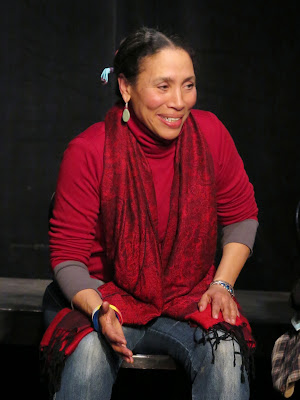
Louis Mofsie

2019 Bessie Award for Outstanding Service to the Field of Dance:

Louis Mofsie, Director of Thunderbird American Indian Dancers, whose work has kept Native American dance forms alive for generations of young people.

Join the celebration at Skirball Center for the Performing Arts on Monday, October 14 (7:30pm). Get information and tickets here.

See the full list of nominees and previously-announced awards here.

******

DISCLAIMER: In addition to my work on InfiniteBody, I serve as Senior Curatorial Director of Gibney. The postings on this site are my own and do not necessarily reflect the views, strategies or opinions of Gibney.

******

Subscribe in a reader

Tuesday, January 16, 2018

American Realness: "We Wait In The Darkness" by Rosy Simas

Rosy Simas in her solo We Wait In The Darkness
(photo: Ian Douglas)


Rosy Simas Danse
We Wait In The Darkness (New York premiere)
co-presented by Abrons Arts Center and Gibney Dance for
American Realness 2018 at Abrons Arts Center

Recent scientific study verifies what many Native people have always known, that traumatic events in our ancestors lives are in our bodies, blood and bones. These events leave molecular scars adhering to our DNA. Our grandmother’s tragic childhood can trigger depression or anxiety in us, but we have the ability to heal these DNA encodings and change that trait for future generations.
--Rosy Simas 

For people of the Black African diaspora, too, these words from Minneapolis-based dance artist Rosy Simas (Seneca, Heron Clan) ring true, and I must begin with gratitude to Simas for work that illustrates the body as truth-teller and healer. We, too, are a people nurtured by connection to ancestors with tragic histories in this hemisphere, and many of us express reverence for ancestral heritage through powerful spiritual and artistic practices that are, in their way, forms of anti-colonial resistance and justice-making.

Simas's 50-minute solo, We Wait In The Darkness--with its soundscape by composer François Richomme--uses visual, textual, kinetic and sonic mediums to affirm and reclaim the strength of ancestry and environment. By employing this sensory overlapping and overload, viewers grasp what it must be like to uncover the memories one's body holds--some sweet, some painful, some subtle or slow to emerge, some earthshaking--and to tap its wisdom.

Over one end of the stage hangs Simas's long, white paper model of a DNA strand. Towards the center back a white, puff-sleeved dress with a long, old-fashioned dirndl skirt dangles. Along stage left, Simas has suspended a series of white paper panels textured like fine quilts. Panels also capture film imagery, often hazy, glimmering and ethereal, that allude to place--and sometimes people--without specific identification for the benefit of those outside Seneca culture. This poetically elusive quality renders the work as ritual rather than documentary, gives it a spaciousness rather than containing it as the story of a particular individual--although we do hear a voiceover of actual letters of Simas's grandmother, as read by her mother, and we also hear words in the Seneca language gruffly whispered as Simas dances. So, precious, protected mystery exists but also a certain porosity and generosity to help all of us begin to understand the possibility and path of healing.

Theater of both the vivid and the indistinct, then. As Simas sits with her naked back to the audience--spine and arms deeply flexing, stretching and reaching, snaking and twisting--I recall my first realization, when I practiced energy healing, that the back shares more information, without a person's conscious intervention and manipulation, than the front of the body. Throughout the dance, even when she finally dons that white dress, Simas shows us a body of focused, determined will, sure of itself, sure of its mission, sure of the ultimate fulfillment of that mission. We come to understand the evocative sound and visual imagery--drawn from earth and waterways of Seneca land--as its sacred source. And we also contemplate what it meant, for indigenous people, to be literally torn from that grounding, nourishing source. Her body speaks as it moves, and it is saying: I will this. I call this back. The spirits of the land respond in Richomme's mesmerizing, commanding weave of sound.

Near the end of the piece, projections of schematic diagrams suggest maps with numbered sections, a landscape reduced to arbitrary parts for some entity's benefit. Again, nothing is identified, verbally or visually, yet the implications are clear. An environment we just experienced so powerfully in sight and sound, now lies butchered. Simas brings out a sheet of white paper marked with this diagram, solemnly ripping each section from its matrix and placing each strip in a carefully-chosen position along the edge of the floor. She also rips away more of these sections before descending into the audience and gifting them to several of us.

I received number 12. Although I have no idea what territory--real or metaphoric--that it might represent, I will preserve and treasure it.

Letter reader: Laura Waterman Wittstock (Simas’s mother)
Letters: Clarinda Waterman (Simas’s grandmother)
Lighting design: Karin Olson and Carolyn Wong
Set and film design: Rosy Simas

Closed. American Realness 2018 concludes this evening. For further information, click here.

Subscribe in a reader

Thursday, September 21, 2017

Native feminist troupe Spiderwoman is 40! Party!!!

Spiderwoman Theater's Gloria Miguel (Kuna/Rappahannock)
with daughter Monique Mojica
(photo: Nicky Paraiso)
Spiderwoman's Muriel Miguel (Kuna/Rappahannock) at left
with Oneida-Oswegan songwriter Lacey Hill
who performed at the celebration.
(photo: Star Black)


On Tuesday evening, La MaMa's Ellen Stewart Theatre hosted a warm, down-to-earth gathering of family, friends, colleagues and fans of Spiderwoman Theater in tribute to the renowned troupe's 40-year milestone. Founded by three intrepid sisters of Kuna and Rappahannock lineage--Gloria Miguel, Muriel Miguel and the late Lisa Mayo--Spiderwoman is fundamental to the development of New York's avantgarde and feminist theater movements. With forthright, woke politics of resistance and bawdy, boisterous humor, the Spiderwomen have long been revered role models for generations of artists on the downtown scene like Taylor Mac, Peggy ShawLois Weaver, Alessandra Belloni and Carmelita Tropicana who participated in the celebration and benefit.

The fun evening was capped by a dance party presided over by First Nations electronic group A Tribe Called Red.

Musicians Ian Campeau, Tim 2oolman and Bear Witness of
A Tribe Called Red working the after-party
(photo: Star Black)
SiverCloud Singers
(photo: Star Black)
On screen, Spiderwoman's Lisa Mayo (1924-2013)
remembered at La MaMa
(photo: Star Black)
Laura Ortman of the all-Native Coast Orchestra
and Brooklyn's Stars and Fleas
(photo: Star Black)
Above: choreographer Elizabeth Streb
with Carey Lovelace (Loose Change Productions),
co-producer of the Spiderwoman benefit
Below: Zach Morris and Tom Pearson, co-artistic directors of
award-winning Third Rail Projects theater troupe
(photos: Star Black)


Subscribe in a reader

Monday, January 9, 2017

"Native American Realness": Address/redress cultural appropriation

Rosy Simas and Christopher K. Morgan
(photos: Tim Rummelhoff and Brianne Bland)


On Saturday, January 7, American Realness 2017 presented a conversation featuring Native American choreographers Rosy Simas (Seneca) and Christopher K. Morgan (Native Hawaiian) with Sara Nash, Program Director, New England Foundation for the Arts at Brooklyn's ISSUE Project Room.

The afternoon session was organized by American Realness in response to concerns first raised in mid-December by Simas about the APAP-related festival's planned programming of a solo performance by Latifa Laâbissi, a French national of Moroccan lineage. (See Rosy Simas Reads Laâbissi’s "Self Portrait Camouflage", InfiniteBody, December 13, 2016.)  Sima's complaint and subsequent conversations with American Realness founder, curator and producer Thomas Benjamin Snapp Pryor led to an apology statement from Pryor, who had programmed the Laâbissi show in collaboration with MoMA PS1 associate curator--now Executive Artistic Director of Performance Space 122--Jenny Schlenka. Although Pryor quickly withdrew his organization's co-sponsorship of the Laâbissi event, MoMA PS1 kept the show on its APAP schedule. In the meantime, Simas and Laâbissi had an extensive conversation about the issue. 

The Native American Realness forum was convened on Saturday:
"to discuss the state of Native American performance work across the US and the epidemic of institutional negligence, insensitivity and attempted erasure of and towards Native American / Indigenous / First Nations’ values, histories and contributions to contemporary artistic practice. This conversation seeks to investigate how our dominant culture’s historical insensitivity aids in forms of cultural appropriation, Redface, and racism in artistic practice, spectatorship and presenting. Does Redface sell? Is curating Native artists seen as risky, unsellable, or uninteresting, or does this speak to institutional and societal ignorance?"
Orlando Zane Hunter, Jr.--co-founder, with Ricarrdo Valentine, of Brotherhood Dance!--attended this session and contributes a report.


Native American Realness
by guest contributor
Orlando Zane Hunter, Jr.


Native American Realness was nothing short of a resistance that's been happening for over 500 hundred years. Artist Rosy Simas from Minneapolis initially sparked what's part of a larger fire as it relates to indigenous performance, life and well-being. Simas challenged the annual American Realness festival to reexamine why it would present Latifa Laâbissi's Self Portrait Camouflage, a Red Face performance, an appropriation by an artist who may or may not have done the research on indigenous performance.

Laâbissi was not there to defend her work and dialogue with Simas. Should she have been?

The conversation opened with each person stating their names and if they belonged to any indigenous nation--a traditional way of opening the space and filling it with ourselves and our ancestors. The first questions posed for the room were loaded yet poignant: What is "Red Face" and why is it problematic? Why is it programmed? We further questioned: Why does Red Face programming get funded in the United States while Native American artists do not? Boundaries were set so that Indigenous people in the room would speak first.

It should be noted that not every cultural institution would have the integrity to share their failure so publicly and be willing to host the provocateur and many others who stand in solidarity. And they did this only a month after the controversy arose. Response plus action.

Red Face is a racialized representation of Native American people similar to Black Face in America. Red Face is the impersonation of Native American people by white people of European descent, though not exclusively. People of color can also objectify their own cultures as well as others. Educational structures and cultural production sectors use this and other similar mechanisms to control the image of Native Americans. These efforts continue to write Native Americans out of their own stories, never affording space or access to funding for Native Americans to write their truths.

As the conversation progressed, further challenges emerged around intention and the research process. Who is authentic? For bodies of color, entering European performance spaces is a radical act in and of itself.

Participants questioned how context can be provided for the audience. Should it even be provided? When it comes to esthetics, what is disruptive? If the standard is European esthetics, then we must question who is radical. Someone mentioned a recent performance by Will Rawls that was sourced in Balkan dance traditions. What does "radical" mean for different cultures? In the words of Rosy Simas, "If an artist says it's radical, shouldn't we believe them?" Contextualizing performance is left up to the artist who must negotiate how much they want to let the audience in on their intended communication.

As the ninety-minute conversation ended, everyone realized that this was only a beginning to the work of excavating the dissociative culture we live in and its reluctance to process the trauma suffered by indigenous cultures. How do we heal?

Native American Realness was an opportunity for cultural workers and community members to have open dialogue about the misrepresentation and appropriation of Native culture and performance. This conversation was an example of how cultural production platforms and artists can work together to incite change, offering healing resistance with rigorous dialogue and harmonious creative space.


Orlando Zane Hunter, Jr.
(photo courtesy of the artist)

Orlando Zane Hunter Jr. is a choreographer and dancer who researches, illustrates and creates from an African-American male perspective. In his work, he tackles issues resulting from a capitalistic imperialist patriarchal white supremacist system. Hunter grew up dancing hip-hop and graduated with a BFA in Dance from University of Minnesota, where he performed works by Donald Byrd, Bill T. Jones, Carl Flink, Louis Falco, Colleen Thomas, Uri Sands, Stephen Petronio and Nora Chipaumire. His solo Mutiny was selected to represent the University of Minnesota at the 2011 ACDFA gala in Madison, Wisconsin. Orlando studied LGBT activism and history in Amsterdam and Berlin. He has performed with Christal Brown/INspirit Dance Company, Contempo Physical Dance, Forces of Nature, Makeda Thomas, Threads Dance Project, TU Dance and Ananya Dance Theater, an all-women’s company where he was the first male member and toured with them to Trinidad & Tobago and Zimbabwe. Hunter is a co-founder of the collective Brother(hood) Dance!

Free email subscription
to InfiniteBody

Tuesday, December 13, 2016

Rosy Simas reads Laâbissi’s "Self Portrait Camouflage"

Choreographer Rosy Simas
(photo courtesy of the artist)

On Sunday, January 8, MoMA PS1 and the American Realness festival will co-present Self Portrait Camouflage, an hour-long performance by France's Latifa Laâbissi, a dance artist raised in France by Moroccan immigrant parents. Curated by Jenny Schlenzka, the work is described on the festival's website as a use of
"tropes of caricature and the grotesque to conjure the silent aggressions and tensions at the heart of some immigrant experiences. Performing the piece naked, in bright spotlight against a sterile white backdrop, fully exposed to the world, Laâbissi becomes an object to be gazed at, studied, and scientifically dissected—evoking the imperialist custom of exhibiting indigenous people at World’s Fairs. Against the backdrop of recent anti-immigrant populism in the U.S. as well as the rest of the Western world, Laâbissi’s themes of 19th century representational politics and marginalization acquire new relevance."
Minneapolis-based choreographer Rosy Simas, who is Native American (Seneca, Heron Clan) addresses Laâbissi’s performance in the following statement posted last evening on Facebook. I have reached out to Ben Pryor, American Realness director and curator, for his response and will report back to you once I have heard from him.


*****


December 12, 2016

Dear MoMA PS1, American Realness, and Latifa Laâbissi:
I am writing to express my utter disbelief and outrage at the proposed production of Latifa Laâbissi’s Self Portrait Camouflage for the American Realness program. In the eyes of the Native American community, this production is an aggressive act of hate speech, cultural appropriation, and sacrilege.

My name is Rosy Simas. I am Seneca, Heron Clan. I am the fifth great-granddaughter of Cornplanter, the chief who negotiated with George Washington. My whole family line is of negotiators who have worked to create more understanding between our peoples.

I am a Minneapolis-based dance maker, a moving image maker, a performer, teacher, and an activist. I am a nationally known artist who has toured all over the U.S. and Canada. I am a Guggenheim fellow, a Native Arts and Cultures Foundation fellow, a First People’s Fund fellow, and a McKnight fellow. My work is currently funded by NEFA National Dance Project and National Performance Network Creation Fund.

So I am speaking to you as an expert in the field of choreography and as a practicing cultural artist.
I want to explain as best I can why the production of Latifa Laâbissi’s Self Portrait Camouflage is traumatizing to Native women, disrespectful to Native peoples, and an act of white supremacy at MoMA PS1 and the American Realness Festival in NYC.
 

I am also going to tell you what can be done on the part of the presenters and the artist to apologize for this atrocity and where you can begin to reconcile.

The description of this work says it is highly personal and that the performer is nude throughout the piece.

She is not Native American, yet the only thing she is wearing is something sacred to Native culture, a Native American headdress, the scared symbol of the Sioux Nations (the Lakota, Dakota, and Nakota peoples). Obviously the headdress is fake. Laâbissi would not be allowed to own sacred eagle feathers. Any artist of her stature SHOULD have taken the time to research the subject matter. The production has already been touring for some time now; in fact, this is the second presentation in New York City. The artist has had years to learn about Native people and sacred Sioux headdresses.

Second, the work cannot be highly personal when the weight of it is in the images. She wears the headdress through the whole piece. There is nothing highly personal in the appropriation of a sacred object of another people.

This is America. We are the First Americans. We are Native Americans. And there is nothing real in a non-Native choreographer pretending to be Native on stage. So this is not only offensive — but it is about as far from “American realness” as you can get.

Why would MoMA PS1 and American Realness want to add to the systematic genocide and erasure of Native people? Because that is what this production does.

Why doesn’t the artist draw from her own cultural experience if she is making a highly personal work?

European settlers, American culture and Hollywood has historically objectified, sexualized, and exotified Native women for hundreds of years. It is common to see the sexy mostly nude “squaw” sometimes with a headdress at Halloween, in pornography, in advertising and marketing. We have been and are still treated as if we are just a historic people of the past.

One really must be out of touch to not know that thousands of Native women have been missing in Canada and the U.S. The rape and murder of Native women has been devastating to our people over the past few hundred years -- and it continues today.

So when I see these images of Laâbissi, that is what I see. I see a non-Native woman in a fake headdress performing naked. I see a mockery of who Native women are. And I see a stage reserved for whiteness excusing itself from responsibility because it is an international person of color performing this mockery.
 

These images are traumatizing to Native people. Imagine what it triggers for Native women who have been raped and the families of those women who have been murdered and/or are still missing?

Images like this remind those women, remind all of us Native Americans, that we don’t matter and we do not even exist in your eyes.

What needs to happen next:

1) A public apology from the presenters and the artist needs to be issued immediately.

2) This performance should not go on as planned. Laâbissi needs to take off the headdress minimally. A cancellation of the production would be better, and in its place, a public forum led by Native artists on our work should be held, in which stereotypes and cultural appropriation can be dismantled.

3) A commitment from MoMA PS1 and American Realness to present and support contemporary Native American artists.

If this production proceeds as planned and advertised, MoMA PS1 and American Realness can expect a loud, sustained, and highly visible protest. As demonstrated by the Standing Rock Water Protectors in recent months, Native Americans will not quietly tolerate and accept the theft of our territories, the violent rape of our land, the appropriation and profaning of our religious beliefs, and colonization of our bodies.

Please contact me directly so we can begin to correct this injustice and work toward authentic reconciliation.

Nya:weh Sgeno,

Rosy Simas
 
Choreographer

Friday, May 13, 2016

Spiderwoman: "Material Witness" to violence against women

Gloria Miguel of Spiderwoman Theater
in Material Witness at La MaMa
(photo: courtesy Spiderwoman Theater)

I leave the door open for the spirits to walk about freely.
I welcome all the guardians to our space.
--Gloria Miguel in Material Witness

I never saw Spiderwoman Theater's original Women in Violence--the first production by this legendary Native American troupe, premiered in New York in 1976. But, last night at La MaMa, I got a good look at its rambunctious offspring, Material Witness, a piece designed to reach out to today's young women. It aims to remind them, and all of us, that physical, sexual and emotional abuse has not been eradicated from Native communities and that silence about it remains a deadly force.

Material Witness is directed by Spiderwoman co-founder Muriel Miguel, co-written by its six-woman cast with Miguel, and co-presented with Aanmitaagzi, an indigenous, interdisciplinary troupe from Nipissing First Nation, Ontario.

The 90-minute work bears all the hallmarks of Spiderwoman--communal, community-minded theater, story-based exposition, rollicking physical humor often reminiscent of vaudeville and slapstick comedy, and strong musical drive. The 1976 tune from AC/DC, "Dirty Deeds Done Dirt Cheap"--its chorus cheekily woven into a narrative about deeds most dirty--meets up with Lady Gaga's "Til It Happens to You." But, of course. And its new generation--the radiantly charming and kickass Cherish Violet Blood, Penny Couchie (choreographer), Donna Couteau, Ange Loft and Tanis Parenteau--share the stage with veteran Spiderwoman Gloria Miguel who serves as witness to their struggles and stories, setting and holding the space for them, collaborating in their honesty and victories. The music is dance-club loud, Soni Moreno's costume and decor colors and combos are eye-popping, and the performers' energy rocks the house.

Let me issue a standard trigger warning:  Some stories related here can be uncomfortable for anyone, especially survivors of violence, to hear. But I must also leave you with this laughter trigger warning: Spiderwoman's commitment to humor as a disinfectant has not and will never quit.

Material Witness continues through May 29 with performances Thursday to Saturday at 7:30pm and Sunday at 2pm. Panel discussions are scheduled following certain performances. For information and tickets, click here.

74A East 4th Street (between 2nd and 3rd Avenue), Manhattan

If you like what you're reading,
subscribe to InfiniteBody!

Friday, January 23, 2015

I dance as my lungs need to breathe: "Cedars" at La MaMa

Joan Henry (Cherokee) in Cedars
(photo: Jonathan Slaff)
Matt Langer (Dakota) in Cedars
(photo: Tatiana Ronderos)

I dance for those who dance no more....
I dance as my lungs need to breathe....
I dance whatever my daily circumstance....
--excerpts from the text for Cedars

Cedars--revised from its 2002 production by a Seattle troupe and presented at La MaMa by Mirage Theatre Company--features an ensemble of five Native American actors and director June Prager's adaptation of works by writers such as Evan Pritchard (M'kmaq) and Joseph Bruchac (Abenaki). Its strength lies in its insistence on the self-definition and visibility of indigenous peoples, the owning and treasuring of difference: "Refusing to vanish, I can only answer with my dark name."

The 80-minute presentation and its cast seem reticent and mild, though, in comparison to Prager's text--a rough-textured collage drawn from existence in the crosshairs of history at the crossroads of cultures. As with the Black Lives Matter movement, our moment calls for disruptive narratives like those at the core of Cedars. If only this sincere and careful production could bring out and deliver a much-needed jolt.

Performances by Wolfen de Kastro (Aztec/Huasteca/Maya), Joan Henry (Cherokee), Alana LaMalice (Dene-Cree), Matt Langer (Sioux and Cree), John Scott-Richardson (Haliwa-Saponi and Tuscarora). Music by Charles Upham (Blackfeet) and masks by Roger Fernandes (Lower Elwha s'Klallam)

Cedars runs through February 1 with performances Thursdays-Saturdays at 7:30pm and Sundays at 2pm. For information and tickets, click here.

La MaMa (First Floor Theatre)
74A East 4th Street (between Bowery and 2nd Avenue), Manhattan
(map/directions)

Sunday, January 19, 2014

Thursday, October 17, 2013

Sherman Alexie: writing on and off the reservation of your mind

Alexie never thought he could leave his reservation to pursue a writing career—but a line written by Adrian C. Louis taught him to venture outside the "reservation of his mind."
by Joe Fassle, The Atlantic, October 16, 2013

Copyright notice

Copyright © 2007-2023 Eva Yaa Asantewaa
All Rights Reserved

Popular Posts

Labels