Search This Blog

Showing posts with label contemporary dance. Show all posts

Thursday, October 21, 2021

Cynthia Oliver and Dormeshia are 2021 Doris Duke Awardees

Cynthia Oliver (photo: Ian Douglas)

Dormeshia (photo: AK47 Photography)


Congratulations to two of our stellar dance artists--Cynthia Oliver and Dormeshia--who are among seven winners of the 2021 Doris Duke Awards announced today by the Doris Duke Charitable Foundation!

Other 2021 awardees include saxophonist/composer Wayne Shorter, pianist/composer Danilo Pérez, pianist/composer Kris Davis, theater director Lileana Blain-Cruz, and actor/writer/director Teo Castellanos.

The annual Doris Duke Award, the largest national award to individuals in the performing arts, provides artists in theater, dance, and jazz with an award of $275,000.

“We are thrilled to award this year’s cohort of exceptional artists with this support,” said Maurine Knighton, program director for the arts at the Doris Duke Charitable Foundation. “With the knowledge that these performing artists excel in their forms, we recognize that they deserve funding that trusts them to best determine how to invest in their own futures. These awards are intended to enable artists with the freedom to create the way that artists are meant to create: freely, organically and without restrictions.”

Read more about the Doris Duke Artist Awards and the 2021 Doris Duke Artists here. 


About the Doris Duke Artist Awards


The Doris Duke Charitable Foundation designed the Doris Duke Artist Awards to invest in exemplary individual artists in contemporary dance, jazz and theater work who have demonstrated their artistic vitality and ongoing commitment to their field. The award is not a lifetime achievement award. Rather, it is a deep investment in the creative potential of dedicated artists. The foundation aims to empower Doris Duke Artists through the freedom of unrestricted support to take creative risks, explore new ideas, and pay for important professional and personal needs not typically funded by the project-related grants that dominate arts funding. While the Doris Duke Charitable Foundation initially conceived the Doris Duke Artists Awards as part of a larger $50 million special initiative that finished in 2017, recognition of the program’s importance in helping artists thrive spurred the foundation to cement a place for the flexible awards in its core strategy to support the arts.


About the Doris Duke Charitable Foundation


The mission of the Doris Duke Charitable Foundation (DDCF) is to improve the quality of people’s lives through grants supporting the performing arts, environmental conservation, medical research and child well-being, and through preservation of the cultural and environmental legacy of Doris Duke’s properties. The Doris Duke Charitable Foundation focuses its support to the performing arts on contemporary dance, jazz and theater artists, and the organizations that nurture, present and produce them. In 2015, the National Endowment for the Arts (NEA) awarded the foundation with a 2014 National Medal of Arts, presented by President Barack Obama, in special recognition of DDCF’s support of creative expression across the United States and “bold commitment” to artistic risk, which has helped artists, musicians, dancers and actors share their talents and enriched the cultural life of the nation. For more information, please visit www.ddcf.org.

******

DISCLAIMER: In addition to my work on InfiniteBody, I serve, at Gibney, as Senior Director of Curation and Editorial Director. The postings on this site are my own and do not necessarily reflect the views, strategies or opinions of Gibney.

******

Subscribe in a reader

Wednesday, August 19, 2020

Artists Reach Out: Laurel Lawson

Dear friends,

Welcome to Artists Reach Out: reflections in a time of isolation. I dreamed this series of interviews out of grief for my work both as a documenting arts writer and curator of live performance. In this time of social distancing, we are called to responsibly do all we can to safeguard ourselves and our neighbors. It is, literally, a matter of life and death.

But there's no distancing around what we still can share with one another--our experiences, thoughts, wisdom, humor, hearts and spirit. In some ways, there are more opportunities to do so as we pull back from everyday busyness out in the world and have time to honor the call of our inner lives.

So, let me introduce you to some artists I find interesting. I'm glad they're part of our beautiful community, and I'm eager to engage with them again (or for the first time) in years to come.

--Eva Yaa Asantewaa, InfiniteBody


Laurel Lawson


In a rehearsal moment for Wired, Laurel is suspended in midair.
She looks joyfully to the right of the frame,
her hands extended below from pushing off the ground,
body diagonal to the gray marley floor.
A black cord at her waist leads upward and loops
of barbed wire are visible in the foreground.
(Photo: Grace Kathryn Landefeld, courtesy of Jacob’s Pillow)

Dancer, choreographer, and engineer, Laurel Lawson found that dance combines her lifelong loves of athleticism and art.  Featuring liminality, synthesistic myth, and partnering, her work includes both traditional choreography and novel processes for extending and creating art through technology and design.

Laurel began her professional dance career with Full Radius Dance in 2004 and is part of the disabled artists’ collective Kinetic Light, where in addition to choreographic collaboration and performance she contributes costume design and leads technical innovation, including the Audimance project, a revolutionary app centering non-visual audiences, and the Access ALLways initiative. Beyond dance, Laurel is an advocate and organizer, musician, skates for the USA Women’s Sled Hockey team, and leads CyCore Systems, a technology consultancy specializing in novel problems.

Laurel Lawson is a 2019-20 Dance/USA Artist Fellow.  Dance/USA Fellowships to Artists is made possible with generous funding from the Doris Duke Charitable Foundation.


In a moment from Wired, two dancers in wheelchairs
(Alice Sheppard, a light-skinned Black woman and Laurel Lawson, a white woman)
reach for each other while suspended above the ground by tethers.
The skin of their backs and arms is exposed and their faces overlap intimately.
If they let go of each other, the tethers will swing them like pendulums.
(Photo: Mengwen Cao)


Do you have a current or planned project whose progress is affected by the pandemic?

I am a dancer, choreographer, and engineer; a member of Kinetic Light, a leading disability arts ensemble; a member of Full Radius Dance; and an independent choreographer, artist, and educator.

In January, my 2020 calendar was fully booked, mostly on the road, with the next two years filling up quickly. In fact, I arranged to give up my lease at the beginning of March since I would be away from home most of the year. I moved a few bags of what I would need for residencies and touring to Kinetic Light’s New York City rehearsal hub and the rest went into storage with only a few necessities for short stays going into the house my partner and I are gutting and renovating to rehabilitate it and make it accessible.

Instead, with incredible foreshadowing, I began the year with a tour cancellation in Hong Kong, briefly visited Vancouver for as a member of the USA Women’s Sled Hockey Team, visited Kirkland the day their nursing home outbreak was announced and then went to NYC for a showing. I left NYC one day before Gibney closed--thinking I would immediately return, my dance chair and most of my rehearsal gear is still there, five months later. We are lucky to have been able to move into the un-renovated house--very much not accessible, but temporarily habitable. I have a few pieces of shower board taped up over the uneven floor in one room to make an impromptu video studio for taking class, teaching, and filming.

Five months later, and it begins to sink in. The original premiere date at the Shed for Kinetic Light’s new work WIRED has come and gone. Many of the touring dates for that work and for DESCENT may never be rescheduled, depending on how large venues fare and when people can return to indoor environments. My artistic life exists in brief flashes of video--instead of intensive day-long partnering and rehearsal; instead of choreographing for commissions; instead of the day to day of touring.

While I am happy to be able to make some work, I do not relish the technical aspects of producing film. I am grateful to be able to work with funders for program-building and to create necessary and innovative software and products, but my body is not made for  administration and constant long days at my computer. And I cannot help but grieve the commissions lost, very much at the beginning of my choreographic career.

Likewise, in this shifting time: I do not, cannot, resent my work as an activist, as a community organizer, in this time. I absolutely can resent the need for it. I am furious as all the people and all the systems found they could change and shift massively, people still made choices to exclude disabled people; even as it becomes easier to provide access, as the necessity of change makes space for the change, people are making choices to deny access and promote exclusion. No longer shielded by the excuses of convenience or cost, it is revealed as we always knew it to be--bigotry and lack of care. Nonetheless, I am beginning or continuing several major projects, accessible software, accessible community and teaching practice; and perhaps when we are no longer in crisis I can even get to some of the (many) writing projects I’ve needed to backburner.

Briefly, tell me about how you got involved in the arts and in your particular practice.

My professional work in the arts began in music. I was diverted from attending conservatory by sudden and severe repetitive stress injury; I successfully made the transition from classical music to folk and jazz and made part of my income gigging in college, also picking up theatrical tech & design along the way. Before grad school, I took a gap year and fell by chance (while working a physical acting job) into my first modern dance class with Douglas Scott of Full Radius Dance, who later invited me into his company.

As a dancer, I strive to remain grounded in the meeting of athleticism, precision, and storytelling. As a choreographer I make work that tells stories through ensemble, physicality, and partnering; liminal space, often structured with synthesistic mythology: old stories from a new angle. And as a designer and artist-engineer, my practice encompasses the fusion of technology and traditional work, creating entirely new ways of experiencing art.

In a more specific way, what are you practicing? And what are you envisioning? How does your practice and your visioning align with what you most care about?

My practice is built on the synergy of collaboration and the exposure of deep stories. While I cannot, in this moment, practice in the way I would prefer, the purpose remains. I am working to understand how I can connect the diversity of my areas of practice to create new things and to extend the things I already do. In addition to what people might immediately think of as dance, as art: I am practicing the understanding of how people are influenced by systems and environments. Art is neither immune nor somehow above the still-rising tides of surveillance and covert manipulation; art is itself a means of communication and influence. So my work in exposing those aspects in tech, in art; my work in inviting people to think about community, about ethics, about equity: these take practice, work, commitment, time, and support.

How does your practice function within the world we have now?

This is a time not of rest, but of building infrastructure--work that is traditionally undervalued in the dance world. Creating new systems, teaching, organizing. Not being a prophet, I am waiting to find out what world, what society, will emerge from this time--as well as working to bring about a society that shares my values. And moreover how the shifts that we can see happening, long overdue, will affect the arts: what does sustainability and justice look like? As remote work becomes normalized, how does that resonate outwards into geographic and economic equity? We are a vital and deeply interdependent part of the ecosystem.

Briefly share one self-care tip that has special meaning to you now.

I am now practicing: Patience. Care. Struggling to stay present with both the passage of time and work which might not be my preference but is nonetheless both important and urgent.

******

DISCLAIMER: In addition to my work on InfiniteBody, I serve, at Gibney, as Senior Director of Artist Development and Curation and Editorial Director. The postings on this site are my own and do not necessarily reflect the views, strategies or opinions of Gibney.

******

Subscribe in a reader

Thursday, July 9, 2020

Artists Reach Out: Michael Maag

Dear friends,

Welcome to Artists Reach Out: reflections in a time of isolation. I dreamed this series of interviews out of grief for my work both as a documenting arts writer and curator of live performance. In this time of social distancing, we are called to responsibly do all we can to safeguard ourselves and our neighbors. It is, literally, a matter of life and death.

But there's no distancing around what we still can share with one another--our experiences, thoughts, wisdom, humor, hearts and spirit. In some ways, there are more opportunities to do so as we pull back from everyday busyness out in the world and have time to honor the call of our inner lives.

So, let me introduce you to some artists I find interesting. I'm glad they're part of our beautiful community, and I'm eager to engage with them again (or for the first time) in years to come.

--Eva Yaa Asantewaa, InfiniteBody


Michael Maag


Michael Maag, a white man,
smiles at the camera with twinkling eyes.
He has white/blond hair with an impressive long beard,
glasses and a light complexion.
(photo: Jenny Graham)

Alice Sheppard, Laurel Lawson, and Michael Maag
sit side by side in their chairs, on gray marley and lit by stage lighting.
Alice is a light skinned Black woman with short curly hair,
Laurel is a white woman with very short silver hair,
and Michael is a white man with long blonde hair
and a flowing white/blonde beard.
They are wearing casual and rehearsal clothing,
and all three are grinning at someone in the audience.
(photo: Chris Cameron/MANCC)


Michael Maag is the video, projection, and lighting designer for Kinetic Light, a project-based ensemble working at the intersections of disability, dance, design, identity, and technology. Maag designs at the intersection of lighting, video, and projection for theater, dance, musicals, opera, and planetariums across the United States. He sculpts with light and shadow to create lighting environments that tell a story, believing that lighting in support of the performance is the key to unlocking our audience’s emotions. Maag has built custom optics for projections in theaters, museums and planetariums; he also designs and builds electronics and lighting for costumes and scenery.

As a wheelchair user, Maag is passionate about bringing the perspective of a disabled artist to technical theater and design. He is currently the Resident Lighting Designer at the Oregon Shakespeare Festival. His designs have been seen on the Festival’s stages for the last 20 years, as well as at Arena Stage, Brooklyn Academy of Music, Seattle Repertory Theatre, Utah Shakespearean Festival, Florida Studio Theatre, and the Henry Hudson Planetary, Albany.


Alice Sheppard, a light-skinned Black woman,
and Laurel Lawson, a white woman, are both in their wheelchairs
with a vibrant multicolor sunset in the background.
Alice is crawling on her forearms with her knees in Laurel's footplate,
and Laurel is arching her back on the ground as she is dragged along the floor.
Alice is exerting effort, and Laurel is in surrender.
(photo: M A N C C / Chris Cameron)

Laurel Lawson, a white woman, is flying in the air
with arms spread wide, wheels spinning,
and supported by Alice Sheppard.
Alice, a light-skinned Black woman,
is lifting from the ground below.
Behind them appear a dark blue sky and mountainscape;
figures appear in the key, bursting with light.
(photo: Jay Newman/BRITT Festival)


Do you have a current or planned project whose progress is affected by the pandemic?

Yes. Like everyone in the entertainment industry, it seems like my work, my art, my life is on hold. I am a member of the project-based disability arts ensemble Kinetic Light and our residency work on a new piece, Wired, has been postponed as have the performance dates at The Shed, though some development and design work has continued remotely. Our piece DESCENT was supposed to perform in Hong Kong in February, and our US dates have been postponed. My work as the Resident Lighting Designer at the Oregon Shakespeare Festival is on pause, as is my mentoring practice with the FAIR Program.

Briefly, tell me about how you got involved in the arts and in your particular practice.

The Theater enticed me into the arts at a young age, and I became a Lighting Designer when I discovered that light communicates emotion directly to the subconscious of the audience. This happened the first time I touched a Lighting Control Panel. At that time, those were enormous panels of levers often labeled with the color of the gel in the lights. I had a dream that night in which the levers were labeled with the emotions the light conveyed. I have been living that dream ever since. My practice is to use light to tell the story, and to immerse the audience (all of them) in the emotional journey.

In a more specific way, what are you practicing? And what are you envisioning?

My practice is collaborative and inclusive. I work with choreographers, directors, scenic and costume designers to create meaningful art. As a disabled artist, I am particularly interested in working from a disabled perspective, with a focus on access. To me, this means two things: to create accessible work for the disabled community that speaks to and reflects their experience, and to welcome the able-bodied into our environment.

At Kinetic Light, we work at the intersection of disability, race and gender. The horrific ongoing systemic racism in this country must end. We must interrogate the origin, meaning and reasons for the societal contracts we have made or have been forced onto us. Those societal contracts that no longer serve must be dismantled. We can come up with a better way to run a “free” society than one that uses principles like democracy and capitalism to perpetuate injustice. It is our job as artists to provide vision, hope and guidance for our society. Most importantly, we must act in an anti-racist, anti-ableist, anti-sexist manner throughout our process.

I envision art that helps our society realize our failures to others and ourselves. I envision art that heals. I envision art that shines.

How does your practice and your visioning align with what you most care about?

I am on a journey, someplace on the road to an inclusive, fair and just practice. In that way I feel like I am in alignment with my dreams. I also feel like I am personally at the bottom of a steep hill and need to keep pushing my wheels up the road to completely inhabit the world I want to see.

My work as a mentor continues with many young lighting designers out in the world. I am embarking on a new fellowship through Kinetic Light to mentor a disabled lighting designer. Even in these pandemic times, we can connect and collaborate.

My practice includes continual learning. I am never bored. There is always something to learn about, or something to be better at.

How does your practice function within the world we have now?

By remotely collaborating, creating and even lighting from a distance, my art is becoming enhanced by better communication skills. At Kinetic Light, we managed to pull off one virtual, remote dance concert by “dancing in place” (you can view that event, hosted by the Rubin Foundation, on their website) and have another scheduled in July. I am spending time learning new tools and creating a library of visuals for Wired. So in a way it is not all that dissimilar to how I normally work; just a lot less time in Technical Rehearsals.

Briefly share one self-care tip that has special meaning to you now.

I’ve been meditating about the meaning of the Japanese word ma and its relevance now. The word means something like space, gap or interval. But, more deeply, it is an awareness of place, a concentration of vision between form and non-form. Here we are in the shadows between structured time. Without these shadows, there can be no awareness of light. Which I guess is a long way of saying pause, create ma, and meditate on something meaningful to you.

******

DISCLAIMER: In addition to my work on InfiniteBody, I serve, at Gibney, as Senior Director of Artist Development and Curation and Editorial Director. The postings on this site are my own and do not necessarily reflect the views, strategies or opinions of Gibney.

******

Subscribe in a reader

Friday, July 3, 2020

Artists Reach Out: Mariana Valencia

Dear friends,

Welcome to Artists Reach Out: reflections in a time of isolation. I dreamed this series of interviews out of grief for my work both as a documenting arts writer and curator of live performance. In this time of social distancing, we are called to responsibly do all we can to safeguard ourselves and our neighbors. It is, literally, a matter of life and death.

But there's no distancing around what we still can share with one another--our experiences, thoughts, wisdom, humor, hearts and spirit. In some ways, there are more opportunities to do so as we pull back from everyday busyness out in the world and have time to honor the call of our inner lives.

So, let me introduce you to some artists I find interesting. I'm glad they're part of our beautiful community, and I'm eager to engage with them again (or for the first time) in years to come.

--Eva Yaa Asantewaa, InfiniteBody


Mariana Valencia


Mariana Valencia
(photo: Charlotte Curtis)


Mariana Valencia is a New York based choreographer and performer. Her work has been presented by Danspace Project, American Realness, AUNTS, The Chocolate Factory Theater, Performance Space, the Portland Institute for Contemporary Art (OR), The Hirshhorn Museum and Sculpture Garden (DC), The Museum of Contemporary Art (Chicago), and internationally in England, Norway, Macedonia and Serbia. Valencia is a Whitney Biennial artist (2019), a Bessie Award recipient for Outstanding Breakout Choreographer (2018), a Foundation for Contemporary Arts Award to Artists grant recipient (2018), a Jerome Travel and Study Grant fellow (2014-15), and a Movement Research GPS/Global Practice Sharing artist (2016/17). She is a founding member of the No Total reading group and she has been the co-editor of Movement Research’s Critical Correspondence (2016-17). She has held residencies at Chez Bushwick, New York Live Arts, ISSUE Project Room, Brooklyn Arts Exchange, Gibney, Movement Research and at the Portland Institute for Contemporary Art (OR). Valencia has worked with Lydia Okrent, Jules Gimbrone, Elizabeth Orr, Kate Brandt, AK Burns, Guadalupe Rosales, Em Rooney, robbinschilds, Kim Brandt, Morgan Bassichis, Jazmin Romero, Fia Backstrom and MPA. In 2019, she published two books of performance texts entitled Album (Wendy's Subway) and Mariana Valencia's Bouquet (3 Hole Press). Valencia holds a BA from Hampshire College in Amherst, MA (2006) with a concentration in dance and ethnography.


Mariana Valencia in Air (2020)
(photo: Jeenah Moon)


Do you have a current or planned project whose progress is affected by the pandemic?

Yes. I've had about nine national and international engagements postponed to 2021-23 but, in my mind, that feels like 2034-35.... No one ever knew the future; projections feel silly now. Our community of dance artists, choreographers, tech and venue staff is undergoing a huge strain.

On a personal level, I'm not sure what the horizon holds, but I'm staying resourceful. Some institutions and organizations have offered me small video projects which I'm grappling with because the medium is not live, and I don't "make" video art. It's like asking a therapist to stop talking in session, but they can still meet with their patients. A big "HOW?" looms over me.

Briefly, tell me about how you got involved in the arts and in your particular practice.

I learn through example and by doing; I'm an observer. I grew up watching my family dance at social gatherings; I learned to dance. I was taught to cut and sew garments; I make some of my costumes. I was taught to memorize poetry at a young age, so I have skills in memorizing my scripts. I learned to build things, so I craft the sets in my shows from scratch and ready-made compositions. This learning from example and doing is what has revealed to me the art that I make, and it has helped me re-frame and devise the layers of my performances.


Above and below:
Mariana Valencia in Air (2020)
(photo: Maria Baranova)


In a more specific way, what are you practicing? And what are you envisioning?

I'm practicing a daily mode of survival, one hour at a time, and it gives me a short scope of what is possible, since the possibility of what I've known is a bit impossible to envision in the future. I make the bed, cook, read, organize the spices, move the crystals and rocks from one surface to another. I take long walks. I Windex the mirrors.

Seeing these tasks through lends a sense of home, it honors where my body lives and moves and that care for me is similar to the care I give to my projects. So I'm grateful to blend the home/work space daily. I'm re-imagining the 40-hour work week, in particular how the 40-hour work week has impacted when and where I've presented my work.

Why are shows at night? Because we work during the day. Why do shows cost money? Because the arts have been established as a market that isolates entire communities from "it" within Capitalism. These shortcomings have given a price to the art I make, my time, my value.

I'm rethinking how I will continue to move through my community while questioning the scaffold that has stifled us/me. I'm feeling hopeful about this thinking; the need for each other and community has never felt so deep. I've been thinking about staying active and present so that I don't have to feel reactive and chased.

How does your practice and your visioning align with what you most care about?

I care about the people that I love, and that makes me think about love at-large and how if we all feel love for someone or something,  then the love web is wide and connected. I've been ruminating inside of the web and navigating it from this viewpoint and essentially, the goal is the path, and the path has many encounters, so let's honor each other.

How does your practice function within the world we have now?

My work has been focused onto the personal/political and the abstraction of these subjects for some time now. I now imagine my work on some sci-fi frequency (on video because of the pandemic) of just me doing things that bring me joy, that frame me as I am in my daily tasks. If I make who I am visible as "I am," then maybe I don't have to keep railing about how "in the margin" I've been made to live.

I define who I am. I also often erase that vision and, instead, envision this daily "me" on video with a really clear political statement that continues to shine a light on the ugly, the unfit and the underserved-- so, as is my custom, it will probably be a blend.

Briefly share one self-care tip that has special meaning to you now.

Do a day at a time. Don't try hoarding past or future time by dwelling and planning. Listen to right now and be with that. Reaction is different from action. Action gives me meaning, reaction shows me a deficit, a lack and a certain late sense of arrival.

******

DISCLAIMER: In addition to my work on InfiniteBody, I serve, at Gibney, as Senior Director of Artist Development and Curation and Editorial Director. The postings on this site are my own and do not necessarily reflect the views, strategies or opinions of Gibney.

******

Subscribe in a reader

Monday, June 8, 2020

Artists Reach Out: Sydnie L. Mosley

Dear friends,

Welcome to Artists Reach Out: reflections in a time of isolation. I dreamed this series of interviews out of grief for my work both as a documenting arts writer and curator of live performance. In this time of social distancing, we are called to responsibly do all we can to safeguard ourselves and our neighbors. It is, literally, a matter of life and death.

But there's no distancing around what we still can share with one another--our experiences, thoughts, wisdom, humor, hearts and spirit. In some ways, there are more opportunities to do so as we pull back from everyday busyness out in the world and have time to honor the call of our inner lives.

So, let me introduce you to some artists I find interesting. I'm glad they're part of our beautiful community, and I'm eager to engage with them again (or for the first time) in years to come.

--Eva Yaa Asantewaa, InfiniteBody


Sydnie L. Mosley


Sydnie L. Mosley
(photo: Jamie McLean)


Sydnie L. Mosley​ is an award winning artist-activist and educator who is interested in creative work that is both artistically sound and socially aware. ​She produces experiential dance works with her collective SLMDances. Through their choreographic work, the collective works in communities to organize for gender and racial justice. Her evening length dances The Window Sex Project and BodyBusiness, their creative processes and performance experiences are a model for dance-activism. ​​​Her dances have been performed extensively throughout New York City and she was listed by TheRoot.com as one of twenty-five “Up and Coming: Young Minority Artists and Entrepreneurs.”​ Sydnie was recognized by NYC Mayor Bill de Blasio and First Lady Chirlane McCray for using her talents in dance to fuel social change.

Currently, SLMDances is engaged in a multi-year residency through Lincoln Center Education as the Manhattan Community Artists in Residence toward the development of their newest work, PURPLE. They also received LMCC Creative Engagement funding to support The Window Sex Project: Community Workshops (2017 + 2019), and PURPLE (2020).

Other support includes: CUNY Dance Initiative (2016 + 2017 Artist in Residence), Dancing While Black Artist Fellowship (2015-2016), and The Field Leadership Fund (2015-2017). The Performance Project @ University Settlement (Artist in Residence 2015-2016). She is a 2013 alumna of the Create Change Fellowship with The Laundromat Project, and the Gibney Dance Institute for Community Action Training. In 2011, she became the inaugural Barnard Center for Research on Women Alumnae Fellow.

​A versatile dancer, Sydnie is a part of the 2017 Bessie Award winning cast of the skeleton architecture, or the future of our worlds curated by Eva Yaa Asantewaa. Sydnie danced with Christal Brown's ​INSPIRIT, a dance compan​y (2010-2013) and has continued to appear as a guest artist for Brooklyn Ballet since 2009.

​As a dance educator, Sydnie's technique classes pull together orientations from the African diaspora, attention to the architecture of traditional modern dance, and the language of Laban/Bartenieff Fundamentals grounded in the use of breath, voice, and personal choices. She has been an Adjunct Lecturer with the Barnard College Dance Department, led guest artist residencies at colleges across that nation including Oberlin College, Washington University in St. Louis, and in 2012 designed Barnard’s Dance in the City, Pre-College Program which she continues to teach.

She graduated from Barnard College in Dance and Africana Studies and earned an MFA in Dance Choreography from the University of Iowa.​​​​

Sydnie resides in Harlem, New York City. When she isn’t dancing, she is writing, listening to music, and cooking.


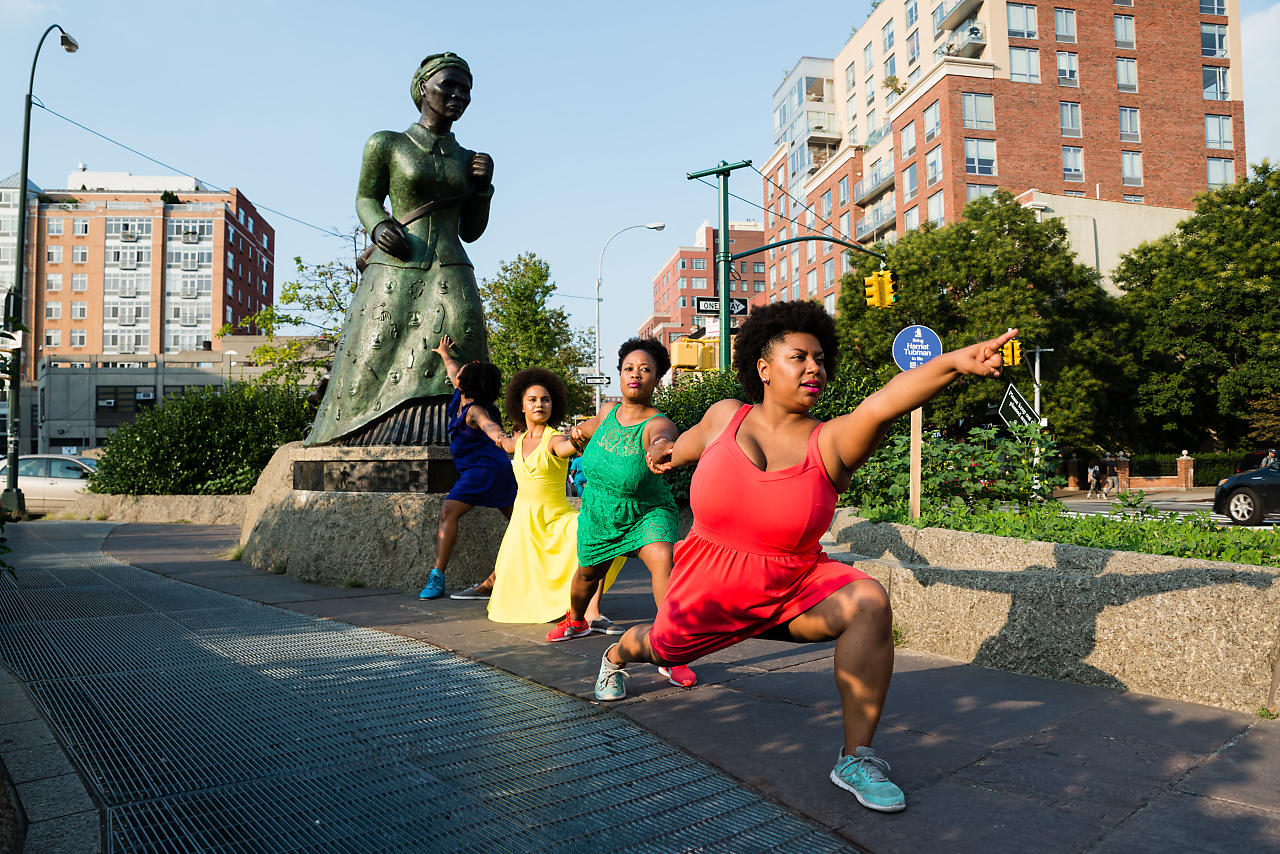
SLMDances in Direction from Harriet
(photo: ShocPhoto)

Sydnie L. Mosley in Body Business
(photo: Kearra Gopee)


Do you have a current or planned project whose progress is affected by the pandemic?

Kind of. SLMDances has been in a long term research and development process for PURPLE. PURPLE is a multi-project universe that illuminates the power of “deep sisterhood for social change” through storytelling and movement. Among its projects-in-progress there are: a community-engaged oral history project with elders, a stage work for an intergenerational ensemble of twelve artists, and the development of a series of solos on veteran performers (that language borrowed from you, Eva!).

The thing is, PURPLE is actually a life practice. So although we are no longer able to meet in person with our elder friends or be in a studio movement practice, the way that we continue to work together is practicing the work and moving it forward.

Briefly, tell me about how you got involved in the arts and in your particular practice.

The first dance I choreographed was to a Langston Hughes poem performed in the center aisle of an AME sanctuary dressed in kente cloth. I was 7. I come from: making up lip synch dances to En Vogue with my sister, cousin, and God-sister; pink tights and sequined tutus in mirrored studios; summers at the American Dance Festival four-week school; choreographing for and running my grade school dance companies; and moving in and out of linoleum community center floors.

At 17, I decided I wanted to run my own dance company. I used my college and graduate school educations--including classroom, work study job, and internship experiences--to learn everything I possibly could about my craft and the field in New York City. From laying the marley to composition to technique to company management.

I also come from formative experiences that affirmed my Blackness, my identity as a woman, my trust in community. That taught me how to lead, organize, and hold space.

By the time I got to making my first evening-length work, I was figuring out how to connect my history advocating and creating space for my communities with choreography and production.

In a more specific way, what are you practicing? And what are you envisioning?

I am practicing stillness. I am practicing surrender. I am practicing listening. I am practicing being cared for. I am practicing writing. I am practicing advising. I am practicing healing. I am practicing wellness. I am practicing joy. I am practicing being who I am becoming.

How does your practice and your visioning align with what you most care about?

Everything I do is in alignment. I care the most about Black people, Black women and girls, artists with marginalized identities, dance as a field--wellness, thriving, and liberation for all. The act of growing the SLMDances collective, dance by dance, organizational iteration by organizational iteration is my practice. We are guided by our core values: Dreaming, Activism, Community, Transparency, Humanity, Learning. This is our framework, compass, and rubric for accountability.

How does your practice function within the world we have now?

My practice LOVES the world we have now. My practice is affirmed by the world that we have now. The SLMDances COVID-19 pivot is not really a pivot. Our continued rehearsal ritual, as we call it, has been grounding, with most of us tracking time in the past thirteen weeks by SLMDances Day or non-SLMDances Day. Even though we are meeting virtually, we are still moving together, still breathing together, still checking in, and still creating together.

The collective organized a professional development series with guest facilitators sharing their expertise in topics ranging from theater devising techniques to trauma-informed facilitation to plant medicine to financial wellness. We are tending to our own wellness by being together, acquiring information together, brainstorming together. We are sustaining relationships with our elder community partners by making phone calls and connecting them to resources where and how we can.

Briefly share one self-care tip that has special meaning to you now.

Give yourself permission. This is an idea we have talked a lot about in developing SLMDances’ most recent work PURPLE. As the world has turned upside down, it has become increasingly important to be kind to yourself and give yourself grace. Be gentle and release expectations. We are grieving, we are shocked and upset, we are losing grasp of everything we thought we knew. Give yourself permission to feel your feelings, to not work, to rest, to eat, to dance it out. What we once knew has gone. You have permission to be new.

******

DISCLAIMER: In addition to my work on InfiniteBody, I serve, at Gibney, as Senior Director of Artist Development and Curation and Editorial Director. The postings on this site are my own and do not necessarily reflect the views, strategies or opinions of Gibney.

******

Subscribe in a reader

Artists Reach Out: Laurie Berg

Dear friends,

Welcome to Artists Reach Out: reflections in a time of isolation. I dreamed this series of interviews out of grief for my work both as a documenting arts writer and curator of live performance. In this time of social distancing, we are called to responsibly do all we can to safeguard ourselves and our neighbors. It is, literally, a matter of life and death.

But there's no distancing around what we still can share with one another--our experiences, thoughts, wisdom, humor, hearts and spirit. In some ways, there are more opportunities to do so as we pull back from everyday busyness out in the world and have time to honor the call of our inner lives.

So, let me introduce you to some artists I find interesting. I'm glad they're part of our beautiful community, and I'm eager to engage with them again (or for the first time) in years to come.

--Eva Yaa Asantewaa, InfiniteBody


Laurie Berg


Laurie Berg
(photo courtesy of the artist)


Laurie Berg makes work in a variety of forms including dance, performance, collage and jewelry. She is co-organizer of AUNTS, co-curated the Movement Research Spring Festival 2017, was the 2016 recipient of “The Tommy” Award and a 2016-17 LMCC Workspace Artist-In-Residence. Recent works include EZ Pass (Roulette Intermedium), scape: Times Square (co-commission by Times Square Arts and Danspace Project), Ziegfeld Goes Down (as part of Charles Atlas Presents: The Kitchen Follies), Terrifying Times Call For Terrifying Jewelry (Dixon Place) and The Mineralogy of Objects (Danspace Project).

Whether working with dance and performance, collage, or jewelry, Berg draws on her interest in iconography, detail, humor, and absurdity to cultivate a collaborative, creative space that allows for rigorous play. Through complex choreographic structures and collaborations between people and objects, her performances conjure a space that is simultaneously structured and fantastical, layering together past, present, and future; bodies, objects, light, and space; imagination and knowledge; the real and the surreal.


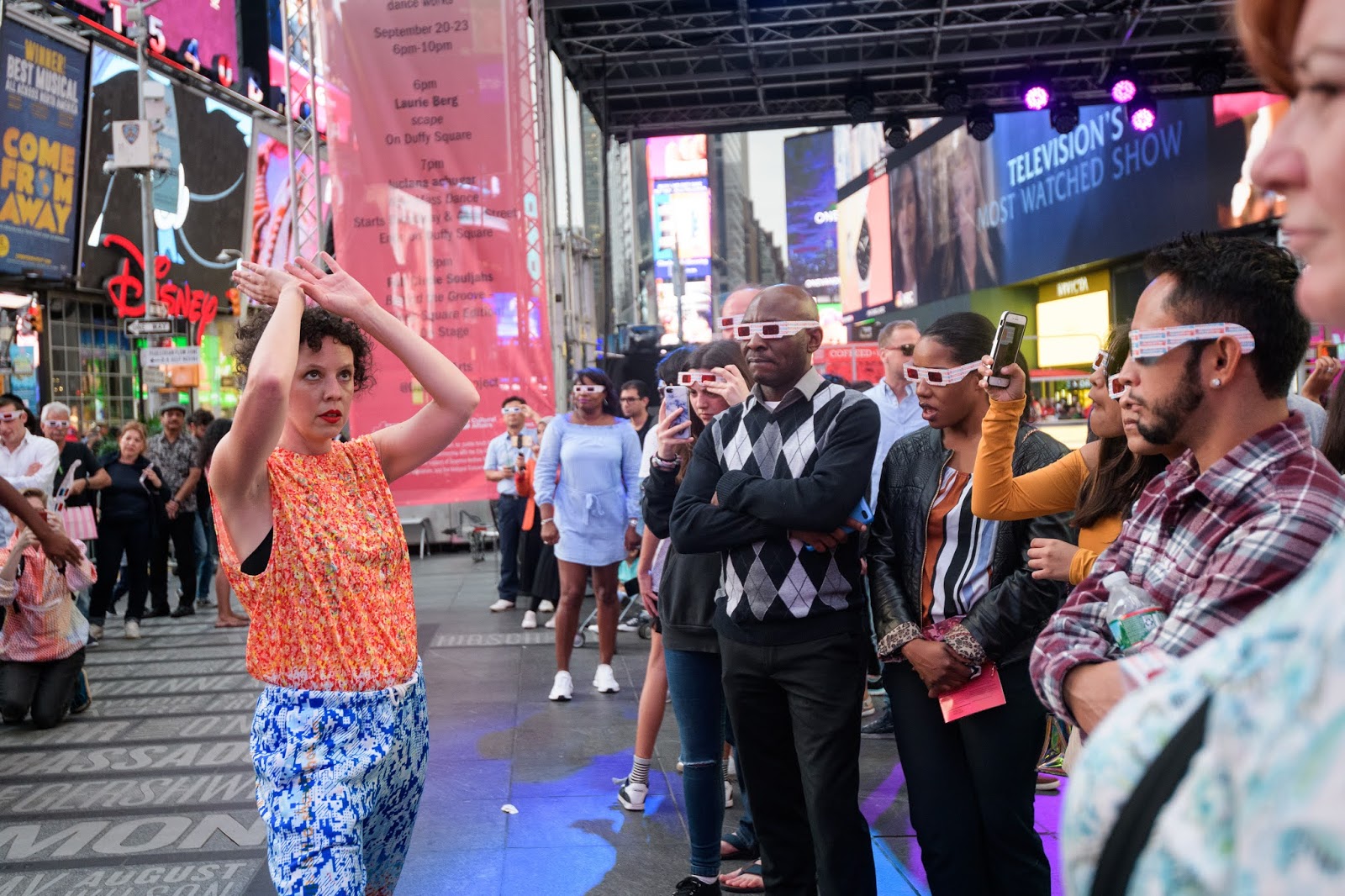
scape: Times Square (2018)
(photo: Ian Douglas)


"Doll Ball," EZ Pass (2018)
(photo: Tony Sisco)


Do you have a current or planned project whose progress is affected by the pandemic?

I have lost a few gigs due to the pandemic, and the hope is these are just postponements and not cancellations, but right now it is hard to tell when we might all be able to gather again in a theater, bar, or gallery space. UPDATE: Between writing these responses and sending this in, George Floyd was murdered by police in Minneapolis. Black Lives Matter activists and BIPOC leaders have led us into the streets in protest. Clear demands have been made. This moment is unprecedented. A revolution within a pandemic.

I’m supposed to have a show next Spring, which seemed far away. Now, it seems unlikely that we will be able to gather in a theater even next Spring. Honestly, the biggest project that was put on hold, was re-emerging from my art hiatus. I never completely stopped making things (jewelry, performance, a baby) and planning projects, but I slowed way down after the birth of my baby, Zelda (who just turned one). It was just two weeks before New York City shut down that I got childcare a couple days a week, so I could think about setting up rehearsals for a new project, and return to work without bringing Zelda along.

Briefly, tell me about how you got involved in the arts and in your particular practice.

Dance was a way to escape my shyness. Even when I was young, performing felt elevated. Time functioned in a different way. Every detail was important. I started taking classes in a strip mall dance studio in St. Louis, MO when I was 5 or 6. That studio was all I knew about the dance world. It was MY dance world and my dance family.

Finding myself where I am now was a long steady process of questioning what I was looking at, looking for more. It wasn’t until I got to college that I started to use the term “artist” to describe myself. That I was a dancer and an artist. A dance artist. I was also a misfit, and a weirdo, and proud of it. But that realization took time as well. The process of naming things, so I could move past the names and towards embodiment.

In a more specific way, what are you practicing? And what are you envisioning?

I’m practicing patience, compassion, flexibility (not the body kind--I’m so sore these days), and listening. I’m working towards a new project I’m calling :FOMO::DIPTYCH: but, right now, my attention is drawn to the conversations happening in dance and art communities all over the US. UPDATE: “Patience and compassion” also must include endurance and vigilance. “Flexibility” must include changing existing familiar and comfortable structures, de-centering whiteness, and centering BIPOC voices. “Listening” stays just that. I am practicing and learning ally-ship. This is an ongoing practice. I’m envisioning real lasting change. For me, as a white dance artist, maybe my new choreography needs to look something like this: look left, look right, step to the side, step back, and step up.

In mid-March the dance and performance platform I co-organize, AUNTS, decided to do a 15-day online series: AUNTS WPA micro-stimulus (a reference to the Federal Art Project as part of the New Deal). AUNTS WPA would be chain curated, so that we invite 5 artists, then those 5 artists would invite an artist and so on, to create 5 chains of 3 artists. Each artist would take over our Instagram account for one day and would do some kind of live broadcast. Artists choice! In the tradition of AUNTS, the artist could perform/broadcast--for 5 minutes or as long as instagram would allow--whatever they were working on or interested in sharing, and then we would pay them $75 via PayPal. It wasn’t a huge amount of money, but at least it could buy some groceries or pay part of a phone bill. Because of generous donations from individuals, instead of lasting 15 days, it ended up going for over a month with 42 artists participating. I never left my home and I met so many new artists!

How does your practice and your visioning align with what you most care about?

With AUNTS and my own choreographic work, my focus goes towards collaboration, resource sharing, and creating temporary and often permanent artistic families around each project. There is an opportunity in this particular moment to move towards radical change in how our arts institutions function. On all levels. I’m trying to envision what shape these potentially new structures could take. What should our institutions look like? Should we even have institutions? Trust artists! Can granting organizations fund artists instead of projects (allowing the money to precede the planning process)?

An artist receives a grant and pays their rent. Great!

An artist receives a grant, takes a risk, and fails, but everyone working on the project got paid. Great!

An artist receives a grant and the work receives many awards. Great!

“The system isn’t broken; it was built this way.” The truth is hard to swallow, and the change has to go deep. I’m ready to get out a shovel and dig down below the toxic rhizome that is capitalism and plant something new. This is work I have to do on myself as well as in my community. More content, less profit.

How does your practice function within the world we have now?

UPDATE: Honestly, I’m not quite sure at the moment. I’m going to wear comfortable shoes, stay ready, and bring snacks for everyone.

Briefly share one self-care tip that has special meaning to you now.

Enjoying this concentrated time with baby Zelda (who is a joyful, funny kid). I’m taking photography lessons from Zelda, who has a special iPhone photo technique which involves erratic (but also consistent?) hand movements--zooming in and out on the screen--while in panoramic mode to achieve a dual focus within a single photo. One half of the photo is in focus, while the other half is blurry, achieving the diptych form within the confines of a single image. I’m still working on it.

******

DISCLAIMER: In addition to my work on InfiniteBody, I serve, at Gibney, as Senior Director of Artist Development and Curation and Editorial Director. The postings on this site are my own and do not necessarily reflect the views, strategies or opinions of Gibney.

******

Subscribe in a reader

Thursday, June 4, 2020

Artist Reach Out: Charmaine Warren

Dear friends,

Welcome to Artists Reach Out: reflections in a time of isolation. I dreamed this series of interviews out of grief for my work both as a documenting arts writer and curator of live performance. In this time of social distancing, we are called to responsibly do all we can to safeguard ourselves and our neighbors. It is, literally, a matter of life and death.

But there's no distancing around what we still can share with one another--our experiences, thoughts, wisdom, humor, hearts and spirit. In some ways, there are more opportunities to do so as we pull back from everyday busyness out in the world and have time to honor the call of our inner lives.

So, let me introduce you to some artists I find interesting. I'm glad they're part of our beautiful community, and I'm eager to engage with them again (or for the first time) in years to come.

--Eva Yaa Asantewaa, InfiniteBody


Charmaine Warren


Charmaine Warren
(photo: Tony Turner)


Charmaine Warren (performer, historian, consultant, and dance writer) is the founder/artistic director for "Dance on the Lawn: Montclair's Dance Festival," and curator of dance at The Wassaic Project. She is the Producer of DanceAfrica, has curated for E-Moves and danced with david roussève/REALITY. Charmaine is on faculty at  Empire State Colleges, and is a former faculty at Ailey/Fordham, Sarah Lawrence College, Hunter College and Kean University. She has been published in Dance Magazine and Amsterdam News and served as a panelist for Robert Battle's New Directions Choreography Lab.

Charmaine holds a Ph.D. in History/Howard University, a Master’s in Dance Research/City College, and Bachelor Degrees (Dance/English)/Montclair State College. She is a 2017 Bessie Award Recipient for Outstanding Performance as a member of Skeleton Architecture Collective.


Charmaine Warren
(photo: Tony Turner)


Do you have a current or planned project whose progress is affected by the pandemic?

Sadly, this year, 2020, was to be my first live DanceAfrica as the newly-hired Producer. Like other presenting organizations, BAM was closed, and we were all directed to follow the shelter-in-place directives. With the support of my many colleagues at BAM, most especially Coco Killingsworth, we created and presented Digital DanceAfrica.

Briefly, tell me about how you got involved in the arts and in your particular practice.

So many years ago, I was introduced to dance as an 8th grader, preparing for high school in Montclair, NJ. The school system was to begin a performing arts program at the high school, and one could take dance instead of gym. I signed up quickly.

It was this introduction to dance in Montclair, at the high school--then Montclair State College, now Montclair State University, just a bus or train ride to New York--that opened up the world of dance to me. I will name Andrew Jannetti with whom I began dancing through my college connections, but later I spent many years as a member of david rousseve/REALITY.

Those were great years of learning, performing and fellowship which I still hold dear. Now, most of my time is spent as an administrator (Founder/Artistic Director, Dance on the Lawn: Montclair's Dance Festival; Producer, DanceAfrica), but I cherish my time as a member of the improvisational group Skeleton Architecture, begun by Eva Yaa Asantewaa.


Four members of Skeleton Architecture Collective
in a 2018 appearance at Danspace Project.
Left to right: Angie Pittman, Melanie Greene,
Charmaine Warren and Jasmine Hearn
(photo: Ian Douglas)


In a more specific way, what are you practicing? And what are you envisioning?

I always had a daily practice, but now I'm giving more time to it. I practice Ashtanga yoga. I practice French through the Duolingo app.  I'm also thinking of how best to support African-descended artists beyond check-in phone calls.

How does your practice and your visioning align with what you most care about?

My yoga practice helps me to stay centered and allows time to truly think about next steps, because I sometimes move too fast. ;-) I highly recommend that some form of self-care is embraced.

I began French in high school and continued in college. As the Producer of DanceAfrica, I want to be as adept in the language as possible for those visits to francophone Africa; I want to be able to speak easily with my brothers and sisters there.

Lastly, it has always been my charge to support African-descended artists, so I am determined to find a way to do so from afar. I'm close to knowing what that thing is...very close.

How does your practice function within the world we have now?

My yoga practice (stillness), my French lessons (connecting), and my commitment to African-descended artists is what keeps me strong; it keeps me centered; it helps me to know that there is truth in what we have done, what we do now, and what we will continue to do--MAKE ART!

******

DISCLAIMER: In addition to my work on InfiniteBody, I serve, at Gibney, as Senior Director of Artist Development and Curation and Editorial Director. The postings on this site are my own and do not necessarily reflect the views, strategies or opinions of Gibney.

******

Subscribe in a reader

Wednesday, June 3, 2020

Artists Reach Out: Aszure Barton

Dear friends,

Welcome to Artists Reach Out: reflections in a time of isolation. I dreamed this series of interviews out of grief for my work both as a documenting arts writer and curator of live performance. In this time of social distancing, we are called to responsibly do all we can to safeguard ourselves and our neighbors. It is, literally, a matter of life and death.

But there's no distancing around what we still can share with one another--our experiences, thoughts, wisdom, humor, hearts and spirit. In some ways, there are more opportunities to do so as we pull back from everyday busyness out in the world and have time to honor the call of our inner lives.

So, let me introduce you to some artists I find interesting. I'm glad they're part of our beautiful community, and I'm eager to engage with them again (or for the first time) in years to come.

--Eva Yaa Asantewaa, InfiniteBody


Aszure Barton


Aszure Barton
(photo: Tobin Del Cuore)


Aszure Barton received her formal dance training from Canada’s National Ballet School, where she helped originate the Stephen Godfrey Choreographic Showcase as a student. She has been creating dances for over 25 years and has collaborated with celebrated dance artists and companies including Mikhail Baryshnikov, Teatro alla Scala, English National Ballet, American Ballet Theatre, Nederlands Dans Theater, National Ballet of Canada, Martha Graham Dance Company, Bayerisches Staatsballett, Hubbard Street Dance Chicago, Sydney Dance Company, and Houston Ballet, among many others. She has received accolades and honors including the prestigious Arts & Letters Award. She was the first Martha Duffy resident artist at the Baryshnikov Arts Center and is an official ambassador of contemporary dance in Canada. She founded Aszure Barton & Artists in the early 2000s in order to create an autonomous, collaborative platform for process-centered creation. As an educator, Aszure is regularly invited to collaborate with and give workshops at universities and art institutions around the globe. She is currently an artist in residence faculty member at the University of Southern California.


Do you have a current or planned project whose progress is affected by the pandemic?

Yes, like so many other artists, I have had projects cancelled. I was currently scheduled to be working with the glorious dancers of Cuba’s Malpaso Dance Company, but unfortunately the project has been cancelled indefinitely. I was also scheduled to work with Houston Ballet last month and had planned to spend the summer creating and touring with my own team (Aszure Barton & Artists) but, again, these events were cancelled.

I am scheduled to work with LA Opera in the fall, though this process and its premier are pending. We shall see what manifests! There are also a couple other stagings pending for the fall and winter season. All this said, I am hopeful that some of these projects, and others, will still happen at some point (in some form) in the future so I’m maximizing this period of time/space to further research and develop the work.

Briefly, tell me about how you got involved in the arts and in your particular practice.

I was born into a dance-loving family. My mother never took lessons herself but she encouraged us; she has always been profoundly moved by dance. My father dances all of the time, not on the stage but from and for his own heart's sake. I am the youngest of three women, and we are all still involved in dance.

I started making dances when I was a child. It was a way of bringing my friends and family together. I saw that it made people feel good, and that brought me joy. Still does.

In a more specific way, what are you practicing? And what are you envisioning?

During the past couple months, I have discovered my own body again. I hadn’t realized the extent of how disconnected from my physical being I had become. I was a stranger to my own body but, thank goodness, this quiet moment of isolation has presented an opportunity for me to go within and to listen. What I am being taught through obstacle is the importance of community and communication. I have been taking online classes and am wallowing in the generosity and skill of my teachers. It’s really awesome to return to the fundamentals and such a treat to listen and receive direction from others!

How does your practice and your visioning align with what you most care about?

Practicing movement again has reminded me to show up for myself as well as for others.

How does your practice function within the world we have now?

In terms of my daily routine, I carve out very clear windows of time to focus on my physical and choreographic practice. I find that creating a precise timeline for myself allows me to be more present and to have more fun. I have been archiving works from the past and have been researching for projects in the future. I also carve out hours to actively practice “making” (whether that’s on paper or in hand or in the kitchen or garden), or online with a dear friend through Zoom or in person with my generous husband. The other day I was so desperate to practice making movement with a live body in space, that my husband volunteered to be the dancer. He is a nurse, not a dancer, but he did his best. :-)

It’s all a work in progress, and change is a constant.

My self care tip/mantra: Make space for stillness. This is an opportunity for pause and to ask ourselves, “What can we do to make things much better?”

******

DISCLAIMER: In addition to my work on InfiniteBody, I serve, at Gibney, as Senior Director of Artist Development and Curation and Editorial Director. The postings on this site are my own and do not necessarily reflect the views, strategies or opinions of Gibney.

******

Subscribe in a reader

Copyright notice

Copyright © 2007-2023 Eva Yaa Asantewaa
All Rights Reserved

Popular Posts

Labels