Search This Blog

Showing posts with label Eiko. Show all posts

Sunday, May 12, 2019

Eiko Otake: Distance is Malleable

Eiko Otake
at Middle Collegiate Church, East Village
during Danspace Project Platform 2016: A Body in Places
(photo: Eva Yaa Asantewaa)

This year's Soshitsu Sen XV Distinguished Lecture on Japanese Culture--presented by Columbia University's Donald Keene Center of Japanese Culture--was given by venerable dance/interdisciplinary artist Eiko Otake who showed up fully as Eiko Otake, a body in places. The place, in this case, was the lobby of Columbia's Miller Theatre.
Fukushima is everywhere.
-- Eiko Otake
She showed up, as always, a wound in motion. Trailing crimson cloth behind her. Thwacking a yellow CAUTION WET-FLOOR sign on the tile floor. Darting out into the daylight of Broadway. Dropping white sheets of manifesto poetry from the theater balcony like a lazy snowstorm.

And only then talking. But not without images from her epic collaboration with photographer William Johnston that help her help us bridge the nearly 7,000 miles between New York and Fukushima, sites of mass trauma, of what she calls "fast violence and slow violence."
There's a sense of agitation in me, in finding two places so connected in me.
-- Eiko Otake
Her lecture--Distance is Malleable--gave us a mini-tour of her work of recent years, including residencies, installations and performances at Danspace Project (2016) and The Cathedral of St. John the Divine (2016-2017) that I was fortunate to attend. It came with the poetic manifesto that a reader could drop into at any point and swim for a long, long time. All told, Otake's poem and her holistic performance--I will refrain, now, from calling it a lecture--offered valuable insights into this woman and artist I have long admired.
I don't want to dance in studios. Going to places is my choreography.
-- Eiko Otake
I now more clearly grasp the consistency of her presence and witness, how she seeks to interrupt societal trance and avoidance, to archive and deliver evidence through ragged and asymmetrical aesthetics, to reshape time and distance through her body so that we, in turn, might reshape what we think important enough to care about.
People make things not knowing what to do when they break.
-- Eiko Otake
I suddenly, and enviously, get the radical freedom she has long claimed for herself--Decide where to go, when, with whom, how and for how long/Decide where to learn, when, with whom, how, and for how long--and I marvel at it. Self-curation! That's what she calls it, excitedly adding that exclamation point. (In Nguzo Saba terms, I have long exclaimed the Kwanzaa principle called Kujichagulia, self-determination, my favorite.) Otake's Self-curation! strikes me as bearing a double-meaning. Exercising your right to do what you want and need to do in your own way, yes, but also fundamentally curating a self--and doing that your way, too.

When she next writes of how the student chooses the teacher (not vice versa), I feel the strength of her determination. She knows her own mind. She has been on this path a long time and is an excellent teacher to choose.

Follow Eiko Otake's work here.

Learn more about the illustrious history of the annual Sen Lecture here.

******

DISCLAIMER: In addition to my work on InfiniteBody, I serve as Senior Curatorial Director of Gibney. The postings on this site are my own and do not necessarily reflect the views, strategies or opinions of Gibney.

******

Subscribe in a reader

Friday, May 12, 2017

Koma Otake honors his ghosts at Danspace Project

Master dancer Koma Otake performs
the final section of his solo, The Ghost Festival,
outside St. Mark's Church, May 11.
All photos ©2017, Eva Yaa Asantewaa


all photos ©2017, Eva Yaa Asantewaa

Using a mobile trailer, Koma creates an interactive visual art installment, as well as a performance space. The design, paintings, and choreography, have all been created or set by Koma himself. Only through performance and the presence of his body in relation to the set does The Ghost Festival truly come to form. Koma envisions The Ghost Festival as a meditative and communal space to honor the connection between past and present, and provide a home for lost spirits.
--from publicity for The Ghost Festival by Koma Otake 

The legends surrounding St. Mark's Church-in-the-Bowery--home of legendary Danspace Project--include hauntings by its 17th Century builder, Peter Stuyvesant, Secretary-General of the Dutch colony of New Amsterdam, who is entombed in the church's east wall. But now dance artist Koma Otake has raised other shades at St. Mark's with The Ghost Festival, his first multidisciplinary project without Eiko Otake, his wife and long time creative partner. Although not entirely without Eiko!

If you showed up at St. Mark's at 7pm to catch a five-minute preview in the little park outside the church, you'd catch a glimpse of Eiko ladling cool water onto Koma's naked but bandaged back as he crouched and bent into a trailer painted with his art and bearing a shallow pool of water in which a stand of candles float and glisten.

This mysterious preview is almost unbearably poignant, especially when Eiko carefully closes the trailer's doors around Koma's still-crouching body. One thinks of the foot injury that kept this master dancer from performing for nearly a decade and set the stage for Eiko's well-honored solo projects. It is wonderful to see Koma again. The image he presents carries dimensions of sacredness and of sadness. Of course, isn't that almost a definition of what Eiko and Koma have always done--together or apart?

Inside the church, shortly after 8pm, the performance proceeds like an offering to the spirit of Pina Bausch, an early influence on Eiko and Koma, especially heard in the Francisco Canaro milongas and tangos that fill most of the soundtrack, music that brings to mind Bausch's signature dance-theater. Butoh's genius, Kazuo Ohno, is also here, for sure, from Koma's legacy, but I do not think I am wrong to see Charlie Chaplin peeking impishly from behind an invisible curtain.

How is it possible that I have never truly focused on Koma before The Ghost Festival? How is it that I find myself now smitten by this dancer when, before, I was merely impressed? He is heartbreaking. He is sexy. He is coy and elfin and sly. His unkempt cascade of hair and soft, pliable form are illuminations. He is rumpled, dusty, disheveled, musty, imprecise as a branch in the wind that carries a current of feeling. He is one with the props that surround him, folding his entire slim and yielding body over a chair stacked with black pillows, his legs splayed behind him. He is an irresistible performer. All of this must come from the love he offers these predecessors in dance. Koma is radiant with this love for performance and performers; as the piece opens with Jacques Brel's Ne Me Quitte Pas, he seems to plead for even the shadow of their presence to stay and never leave him.

In the spirit of "every goodbye ain't gone," Koma's "festival" does not end despite an assistant parading around the space with a sign that reads "Finale." We're given a fifteen-minute break, mainly to pick up our belongings and move outside the church. (People lagged a bit; it was a chilly evening.) Once assembled, we heard the strains of a Japanese folk song--one perhaps related to traditional celebrations of the departed--and Koma emerged in flowing white to engage with his intriguing trailer/temple, at one point mounting it and generally behaving like the sort of looney you rarely see anymore around this East Village neighborhood. It was fun to watch unsuspecting folks walk by and check out our crowd and Koma's commotion.

With lighting by the legendary Kathy Kaufmann

The Ghost Festival continues through Saturday with performances at 8pm as well as free 5-minute public previews, open to all, at 7pm outside St. Mark's Church. For information and tickets, click here.

Danspace Project
St. Mark's Church in-the-Bowery
2nd Avenue and 10th Street, Manhattan
(map/directions)

Subscribe in a reader

Sunday, February 5, 2017

Update on Eiko Otake at Cathedral of St. John the Divine

Eiko Otake at New York's Cathedral of St. John the Divine
November 2016
(photos: William Johnston)


Ask master dancer Eiko Otake about her experience of being an artist-in-residence for the Cathedral of St. John the Divine's Dignity Initiative and, among other things, she will speak of keen feelings of outsider identity. Not US born, not white, not Christian. And yet this grand, historic institution on New York's Upper West Side--with its well-known commitment to the arts, the environment and social justice--has become a space for her to connect with people from all over the world and all walks of life, most by happenstance.


Last November, I wrote of Otake's engagement there in The Christa Project, a visual arts exhibition centered on images of female divinity (see post). Her unique residency continues through early March when she will join with anthropologist Marilyn Ivy (Columbia University), photographer-historian William Johnston, videographer Alexis Moh, performance artist John Kelly and other speakers and participants to commemorate the six-year anniversary of the nuclear disaster in Fukushima, Japan, the most severe nuclear accident since Chernobyl.

Remembering Fukushima: Art and Conversations, presented in partnership with Asia Society and Danspace Project, will explore the relationship of body, place and history. Participating artists and speakers include:

Eiko Otake
William Johnston
Marilyn Ivy
Thomas Looser
Mark McCloughan
Alexis Moh
Nora Thompson
Megu Tagami
John Kelly
Carol Lipnik
DonChristian Jones
Geo Wyeth
Ronald Ebrecht
Ralph Samuelson
Elizabeth Brown
Jake Price
Nona Faustine Simmons
NYC iSCHOOL

Remembering Fukushima: Art and Conversations
Saturday, March 11, 1pm-5pm
The Cathedral of St. John the Divine
1047 Amsterdam Avenue (at 112th Street), Manhattan

All are welcome. A donation of $10 is suggested but not required.

For information and updates, click here.

Free email subscription
to InfiniteBody

Monday, January 16, 2017

Process and Performance: a talk with dance artist Eiko Otake

Site dance artist Eiko Otake
Above: Kifune Shrine, 4 August 2016
Below: Yaburemachi 5 August 2016
(photos: William Johnston)


Lauren Grant
(photo: Amber Star Merkens)


For my Montclair State University course, Performance Perspectives, Dance MFA student Lauren Grant spoke with Eiko Otake about her site-specific residency at New York's Cathedral of Saint John the Divine.


Process and Performance:
A talk with dance artist
Eiko Otake

by guest contributor
Lauren Grant


Contemporary artist and choreographer Eiko Otake is in residence at the Cathedral of Saint John the Divine in Manhattan from October 2016-March 2017. Her collaborative work with historian-photographer William Johnston, A Body in Fukushima, is on display as part of the cathedral’s art exhibition, The Christa Project. During her residency, she will explore movement and space, welcome discussions with visitors, design a new video installation, expand her photo exhibit within the cathedral, offer solo performances and curate a culminating event on March 4 and 11, commemorating the sixth anniversary of the nuclear disaster in Fukushima, Japan.

I spoke with Ms. Otake about her residency at the cathedral, as well as her process and experiences as a site choreographer.


Lauren Grant: Although your research of movement and space at the cathedral is currently exploratory, it is conducted in front of others. So, in a sense, you are performing. When does the workshop phase become the performance?

Eiko Otake: Yesterday, I was workshopping, but at the same time I was also performing because I was aware there were people already starting to look. I was the same performer that I always am, but I did not know exactly what I was doing; I was more in the process. Although I am in professional performance mode, there is no ticketed audience, nor do I have material with a beginning, middle and end. If I look performative, the people who are watching are kind of happy, but there’s no more story than that; no big crescendo. I am merging process and product.

LG: Do you improvise in performance?

EO: Yes, but in a different way than how dancers go in the studio and improvise. My improvisatory research period gives me the material for a score I will use in the performance. Choreography in a space like this is very contextualized; I may crawl in the center of the cathedral, or become one of its gargoyles. These will be my prompts, and what I do between these prompts may be more improvised. I rehearse the prompts so as I improvise in performance I won’t have to question, “Where is my foot? Where am I standing? Is it dangerous?” I will have already explored that place. It allows me to be more improvisatory in performance because I don’t always have to figure out what’s going on. If I don’t know where I am going, I don’t know what I am doing. If I know I am going to a specific spot, I can decide in the moment how it is I will get there. Once I start going there, I may pretend I’m not, because if I’m too clear, there’s no sense of conflict. The score tells me where to start, maybe where to end, and three or four other things to do; but within those markers, I can do anything. I will never decide how many steps I take to go to a certain place. But I know I will go to that place. I will, however, also reserve the right not to go. My intention will be to go, but if there is something more interesting happening elsewhere, I may skip that part of the score. I own the score, but I am not a servant to it.

LG: What else is involved in this development stage of your residency in the cathedral?

EO: I have this empty space (which is not empty—it’s a very historical, amazing place) and I’m wondering, “What do I do? What do I want from here?” The residency gives me resources. Last week, a videographer or photographer was always with me as we tried to get five or six amazing pictures. My exploration in the space serves to get to those moments. Once I have that raw footage, I can then edit it, which is not too different from choreographing. I’m interested in learning how I can make more of the installation. I’m creating a media work. Perhaps the footage I shoot can end up somewhere on a monitor so people can see another part of me and the church as they move through the cathedral, recognizing that the woman they are seeing here is the woman they saw over there and that this is the front of a church, but they are now inside it. These additions will add layers to my installation.

Filming and photographing my explorations in the space also serve as tools to help me in my creative process. Alexis Moh, my videographer, helps capture what it is I’ve done here because, after a day of workshopping material, I forget what happened. Filmic ways also help me make sense of what I am doing. I find it quite strange that, as an immigrant, and a non-Christian, I have been given a chance to be an artist in residency at this cathedral. Watching the footage helps me materialize what all this means and also serves to point out when my explorations are just me fooling around. Since I am my own director, I need a tool to help me look and think. I don’t believe that video can accurately show me what I do, but it is a helpful little tool.

LG: Do you prefer working in a site versus a theater?

EO: I give up control when I perform in a space other than a theater—I can’t design the light and sound. But I’ve successfully done that kind of theater work for 40 years and am not interested in that anymore. I’m interested in conflict now; a kind of weirdness where people ask, “What is she doing here? Why?” and I don’t have an answer for them.

LG: What is the difference in how you connect with the audience in a site versus a theater?

EO: In a site performance I can see the audience. That’s a huge difference. And they can move around. In a theater they cannot move; they’re usually stuck. And I can’t see them.

LG: How do the different responses from people as they watch (or ignore) you affect you as a performer?

EO: It affects me if they watch; it doesn’t affect me so much if they don’t watch. They ignore me and I ignore them, it’s not really a big deal. I have other things to think about, like “How much did I move forward? Is this video working? Am I going in the right direction?”

LG: In your exploration, I saw a very interesting interaction at the doorway. You caught someone off guard. A woman held the door open for you (for a very long time). I don’t think she knew you were performing.

EO: She said, “Are you ok?” because I looked pretty broken. And I whispered, “Yes, thank you.”

LG: It was beautiful—a human-to-human connection. When you perform, do you seek out moments or opportunities like that with the audience?

EO: When it happens, I recognize it. I don’t seek it out. But when an opportunity arises, I acknowledge it, and may even linger on it. I like lingering on those moments.

LG: How would you feel if somebody was drawn to physically interact with you?

EO: It’s happened a few times. People have called an ambulance or have tried to help me. In a performance in Hong Kong, I started very far from the audience who were watching me from up high. I was eventually to go to them, but I began by lying by the highway. One man stopped and said, “Are you ok?” Since I was in the middle of a performance I only whispered, “I am ok,” but he couldn’t really hear me because I didn’t shout. So he started to call “Help!” That’s when the organizer ran in and told him, “she’s actually performing,” and he was like, “What? But there’s nobody around.” He looked up and saw tons of people watching and he was like, “sorry, sorry!” This is what happens. I kind of enjoyed it. I like that place where I’m really feeble as a performer.

Beauty is contextualized with something hurt. Real beauty is kind of dull because it doesn’t have a pain. I think we find it beautiful, even without that knowledge, but with that knowledge, we find it even more beautiful. If a little Buddha statue has some broken parts, you actually feel more empathic towards it. A little wound makes us feel more deeply.


Eiko at the Cathedral for video installation from Eiko and Koma on Vimeo.


EIKO OTAKE

Born and raised in Japan, and based in New York since 1976, Eiko Otake is a movement based multidisciplinary performing artist. After working as Eiko & Koma for over forty years, Eiko began her solo project, A Body in Places, with A Body in a Station, a twelve-hour performance at Philadelphia’s Amtrak station in October 2014. In the spring of 2016, Eiko was the subject of Danspace Project’s Platform, a month-long curated program of daily solos, installations, workshops and exhibitions. In the fall of 2016, the Bessie Committee awarded a special citation to Eiko for her Platform for “making herself ‘radically available’ in public and private spaces.” Eiko is currently an artist in residence at the Cathedral of St. John the Divine, where her photo exhibition in collaboration with William Johnston is on view, and Eiko shares her dance practice with visitors. A recipient of a MacArthur Fellowship, the Samuel H. Scripps American Dance Festival Award, the Dance Magazine Award, and an inaugural USA Fellowship, the Duke Performing Artist Award, and “Anonymous Was a Woman Award,” Eiko regularly teaches at Wesleyan University, NYU and Colorado College.


LAUREN GRANT

Lauren Grant has danced with the Mark Morris Dance Group since 1996, appearing in 60 of Morris’ works. She teaches technique around the globe, including classes for the company and The School at The Mark Morris Dance Center, sets Morris’ work at universities, and is currently Morris’ rehearsal assistant on his newest creation. Grant received a 2015 New York Dance and Performance Award ("Bessie") for her sustained achievement in performance with Mark Morris and in recognition of her "invigorating spontaneity, expansive phrasing, and robust musicality.” Grant has been featured in Time Out New York, Dance Magazine, the book Meet the Dancers, appeared in PBS's Great Performances, Live From Lincoln Center, and ITV's The South Bank Show, and was a subject for the photographer Annie Leibovitz. Before joining MMDG, Grant moved to New York City from her hometown of Highland Park, Illinois, and earned a B.F.A. from NYU’s Tisch School of the Arts. She is currently pursuing her M.F.A. at Montclair State University where she is also an adjunct professor.


Free email subscription
to InfiniteBody

Wednesday, October 5, 2016

Eiko Otake to take special honor at the 2016 Bessies

This brings back memories!
A moment from Eiko Otake's East Village sojourn,
A Body in Places, presented by Danspace Project
(photo: Ian Douglas)

Today, the NY Dance and Performance Awards organization (the Bessies) announced that a Special Citation will be awarded to dancer-choreographer Eiko Otake "for her expansive and transformative A Body in Places," a platform presented in March by Danspace Project. Meredith Monk will present Otake's citation at the 32nd annual Bessie's ceremony, hosted by award-winning choreographer, writer, and comedian Adrienne Truscott.

Adrienne Truscott
will host the 2016 Bessies
at BAM.
(photo: Richard Hardcastle)

The 2016 Bessies

Tuesday, October 18, 7:30pm

Doors open at 6:30pm 
for red carpet and pre-show celebrations.


The 2016 Bessies presenter line up includes Tei Blow, Katy Clark, Ayodele Casel, Ishmael Houston-Jones, Judy Hussie-Taylor, Judith Jamison, Alastair Macaulay, Joan Myers Brown, Amar Ramasar, Regg Roc and Carlota Santana.

Other special presentation recipients include Brenda Bufalino, recipient of the 2016 Bessie for Lifetime Achievement in Dance, and to The Jerome Robbins Dance Division of The New York Public Library for the Performing Arts and Alex Smith, Executive Chairman of the Thelma Hill Performing Arts Center, both recipients of awards for Outstanding Service to the Field of Dance.

The ceremony will feature a performance by Joya Powell, recipient of the 2016 Outstanding Emerging Choreographer Award, Donald McKayle’s Rainbow ’Round My Shoulder (2016 Bessie for Outstanding Revival), performed by Dayton Contemporary Dance Company and produced by Paul Taylor’s American Modern Dance, and an all-star tap tribute to Brenda Bufalino.

Post-ceremony party 
(open to all Bessie Awards ticket holders)
647 Fulton Street, Brooklyn

Produced in partnership with Dance/NYC, the Bessies recognize exceptional and groundbreaking work in choreography, performance, music composition, and visual design. For a complete list of 2015−16 Bessie nominees, go to: www.bessies.org.

Get your free email subscription
to InfiniteBody.

Saturday, March 12, 2016

My Eiko journal: Part 6

Eiko's A Body in Places
Saturday, March 12 -- 3pm

Meredith Monk
marked the hour at 3pm
at St. Mark's Church
for Eiko's A Body in Places.
photos (c)2016, Eva Yaa Asantewaa
Eiko (left) with Meredith Monk
who taught us all a Japanese lullaby, The Red Dragon Fly
(c)2016, Eva Yaa Asantewaa

Come by today and this evening for the continuation of Danspace Project's commemoration of the Fukushima tragedy with an installation of William Johnston's powerful photographs and a performance offering by artists every hour on the hour through 9pm. For more information, click here.

******

Read My Eiko journal: 

Part 1
Part 2
Part 3
Part 4
Part 5

*****

Eiko's A Body in Places platform continues at Danspace Project and other venues through March 23. There's so much going on in this platform's programming, that Danspace Project is actually offering consultation with a docent to help you get your bearings. Really. For detailed information, click here.

Danspace Project
St. Mark's Church in-the-Bowery
131 East 10th Street (at Second Avenue), Manhattan
(map/directions)

If you like what you're reading,
subscribe to InfiniteBody!

My Eiko journal: Part 5

Eiko's A Body in Places
Conversation Without Walls: Bearing Witness
Friday, March 11 -- 4pm

Commemorating the fifth anniversary of Japan's triple disaster--earthquake, tsunami, nuclear reactor meltdown--Eiko Otake and Danspace Project convened three rounds of hour-long conversations as part of A Body in Places. Scholars, activists and artists such as luciana achugar, Yoshiko Chuma, Koosil-jaKatja Kolcio and William Johnston, offered contextual information on the ongoing crisis of nuclear waste and displacement in Fukushima. Presenting and responding speakers provided insight into the necessity and challenges of artistic response to this great loss as well as the numerous traumas of our planet.

I was fascinated to learn that the people of Fukushima, a site of Japan's neolithic culture, had preserved ancient folk and shamanic practices, a strong interest of mine.  Fukushima, impoverished and precarious, was long considered an expendable "sacrifice zone," a backwater targeted for industrialization and nuclear reactor construction.  Around 100,000 people were displaced from their homes by the disaster, and there's little hope that this area can ever be restored to normalcy.

Johnston's large photographs of Eiko dancing at affected sites in Fukushima and elsewhere filled the floor and risers at the sanctuary of St. Mark's. In the short breaks between conversation sessions, I tried to get around to see as many of these images as I could, and each one pierced my heart. As noted in the discussions, they are rigorous, exceedingly beautiful compositions but devastating to see. And they underscored what I've been learning about Eiko and her purpose--that her practice is shamanic in its resistance to and disruption of the daily current of time, in its ability to bridge apparent gaps of distance, bringing Fukushima to New York, and not just in Johnston's brilliant photographs but throughout her work in the world.

Someone described Eiko's performance as "a prophetic form of mourning" not just for Fukushima but for all the suffering that surrounds us now and the suffering that is to come. And dance artist achugar spoke of resisting "the tyranny of the [linear] arrow of time" and "the illusion of separation." Eiko, herself, spoke of how "distance becomes malleable." Collapsing distance--of time, of geography, of minds, of hearts--is her special gift with which she has bewitched and inspired us throughout A Body in Places.

******

Read My Eiko journal: 

Part 1
Part 2
Part 3
Part 4

*****

Eiko's A Body in Places platform continues at Danspace Project and other venues through March 23. There's so much going on in this platform's programming, that Danspace Project is actually offering consultation with a docent to help you get your bearings. Really. For detailed information, click here.

Danspace Project
St. Mark's Church in-the-Bowery
131 East 10th Street (at Second Avenue), Manhattan
(map/directions)

If you like what you're reading,
subscribe to InfiniteBody!

Wednesday, March 9, 2016

My Eiko journal: Part 4

Eiko's A Body in Places
Tuesday, March 8 -- 7pm
Tonight is not necessarily about linking the work of Eiko and DonChristian but considering their perspectives side by side. Through this intergenerational conversation around institutionalized forms of violence and inequality, I hope we can reach a more nuanced and empathetic understanding of our present moment.
--Lydia Bell, co-curator of Danspace Project's A Body in Places

DonChristian in Remembering "Egg Box"
The rapper and painter was a guest artist
for Eiko's A Body in Places platform at St. Mark's Church.
photos (c)2016, Eva Yaa Asantewaa


Although he studied with Eiko at Wesleyan University, DonChristian--painter, rap/R&B artist and producer--does not claim to be, in his words, "a mover." For her part, Eiko eshews the label "professor," preferring to think of herself as "a working artist who teaches." However they identify themselves, the non-academic likely approves of the way the non-dancer surveyed the difficult realities faced by young Black men at risk in a violent America in his short solo Remembering "Egg Box".

DonChristian, a guest artist for Eiko's A Body in Places platform at Danspace Project, journeyed through Eiko's installation in St. Mark's sanctuary. Stooped and vibrating, he crept down the sanctuary steps, around its outskirts, among canvases hung to serve as video screens, past costumes and props from Eiko's various solos. These items laid down a pathway--or a gentle, atmospheric surround--with a touch of ritual magic to their presence.

DonChristian at St. Mark's Church
photos (c)2016, Eva Yaa Asantewaa


He surveyed as a barefoot youth pulling thick rope behind him, a rope tied around his waist and, with our history, there can be no mistaking the significance of Black Man + Rope.  He might be an Eiko-styled ghost-in-places or, at best, an escapee--the rope remaining, though.

A few surprising musical accents--Anita Baker's "Caught Up in the Rapture" and Antonio Carlos Jobim's "A Felicidade" from Black Orpheus--infuse the solo with an air of sensuality and tenderness. "Escape," then, suggests the slipping of imposed, internalized restraints that bind body and mind, the offer of a freer way for Black men to see themselves and interact in the world.


DonChristian,
circling back to the sanctuary steps,
claims a place of power.
photo (c)2016, Eva Yaa Asantewaa

I wished for better clarity of sound for DonChristian's vocals, but he and Eiko made their meanings clear later in the post-performance chat moderated by Danspace Project's Lydia Bell. Guest curator Shin Otake--son of Eiko and Koma, and DonChristian's friend at Wesleyan--also spoke of the interconnection of state violence and intimate violence: "No violent incident is isolated [but is] embedded, generation to generation, in our DNA." 

Eiko and DonChristian share an interest in getting at the root of this trauma, a wound central to the American origin story and so many stories around the world. "Her practice alone makes me want to work harder," he said. She taught him to "find the light, feel the light that's on your body." When he felt daunted by the invitation to create a responding solo for the platform, she encouraged him. "She told me, 'Make this work thinking that I'm your aunt.' She's an extension of my family."

Yes, and by the time A Body in Places concludes in a few more weeks, we'll all feel that way about Eiko.

*****

Read My Eiko journal: 

Part 1
Part 2
Part 3

*****

Eiko's A Body in Places platform continues at Danspace Project and other venues through March 23. There's so much going on in this platform's programming, that Danspace Project is actually offering consultation with a docent to help you get your bearings. Really. For detailed information, click here.

Danspace Project
St. Mark's Church in-the-Bowery
131 East 10th Street (at Second Avenue), Manhattan
(map/directions)

If you like what you're reading,
subscribe to InfiniteBody!

Sunday, March 6, 2016

My Eiko journal: Part 3

Eiko's A Body in Places
Saturday, March 5 -- 7-10pm

It was disconcerting to see Eiko with a bandaged sprained arm--the result of a trip and fall at home. But she still danced, still valiantly surveyed, on this Saturday evening in St. Mark's Church along with invited soloists--Michelle Boulé, Beth Gill, Neil Greenberg, Koma Otake, Jimena PazArturo Vidich and Geo Wyeth. Each soloist took a piece of the church--Koma, on the porch in his filmy-thin costume, braving the cold night air; Greenberg commandeering one side of the balcony; Gill inchworming her way all around the sanctuary's carpeted risers--over the course of three hours.

Members of the audience, armed with a site map and schedule, curated their individual experiences. But, clearly, everyone wanted to see everything--or as much of everything as logistics will allow. That meant trying to get over to a tiny space--say, the reportedly-haunted Priest's Room--in time to squeeze yourself in with a dozen other people as Vidich struck and vibrated church bells. His solemn performance, though simple in form, rivaled only Paz's stark, crow-like expressionism for beauty.

Overall, this evening proved to be a fragmentary experience--chaotic, impossible, a nightmare for the claustrophobic but interesting for not only dancer-watching at various angles but watcher-watching. It was funny to run into an old friend who mentioned the same phenomenon--enjoying the unusual vantage points for looking at how people look at the dancing they're looking at.

*****

Read My Eiko journal: 

Part 1
Part 2

*****

Eiko's A Body in Places platform continues at Danspace Project and other venues through March 23. There's so much going on in this platform's programming, that Danspace Project is actually offering consultation with a docent to help you get your bearings. Really. For detailed information, click here.

Danspace Project
St. Mark's Church in-the-Bowery
131 East 10th Street (at Second Avenue), Manhattan
(map/directions)

If you like what you're reading,
subscribe to InfiniteBody!

Thursday, March 3, 2016

My Eiko journal: Part 2

Eiko's A Body in Places
Wednesday, March 2

11:30am Delicious Movement workshop

I arrived a tad late but slipped off my shoes, got down on the floor with everyone else and took part in the second of Eiko's weekly Delicious Movement workshops at St. Mark's Church, learning so much about the genesis of her work. I enjoyed her focus on words like "surveying" and "landscape." The thought of every part and every millimeter of the body being unique terrain to be slowly surveyed, with the aid of the floor or a partner's body, effortlessly liberates the imagination. For the first time, I understand why she calls this movement "delicious." And Eiko is wickedly, wickedly funny! If you have only seen her perform, could you have guessed that?

May she get her wish to go the UN and teach Obama and Putin Delicious Movement, the critical aesthetic of hesitation! I'm grateful to Danspace Project for giving all of us this chance to get to know her better.

3pm Eiko solo

Can Eiko just stay in the East Village indefinitely and continue to reveal it? Please secure funding.

Yesterday, we walked south on Second Avenue and turned on Seventh Street into the office entrance of Middle Collegiate Church. We found Eiko sprawled on the floor of a brightly-lit meeting room where crimson fabric spilled against cream-colored tiles.


Eiko at Middle Collegiate Church
photos (c)2016, Eva Yaa Asantewaa

In the past, I might have written that Eiko made achingly-slow, minute "adjustments." After taking her workshop, I found the idea of "adjusting" too brain-oriented and deliberate for something that arises from discovery in the complex, intimate relationship of surfaces--body to floor, body to fabric. When force or sudden movement arises, it's like a dash of strong color across canvas or spice dropped into the recipe.

She worked that red stream, burying her face in it, gently pulling it to her, reaching into it, giving a sudden tug that reduced it to a puffy triangle. She crawled a bit and then withdrew with the fabric cascading from her chin to the floor. She protected it, perhaps, hid behind it in another moment. She struggled, finally smacking it against a blank white space on the wall where a film could have been projected. At one point, I got a good look at the fabric and noticed holes and tattered edges.

Here's a moment of Eiko walking against the carpet of the church's sanctuary where she took us next:

Eiko in Middle Collegiate Church sanctuary
photo (c)2016, Eva Yaa Asantewaa

Eiko's bits of business with a half-filled bowl of water, a sheet ripped from a presentation pad and the church's piano filled time in the church's handsome, empty sanctuary. That is all. But look at Eiko approaching light at the front door:

Eiko approaches Middle Collegiate's front entrance.
photos (c)2016, Eva Yaa Asantewaa

Here, with the incipient emergence of her body into the light and rush of the street, the solo took on tension and poignancy.

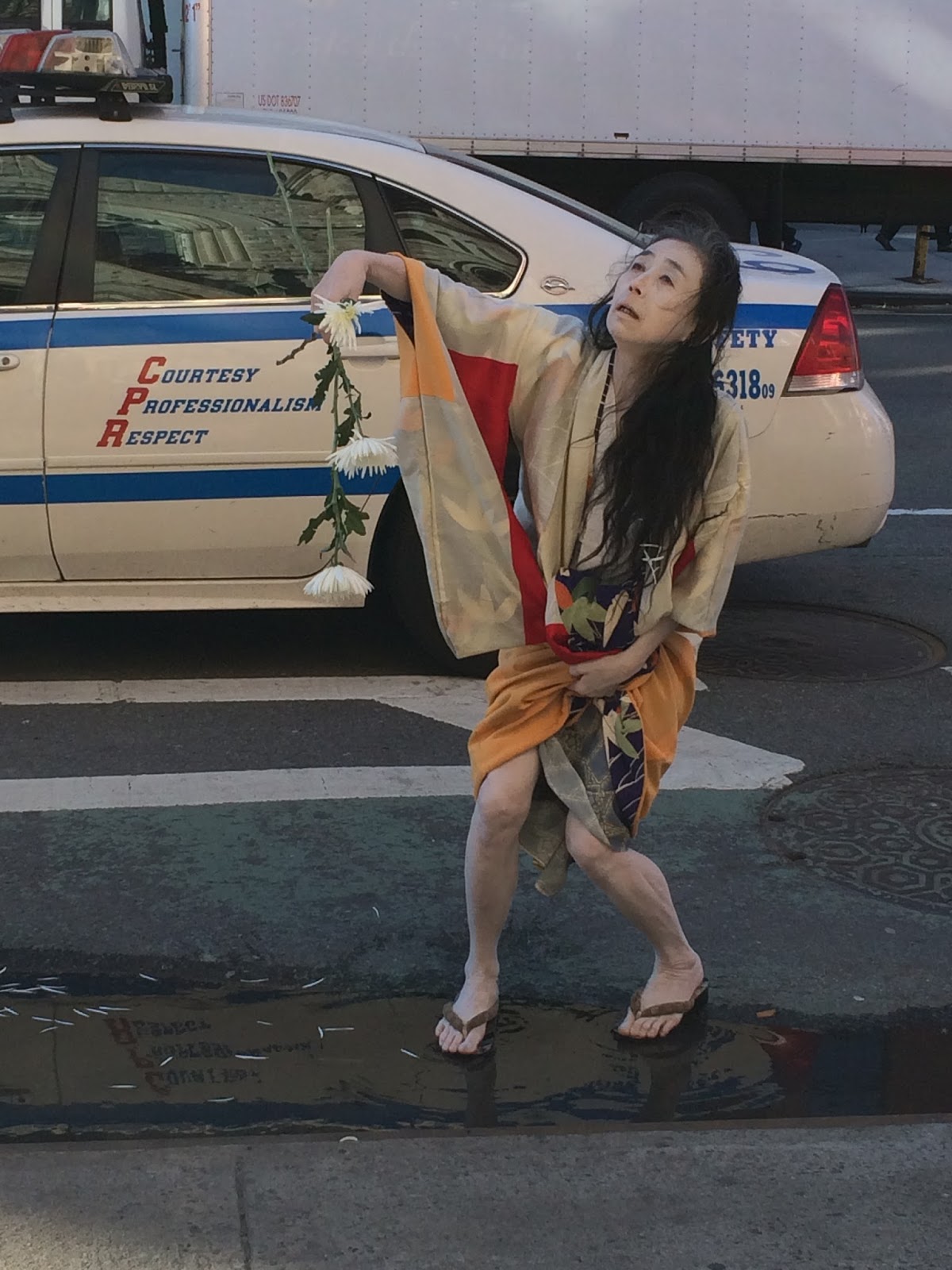
Courtesy, Professionalism, Respect...and Eiko
photo (c)2016, Eva Yaa Asantewaa

*****

Read My Eiko journal: Part 1 here.

*****

Eiko's A Body in Places platform continues at Danspace Project and other venues through March 23. There's so much going on in this platform's programming, that Danspace Project is actually offering consultation with a docent to help you get your bearings. Really. For detailed information, click here.

Danspace Project
St. Mark's Church in-the-Bowery
131 East 10th Street (at Second Avenue), Manhattan
(map/directions)

If you like what you're reading,
subscribe to InfiniteBody!

Wednesday, March 2, 2016

My Eiko journal: Part 1

Flower from Eiko
(photo: Eva Yaa Asantewaa)

Eiko's A Body in Places
Tuesday, March 1 -- 12pm

For my initial engagement with A Body in Places--Danspace Project's massive, multifaceted new platform--I join a group of people assembled at the gate of St. Mark's Church and await word of where to meet dance soloist Eiko. At noon, Danspace staff guide us across Second Avenue to a corner by Liquiteria, the juice/smoothies emporium. And there is Eiko, perched on Liquiteria's outdoor bench, wrapped in clothing of thin, vulnerable fabrics and a small comforter, feet in flipflops, scant defense against the late-winter chill. I'm certain that if my neighborhood noticed her at all, people would assume her to be homeless and pay no mind.

Those of us gathered with a purpose, though, we're rapt. This is Eiko who inserts her dancing body into places and makes you think about things you usually do not see. Eiko whose way of creating a separate channel for time adds dimension to the everyday. Stop and think. Stop and feel. Stop.

We stop. Gaze at her. She gazes back. She rises, silently draws us around the corner. She curves her comforter up into the air; her reach is small, vulnerable. She crouches near the pavement, near a parked taxicab, its driver alert to the presence of a woman with claw-like fingers and comforter lined in royal purple. She bunches it up against the bark of a tree. She bunches it up against her face and appears to grieve.

Arching. Stretching. Twisting. Trotting. Sudden cracks of hard slipper heels against concrete and garbage cans. Pretty soon, drivers stopped in traffic are looking; pedestrians, stopping and looking.

Ha-hah! Made you look!

Her ultimate destination? Kathy Kemp's tiny clothing and jewelry design boutique, ANNA, at 330 East 11th Street. Eiko has placed a few white flowers on the ground by the storefront. Some flowers will end up in her mouth, their petals spit out and scattered. She's less squeamish than I would be on these seriously skanky streets. She staggers, flinging petals, a stem. She heads through ANNA's screen door, most of her audience in tow.

We arrange ourselves around a small, rectangular table draped with several gold necklaces draped across it. We file past a rack of clothes, wondering how Eiko chose this delicate site and negotiated its use. Kemp stands by with her charming little dog resting quietly in her arms, its neck wrapped in chunky pearls.

Eiko fits herself into narrow space between curtained dressing rooms. We watch her and her reflection in the mirror. Beneath a sheer, dark tunic, she reveals the pink and salmon print of her underskirt. She emerges from this slot in space, pushes past a rack of clothes, tottering backward, humming to herself.

She seems alien, her body language foreign to these parts, her regard of her surroundings a sorrowful one on its way to self-abasement and erasure since it cannot accept what it perceives. Anyway, that's what I get and, at the same time, I'm feeling the following: "These fabrics and colors are really kinda nice. I wonder how much...."

The solo winding down, Eiko draws us back out into the noise of school kids at recess. She holds a flower out to me, and I take it. I realize that I want it. Very much. I'm hoping I won't have to give it back. And, as it happens, I won't have to. That makes me inexplicably happy. I'll take it home, just around the corner, down the avenue.

Eiko looks into traffic, crosses the street, does what I expected she would do. At first, her presence at the schoolyard fence seems to make the kids drift off. But, after a while, they watch before Eiko turns to us and sort of shoos us away before disappearing eastward.

*****

My Eiko journal will continue with reflections on Eiko's Delicious Movement workshop today and another site-specific A Body in Places solo in an undisclosed location. Check back for more.

*****

Eiko's A Body in Places platform continues at Danspace Project and other venues through March 23. There's so much going on in this platform's programming, that Danspace Project is actually offering consultation with a docent to help you get your bearings. Really. For detailed information, click here.

Danspace Project
St. Mark's Church in-the-Bowery
131 East 10th Street (at Second Avenue), Manhattan
(map/directions)

If you like what you're reading,
subscribe to InfiniteBody!

Friday, January 16, 2015

The Pen Thief

Well, actually, from all accounts, there are two of them--Trajal Harrell and Eiko Otake.

Both award-winning, internationally-renowned dance artists. Both of Japanese descent--Harrell by way of one distant ancestor. Both of whom have presented work at the Museum of Modern Art where, last night, they met for the first time for Harrell's much-desired "blind date," introduced and ably chaperoned by LMCC prez Sam Miller.

So, about the pens. Harrell admitted that if he's handed a pen to sign papers, he's liable to just tuck that pen away for safekeeping. Otake, quickly raising her pen in the air, confessed to the same larcenous trait. As a huge fountain pen aficionado, I can tell you, I plan to keep both of these people at arm's length. You do not steal pens from me and live to make art another day. Fair warning.

The most exciting thing about the Harrell-Otake conversation, part of American Realness 2015, was the chance to hear Otake speak at length about her relationship to Japan--apparently, a challenging one. In 1972, with her husband, Koma Otake, she left behind Japan's master-disciple system to craft an independent practice. When she returns to her homeland now, she finds herself getting angry.

"Being angry is very important to me," she said. "It pushes me."

Along with that anger comes feelings of grief and remorse. "And I don't want to be released from that," she added.

Anger can be fuel. I was amazed to hear Otake's statement as I shared the same insight, just hours before, with another choreographer. When we shame and seek to scrub ourselves of these troubling energies--which the viewer can readily see in Eiko and Koma's demanding, uncompromising work--what creativity do we end up washing away?

American Realness: Discourse, now through Sunday, January18

Wednesday, January 12, 2011

"Looking for the unexpected moment"

Talking Dance with Eiko & Koma
Walker Channel, Walker Art Center, October 28, 2010

Senior performing arts curator Philip Bither in conversation with Walker artists-in-residence Eiko & Koma

This excellent podcast episode (and others like it in the Walker series) may also be found on iTunes.

Saturday, July 31, 2010

ProjectSite: where artists and donors connect

The enterprising United States Artists organization has launched ProjectSite, an Internet portal to facilitate direct connection between potential donors and artists from a variety of disciplines, including the dance companies Urban Bush Women and Eiko and Koma:

ProjectSite was created by United States Artists to expand its mission of investing in the creativity of American artists collectively and individually by encouraging personal encounters and choices. Eiko & Koma were honored with a United States Artists Fellowship when it was first created in 2006. ProjectSite is a community where artists and those that love and support them can share their latest work, discover new artists, enter into a dialog with each other, and make direct donations (of any size, all of which are tax deductible) in new projects created by each artist. US Artists envisioned ProjectSite as the first Internet site that allows direct public donations between art patrons and pre-selected artists.

Visit Eiko & Koma's ProjectSite here.

Visit Urban Bush Women and the Hot 8 Brass Band's ProjectSite here.

Artists and potential donors, learn more about how ProjectSite works here.

Tuesday, July 13, 2010

Apollinaire Scherr to speak on dance criticism

Critic, journalist and blogger Apollinaire Scherr invites you to her keynote address at the Dance Critics Association Conference this Friday, July 16 (9:30am) at NYU Kimmel Center at 60 Washington Square South. Get directions and more nifty details at Scherr's own blog post here.

Scherr's topic?

"How to write criticism that leaves room for dance's future"

She promises answers that are "provisional, hopeful and possibly cause for debate and fuming."

So, if you're up for some fuming, but you're not registered for the DCA conference, Scherr has a deal for you. You can get into the keynote event for a mere $8. But you absolutely must click here to pay in advance, okay?

BTW, if you do go to the DCA conference, you'll find me--your friendly grassroots blogger--on a panel at Dance Theater Workshop with Eiko of Eiko & Koma, writer Valerie Gladstone, presenter Baraka Sele, Jawole Willa Jo Zollar of Urban Bush Woman, and writer Lori Ortiz (moderator). We're talking Cultural Exchange in 2010. I hope to see you there!

Saturday, August 11, 2007

Orientarhythm takes Manhattan!

Ladies and gentlemen, the Fringe is on! For rabid fans of this dog-days-of-theater festival, that means it’s once again time to dash around downtown, from venue to venue and for better or for worse.

My first Fringe foray this month came down on the better side with the New York debut of the fierce yet personable Japanese duo known as Orientarhythm--Katsumi Sakakura and Eiko--and their versatile ensemble of women dancers. According to the troupe’s Web site, the unbelievably slick Sakakura’s superpowers include locking, street nunchaku (the pair of weaponry batons linked by a cord or chain), karate and boxing; silky-butchy Eiko (not to be confused with the famous avantgarde dancer of the same single name) claims panking, jazz, hip hop, street nunchaku and body boarding.

Their Fringe show is wonderful fun, combining Japanese youth culture and martial arts with hip hop culture in a confident and often humorous way. I wanted to see them slip in a little juicy capoeira for good measure, but I'm content with their electrifying staccato style. The show could be improved by snipping out the contemporary dance--Sakura--which two young women perform competently. This number displays no discernible choreographic flare, especially compared to the wit and dramatic fireworks of the duet that follows it--Sakakura and Eiko’s ninja fight dance, Shadow master.

When Orientarhythm returns to New York, I hope they’ll have a far better venue than the musty assembly hall of Our Lady of Pompei Church (West Village). If you go, take your earplugs, or don’t sit in the music’s line of fire; this troupe likes to crank up the volume.

Remaining shows: tonight (Sunday) at 7:15PM; Monday, August 13 at 9:30PM, Tuesday, August 14 at 6:45PM, and Wednesday, August 15 at 7:45PM. Click here or here for ticketing or call 212-279-4488 or 1-888-FringeNYC. Advance ticketing (more than 24 hour hours before show time) is recommended. Otherwise, purchase tickets at the door, cash only, 15 minutes before show time.

© 2007 Eva Yaa Asantewaa

Copyright notice

Copyright © 2007-2023 Eva Yaa Asantewaa
All Rights Reserved

Popular Posts

Labels