Search This Blog

Showing posts with label photography. Show all posts

Wednesday, March 29, 2023

BODY AND SOUL: Ricarrdo Valentine: Rest for freedom

Ricarrdo Valentine (photo: Orlando Zane Hunter Jr)

A Black man wearing a salmon-colored sweater is looking directly into the camera, wearing a gold ring on the left and a silver and blue ring on the right with a multicolored Kufi hat.

During the pandemic, dance artist and photographer Ricarrdo Valentine continued to work towards a graduate degree in Dance, keenly aware of academia's toll on body, mind, and spirit. Influenced by healing philosophies, such as the famed Nap Ministry of Tricia Hersey, Valentine shares what he has learned about self-compassion and rest, critical tools of liberation from capitalism and grind culture.

To listen to today's Body and Soul podcast with Ricarrdo Valentine, click here!

Bio: Ricarrdo Valentine is a second-generation Black, Jamaican American/estadounidense, Same-gender-loving photographer and dancer who finds value in collaboration, individuality, and intimacy. I move and take photos from intuition. Ricarrdo’s photographic work has been exhibited at Universidad Autónoma de San Luis Potosí, Centro Universitario de las Artes (MX). He has presented his choreography at Bates Dance Festival, Brooklyn Museum, El Museo del Barrio, LaGuardia Community College, and more. Ricarrdo continues to collaborate and work with Christal Brown/INspirit, Edisa Weeks/Delirious Dance, Paloma McGregor, Dante Brown/Warehouse Dance, Malcolm Low/Formal Structure, Jill Sigman/Thinkdance, Sage Ni'Ja Whitson-Adebanjo/NWA project, Andre Zachary/RPG, Emily Berry/B3W, and Barak ade Soliel. Ricarrdo is also the co-founder of Brother(hood) Dance!, a Brooklyn-based dance collective and a 2020 Bessie Award honoree for Afro/Solo/Man.  He is working on an ethno-visual project, Where My People At?, as a 2020-2021 NorthStar Art Incubator Fellow in addition to pursuing an MFA in Dance integrating agriculture and technology at The Ohio State University.  To view Ricarrdo's images, you can visit www.ricarrdovalentine.com. Also visit www.bhooddance.com.

Thursday, April 16, 2020

Artists Reach Out: Simon Courchel

Dear friends,

Welcome to Artists Reach Out: reflections in a time of isolation. I dreamed this series of interviews out of grief for my work both as a documenting arts writer and curator of live performance. In this time of social distancing, we are called to responsibly do all we can to safeguard ourselves and our neighbors. It is, literally, a matter of life and death.

But there's no distancing around what we still can share with one another--our experiences, thoughts, wisdom, humor, hearts and spirit. In some ways, there are more opportunities to do so as we pull back from everyday busyness out in the world and have time to honor the call of our inner lives.

So, let me introduce you to some artists I find interesting. I'm glad they're part of our beautiful community, and I'm eager to engage with them again (or for the first time) in years to come.

--Eva Yaa Asantewaa, InfiniteBody


Simon Courchel


Simon Courchel
(courtesy of the artist)
Courchel in Jon Kinzel's Cowhand Con Man
(photo: Scott Shaw)


Simon Courchel is a freelance dancer and photographer, native of Paris, France where he studied dance, physiology, and art history at Le Conservatoire Supérieur de Musique et de Danse de Paris. He then worked in Europe with several choreographers such as Lucinda Childs, Russel Maliphant, Bertrand d’At, Yuval Pic, Jean Claude Gallota, Michel Kelemenis, Karole Armitage and Tero Saarinen. He also interpreted repertory works by choreographers Merce Cunningham, William Forsythe, Georges Balanchine, Vaslav Nijinsky and Dominique Bagouet.

Later, he joined the choreographer Frederic Flamand and his team in Marseille, to collaborate with architects Zaha Hadid, Dominique Perrault and Thom Mayne in pieces that toured internationally.

Based in Brooklyn since 2010, Courchel has worked and danced with Carolee Schneemann, Fanny de Chaillé, John Jasperse, Tere O’Connor, Paul-André Fortier, Maria Hassabi, Yanira Castro, Yoshiko Chuma, Jon Kinzel, Brendan Fernandes and Rebecca Lazier.

Courchel also develops his own work as a photographer, and works at The Invisible Dog Art Center in Brooklyn NY. www.simoncourchel.com


*****

Do you have a current or planned project whose progress is affected by the pandemic?

Yes, unfortunately. I was about to start a new project with choreographer Jon Kinzel to be presented at Roulette in May. I was really excited to be back at work with Jon. It is always a delight of many facets to be in a process with him. He just came back from a residency to do research on the piece in solitude, I was looking forward to discovering what he imagined.

The evening was also shared with Vicky Shick. I was so thrilled to share the stage with her and her team.

Beside dancing, I am also a photographer. I had some photo gigs cancelled due to the situation.

Taking photos is my other art practice and motivation. Also a way to "make a living.’’

Briefly, tell me about how you got involved in the arts and in your particular practice.

I started to dance when I was 9 years old. And I should thank my little sister Julia for that.

Our parents just enrolled us at an after school, with the options of karate and jazz dance. Naturally, she chose dance, and I tried to go fight. We immediately both hated it. The following day, we switched without hesitation. It was such an emotion to dance, it just felt right.
Just the satisfaction of finally wearing on my legs, out in public, the tights I would put on my head at home to pretend that I had long silky hair.

I found a safe place in a dance studio.

In 2010 I moved to New York City and joined Lucien Zayan to work at The Invisible Dog Art Center in Brooklyn. This is how I started taking images, photographing and documenting the life and activity of this space. The Invisible Dog is a unique place; I found another safe place.

In a more specific way, what are you practicing? And what are you envisioning?

I have recently started a new photography project titled Confined View: a series of images taken from my windows. With photography, I create images that are driven by circumstances; images that thrive within clear boundaries. The life we are experiencing now creates this situation.

Similar to an audience gazing through the proscenium, I am drawn to one clear point of focus within the frame and the surrounding layers that texturize the subject.

This circumstance--restriction--unlocks a deeper investigation.

After identifying the formal structures that motivate the impulse to capture a first image, I use the same compositional principles and process to re-imagine and reconstruct the same subject and space.

With each image, we share in this experience of (re)discovery.

I try to highlight a larger series of moments that bleed into each other and form a deeper consideration.

I become a witness, striving to make each photograph a performance, a conscious set of choices, a nod to my background as a dancer.

How does your practice and your visioning align with what you most care about?

I care about the tragic, beautiful and inevitable ephemerality that is a movement and a moment; portrayed by both dance and photography.

How does your practice function within the world we have now?

I am trying to figure it out.

******

DISCLAIMER: In addition to my work on InfiniteBody, I serve as Senior Curatorial Director of Gibney. The postings on this site are my own and do not necessarily reflect the views, strategies or opinions of Gibney.

******

Subscribe in a reader

Monday, August 5, 2019

Disabled Arts on Camera, Part 2: "Vision Portraits" by Rodney Evans

Dancer Kayla Hamilton,
one of four artists featured in Vision Portraits
(photo: Kjerstin Rossi)
Writer Ryan Knighton telling his story at The Moth
(photo courtesy of Vision Portraits)

(2019, USA/Canada/Germany; 78 min.)
written and directed by Rodney Evans


The documentary Vision Portraits introduces us to four dedicated artists whose lives, careers and creative approaches have been profoundly impacted by diminished or lost sight. They include art photographer John Dugdale, our beloved dance colleague Kayla Hamilton, Canadian writer Ryan Knighton and the award-winning filmmaker himself, Rodney Evans, best known for his 2004 narrative feature, Brother To Brother.


filmmaker Rodney Evans
(photo: Kjerstin Rossi)

We visit with these appealing and thoughtful people, the stories and glimpses of the work of the first three interspersed with the story of Evans's attempts to reverse the degeneration of his vision from Retinitis pigmentosa. Evans also wants to share with us how impairment affects vision through occasional images simulating fuzzy or dim sight, narrowed visual range or--as in the case of Dugdale--a nonstop internal light show of spectacular colors and effects.


Self-portrait of photographer John Dugdale

Dugdale's photography, achieved with assistants who adjust lens focus, is deeply poetic, melancholic and moving. When a stroke befell him at the age of 30, taking all but a crescent-like sliver of his sight, he told his mother "What makes you think I'm not going to be taking pictures anymore? I'm going to be taking pictures like crazy now!" I am grateful for that indomitable spirit; the work is so beautiful.

It was also fun to get to know a little about Knighton (author of the memoir Cockeyed), who considers his blindness to be a door onto "a different way of living, a different point of view." His blindness opened a portal to deeper honesty and a wicked sense of humor. If you watch this documentary for no other reason, you will value it for the concise yet uproarious story of the trip he took with his brother to a snake rodeo in Texas. It's a safe bet you'll never set foot at a snake rodeo in Texas or any other state but also a safe bet you'd enjoy hanging out with these guys.


Vision Portraits opens in New York City at Metrograph on August 9 and in Los Angeles at Laemmle Royal on August 23.

******

DISCLAIMER: In addition to my work on InfiniteBody, I serve as Senior Curatorial Director of Gibney. The postings on this site are my own and do not necessarily reflect the views, strategies or opinions of Gibney.

******

Subscribe in a reader

Sunday, May 12, 2019

Eiko Otake: Distance is Malleable

Eiko Otake
at Middle Collegiate Church, East Village
during Danspace Project Platform 2016: A Body in Places
(photo: Eva Yaa Asantewaa)

This year's Soshitsu Sen XV Distinguished Lecture on Japanese Culture--presented by Columbia University's Donald Keene Center of Japanese Culture--was given by venerable dance/interdisciplinary artist Eiko Otake who showed up fully as Eiko Otake, a body in places. The place, in this case, was the lobby of Columbia's Miller Theatre.
Fukushima is everywhere.
-- Eiko Otake
She showed up, as always, a wound in motion. Trailing crimson cloth behind her. Thwacking a yellow CAUTION WET-FLOOR sign on the tile floor. Darting out into the daylight of Broadway. Dropping white sheets of manifesto poetry from the theater balcony like a lazy snowstorm.

And only then talking. But not without images from her epic collaboration with photographer William Johnston that help her help us bridge the nearly 7,000 miles between New York and Fukushima, sites of mass trauma, of what she calls "fast violence and slow violence."
There's a sense of agitation in me, in finding two places so connected in me.
-- Eiko Otake
Her lecture--Distance is Malleable--gave us a mini-tour of her work of recent years, including residencies, installations and performances at Danspace Project (2016) and The Cathedral of St. John the Divine (2016-2017) that I was fortunate to attend. It came with the poetic manifesto that a reader could drop into at any point and swim for a long, long time. All told, Otake's poem and her holistic performance--I will refrain, now, from calling it a lecture--offered valuable insights into this woman and artist I have long admired.
I don't want to dance in studios. Going to places is my choreography.
-- Eiko Otake
I now more clearly grasp the consistency of her presence and witness, how she seeks to interrupt societal trance and avoidance, to archive and deliver evidence through ragged and asymmetrical aesthetics, to reshape time and distance through her body so that we, in turn, might reshape what we think important enough to care about.
People make things not knowing what to do when they break.
-- Eiko Otake
I suddenly, and enviously, get the radical freedom she has long claimed for herself--Decide where to go, when, with whom, how and for how long/Decide where to learn, when, with whom, how, and for how long--and I marvel at it. Self-curation! That's what she calls it, excitedly adding that exclamation point. (In Nguzo Saba terms, I have long exclaimed the Kwanzaa principle called Kujichagulia, self-determination, my favorite.) Otake's Self-curation! strikes me as bearing a double-meaning. Exercising your right to do what you want and need to do in your own way, yes, but also fundamentally curating a self--and doing that your way, too.

When she next writes of how the student chooses the teacher (not vice versa), I feel the strength of her determination. She knows her own mind. She has been on this path a long time and is an excellent teacher to choose.

Follow Eiko Otake's work here.

Learn more about the illustrious history of the annual Sen Lecture here.

******

DISCLAIMER: In addition to my work on InfiniteBody, I serve as Senior Curatorial Director of Gibney. The postings on this site are my own and do not necessarily reflect the views, strategies or opinions of Gibney.

******

Subscribe in a reader

Wednesday, January 24, 2018

MOMA to explore work of Judson Dance Theater artists

Peter Moore. Performance view of Trisha Brown and Steve Paxton
in Brown’s Trillium, Concert of Dance #4, January 30, 1963.
© Barbara Moore/Licensed by VAGA, New York, NY.
Courtesy Paula Cooper, New York

announces its upcoming exhibition:

September 16, 2018–February 03, 2019

Ana Janevski, Curator
Thomas J. Lax, Associate Curator
with Martha Joseph, Curatorial Assistant,
Department of Media and Performance Art

For a brief period in the early 1960s, a group of choreographers, visual artists, composers, and filmmakers made use of a local church to present performances that Village Voice critic Jill Johnston declared the most exciting new developments in dance in a generation. Redefining the kinds of movement that could count as dance, the Judson participants—Trisha Brown, Lucinda Childs, Philip Corner, Bill Dixon, Judith Dunn, David Gordon, Alex Hay, Deborah Hay, Fred Herko, Robert Morris, Steve Paxton, Rudy Perez, Yvonne Rainer, Robert Rauschenberg, Carolee Schneemann, and Elaine Summers, among others—would go on to profoundly shape all fields of art in the second half of the 20th century. Taking its name from the Judson Memorial Church, a socially engaged Protestant congregation in New York’s Greenwich Village, Judson Dance Theater was organized as a series of open workshops from which its participants developed performances. Together, the artists challenged traditional understandings of choreography, expanding dance in ways that reconsidered its place in the world. They employed new compositional methods to strip dance of its theatrical conventions, incorporating “ordinary” movements—gestures typical of the street or home, for example, rather than a stage—into their work, along with games, simple tasks, and social dances to infuse their pieces with a sense of spontaneity.

Judson Dance Theater: The Work Is Never Done highlights the ongoing significance of the history of Judson Dance Theater, beginning with the workshops and classes led by Anna Halprin, Robert Ellis Dunn, and James Waring and exploring the influence of other figures working downtown such as Simone Forti and Andy Warhol, as well as venues for collective action like Judson Gallery and the Living Theatre. Through live performance and some 300 objects including film, photographic documentation, sculptural objects, scores, music, poetry, architectural drawings, and archival material, the exhibition celebrates the group’s multidisciplinary and collaborative ethos as well as the range of its participants. The Work Is Never Done includes a gallery exhibition, a print publication, and an ambitious performance program in the Museum’s Donald B. and Catherine C. Marron Atrium.

Exhibition information

Museum of Modern Art
11 West 53rd Street (between 5th and 6th Avenues), Manhattan
(map/directions)

Subscribe in a reader

Monday, October 30, 2017

Trisha Brown: a loving community offers thanks


Leah Morrison


A bouquet of images from

Bird/Woman/Flower/Dare Devil: 
Trisha Brown
A Community Memorial


Saturday, October 28, 2017

at Danspace Project

organized by Iréne Hultman Monti and friends


All photos 
by Ian Douglas


Ralph Lemon (above)
Tere O'Connor (below)

Trisha Brown, Lemon said, was "our feral dancing goddess."
"...shifting from a fireball to a whisper in a second," said O'Connor.


"Be your most gracious self." -- Trisha Brown
Sam Miller
Stacy Spence
Yvonne Rainer
"In rehearsal, you want to be as correct as possible.
In performance, it's a whole other ballgame."
--Trisha Brown

Stephen Petronio
Iréne Hultman

Subscribe in a reader

Saturday, October 14, 2017

New video series on Black Philadelphians in ballet

Portraits of Black ballerinas
From top:
Judith Jamison, Delores Browne and Joan Myers Brown
(photos: Eva Mueller)

We are still like unicorns, and I wanted to make the invisible visible.
Theresa Ruth Howard, keynote address, Dutch National Ballet's Positioning Ballet Conference 2017

Theresa Ruth Howard--founder of MoBBallet, dedicated to the reinstatement and preservation of the history of Black artists in ballet--announces the launching of a video documentary series on its website. Funded by a $50,000 grant from the Knight Foundation, And Still They Rose: The Legacy of Black Philadelphians in Ballet will feature legendary Judith Jamison, Joan Myers Brown (Philadanco) and Delores Browne (Ballet Americana/New York Negro Ballet) discussing their early training and barrier-breaking experiences in the field. To view the series, starting October 22, click here.

Watch an excerpt:


On Saturday, October 28, join Howard for a panel with Joan Myers Brown, Delores Browne and current Black ballet performers at Philadelphia's The Painted Bride Center (3-5pm). There will also be an exhibition of Eva Mueller's portraits of Black ballet dancers. This event is free or by donation with an RSVP here. To visit the Facebook event page, click here. For directions to The Painted Bride Center, click here.

Watch Theresa Ruth Howard's excellent keynote address on diversity issues in ballet at the Dutch National Ballet's Positioning Ballet Conference (Amsterdam, February 2017).  Click here.

Subscribe in a reader

Tuesday, October 10, 2017

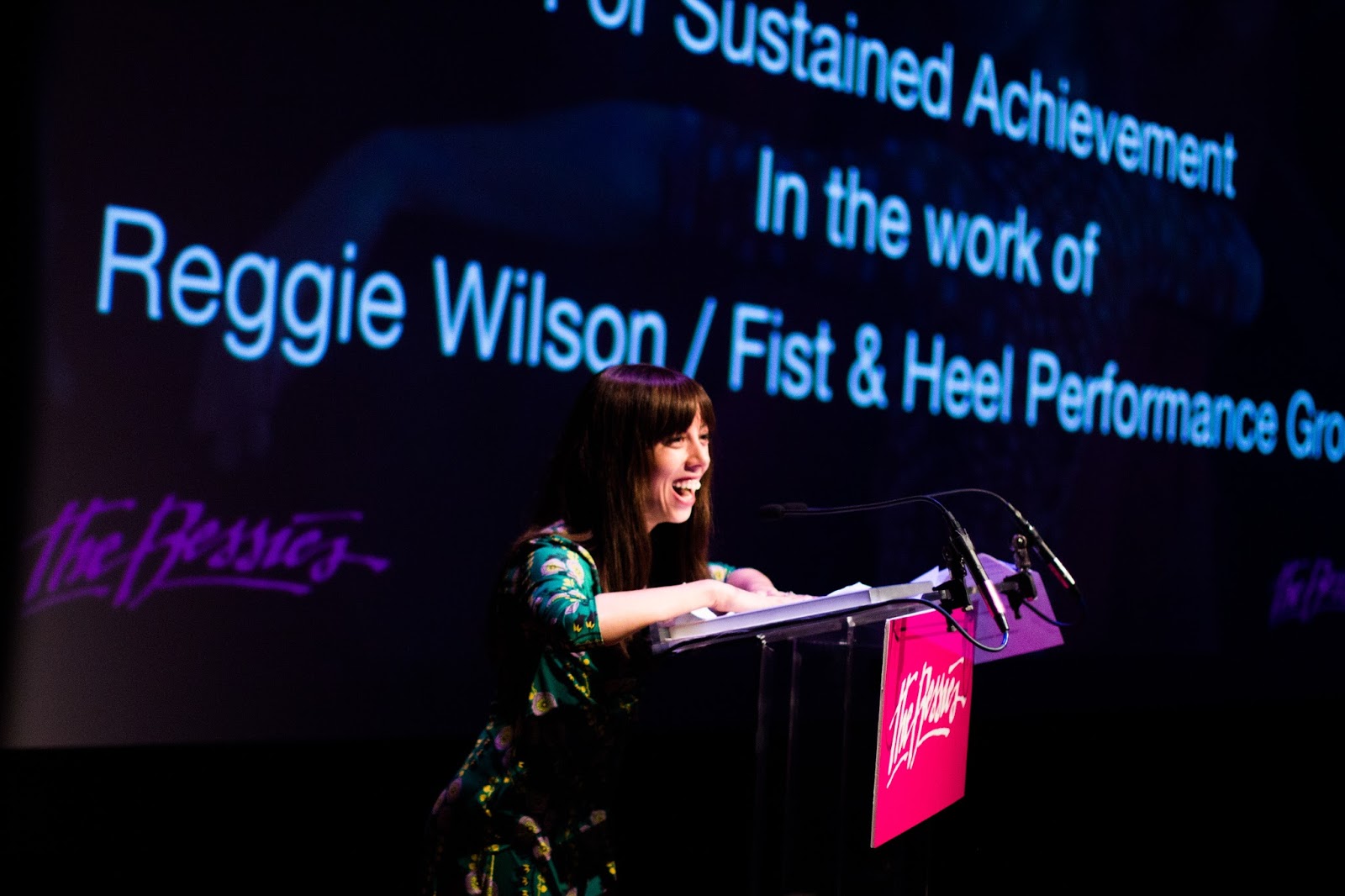
The Bessies in pictures!

The 2017 Bessie Awards
in Pictures

All photos by AK47 Division

Jawole Willa Jo Zollar (left) with presenter Dianne McIntyre
Lela Aisha Jones (far left) greets Eva Yaa Asantewaa at pre-show tribute to nominees.
To right of Eva, Nia Love and Kayla Hamilton of Skeleton Architecture collective.
In far background, another Skeleton Architecture member, Leslie Parker
Members of Skeleton Architecture take a knee
after receiving one of the four Outstanding Performer awards.
Fearless leader Lucy Sexton,
Executive Director of The Bessies,
welcomes the crowd.
Art Bridgman and Myrna Packer
Bridgman
with presenter Reid Bartelme
Jawole Willa Jo Zollar
dances Bitter Tongue (1987)
The evening's hosts:
left, James Whiteside of American Ballet Theatre
with performance artist Shernita Anderson
Below: backstage with James and Shernita
Daaimah Taalib-Din of Abdel Salaam's Forces of Nature
Will Rawls and Ishmael Houston-Jones
Above and below: Thomas F. DeFrantz
presented an award to Eva Yaa Asantewaa

Anna Schön
Bedazzled audience at the 2017 Bessies

Now, do you want to see Bessies 2017 in action? Check out the livestream video on The Bessies' Facebook page here!

List of award winners

Subscribe in a reader

Tuesday, July 25, 2017

Lining up: Abigail Levine performs LeWitt at Fridman Gallery

Dance artist Abigail Levine
at Fridman Gallery, SoHo
(photos ©2017, Eva Yaa Asantewaa)


Sound design by Dave Ruder


Abigail Levine interprets Sol LeWitt’s Wall Drawing #56 (1970) as a choreographic score, taking 25 hours over the course of 5 days to complete the 3,744 lines. Sound design: Dave Ruder. Choreographing LeWitt is the first in the multi-work series Re-stagings, which reads modern and postmodern visual artworks as scores for performance.


On the scaffold, she slowly walks her line, dragging splayed left hand, hip, shoulder along demarcated whiteness, smearing traces. Right hand, high, inscribing. Imperfectly, her lines marks time. A line stops. She stops, turns, regroups at its beginning, beginning beginning. A body beginning, a body makes this, lead scraping paper, with story, a woman's body.

(photos ©2017, Eva Yaa Asantewaa)


Re-stagings No. 1: Choreographing LeWitt continues tomorrow and Thursday, from noon through 6pm. Thursday's closing reception is from 6pm to 8pm. Admission is free. There are a few seats.

Fridman Gallery
287 Spring Street (near Hudson Street), Manhattan
(map/directions)

Subscribe in a reader

Copyright notice

Copyright © 2007-2023 Eva Yaa Asantewaa
All Rights Reserved

Popular Posts

Labels