Search This Blog

Showing posts with label Symbolist art. Show all posts

Friday, June 30, 2017

The Guggenheim's journey into the mystic


Armand Point: The Annunciation or Ancilla Domini (L’Annonciation), 1895
Tempera on panel, 99 x 51 cm
Private collection, courtesy Sotheby’s
Photo: Courtesy Sotheby’s


Solomon R. Guggenheim Museum

presents


Open now through October 4


Ferdinand Hodler: The Disappointed Souls (Les âmes déçues), 1892
Oil on canvas, 120 x 299 cm
Kuntsmuseum Bern, Staat Bern
Photo: Courtesy Kuntsmuseum Bern, Staat Bern


"The world is too much with us," wrote William Wordsworth, critiquing new realities wrought in Britain's first Industrial Age. Nearly a century later, French Rosicrucian writer Joséphin Péladan (1858–1918) struck a similar note, creating space for artists seeking refuge from a swiftly-changing Europe through the embrace of classical myth, Biblical narratives, nature's elevating beauty and the more ethereal, spiritual climes of imagination. The Guggenheim's new show, Mystical Symbolism: The Salon de la Rose+Croix, curated by Vivien Greene, samples Symbolist works that appeared in Péladan's annual salon of international works in Paris over its six years, 1892-1897.


Installation view
Photo: David Heald
©Solomon R. Guggenheim Foundation, 2017


Greene's installation spaces these works in a way that would encourage the sort of concentration and contemplation Péladan surely intended to inspire. But with its wan religious iconography intertwined with pagan flourishes, inert androgyny and women relegated to either virginal or monstrous roles, most of this visual art will likely merit attention mainly for its historical, influential connections to other artistic mediums of the period. I glanced at and breezed by much of it--the familiar (Khnopff, Delville) and the unexpected, such as Charles Maurin's remarkably political painting, The Dawn of Labor--but did find myself lingering with one pencil-and-chalk work on paper.

Armand Point's April or Saint Cecilia (1896) depicts the martyred patron of musicians strumming her harp before a lush cascade of ivy. Point's chiseled modeling of the bones of Cecilia's articulated hands held my eyes once and again. We are meant to notice those bones. Although willowy and idealized in her femininity, Cecilia is neither flattened nor vague and evanescent, unlike so many of the good girls and femmes mystérieuses rendered in Symbolist allegory. She fully inhabits a defined, structured body. And like legendary Orpheus, a subject popular with the Symbolists, she expresses a transcendent power through music.

Audio introduction to the exhibit and related poetry readings: click

Related programming: click

Visitor information: click

Ticketing: click

Guggenheim Museum
1071 Fifth Avenue (between 88th and 89th Streets), Manhattan
(map/directions)

Subscribe in a reader

Thursday, March 17, 2016

Talks on "Dreams, Magic and Desire" at The Met: Part 2

Sir Edward Burne-Jones: 
The Beguiling of Merlin (1872-77)
Lady Lever Art Gallery

This morning, I attended "The British Invasion," the second of Alison Hokanson's excellent presentations on Dreams, Magic and Desire at The Metropolitan Museum of Art. Her talk, this time, focused on Britain's Pre-Raphaelites--exemplified by painters Dante Gabriel Rossetti and Sir Edward Burne-Jones--and their direct influence on the later Symbolist movement. (See my post from last week's talk about Belgium Symbolist Fernand Khnopff.)

Again, Hokanson led us through the factors that gave rise to Symbolism in many European nations--primarily the intensely nationalistic urge to break from the dominance of France-centric academic art, realism and Impressionism, and the desire to explore inner worlds and mystical realms. Symbolism, she said, was not a specific technique but "a range of principles," "a state of mind" valuing individual expression.

As the Symbolists took inspiration from the earnest, elaborately symbol-laden work of the Pre-Raphaelites, that movement looked even further back to paintings of the medieval and early Renaissance eras, citing their "immediacy, purity, authenticity" all that was "full of life and heartfelt." Burne-Jones belonged to the second wave of Pre-Raphaelites, artists devoted to an even more idealized depiction of nature, humanity, myth and mind.

Beauty of form grew in value for these artists, but beauty as "a way to guide the spirit" in a world lately upended by industrialization, commercialization, scientific discovery and political upheaval. The movement also embraced the decorative arts in furnishings, book illustration and objects of everyday use.

"The British Invasion"

Taking as a starting point the Met’s masterpiece The Love Song by Edward Burne-Jones, this talk highlights the appeal that the work of the Pre-Raphaelites in England had for the Symbolist generation in Northern and Central Europe. From Brussels to Munich and Vienna, artists drew on British models to develop modern styles that differed radically from the French trends that dominated the art world. Their work, as one critic put it, “rendered the profundity of life and a melancholy attitude of beauty.”

Sir Edward Burne-Jones:
The Love Song (1868-77)
The Metropolitan Museum of Art

Hokanson's talk centered on The Love Song--the romantic, atmospheric Burne-Jones masterpiece in the Met's collection--tracing its influences back to Botticelli, Giorgione and Titian. A gifted communicator, she made her feelings for this work most clear by adding a recorded chanson to our visual experience of this painting's overtly depicted and subliminal music. It was a sublime moment.

File:Sir Edward Coley Burne-Jones Flamma Vestalis.jpg
Sir Edward Burne-Jones:
Flamma Vestalis (1896)

Hokanson ended her discussion by noting the trauma of World War I and its sweeping effect on the arts in Europe. The Symbolist movement fell away, supplanted by emerging forms for a brutally altered world.

*****

For information on future art talks at the Met, click here. To learn about all other special programming at the Met, click here.

*****

Special note for dance fans:

David Dorfman Dance will take part in tomorrow's lineup celebrating the official opening of The Met Breuer with performances all day long, free with museum admission or membership. Click here for information.

If you like what you're reading,
subscribe to InfiniteBody!

Saturday, March 12, 2016

Talks on "Dreams, Magic and Desire" at The Met


Above: The Silver Tiara
Fernand Khnopff (1911)
The Museum of Modern Art

Below: Self-portrait, Fernand Khnopff (1879)
Willems Collection, Brussels


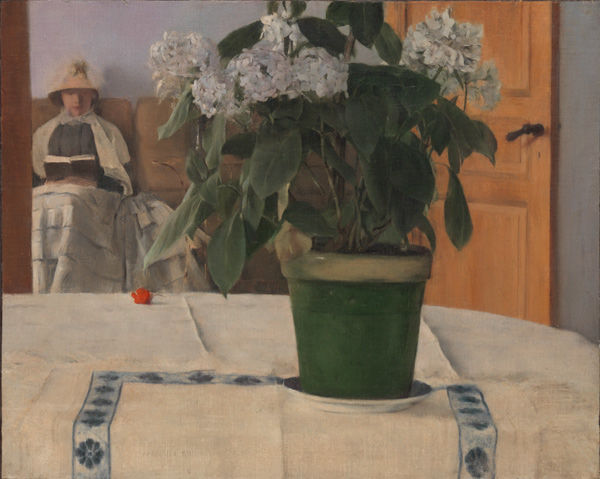
On Thursday, the Metropolitan Museum of Art presented a talk by Alison Hokanson (Assistant Curator, European Paintings) on Symbolism with a focus on the work of Belgian painter Fernand Khnopff. In discussing the broad and enigmatic Symbolist movement, with its concern with "desire, the unconscious, human mortality, timelessness and the inner self," Hokanson acknowledged that it had long been dismissed by most art scholars as "an artistic dead end, not sufficiently sophisticated or forward-thinking."  Now that assessment is under revision. A prime example of this new consideration: The Met's own recent acquisition of Hortensia, an interior innovative, for its time, in Khnopff's confident experimentation with perspective and foregrounding.


Fernand Khnopff's Hortensia (1884)
The Metropolitan Museum of Art

Hokanson is a clear, illuminating presenter, and if you missed this first talk from her Dreams, Magic and Desire series, I highly recommend catching the second--"The British Invasion"--on Thursday, March 17 (11am-Noon).
Taking as a starting point the Met’s masterpiece The Love Song by Edward Burne-Jones, this talk highlights the appeal that the work of the Pre-Raphaelites in England had for the Symbolist generation in Northern and Central Europe. From Brussels to Munich and Vienna, artists drew on British models to develop modern styles that differed radically from the French trends that dominated the art world. Their work, as one critic put it, “rendered the profundity of life and a melancholy attitude of beauty.”
Click here for ticket information.

The Grace Rainy Rogers Auditorium at
The Metropolitan Museum of Art
82nd Street and Fifth Avenue
(visitor information including map and directions)

If you like what you're reading,
subscribe to InfiniteBody!

Copyright notice

Copyright © 2007-2023 Eva Yaa Asantewaa
All Rights Reserved

Popular Posts

Labels