Search This Blog

Showing posts with label New York Live Arts. Show all posts

Tuesday, March 3, 2020

Colleen Thomas: Woman power is persistent and global

Dance artist Colleen Thomas.
(photo: Lovin Ostenrik)

Joanna Leśnierowska (below) in light and desire
(photo: Miguel Anaya)


This year marks the centennial of the ratification of the 19th Amendment to the U.S. Constitution (August 18, 1920), which granted women citizens the right to vote. light and desire--a new, full-evening dance ensemble by Colleen Thomas and her multi-national team of collaborators--comes at a time when lack of respect for women’s political leadership is again a matter of concern and struggle. The piece will have its world premiere at New York Live Arts, March 25-28 (7:30pm), during Women’s History Month.


Colleen Thomas (US), director, performer
Ermira Goro (Albania/Greece), performer
Joanna Leśnierowska (Poland), performer
Ildikó Tóth (Hungary/Germany), performer
Rosalynde Le Blanc (US), performer
Carla Forte (Venezuela), film director, performer
Alexey Taran DP for film
Stacey-Jo Marine, lighting design
Rebecca Makus, mask design
Robert Boston, musician/composer featuring Jo Morris, voice

For further information and tickets, click here.

______________________________________________________

Yesterday morning, I met with Thomas at Gibney to learn more about light and desire. Read on for what she had to say about the concept and making of this timely piece on women's resistance and radical expression.

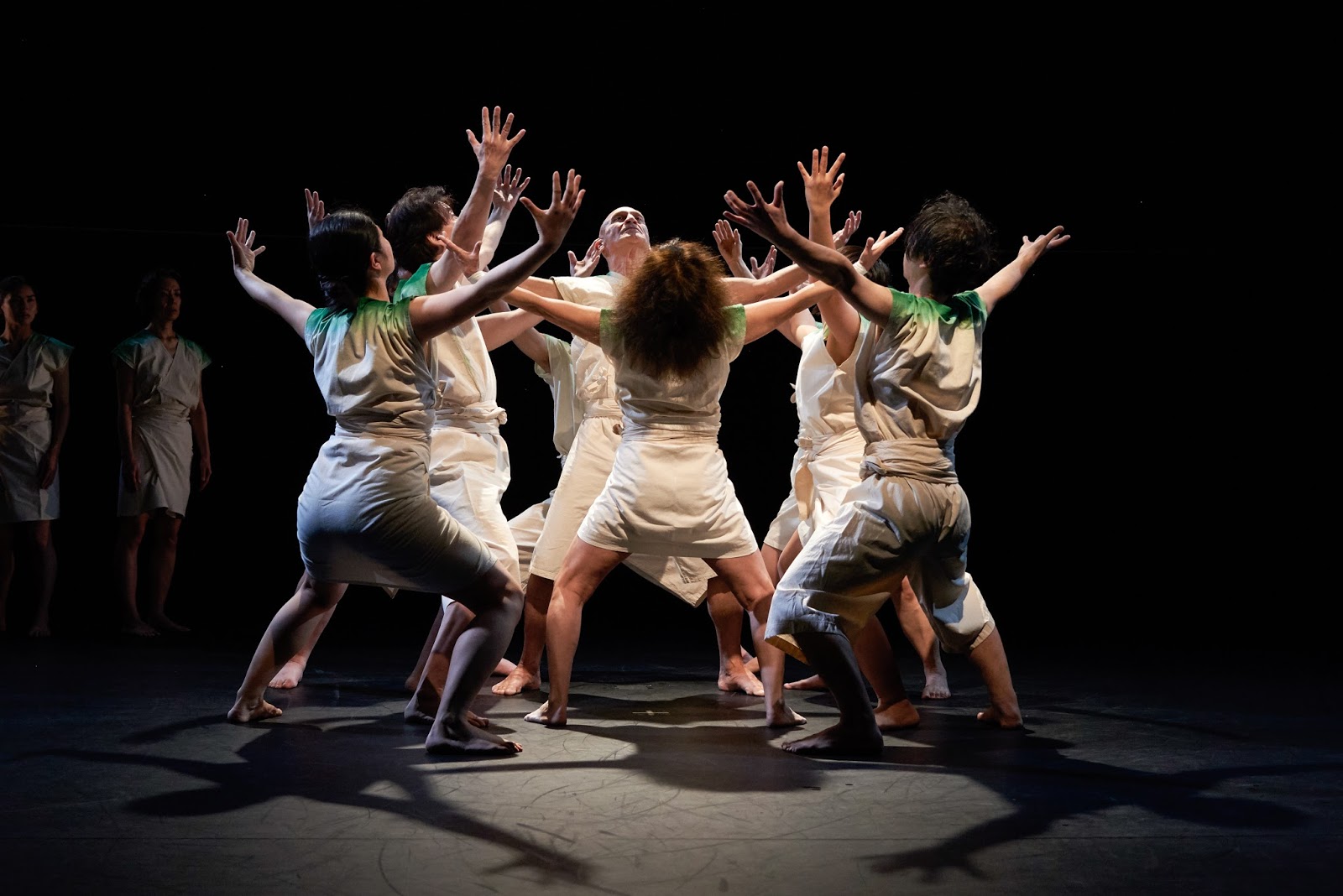
Some performers in light and desire,
by Colleen Thomas and her international collaborators,
premiering at New York Live Arts, March 25-28
(photo: Nadia Halim)

In 2016, I think I was very privileged--and unaware of my privilege--as an American. With the [presidential] election, I just couldn’t believe the misogyny. I sort of woke up to the misogyny that had always been in my world. Maybe I felt I wasn’t good enough, things weren’t happening for me, wouldn’t go my way or just would feel wrong. I’m not good enough, smart enough. It was all on me.


Seeing the way that people looked at the candidates in 2016, how people talked about Hillary Clinton’s personality, which had nothing to do with what her experience was.... Meanwhile, there’s this other person whose personality isn’t great either! But, no, people are talking about her. Even my women friends--smart and artistic, some of the most intelligent, aware people--said things like “I just don’t like her. I don’t know why.” There were other people, family members in other parts of the country, who said things like, “She’s a criminal.” 


I work in academia, I work in this world, and I collaborate with a man in a lot of my work. I just started to question: What is this bias and hatred?


Because of the election, I started talking to people, to women about it. We couldn’t stop talking about it. It was like Voldemort had arrived! None of us had slept. We were in shock. Thank God for New York and our community. But I started talking to people around the globe, people I had worked and toured with for many years. Most of them had worked with us here.

That’s where I woke up to my privilege: Oh, I think it’s so horrible here in America, but they’ve lived through having to move out of their own country to somewhere else where they felt they could have a life. They had personal stories about growing up in a new country. It was really interesting to work with and very cathartic in a way.


All of these women are just extraordinary people. I wanted to work with them because of their dancing and because of who they are, but they are all older now--we’re all older now!--they’re “successful,” whatever that means. We’ve got these jobs, we’re creating art, we’re chairs of departments, we’re successful women. And it’s just interesting to me because I’m not sure we feel that success.


How we feel our power was really interesting to me, how we moved through obstacles. I was interested in telling some personal stories about these women, hopefully something that other people also experience. It went from a political, angry place to “How do we heal? How do we move through? How do we get to this place where we can feel our power, go into our communities and support that?" At the beginning, I was focused on all the negatives: There’s no hope. There’s never going to be a woman president. It’s so deep. And [reflecting on the current presidential candidacy of Elizabeth Warren], we are physically exhausted. I am at the place now where I can’t even read the news.


The stories are an important part of the work. I always work with people’s personal history. That’s what’s real for me rather than having them do something that’s in my mind. Collaboration is so interesting.


There are five other women besides myself, and one--Carla Forte--is Venezuelan-born, a dancer and a documentary and feature filmmaker. She lives in Miami now, but I met her in Venezuela fifteen years ago, and we worked together, toured in different places together. I think she has lived in Miami--where I’m from--ten years now.


When Venezuela just sort of got crazy, she and her husband came here to America. I started off asking each artist how they moved through hard times, passed through their obstacles, and she started talking about being seen a certain way as a Venezuelan in America and even how her mother or their culture expected certain things.

I have a teenage daughter who’s going through a major transition. My husband said this one day--because he’s a man!--”I was a boy, and I went through puberty, and I could just do whatever I wanted.” And he was watching his daughter be seen a different way for that moment of transition where, all of a sudden, other people are seeing you differently, you’re seeing yourself differently, and there’s some kind of freedom that’s lost through how other people look at her. So he just had this epiphany. Really? (laughing hard) Now? At this age, you’re just realizing it now?


So, the piece has become about this idea of transitions, what happens in those moments in between change--slowing down those moments to see what those shifts are. We started with the idea of slowing down the film Carla created for the piece. When things are very, very slow, you can’t tell very clearly what’s happening. Singing can look like a scream...or a laugh. You’re not really sure. That became really interesting to me, the transitions in all forms--women getting older, women moving through hard times, transitions of getting to power, transitions of giving up. Do you give up and move out of your country because it’s so bad there?


Carla talked about her mother wanting her to be a kind of woman like Miss Venezuela--beautiful with the makeup--and she wasn’t. She talked about people in Miami calling her whore because she’s Spanish-speaking. And I talked to people like Ildikó Tóth who lives in Germany, and she said she never felt objectified or anything like that. She said, “I just always dressed like a boy.” Ermira Goro, she lives in Greece now, and she danced with us as well and was here for many years, and then she went on to DV8 [Physical Theatre, a London-based troupe]. She talked about when she moved from Albania to Greece and living with a friend, not having her family there. Everybody seemed to have stories that pertained to their moms and, because I was interested in my daughter’s changes, there's a little flicker of mom stuff in there.

Joanna Leśnierowska is not primarily a dancer; she’s a curator, dramaturg and designer, born in Poland, running a festival. Doing body research with her was really interesting. She’s just so real. She connects to what the truth of the movement is right away, even though she questions, “I’m not a dancer. Should I be doing this?”


I was getting so inspired by my students at Barnard [College] and by [climate change activist] Greta Thunberg, by all these young people who are active out there trying to make change, and they’re like “You guys fucked it up, and we need to do something.” There’s a lot of work I watch my students do that I’m sort of amazed. The idea of having a chorus in the piece, bringing these [local community] people in, was a representation of the inspiration and hope they bring to what’s happening now. 


At first, I wanted a lot of women to take the stage and just stand there, make the audience feel uncomfortable. I was so angry! But then I started workshopping with them. I hope that when I get to do this piece in other places, I will get to workshop with women in these communities. The workshop--working with them through improvisation and talking about their own experiences--it was different because they are a lot younger [than the main cast]. There’s power afforded to us because we have some experience, and we feel strength from the places that we’ve moved through. But the hope that I feel is in working with these young people, talking with them about when they’ve felt erased or objectified or passed over and how they got up and kept going.

These are all my alums of different ages. I have such a personal connection to everybody in this cast. We rehearsed the other day, and I cried after they ran this one section. I realized I know their stories, you know?


The mood I feel, through them, is support--for me, for this piece--and comraderie, community, kind of like the Buddhist sangha. I feel the strength through them. They’re not giving up. They are in a place where they believe they can make change and, just like the masks they wear in the piece, the grotesque becomes beautiful. All of these dancers are able to be vulnerable, which is not always pretty. They have nothing to prove.

That’s the other thing. Maybe that comes with being over 50: I’m done trying to be something. We’re all trying to share this experience with the audience. It gets ugly and uncomfortable, but then, somehow, we work through it--I hope! (laughing hard)


-- Colleen Thomas

See light and desire at New York Live Arts, 219 West 19th Street (between 7th and 8th Avenues), Manhattan (map/directions). For further information and tickets, click here.

******

DISCLAIMER: In addition to my work on InfiniteBody, I serve as Senior Curatorial Director of Gibney. The postings on this site are my own and do not necessarily reflect the views, strategies or opinions of Gibney.

******

Subscribe in a reader

Saturday, December 14, 2019

Tracks get fresher: bold new moves at New York Live Arts

FRESH TRACKS artists, left to right:
Anh Vo, Annie Heath, Jordan Demetrius Lloyd,
Kayla Hamilton and Stuart B Meyers

FRESH TRACKS: Anh Vo, Annie Heath, Jordan Demetrius Lloyd, Kayla Hamilton, Stuart B Meyers
New York Live Arts
December 13-14

I came away from last night's edition of FRESH TRACKS--New York Live Arts' showcase for rising choreographers--eager to see each of the five pieces separately, with ample contemplative, processing time and space around each. But, of course, an omnibus program like this--squeezing in five 15-minute works, diverse in maker and nature--does not allow for that. You might take a restroom break during intermission and look around at other audience members on the line, each of them exclaiming variations on "Whew!" Other than that, you better keep pace. Simply put, this particular FRESH TRACKS lineup can be overwhelming--in a good way. Presentations by Anh Vo, Annie Heath, Jordan Demetrius Lloyd, Kayla Hamilton and Stuart B Meyers made me hopeful for the future of dance in New York City, exemplifying the bold, urgent spirit of the art today.

Kayla Hamilton, first up, is an artist you should already know. But if you don't, take this opportunity. Nearly Sighted/unearthing the dark, created with a community of makers, sasses back at the male gaze, the terrified Karens of this world and anyone who might want to voice unsolicited opinions about a fat Black woman's body. With its quirky lighting cues and accessibility accommodations--including a riveting ASL interpreter/dancer, Brandon Kazen-Maddox--it also messes with the usual centering of non-disabled viewers and points of view.  I love it to pieces.

Informed by German Expressionist film, Stuart B MeyersKOPFKINO (head cinema) enhances its eerie scenario with dim, blueish lighting that strips its dancers--Meyers and Isabel Umali--of healthy skintones and readable, relatable facial features. Aside from its extraordinary visual aesthetics, the piece gets hair-raising power from a combination of slow, creeping movement and frozen tension in the bodies. A nightmare from the past but made for our nightmarish times.

Anh Vo's BABYLIFT--the title memorializes a tragedy of the Vietnam War, the crash of the first plane to airlift evacuated South Vietnamese orphans--is the boldest of the bold and would reward repeated viewings. The subversive quality of Vo's slithery femme, hypersexualized self-presentation in front of a carefully-arranged votive altar would seem to clash with the projected photo of a Buddhist monk immolating himself as fellow monks look on. When I later had a moment to think it through, I realized these two figures might agree that the body is the fiercest site of resistance.

Annie Heath and Sokunthary Svay--a Khmer refugee and now Bronx-based poet and librettist--often occupy different, primarily diametrically opposed areas of the stage in an excerpt from Heath's This Mother/land Fabric. This keeps you wondering about how they are related, how their thoughts and ways are related, as you gaze from one to the other. Careful, expert gestures of wrapping a sarong contrast with desperate, helpless ones such as lifting a heavy pile of folded clothes, trying to secure this bundle high against the back wall with nothing but one's tired arms. Heath struggles and struggles; Svay's words leave a chill: "my mouth is magically sewn together" and "to find a soft landing spot, leave your skin on the ground" and "let me nurture this brutality."

In his witty abstract ensemble, Neighbors, Jordan Demetrius Lloyd keeps five dancers moving like game pieces continually rearranged in dynamic spacial interrelationship. Coming at the end of a demanding evening, Neighbors both clears the palate and looks like a kind of work easily picked up by major troupe looking for bright new repertory. Which is to say, hooray for Lloyd. Watch this guy. But, really, keep track of everyone here.

FRESH TRACKS: Anh Vo, Annie Heath, Jordan Demetrius Lloyd, Kayla Hamilton, Stuart B Meyers concludes with tonight's 7:30pm performance. For tickets, click here.

New York Live Arts
219 West 19th Street (between 7th and 8th Avenues), Manhattan
(map/directions)

******

DISCLAIMER: In addition to my work on InfiniteBody, I serve as Senior Curatorial Director of Gibney. The postings on this site are my own and do not necessarily reflect the views, strategies or opinions of Gibney.

******

Subscribe in a reader

Friday, February 15, 2019

New York Live Arts presents Westwater's "Rambler, Worlds Worlds A Part"

Choreographer Kathy Westwater
opened Rambler, Worlds Worlds A Part
last evening at New York Live Arts
in a co-presentation with Lumberyard.


Kathy Westwater
Rambler, Worlds Worlds A Part
New York Live Arts
(co-presented with Lumberyard Center for Film and Performing Arts)
February 14-16

It is our universal capacity for pain, and our histories of pain, that offer us hope of ever giving a damn about another being--or even just recognizing the value of doing so. Created by Kathy Westwater and her dancers, Rambler, Worlds Worlds A Part, deliberately inflicts nearly unrelenting discomfort and disorder. For the ears, the driven discordance of the late composer Julius Eastman, filled perhaps with the pain of being Black and queer in this society but even more with Black, queer defiance and zest. For the eyes, seven bodies propelled out of everyday, conventional function--how we look, how we walk, when we are doing the things we are asked to do--into states of less rational, conventional control. 

When the audience wanders in to take seats, dancers are already in view, attending to one another in preparation for what their bodies will endure (and achieve). I watched this process during a showing of excerpted material Westwater held at Gibney (a showing, as it happens, that in no way prepared me for the ultimate weight of this production). This time, at the New York Live Arts premiere, I did not enter until very shortly before the dance proper began. So I missed almost all of this prelude. But I remembered its importance and kind of felt it in the air as the dancers rose and moved away from view.

With a dimming of the lights, they returned--a few taking seats in easy chairs tucked into downstage corners; the first explorer, Rakia Seaborn, slowly placing one foot, then the other, in front of her as if testing how, and if, her Black body could relate to the white floor gleaming beneath it.

On either side of the space, pianists began to apply intensity, sharp against ear and mind. One by one, or in duos or groupings, dancers began to layer the space with roughly off-centered, loosely flung and floppy movement tumbling in front of a wide backdrop, Roderick Murray's lighting only slightly revealing ashy streaks rising from a dark, murky surface. Like Westwater's enigmatic title, Seung Jae Lee's visual design compels interest but dances forever out of reach. By the end of the hour-plus piece, past a moment of diminished intensity and complexity, we see things more clearly but still do not gain reliable understanding of what we are seeing.

The work of some dancers stood out for me--Alex Romania, vividly bearing down into giving way into seamless motion; Paul Singh letting his backbone slip; Thomas F. DeFrantz eventually slowing the rush of matters to find his hips, find himself, find his life in the midst of chaos. And, although his gift to the work is relatively brief, countertenor M. Lamar introducing an ambiguity that can be both a place of rest and of lush articulation.

******

Choreographed by Kathy Westwater in collaboration with
the performers

Directed by Kathy Westwater

Performed by Ilona Bito, Thomas F. DeFrantz, Alex Romania,
Rakia Seaborn, Stacy Lynn Smith, Paul Singh and Kathy Westwater

Music by Julius Eastman, performed by Joseph Kubera and
Adam Tendler, with Patrick Gallagher and others; and
M. Lamar, performed by M. Lamar

Set and Visual Design by Seung Jae Lee

Lighting Design by Roderick Murray

Costumes by fufu

Dramaturgy by Melanie George

******

Rambler, Worlds Worlds A Part continues through tomorrow with performances at 7:30. For information and tickets, click here.

Visitor Information/Map/Directions

******

DISCLAIMER: In addition to my work on InfiniteBody, I serve as Senior Curatorial Director of Gibney. The postings on this site are my own and do not necessarily reflect the views, strategies or opinions of Gibney.

******

Subscribe in a reader

Thursday, December 13, 2018

DANCENOISE makes some noise on West 19th

Connie Fleming performs in Lock 'em Up
(photo: Lola Flash)

DANCENOISE
New York Live Arts
December 12-15

There's no business like show business, and the best in the biz know how to zing you with surprises here and there. So, the only thing I'll say about the opening of DANCENOISE's Lock 'em Up is some advice. Keep your coat on and your cellphone camera ready. Night's are cold, and there's so much to see and hear in our fair city.

Celebrating the 35th anniversary of DANCENOISE, the duo of Anne Iobst and Lucy Sexton are back to remind us that feminism not only co-exists with raunchy humor and pugnacious slapstick, yelling at the top of one's lungs and symbolic bloodletting/bloodwearing at the expense of patriarchy but might absolutely require those things. Making space for the rageful Id we'd rather not contemplate, they are all about sprawling across the breadth of New York Live Arts' theater, filling it with the irritating noise of crumpled wads of packing paper, the insistent, rhythmic churning of half-naked dancers and a Goth-friendly, less-than-merry spill of black balloons. What's up with the dancing swastikas? Well, those noxious symbols, regaining open popularity these days, absolutely belong in the universal and cautionary time capsule that Iobst and Sexton is designing for the future of our world. Lock 'em Up is both the audacity of Nope! and a blast of energy to make you get busy with the painful and painstaking work of snatching our country back from the fascist bastards. And it's fun. You must get there.

Choreographer/directors Iobst and Sexton have lots of (great) help with this. So, here come the credits:

Performers: Tyler Ashley, Laurie Berg, Heidi Dorow, Connie Fleming, Melanie Greene, Greta Hartenstein, Anne Iobst, Madison Krekel and Lucy Sexton

Lighting design: David Jensen with Tsubasa Kamei

Video: Charles Atlas

Additional dancers on video: Yoshiko Chuma, koosil-ja, Richard Move, Heather Robles, John Walker, Edisa Weeks, Ashley R.T. Yergens

Production Direction: Lori E. Seid

Production Management: David Jensen with Tsubasa Kamei

Lock 'em Up runs through Saturday with performances at 7:30pm. Tonight's show will be followed by a Stay Late conversation moderated by Cynthia Carr. Saturday's show will be followed by an after party with DJ Johnny Dynell of Jackie 60 in the lobby, free with ticket purchase. For information and tickets, click here.

New York Live Arts
219 West 19th Street (between 7th and 8th Avenues), Manhattan
(map/directions)

******

DISCLAIMER: In addition to my work on InfiniteBody, I serve as Senior Curatorial Director of Gibney. The postings on this site are my own and do not necessarily reflect the views, strategies or opinions of Gibney.

******

Subscribe in a reader

Saturday, October 13, 2018

Together: Nugent and Matteson at New York Live Arts

Jennifer Nugent and Paul Matteson
in their duet, another piece apart
at New York Live Arts
(photo: Ben McKeown)

I regret that I haven't seen Jennifer Nugent and Paul Matteson dance together for a long time. I well remember considering them among my favorite downtown performers--profoundly thoughtful, sensitive and moving in their artistry. Last evening, I went to New York Live Arts, excited to get reacquainted with these two Bessie winners and dance heroes of mine. I caught the New York premiere season of their duet another piece apart. Please do yourself a favor and go tonight--your last chance this time--if you can still get a ticket.

Nothing will distract you from these bodies. Now and again, that sort of spareness can be refreshing. Let us focus, for a minute, on the genius of the body.

Their low-lit performance space is completely bare and yet does not seem vast around them. They compel our eyes and subdue that gaping space. Labored breath and occasional, mostly muffled asides to each other provide raw, human sound to a space empty of accompanying music or soundscape. They are not even dressed for admiring gaze; items of dance-wear, stripped down late in the piece, suggest increasing vulnerability, increased transparency to each other.

And we don't even need that visual metaphor, really. From the moment Nugent first backpedals into the space and Matteson soon touches his forehead to hers, these two operate like limbs (and heightened senses) of one body. Locking, arching, twisting in and out and back into connection with one another, they each move with elastic, springy, sticky qualities as if puzzle pieces in 3-D animation. But, if they are pieces of a puzzle, they are polished ones that fit just so, with just the right knowing.

For most of the time, their intimate world is so tenderly quiet that I feared the scratch of my pen on my notebook paper would be heard in every corner of the theater. We are each exposed by their dancing.

This visual poetry of their duet's conclusion.... Well, let me leave it at that.

Lighting design: David Ferri

Another Piece Apart concludes with a 7:30 performance this evening. For tickets, click here.

PARTNERING WORKSHOP: October 13, 2-5pm

A toolbox of methods for partnering exploring negative space, interdependent support, responses to touch, and various ways of harnessing momentum. By a quick bridging of improvisation into set work—followed by imaginative reconstruction steps—we develop dances that embolden personal voice within kinetic collaboration.

For information on Nugent and Matteson's partnering workshop, click here.

219 West 19th Street (between 7th and 8th Avenues), Manhattan

Subscribe in a reader

Friday, October 5, 2018

"Y" premiered by RoseAnne Spradlin at New York Live Arts


Y is perhaps a chromosome. Or maybe the fork in a choreographic road, a place of duality and uncertainty. In any case, in all its moody sensuality, Y comes to us this week from award-winning choreographer RoseAnne Spradlin who is the 2017-19 Randjelović/Stryker Resident Commissioned Artist at New York Live Arts.

My initial reading of Annie Heath, Ainesh Madan, Athena Malloy, Claire Westby, Connor Voss, Doug Lecours, EmmaGrace Skove-Epes and Thomas Welsh-Huggins, as they streamed down NYLA's aisles and spread across the stage, was of eight dynamic bodies serving as building blocks piled up and tumbling over one another. Weighted, tilted and propelled, they enlivened the air around them with a wonderful freedom. A few mics, stationed close to the floor, captured the sounds of their footfalls--a sounding that registering presence and marking a place for oneself. I pondered how the distance from viewers or the type of footwear or the cover of music or the nature of technique (as in, say, ballet) usually masks this aspect of the labor, and assertiveness, of dancers.

Dim glow from a row of lights placed low to the floor gave the space an eerie, somewhat illicit atmosphere. A torso and pelvis might suddenly and broadly undulate like a creature giving birth or glide over a partner's supine body. The pale outer costumes dancer Voss designed for his colleagues give only illusory coverage.

Stripping down to undies and near- and full-nudity featured heavily later on in the hour-or-so piece as did images of buttocks openly groped with no shame on the faces staring back at the audience--or, really, any display of feeling--as partners embraced. It's interesting that, when the dance was over and performers appeared for their bow, it seemed only men had had time to slip on a bit of clothing. This might mean nothing to Spradlin. It might be a coincidence. I have no idea. But it is curious.

If we always ask ourselves--and we should--what manner of world have we entered when we enter a dance, this world seems transitional and perhaps reflects something of our own transitional time. It is brazen and discomforting. We can take either road branching away from that Y. Which road will it be? And why?

There is, as yet, no answer to that question.

Production and sound design: Glen Fogel
Lighting design: Roderick Murray
Audio engineer and sound design: Ben Manley
Costume design: Connor Voss
Dramaturgy: Susan Mar Landau

Y continues through Saturday with performances at 7:30pm. For information and tickets, click here.

219 West 19th Street (between 7th and 8th Avenues), Manhattan

Subscribe in a reader

Friday, June 29, 2018

Sidra Bell's worlds of imagination and friction

Sidra Bell who presents two works this week
at New York Live Arts
(photo: David Flores)


I'm on the fence about Sidra Bell's new work F R I C T I O N (prequel)--on the bill now at New York Live Arts along with 2014's garment (Director's Choice) about which I am unreservedly enthusiastic. And so it goes. Like super-clever sci fi writers and filmmakers, Sidra Bell Dance New York creates new worlds, exactingly-designed ones and hellish, to which we are invited. We don't have to go, and maybe we don't always.

F R I C T I O N opens this season's lengthy program--two hours with an intermission. You don't get dancers more weirdly excellent--and let me underscore, here, both *weird* and *excellent*--than Bell's troupe. But I really found it difficult to stay with 56 minutes of them behaving like soulless, mechanistic blips in a manic video game. It was just not for me. That's not to say that the audacity and stylishness of Bell's entire interdisciplinary aesthetic isn't brilliant and impressive and even hypnotically seductive. It is.

But then there's garment (Director's Choice), which has already won praise, and rightly so. This 47-minute work has been promoted as:

a playful, slightly offensive jaunt that attempts to rescue the individual by constructing a world that navigates popular zeitgeists, cultural rituals and social containers. Conceived through materials the work exercises small performance ceremonies and allows the performers to speak and mask through filters to observe identity, appropriation, political incorrectness, subliminal language, transfiguration, nonsense, influence, authorship, and reformation. you’ll be remembered…###

So...okay.

But the team really worked the hell out of this one, in both sight and sound. There's Bell, the auteur who bills herself as "Director," not choreographer. And there's Amith Chandrashaker (Creative Director, Lighting Design, Décor), an adept of space and atmosphere, and costume designer Caitlin Taylor. Costuming, as might be guessed, looms large in Bell's universe but so much more here where it suggests a kind of kinky-glamorous masking of the self; an angry, frustrating search for a less-fraught, more ordinary self; and--with Sebastian Abarbanell's expansive, ritualistic solo--finally a taste of freedom.

Bell's worlds are singular--even when colliding with the worlds of Pina Bausch, fashion and Harlem's ballrooms, as they do here. They fold and contort as much as Abarbanell's uncanny body. They are as ridiculously opulent as an extravagant hotel. It's hard not to cheer Bell on when you see all these things laid out just right and danced to perfection by this crew: Abarbanell, Tushrik Fredericks, Drew Lewis, Misa Kinno Lucyshyn, Madison Wada and Leal Zielińska, her self-described "boutique brand of prolific movement illustrators...."

Sidra Bell Dance New York continues through July 1. For schedule and ticket information, click here.

New York Live Arts
219 West 19th Street (between 7th and 8th Avenues), Manhattan

Subscribe in a reader

Thursday, April 5, 2018

For Jack Ferver, "Everything Is Imaginable"

Choreographer Jack Ferver
premieres Everthing Is Imaginable
this week at New York Live Arts.


So...where are we?

Sometimes, that's a useful way to begin looking into a dance.

Jeremy Jacob's visual design frames, while never neatly containing, Jack Ferver's Everything Is Possible--a bifurcated evening at New York Live Arts. The first part of the work features an old-timey set, theatrically artificial and cartoonish in its vague pastel flourishes. For the second, Jacob substitutes an unpainted model of the set which Ferver--petite as he is--looms over. The indistinct look of both sets and the Alice in Wonderland-like shift in size open the possibility that we have quit daytime reality and fallen into a queer space where time dissolves, where things and identities overlap, intersperse or become malleable.

The first act features four solos built around the childhood icons of each of their dancers, starting with ballet star James Whiteside's take on the beloved Judy Garland--resplendent in her spangled dress, physically expansive and exuberant just short of flying to pieces. She looks as some of us will remember her on tv in the early '60s. Cole Porter's "I Happen to Like New York," especially Judy's version, strikes just the right clunky note of intensity--sort of "I'm telling you I like it, but I'm gonna break it--and you--before it breaks me." But Whiteside ends up flopped on his back, as will all the dancers to come.

Martha Graham dancer Lloyd Knight--in a shapely standout performance--gives us an exquisite portrait of Graham over the dance rebel's voice--for instance, her thoughts on how "spontaneity" and "simplicity" in dance require years of grueling work, "costing no less than everything." Garen Scribner invokes figure skater Brian Boitano--an Olympics champ from the '80s who came out as gay in 2013. Ferver slows down or fragments or zooms in on details of a skating routine; Scribner's energy reflects the mix of exhilaration and amusement his viewers might feel. And Reid Bartelme, in a bizarre--if still adorable--twist, trots out as the lavishly pink-maned My Little Pony.

The end of intermission brings on apprehension. We've learned that, during an accident in rehearsal, Ferver tore his calf. Now, turned from the audience and towards the model of Jacob's set, he relates that story, painful to hear. It's worse to watch him make his way through revised choreography; though avoiding jumps and other demanding moves, he really dances far more than anyone might have expected and looks grimly determined as he keeps talking. The injury brings up memories of betrayal, trauma and loneliness, transparently shared. His long exposition throws a different light on the earlier solos; it renders damage and lingering vulnerability all too imaginable.

Costumes: Reid and Harriet Design
Lighting: Lauren Libretti

Everything Is Imaginable continues with performances tonight, Friday and Saturday at 8pm; and Friday at 10pm. For information and tickets, click here.

New York Live Arts
219 West 19th Street (between 7th and 8th Avenues), Manhattan
(map/directions)

Subscribe in a reader

Friday, March 23, 2018

Kinetic Light opens "DESCENT" at New York Live Arts

Scene from Alice Sheppard's DESCENT
Above: Laurel Lawson
Below: Alice Sheppard
(photo: MANCC)
Dancer-choreographer Alice Sheppard of Kinetic Light
(courtesy of the artist)

Months ago, I saw a raw showing of DESCENT, a work being developed by the disabled artist collective Kinetic Light--Alice Sheppard, Laurel Lawson and Michael Maag. Set up in a smallish GIBNEY studio, it lacked Maag's brilliant lighting and video design but was impressive even then--what with two athletically-strong women in wheelchairs tearing up and down a curvaceous ramp like competitive divas and confronting their desire for each other. Influenced by Rodin's sensuous Toilette de Vénus et Androméde and informed by the collective's interest in matters of disability and race, DESCENT's premiere run at New York Live Arts promised to be a must-see.


Rodin's Toilette de Vénus et Androméde (1886)
DESCENT
(photo: Rain Embuscado)


And so it is.

Strikingly beautiful thanks to Maag with his rotation of deep-colored, earthy landscapes and eye-popping starscapes as backdrop; lighting that conjures the play of moonlight and sun; erotic silhouettes; and ghostly, undulating waters skimming up the incline of the ingeniously-designed ramp.

Strikingly hot thanks to choreographer Sheppard and collaborator Lawson (para ice hockey athlete as well as dancer) who take passionate risks in and out of their chairs, on every surface of the ramp's peak, valley and recesses. Even when woozily swirling in their chairs, hurling themselves from one level of the ramp to another, or zooming one body and chair into the other dancer's grasp, these performers appear to be capable of joining impetuous minds. Their duets "sound" like songs to me, harmonies hard won with an outlandishness and tension about them. Will their union hold? Or will it fracture?

Lawson, in particular, made me see wings while gazing at a streamlined wheelchair and recognize a deity as an elemental force whose fire might range from warming to devastating.

DESCENT is sold out! Performances continue at New York Live Arts through tomorrow night--Saturday, 7:30pm. For information on a wait list for tickets, click here or call the box office at 212-924-0077.

New York Live Arts
219 West 19th Street (between 7th and 8th Avenues), Manhattan
(map/directions)

Subscribe in a reader

Thursday, February 22, 2018

Bebe Miller Company and Susan Rethorst make room for process

Gabrielle Revlock and Gregory Holt
in Susan Rethorst's Stealing from Myself
(photo: Robert Altman)

Go here now.

It's "The Making Room," the cleverly-named online home (in development) dedicated to a meeting of the minds between dancemakers Bebe Miller and Susan Rethorst in embodied conversation about creative process "from start to premiere." This week, these two also share evenings at New York Live Arts where, if lucky enough to snare a ticket, you can sit among downtown's savviest artists and watch stellar performers of contemporary dance charge and activate space.

The Making Room is a much longer evening than one might expect at NYLA or most downtown spaces. Rethorst's duet, Stealing from Myself, runs 35 minutes, and Miller's ensemble, In a Rhythm, clocks in at 70. Between them: a 15-minute intermission. So: a commitment. Sort of like your trip to see Ailey, including Revelations...and maybe including revelations. Somehow, though, it never feels excessively long.

Both artists, admirably, draw from a seemingly bottomless, self-refreshing well of movement ideas; in the case of Rethorst, that also includes recycled material (hence, the "stealing from myself"). With Rethorst, the fascination is in watching how she deploys the bodies of Gabrielle Revlock and Gregory Holt along with simple props (two wood chairs, two small stacks of books) without being precious about how we usually see things--the bodies being people and the props being inanimate. Everything presented to us has shape and parts that, like 3-D puzzle pieces, can be set in motion, as if by Mickey's magic wand, and placed in proximity to each other in quirky ways, often at high speed. The pace of the pair's opening section makes things especially amusing if not laugh-out-loud funny. Seeing the familiar put to unfamiliar uses begins to make the viewer call everything into question. When something emerges that kinda looks like a ballet run through a Rethorstian blender, you just chuckle to yourself. Well, of course she would.

With Miller, I found myself not paying attention so much to individual movement ideas as to how she surveyed and, with her ensemble, claimed the landscape of the space, even extending it by leaving houselights up at times and addressing us directly to share artists and incidents that influence her making. The dancers are Michelle Boulé, Christal Brown, Sarah Gamblin, Angie Hauser, Bronwen MacArthurTrebien Pollard and sometimes, and wonderfully, Miller herself. There's that initial, clean, floaty flow; agitation and scattering; sweep around and across the floor; a wash of movement, a splattering, a peeling away, a deft shifting of arrangements; a droopy hanging out together. Here and there, a centerpiece, like Boulé sailing over this song by Donny Hathaway which one YouTube commentor has rightly described as "grown folks music." Boulé gives us full-out grown-folks dancing, as she always does. The juxtaposition of that song--a man giving his all even when he has very little--and her performance is heart-stopping. It might be my imagination, but it sure looked like Boulé made everyone else after her work harder--even Miller.

I also enjoyed noticing individual minds at work--no two alike--and, in particular, watched for Christal Brown's decisions. I assuming they were decisions, not directives, because they looked that way, like they arose from her in the moment, had her signature and were fully hers to make. They made me think back to Miller's citing of Toni Morrison--and the frustrating silliness of an interview Charlie Rose conducted with the valiant Black author (questioning why she always has to write about Black people). In the face of so much failure to "get it," the corrective is just to persist in being Toni Morrison, being Christal Brown, being Michelle Boulé and Bebe Miller. Do what you do and press on.

The Making Room continues nightly through Saturday, February 24 with performances at 7:30pm. After tonight's program, there will be a Stay Late conversation. Saturday, from 2-4PM: Shared Practice. For information and tickets, click here.

New York Live Arts
219 West 19th Street (between 8th and 9th Avenues), Manhattan
(map/directions)

Subscribe in a reader

Friday, January 26, 2018

Lumberyard: Japan's Kei Takei returns with "LIGHT"

Kei Takei solo in LIGHT, Part 8
(photos: Kate Enman)

I remember Japanese choreographer Kei Takei from back in the 1970s when her company made its home in New York, and I used to think of her as "that woman who dances in diapers." Her vision seemed to arise from an earthly environment--she called her troupe Kei Takei's Moving Earth--but also from the humility and scrappiness inspired by watching and feeling and loving the elements of Earth. And, she's no different now at age whatever--which I hear she does not reveal--after many years of being off the New York scene.

Kei Takei's Moving Earth Orient Sphere has opened a season at New York Live Arts, launching this year's Lumberyard in the City Winter Festival. (BTW, while we debate PS 122's re-branding, surely it's time for Lumberyard to retire this festival's clumsy name.)  I was excited to reacquaint myself with Takei's work, which I recalled from the early days of my dance writing career. It felt amazing to revisit her solo from LIGHT, PART 8 (1974) in which this small, scampering character continuously ties fresh white garments to her body, growing into a bulbous, immobile mess that must be carried away by stagehands. The direct, naked lighting on all that white fabric--layered on so thickly--made my eyes sting. Honestly, I don't remember what I made of this absurd, caustic solo back in the day, but last night I wanted to burst out laughing. The opening night audience gazed at it quietly and responded to it, and the ensemble work LIGHT, Part 44 (Bamboo Forest), with reserve and polite applause.

Takei is as funny as a clown...with purpose. Like a clown, she puts her whole body into it. This physical investment you can't help but feel--or, at least, I can't--and that's what made me want to laugh. At the same time, I realize that here she is, an artist of movement, tying herself up and weighing herself down with things she does not need--whether they are material objects or useless ideas or restrictions. Fill in the blank, as I'm sure she'd want us to do. We've all been there. We could be there today, as could our world.


Takei, center, and members of her troupe
in LIGHT, Part 44
(photo: Kate Enman)

LIGHT, Part 44 (Bamboo Forest), a work from 2016 making its US premiere, opened the evening, danced here by Takei and eleven others. About this work, Takei has written:
To me, a bamboo forest is a mystical place. In it something is born, grows, and then vanishes. I am not trying to express anything in particular in "BAMBOO FOREST." It is simply that bamboo, whether it is giant or small, enchants and entices me. I follow it into its world.
And so she does, and so do we, something that we come to understand as the work concludes after a full hour of watching dancers mass, split apart, reorganize themselves into separate organic segments each with its focus, drive and rhythm, turning the single stage space into a tapestry of distinct and changeable dimensions, a living, breathing, regenerating forest. The work--with a minimalist set by Renta Kochi and rich music by Seiichiro Sou--deals with nature's cycles in which we, as mortal beings, partake.

Takei has been bringing to the stage her magnum opus LIGHT--in its numerous autonomous sections, now up to 45--since the late 1960s. She's an impressive elder and shows no sign of any interest, or need, to slow down or break focus.

Kei Takei's Moving Earth Orient Sphere continues tonight and Saturday night with performances at 8pm. For information and tickets for this and other Lumberyard in the City Winter Festival shows at New York Live Arts through February 10, click here.

New York Live Arts
219 West 19th Street (between 7th and 8th Avenues), Manhattan
(map/directions)

Subscribe in a reader

Wednesday, November 22, 2017

Dance artist yon Tande views that "Unicorn"

yon Tande
(photo courtesy of the artist)

For many observers, Memoirs of a... Unicorn--Marjani Forté-Saunders's recent premiere at The Collapsable Hole for New York Live Arts--proved to be an earth-shaking highlight of New York's Fall 2017 arts season (reviewed here by me). Not so much for the chief dance critic of The New York Times. Contrasting it to another dance artist's work he deemed to be "a real piece," Alastair Macaulay dismissed Memoirs as "an intensely personal piece with which I could make few connections" and "choppily incoherent," sparking a blaze of reproach on social media.

I'm happy today to welcome dance/performance artist yon Tande as guest writer. He contributes the following poetic reflections on Memoirs of a... Unicorn.

***

Marjani Forté-Saunders performs Memoirs of a... Unicorn.
(photo: Maria Baranova)

Memoirs of a... Unicorn: Reflections on an Imagined s/p(l)ace of memory, revelation and trauma.

This text is written as a response to the notion of being simultaneously present and absent. As an interviewed subject in the process, removed for technical reasons, but still feeling and knowing my presence and participation, not only as an audience member, an interviewee, but as a native to this society of magical creatures so “gloriously damaged.”

In reflecting on the imagistic creation of Marjani Forté-Saunders and collaborators, one question that remains is “What has been deleted or negated?” In the title written, “Memoirs of a... Unicorn,” the ellipses suggests that something in the title, perhaps in the world, has been negated, left out, deleted, denied. Do ellipses also function as denial?

Cleanse your Feet, for upon this terrain you will meet much filth. But, if you have been cleansed, you will be carried.

Follow the Action - staying engaged and connected to the artist. The agency of sight is precious. Curiosity is enabled and made possible by journeying through the various spaces. The interaction of Marjani, the objects and the spectators, stirring up scopophilic remembrances, and ultimately feelings tied to wonder and concealment. Getting so close to the action that psychic interconnectivity is palpable and its impact unnerving.

Enter the Room(s): a nucleus networked through memory where decentralization and fragmentation create a universe by which such “destruction” yields clarity.

See and Hear the video projections and sound imagery speaking to the slices of living which comes and goes like the long-passed joys and torments that memory realizes. The “jam” which makes you jump to your feet in cultural knowing, the strut that recalls a familiar coding of strength and vitality, and a projection of a “mother” who gives permission to revel in mundanity with the hope that a greatness and complexity may be revealed. Through the constructed collage, the view of fragmentation as wholeness.

“Confined body” - under the staircase speaking with a child’s voice. A vivid reminder of both the communal joy offered and the paralysis-induced desperation as a result of incest. Perhaps the ellipses implies all the possible affects of the unicorn, both making the unicorn what it is and recognizing that it is.

“Garden of the Golden Horn” - so dangerously provocative like a mine field waiting to destroy and delight. How can the image of a golden, dildo-ladened room instill so much fear? Desire has an evil twin called recollection. This room tempting the “outing” of the revelation of discovery and the potentialities of unearthing the makings of what it means to “feel good.” How and when does one first begin to know penetrative sensation...?

“Daddy’s Pyramid”- the mythological place to which one may escape and be born unto. The sledgehammer when tooled to destroy just two sections of the pyramid conjures up the possibility by which a removal from a place and state may be possible. Simply slide into it, like a grand garment, stand and away you go. Launch yourself into the ether never to return to this “place” again.

A Prayer:
Upon these horns, I sacrifice myself to the void of knowing and remembering, being and becoming. I consult, in a secret tongue, the oracle of the void for guidance and direction, in the hopes that one day, I may be resolved.
--yon Tande
***

yon Tande (Whitney V. Hunter) is a dance/performance artist/culture worker and BLACK SEED Native committed to #cultureascatalyst. His work centers around nurturing and cultivating individual and communal spirit through performance, education and curation. He has worked with the Martha Graham Dance Company, Rod Rodgers Dance Company, Reggie Wilson/Fist and Heel Performance Group, Martha Clarke, Ralph Lemon, Fiona Templeton, Daria Faïn and Robert Kocik, John Jesurun, Kankouran West African Dance Company, Yass Hakoshima, Preach R Sun, Najwa Dance Corps and others. He was a Movement Research Artist in Residence (2013-15), a founding member/curator of Social Health Performance Club, and is co-creator of Denizen Arts: with Jude Sandy.

His works have been presented through RISD Museum, AS220, chashama, Kumble Theater for the Performing Arts, Washington Reflections Dance Company, La Mama, Grace Exhibition Space, Panoply Performance Laboratory, Brooklyn International Performance Art Festival and in the streets of NYC, Chicago and Detroit. His grants and commissions for the creation and exhibition of his works are numerous: New York State Council for the Arts, Puffin Foundation Grant, Harlem Stages, Thelma Hill Performing Arts Center, Brooklyn International Performance Art Festival, Lumen Festival, and others.

He has taught nationally and internationally at Southside Cultural Center of Rhode Island, AS220, Peridance Center, Deeply Rooted Dance Theatre, Harlem School of the Arts, The Ailey School, Dance Institute of Washington, and Centro Nacional de Danza Contemporánea (MX), LaGuardia High School of Music & Art and Performing Arts, the Martha Graham School of Contemporary Dance and Long Island University. His academic degrees include: B.F.A in Theatre Arts/Dance (Howard University), M.F.A in New Media Arts and Performance (Long Island University). He is presently a Ph.D. candidate and Driskell Fellow at Institute for Doctoral Studies in the Visual Arts.

www.whitneyhunter.com

Subscribe in a reader

Copyright notice

Copyright © 2007-2023 Eva Yaa Asantewaa
All Rights Reserved

Popular Posts

Labels