Search This Blog

Thursday, March 26, 2020

Artists Reach Out: Stefanie Batten Bland

Dear friends,

Welcome to Artists Reach Out: reflections in a time of isolation. I dreamed this series of interviews out of grief for my work both as a documenting arts writer and curator of live performance. In this time of social distancing, we are called to responsibly do all we can to safeguard ourselves and our neighbors. It is, literally, a matter of life and death.

But there's no distancing around what we still can share with one another--our experiences, thoughts, wisdom, humor, hearts and spirit. In some ways, there are more opportunities to do so as we pull back from everyday busyness out in the world and have time to honor the call of our inner lives.

So, let me introduce you to some artists I find interesting. I'm glad they're part of our beautiful community, and I'm eager to engage with them again (or for the first time) in years to come.

--Eva Yaa Asantewaa, InfiniteBody


Stefanie Batten Bland

Stefanie Batten Bland
(photo: Mark Alan Lovewell)


Stefanie Batten Bland is a Jerome Robbins awardee whose interdisciplinary practice interrogates contemporary and historical culture. She situates her work at the intersection of installation and dance-theatre. Based in New York City since 2011, she founded Company SBB in France while head choreographer at the Paris Opera Comique. SBB and her collaborating artists are in permanent residence at University Settlement, and the Company is regularly produced by La MaMa Experimental Theater, which co-presented her latest work, Look Who's Coming to Dinner, with FIAF’s 2019 Crossing the Line Festival. She has been commissioned by Ailey II, Gina Gibney Dance, Spoleto Festival Italy, Baryshnikov Arts Center, Rire Woodbury, Singapore Frontier Danceland, Brooklyn Museum and others globally. SBB directs dance cinema films that have been shown internationally and creates for fashion and lifestyle partners including Louis Vuitton, VanCleef & Arpels and Hermes. Known for her unique movement aesthetic, she served as movement director for Eve’s Song at the Public Theater (Forbes 2018 Best Theatre List). She is choreographer for American Ballet Theatre’s inaugural Women's Movement Initiative, creator of performance installation at the EU for the United Nations, highlighting the role the performing arts play in climate change awareness, and choreographed for Juilliard New Dances. SBB is a 2019 fellow for New York University’s Center for the Ballet Arts, has been featured in global media including The New York Times, Dance Europe Magazine, Brooklyn Rail, Marie Claire, TV 5 Monde and Dance Teacher Magazine. She received her MFA in interdisciplinary arts from Goddard College and lives in SoHo with her family, where she grew up as the daughter of artists.  www.companysbb.org

I have transitioned radically from being a modern working woman to a full-time mom/schoolteacher/day care center. I frankly don’t even think of art making right now. I’m honestly thinking about how can I best survive with my family and make it to the other side of this alive. It was too risky to travel to my mother’s home, and I do not own a second residence. Thus we are home in NYC. My family lives in a 30-story building that depends on people to run it on a daily basis. The stress in making sure my kiddos and partner are developing, not stressing and being able to thrive is all that concerns me, frankly. I have found occasionally that insta live classes have been wonderful. I’ve been able to participate in two. I’m focusing my energies on finding transitional funds for my artists so as to try and offer help as they see their monies evaporate. My board and supporters are coming to bat for us and this I deeply appreciate.

Do you have a current or planned project whose progress is affected by the pandemic?

Yes, we were due to begin this week in rehearsals for our tour to the Tucker Boatwright festival in Richmond VA. Afterwards, we were to perform in the Park Armory’s 100 Years/100 Women initiative as well the Five Moons Dance Festival at University of Oklahoma’s School of Dance.

Briefly, tell me about how you got involved in the arts and in your particular practice.

The arts and me. ahhhhhh. This is a life story actually. I’m a hand-me-down artist. Daughter of a composer and writer of a Soho loft of the 80’s, so creativity, making and being are all one thing for me. In the sense that I knew performance would be how I would live my life in this world. It has been my whole life. Either post-modern dance, musical theatre, tanz-theatre, dance-theatre, physical theatre, immersive theatre. I’m blessed and lucky as I’ve only had a plan A and I’ve been able to follow that.

In a more specific way, what are you practicing?

Currently survival. I dream, I expose my kids to our now empty neighborhood (the same one I was gentrified out of) and answer mortality questions related to facial costumes (masks). Otherwise, I am a choreographer and movement director. I founded and am artistic director of Company SBB. We are a French/American Dance Theatre company based in New York City.

And what are you envisioning?

Life after COVID-19. That access to space, the right to enter and exit spaces and places is a freedom I cherish and to share that with people I love is what makes me happy and whole. Much of my work looks at space and materials as ways to tell stories. I feel space becomes an expressive performance partner. It evolves as we do, with it and within it.

How does your practice and your visioning align with what you most care about? How does your practice function within the world we have now?

You know, right now I’m looking at how we find the ME inside of the monumental. I’m working within the realms of classical ballet--American Ballet Theatre--to be specific within their Women’s Movement Initiative. Looking at ballet as a living monument--one that can and does transform physically. With my own company, I am looking at how we use the actions of memorialization to correct histories about our past. Specifically, I’m looking at African American Heritage trails and monuments that are actively including voices and showing participation of ancestors who helped make this country, financially- and culturally-speaking. I’m thrilled that I can bring trails, people of the past and people of now together within the same space through performance. How amazing/scary that is is occurring now. During this monumental moment in the world. When we see yet again who is able to seek treatment, who is not and to whom those are connected historically who now don’t have access.

But really, right right now? I most care about my darling family and sustainability for my organization. Specifically, how I can better support my team? The artists that I have the honor to work and collaborate with deserve more certainty that I can currently offer them. I don’t follow a 52-week model. A project model has always best supported our company’s creations. It allows it to live as long as it is meant to and allows me the freedom to create when I am moved to--not obliged to--by our not-for-profit granting system. This crisis has nestled me in deep reflection--when I’m able to carve out alone time, that is.

In this critical moment, I am without means to protect those whom I love and create with. Thus I am determined to remove myself from my company budget line. By doing this, we will have an emergency supply that will always be there for and when we need a cushion. This will enable me to better tell stories that tackle how and why we treat one another the way we do.

As people in a Western civilization, in a post-colonial culture, as a species, we need to listen better. I am hearing the planet right now. She needs us to listen to her; She wants a lot of us gone. GONE. Honestly I don’t blame her. We treat this planet awfully, and we treat one another awfully. If anything, telling stories letting the griot in me out and enabling communication around what and who we are as a people is what I see as the only way to continue once on the other side of this moment in time. I plan to make it through, and I plan to devote my work to making us see how precious and fragile our lives are.

******

DISCLAIMER: In addition to my work on InfiniteBody, I serve as Senior Curatorial Director of Gibney. The postings on this site are my own and do not necessarily reflect the views, strategies or opinions of Gibney.

******

Subscribe in a reader

Tuesday, March 24, 2020

Artists Reach Out: Anh Vo

Dear friends,

Welcome to Artists Reach Out: reflections in a time of isolation. I dreamed this series of interviews out of grief for my work both as a documenting arts writer and curator of live performance. In this time of social distancing, we are called to responsibly do all we can to safeguard ourselves and our neighbors. It is, literally, a matter of life and death.

But there's no distancing around what we still can share with one another--our experiences, thoughts, wisdom, humor, hearts and spirit. In some ways, there are more opportunities to do so as we pull back from everyday busyness out in the world and have time to honor the call of our inner lives.

So, let me introduce you to some artists I find interesting. I'm glad they're part of our beautiful community, and I'm eager to engage with them again (or for the first time) in years to come.

--Eva Yaa Asantewaa, InfiniteBody

Ahn Vo

Ahn Vo selfie
Ahn Vo performs in their work-in-progress BABYLIFT,
New York Live Arts' Fresh Tracks 2019
(Photography by Maria Baranova)

Anh Vo is a Vietnamese choreographer, dancer, theorist, and activist. They create dances and produce texts about pornography and queer relations, about being and form, about identity and abstraction, about history and its colonial reality. Their next evening-length solo, BABYLIFT, will be premiered in Brooklyn Fall 2020. More information at anhqvo.com

Do you have a current or planned project whose progress is affected by the pandemic?


All of my projects are up in the air right now with the waves of postponements and cancellations coming in, and I feel okay about it. I am mostly sad about the closure of studio spaces, but I’m trying to adapt as much as I can. Right now, I spend a significant amount of time writing songs for the rap/music project non-binary pussy, which is a very new and exciting process for me.

Briefly, tell me about how you got involved in the arts and in your particular practice.

Artistically, I was a late bloomer: I found dancing through the club when I was 17. The club was my first queer haven, allowing me to be in touch with my body, to be unapologetic with my pleasure, to surrender my individual self to the rhythm of music and the intimacy of collectivity.

The desire to find a daytime equivalence to the nightclub led me to dance formally when I came to the US to study at Brown. My initial plan was to major in History, focusing on the Cold War as a way to confront the traumatic wake of the Vietnam War. I also had this naive dream of returning to Vietnam and overthrowing the authoritarian Communist government. I cannot explain why I decided to pursue dancing professionally instead, though this early obsession with history and revolution is very much present in my artistic practice as well as my writing.

In a more specific way, what are you practicing? And what are you envisioning?

I am practicing being aware of the many histories that I inherit and how they live through my body. If Western ideology gives me the illusion that history can be transformed and transcended, I try my best to listen to the historic recurrences and stay within their messiness. I do not fantasize about the post-colonial—rather, I ask questions about how my body has been colonized and how my being reproduces the insidious colonial logic.

The world I envision would not be powered by the imperative to progress forward but by the desire for revolution and reparation—it’s not a coincidence that the etymology of revolution refers to the motion of rolling back. I don’t think a revolution has to mean big, sweeping changes. I’m much more invested in small revolutions that happen among interpersonal relationships. For me, the erotic or the pornographic emerges as a productive yet often overlooked site to experiment with revolutionary ways of being.

How does your practice and your visioning align with what you most care about?

I deeply care about relationships. Relationships here can mean structures and feelings we develop for people, objects, or things. I want to not only build communities that support marginalized experiences, but to also account for and tend to the relationships that we’ve been fucking up. History is full of those fucked-ups that we are bound to repeat, and at the same time, it is full of unfinished social experiments that give us clues into how we can better relate to one another.

How does your practice function within the world we have now?

It is difficult to imagine alternative modes of relationship in this extreme time of social distancing. I’m a bit skeptical to explore virtual ways of coming together. Not that I have anything against digital technologies, but I think there’s a capitalist imperative to connect with one another at all costs. So right now, I try to not do anything productive and only maintain a virtual presence when I have to work for money.

******

DISCLAIMER: In addition to my work on InfiniteBody, I serve as Senior Curatorial Director of Gibney. The postings on this site are my own and do not necessarily reflect the views, strategies or opinions of Gibney.

******

Subscribe in a reader

Sunday, March 22, 2020

Artists Reach Out: Jessie Young

Dear friends,

Welcome to Artists Reach Out: reflections in a time of isolation. I dreamed this series of interviews out of grief for my work both as a documenting arts writer and curator of live performance. In this time of social distancing, we are called to responsibly do all we can to safeguard ourselves and our neighbors. It is, literally, a matter of life and death.

But there's no distancing around what we still can share with one another--our experiences, thoughts, wisdom, humor, hearts and spirit. In some ways, there are more opportunities to do so as we pull back from everyday busyness out in the world and have time to honor the call of our inner lives.

So, let me introduce you to some artists I find interesting. I'm glad they're part of our beautiful community, and I'm eager to engage with them again (or for the first time) in years to come.

--Eva Yaa Asantewaa, InfiniteBody


Jessie Young


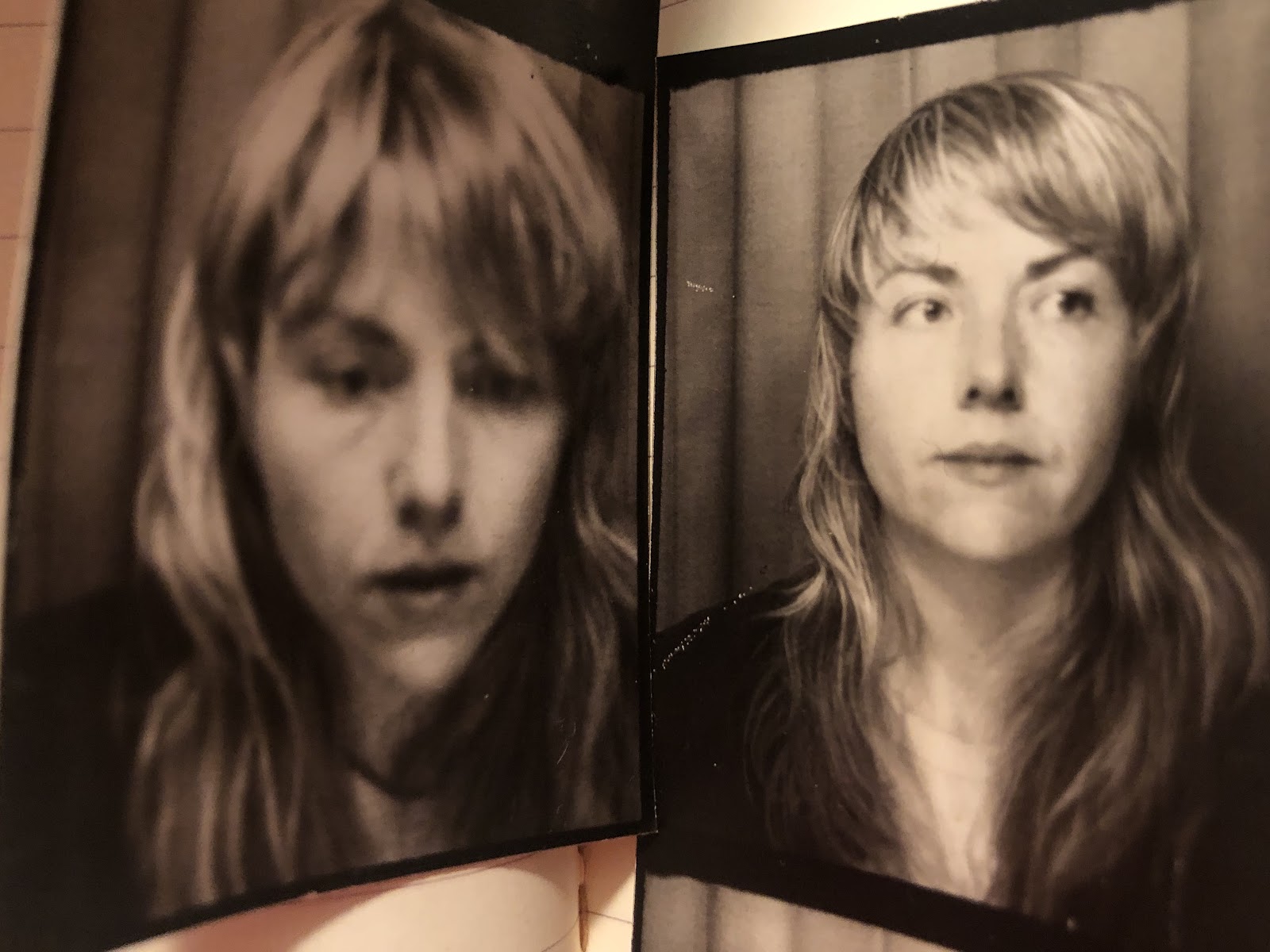
Jessie Young (photobooth, Rainbo bar, Chicago)


Jessie Young is a Brooklyn-based choreographer working in dance, performance and embodied pedagogy. Her work is grounded in a practice of corporeal self-reflection which she uses to investigate personal, familial, and fictional histories. In New York, her work has been presented by New York Live Arts, where she was a Fresh Tracks Artist-in-Residence (2017-18), Danspace Project (DraftWork), AUNTS (Mount Tremper residency), Brooklyn Studios for Dance, DåncēHøLø, Women in Motion and The Current Sessions. She has collaborated and performed with Abby Z and the New Utility, Khecari Dance Theater and The Seldoms, amongst others. She is currently collaborating as a performer with Julie Mayo, Stephanie Acosta and Isaac Pool. She has a BFA from the University of Utah and an MFA from the University of Illinois Urbana – Champaign. She is on faculty at Rutgers University, Mark Morris Dance Group and Gibney. Her forthcoming work, smoke not fog, will premiere in NYC Fall 2020.  More information at Jessie-Young.com.

Do you have a current or planned project whose progress is affected by the pandemic?

Yes. I’m working on a solo I’m calling smoke not fog. My imagined timeline and desired future for its development is changing, its trajectory lengthening. I can feel myself laying down inside the work, closer to the ground of it, listening more intimately and tending more deeply to its divergent threads. This new reality brings my attention to my imaginative space and highlights the ways I construct myself inside of myself. It’s forcing me to reconsider the images I use to understand myself and the work I make.

Right now, time feels altered and random, and I feel altered and random inside of it. In my bedroom as I write this, I’m feeling a flood, as if my mind was a room full of water: a flood of my imagination and of the progress I’ve made in this work. The placement of things (nailed or taped or written in marker or sketched in pencil) have all been altered by the flood of this moment and the unknowability of the future. It’s an interruption of scale.

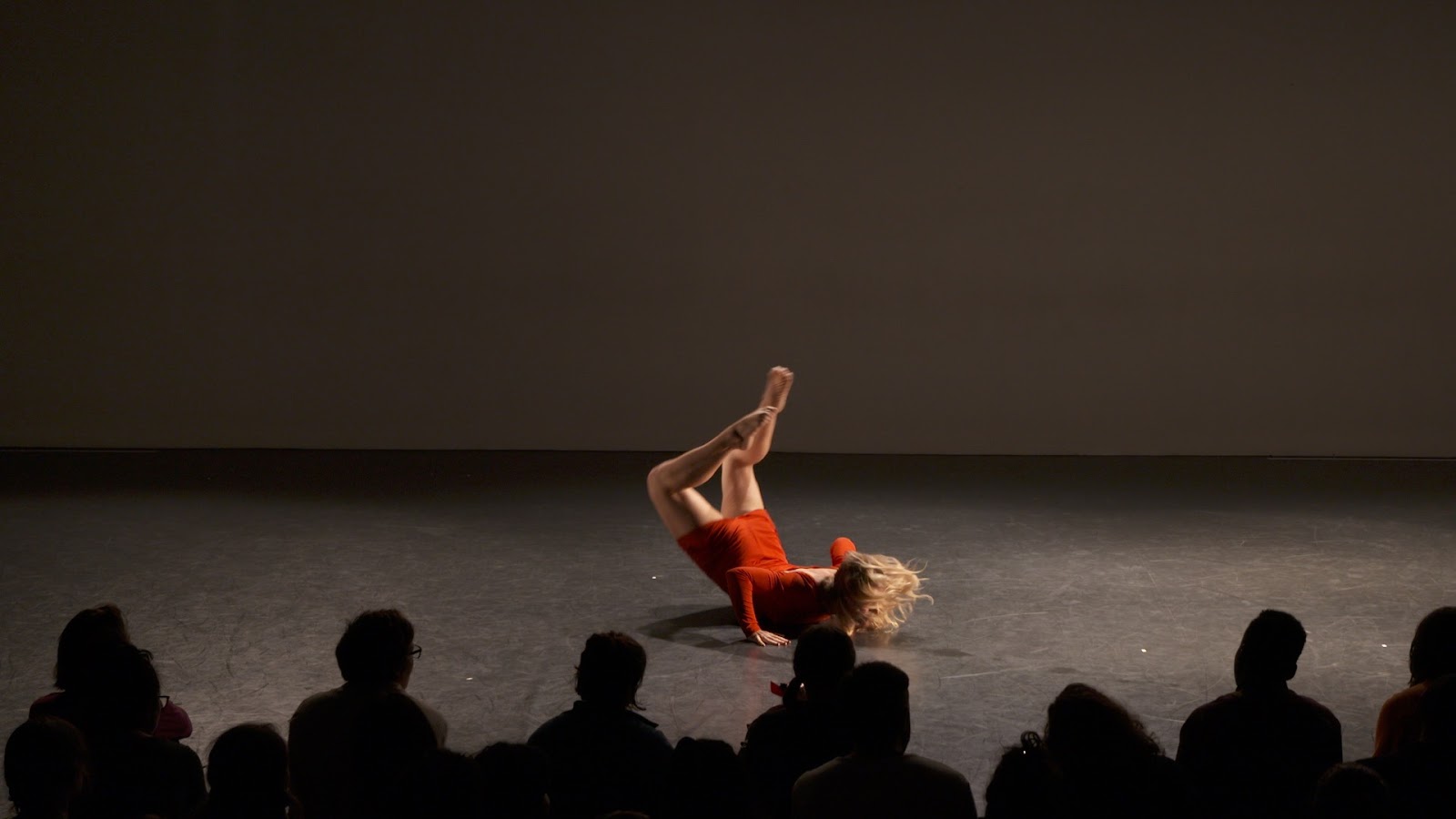
Jessie Young at Lions Jaw Performance + Dance Festival 
(photo: The Fleet)

Briefly, tell me about how you got involved in the arts and in your particular practice.

So much of how I shape myself as an artist stems from impulses I had as a kid: engaging with my curiosity, testing the boundaries of my hyperactivity, wanting attention from other people. As a child I was always trying to move beyond the limits of my childhood “present,” to escape the waves of boredom or loneliness through working and playing in my imagination.

I’m told my family put me in dance classes both for the convenient childcare it provided and because I was already (always) dancing. My dance lineage is shaped by love, at least the parts I choose to remember and carry forward with me. It’s only now, in my mid-thirties, that I’m able to look back at my history and see the abundance of care and love shown by my teachers, mentors, and collaborators. In considering my own “threshold” moments, it overwhelms and concerns me to think about all that I have forgotten (necessarily) along the way, but I think that’s partly why I keep making, to honor those people and remember their lessons. I’ve been supported and emboldened to keep choosing dance by mentors, communities, and kin who support my involvement in the arts every day.

In a more specific way, what are you practicing? And what are you envisioning?

I’m practicing paying attention to what I pay attention to. When I’m making a particular phrase of movement, I think of my organs and viscera and I place a certain weight or light on them. When I’m dancing, I’m noticing where my breath is, registering where it’s living in my body; I’m thinking about the bottoms of my feet, feeling my tongue, the weight in my throat, the tension in my eyes. Moving into that level of detail is one way to be in attendance to, to tend to the work.

In this new reality we’re in, I’m thinking about scale. I think of my work as creating a kind of ecology, and l’ve been working with the image of an atrium or terrarium. I’m remembering my friend’s niece making these terrariums, these little planets or worlds with moss and stone and different embellishments. I envision each work as a kind of ecology with its own environment inside of it, and I work to specify the details of that world so they are ultimately visible enough to be felt at a distance. In all of this, I’m practicing an extension of my imagination.

How does your practice and your visioning align with what you most care about?

I work with the images, associations, and languages that make up the ecology of my mind. Through my conjurings, I come closer to myself and the communities around me. In the imaginary space of my work, I hold other, simultaneous realities close to my own. I think of people I love who are far away and work with the geography between us. Right now, I feel the distance of time and place in a new way and I’m thinking about the new resonance of that distance in my work.

I make my work for spaces where people gather, and I care about how those gatherings happen. I care about how we tend to each other, how we listen to each other and learn and grow in one another’s love. I care to remain clear in love with my kin and sensitive to the people I meet. I care deeply about the possibilities and futures we can construct together. All of this love and this work, this is the practice.

How does your practice function within the world we have now?

In the world I’m in today, this morning with my three housemates in Kensington, my practice is to tend to our home: to light the candle, wipe down the counter, put the dishes away, play the music. This care feels necessary right now, and this community allows me to retreat to my room, with my books and my writing, and take time to reflect on how I’m functioning in this moment. All of this tending, it seems, is my making for this day.

I hope that, over time, I see new possibilities inside of this question for how I might rise to answer it. I want to keep asking it.

******

DISCLAIMER: In addition to my work on InfiniteBody, I serve as Senior Curatorial Director of Gibney. The postings on this site are my own and do not necessarily reflect the views, strategies or opinions of Gibney.

******

Subscribe in a reader

Artists Reach Out: olaiya olayemi

Dear friends,

Welcome to Artists Reach Out: reflections in a time of isolation. I dreamed this series of interviews out of grief for my work both as a documenting arts writer and curator of live performance. In this time of social distancing, we are called to responsibly do all we can to safeguard ourselves and our neighbors. It is, literally, a matter of life and death.

But there's no distancing around what we still can share with one another--our experiences, thoughts, wisdom, humor, hearts and spirit. In some ways, there are more opportunities to do so as we pull back from everyday busyness out in the world and have time to honor the call of our inner lives.

So, let me introduce you to some artists I find interesting. I'm glad they're part of our beautiful community, and I'm eager to engage with them again (or for the first time) in years to come.

--Eva Yaa Asantewaa, InfiniteBody


Olaiya Olayemi


Selfie by Olaiya Olayemi


olaiya olayemi is a blk/trans/femme/womxn/artist/educator/and activist who centers women of the african diaspora in her performative/literary/cinematic/and sonic works of art that explore love/sex/relationships/family/history/memory and radical joy/pleasure. her work is informed by blk/queer/feminist theories/aesthetics/and politics and african indigenous and diasporic spiritual traditions. she has performed at Brooklyn Arts Exchange, JACK, AAA3A, The Wild Project, The Langston Hughes House, Starr Bar, Mayday Space, and Dixon Place. she holds a bachelor of arts in english/creative writing (with a minor in african/black diaspora studies) from depaul university and a master of fine arts in creative writing from emerson college where she was a recipient of the dean's fellowship. she is currently a performance fellow in Queer Art's mentorship program. she currently lives in queens.

Do you have a current or planned project whose progress is affected by the pandemic? I am currently working on a solo performance piece entitled ado (a remix of my name). I have been able to do some work-in-progress showings of the piece over the last year. Thankfully its progress has not been derailed by the current climate. The great thing about being a writer is that I can work from anywhere and because it's a solo piece, I can rehearse whenever I want. I have great freedom in that way. I also have many other projects that I am writing/thinking/dreaming about. Briefly, tell me about how you got involved in the arts and in your particular practice. I have always been a creative. I was involved in the chorus and art club in elementary school, I was in my school play in junior high school , and I participated in my high school's speech team. I took as many writing classes as I could in undergraduate. While in graduate school, I decided that I specifically wanted to focus in on writing for live performance and visual media. By participating in a queer performance workshop at Brooklyn Arts Exchange, I discovered that I was also a performer. In a more specific way, what are you practicing? And what are you envisioning? I am practicing radical ways of existing. I am shedding layers, I am gathering the pieces of myself and putting them together bit by bit. I am practicing the very best way to be myself in this world and being a mirror for others to be their very best selves. I am healing/organizing/teaching myself and others through my art. I am envisioning a world where joy and pleasure overflow, a world where liberation and justice are commonplace, a world that we used to live in and will live in again in the future. How does your practice and your visioning align with what you most care about? I care most about living a pleasurable existence. It is my belief that living in pleasure and joy is the point of life. We are not meant to suffer or sacrifice. In many ways, we've been duped by the system in which we live. But it is up to artists to envision new ways of being. I feel that my art is instructional in that way. I am crafting alternative worlds and universes so that people can imagine new ways of living other than the stilted/stifling/imitative ways that we've been taught. How does your practice function within the world we have now? Life is a performance. We participate in it as players in a game that we did not design. Hopefully my practice pushes us toward more pleasurable futures by (re)imagining a pleasurable past. It is my belief that by investigating the past, we can recreate ourselves and this senseless system.

******

DISCLAIMER: In addition to my work on InfiniteBody, I serve as Senior Curatorial Director of Gibney. The postings on this site are my own and do not necessarily reflect the views, strategies or opinions of Gibney.

******

Subscribe in a reader

Tuesday, March 17, 2020

It's also okay to take time to grieve.

Eva Yaa Asantewaa


It's also okay to take time to grieve.

by Eva Yaa Asantewaa, InfiniteBody


Hey, friend! How are you doing? How are you faring in this new reality?

Me? It's different from moment to moment, day to day. And that's the way I've learned to take it. Because that's the only way it's going to work. The information and guidelines and rules we're getting evolve as this coronavirus pandemic sweeps across the world, our state and our city, and we inch along towards an unknown future. We're all trying to do our best.

Well, some of us, actually, are doing our usual. Which is not helpful. It's a time for responsibility. And I'm livin' in the USA where gun sales are rising and young people have to be forced to stay away from bars.

Anyway, my fellow Americans, my fellow New Yorkers, my fellow arts folks, here's where we find ourselves.

Lord love us, the virus struck, our daily habits and plans and expectations got shut down but--damnit!--we got busy. Right away!

We've now put a flood of videos and livestreams out with everything from opera performances to yoga and meditation and cooking classes to art museum tours. Oh, thank goodness we've got the Internet and social media and the same electronic devices we'd just spent months and months complaining about and trying to spend more time away from so we could have authentic experiences with our loved ones IRL.

Now, we're finally making good on those old resolutions to study French or learn to knit or...I don't know...maybe master brain surgery on YouTube. And there's just so much out there to dig into while we wait for the world to turn right-side up again (or what we thought was right-side up...that's debatable).

There's more and more and more online content every day for the stuck-at-home. I've got friends and colleagues busy making some of it. And even this blog post! Because we're resilient, we're creative, we want to keep active before we lose our natural minds. It's really fantastic, isn't it?

It's also exhausting.

All the time in the world now to catch up with the tons of unread books I have here, the millions of unread articles I have saved in the Pocket app, the podcasts people keep telling me I have to hear, my Netflix list, my bag of knitting supplies, my personal writing, the two free Coursera courses I've just signed up for and--Godx, help me--my lifelong practice of introversion. And yet....

I can't. Anyone else feel me on this? I just can't.

I wish I could put this enforced isolation time to good use. But....

It even took me a while to realize I could write a post like this to share with you how I'm feeling.

Because we're supposed to spring into action as if nothing, absolutely nothing could ever slow us down.

We're Americans, damn it!

We're New Yorkers, damn it!

We got through 9/11 together, and we'll power through this trauma.

And I actually think, as much as artists and folks who work with artists--particularly dance artists--are marginalized in this society, most of us have a keen sense of responsibility to community and world, a sense of generosity and mission, that moves us to pick ourselves up, dust ourselves off, start all over again. Right away!

I'm here to admit I'm both feeling it (that natural urge) and not feeling it.

I'm leaning in...and swerving away.

And, yeah, all of the labor I normally do (and dearly love) is dependent upon either:

1) getting wonderful artists into spaces where they will perform live in front of, I hope, densely-packed audiences (curation)

2) attending and reporting on live performances amid often densely-packed audiences (dance writing).

So, right. I've got lots of new time on my hands. But my proudest achievements, lately, involved strategic grocery shopping and the complete reorganization (and subsequent re-stuffing) of my pantry.

My newly-unfolding Spring season at Gibney is in tatters; my calendar for other New York City happenings is suddenly wiped cleaner than a subway pole first thing on a March morning. And I miss every one of you I used to encounter all the time on my sidewalk, in the lobbies and aisles of performance venues, in the corridors and studios of my workplace.

I miss you. I'm grieving. It's okay to take time to grieve a little. It's okay to take a look around and realize you don't know what to do next. You just don't know what to do. You feel overwhelmed and helpless in the face of unimaginable uncertainty. And you're no expert on any of this.

Take even just a minute. You can spare a minute.

2020. Remember when we thought this was a fresh new year with a cute name? Little did we know it was coming for us. Threatening our health, our businesses, our incomes, our socializing, our freedom to greet one another with a warm hug in the time-honored manner.

Last night, when I couldn't even relax with a Met Opera video (free!) because, I guess, the system wasn't strong enough for all the new demand on it, I threw in the towel. I went to bed, read a little, went to sleep. Sleep is also free and, occasionally, you feel refreshed when you wake up from it.

Lately, waking up from it has also been a proud achievement.

Productivity is as American (and as capitalist) as apple pie. And this Virgo, of course, would love to feel useful and productive. This blog post is actually a tilt in that direction. Look, I'm communicating with you again! But what I'm communicating is about making space for my feelings--and yours. I hope you can feel it's okay to do the same.

Take good care of yourself and all who are precious to you and a comfort to you in this difficult moment. I send much love and wishes for your safety and well-being!

Eva

******

DISCLAIMER: In addition to my work on InfiniteBody, I serve as Senior Curatorial Director of Gibney. The postings on this site are my own and do not necessarily reflect the views, strategies or opinions of Gibney.

******

Subscribe in a reader

Saturday, March 7, 2020

Oona Doherty: the stories she's carried

Belfast's Oona Doherty is a thrilling soloist
in Hope Hunt and The Ascension into Lazarus.
(photo courtesy of the artist)

Hope Hunt and The Ascension into Lazarus
by Oona Doherty
92Y Harkness Dance Festival
March 6-7

Such a percussive and narrative, if mystifying, title: Hope Hunt and The Ascension into Lazarus. It makes the heart beat a bit harder and the breath come a bit faster just to read it out loud. And that's an appropriate reaction. It really is a bracing kind of story, an epic one with what seems to be hundreds of characters--working-class men you might find on the byways of dancer-choreographer Oona Doherty's Belfast, Northern Island.

The multiple award-winning artist brought her electrifying tour de force to 92Y Harkness Dance Festival for a short run of three performances over two days. I hear tell it's the last time she'll ever perform it. So, head there this afternoon or tonight because she's worth a look.

The piece begins directly in front of 92Y at the Lexington Avenue curb and sidewalk with some crunchy pelting and hip-hop tumbling about in hoodies. This launch introduces Doherty and a couple of her compatriots, two young men who soon speed away from the scene. A first impression, it deftly encapsulates how reckless she's willing to be as a mover but, in retrospect, I don't know how much of this you actually need once you've seen what she does upstairs in 92Y's Buttenweiser Hall.

For, once there, you're captive to a short solo that moves past you at the speed of light--or as if someone took a very long novel and flipped the pages so you'd get flashes of characters in action, flashes of speech, all of it thrown your way with tremendous force and unexpected fluidity, with transitions from one situation to another that would seem to be impossible but, no, there they are unfolding right in your face.

Once there in your seat, the first thing you notice are flashes of Doherty's flesh caught in light, the parts not covered by a dark, shapeless, nondescript costume, as she whips back and forth from one side of the darkened space to the other. Then she comes forward in the space, building an impression of harsh environments and harsh life with her repetitive, explosive vocalizations, physical and vocal tics and eruptive movements. You hear a fan chanting at his favorite football team, a man trying (and failing) to make time with someone named Stephanie, and any number of people you give up trying to hold onto in the avalanche of scenes and players.

Life is raw, vivid, fleeting. Doherty's putty-like tomboy's body, expressive face and vocal dexterity make her a thrilling performer in full mastery of this roaring stream of consciousness.

It takes little over a half-hour to complete but, really, how much more could Doherty's body have sustained? She has given so much.

She accepts our grateful applause and goes away only to come right back and draw aside a curtain, revealing her DJ, Joss Carter. She invites the audience to get up and dance and--if I heard this right--find some cans of beer among the garbage (her set) tucked away in a far corner of the space. The music played, and a small handful of folks rose from their seats, but this ending seemed oddly awkward, lifeless and superfluous.

Nevermind. If Doherty is saying goodbye to all the men she brought through in Hope Hunt and lived with since 2016, I'm quite eager to see where she's moved to since then and where she's moving next.

Music by Oona Doherty and Luca Truffarelli
Set and costumes by Oona Doherty

Hope Hunt and The Ascension into Lazarus continues and concludes today with performances at 4pm and 9pm. For information and tickets, click here.

92Y Harkness Dance Center
92nd Street Y
1395 Lexington Avenue, Manhattan
(map/directions)

******

DISCLAIMER: In addition to my work on InfiniteBody, I serve as Senior Curatorial Director of Gibney. The postings on this site are my own and do not necessarily reflect the views, strategies or opinions of Gibney.

******

Subscribe in a reader

Tuesday, March 3, 2020

Colleen Thomas: Woman power is persistent and global

Dance artist Colleen Thomas.
(photo: Lovin Ostenrik)

Joanna Leśnierowska (below) in light and desire
(photo: Miguel Anaya)


This year marks the centennial of the ratification of the 19th Amendment to the U.S. Constitution (August 18, 1920), which granted women citizens the right to vote. light and desire--a new, full-evening dance ensemble by Colleen Thomas and her multi-national team of collaborators--comes at a time when lack of respect for women’s political leadership is again a matter of concern and struggle. The piece will have its world premiere at New York Live Arts, March 25-28 (7:30pm), during Women’s History Month.


Colleen Thomas (US), director, performer
Ermira Goro (Albania/Greece), performer
Joanna Leśnierowska (Poland), performer
Ildikó Tóth (Hungary/Germany), performer
Rosalynde Le Blanc (US), performer
Carla Forte (Venezuela), film director, performer
Alexey Taran DP for film
Stacey-Jo Marine, lighting design
Rebecca Makus, mask design
Robert Boston, musician/composer featuring Jo Morris, voice

For further information and tickets, click here.

______________________________________________________

Yesterday morning, I met with Thomas at Gibney to learn more about light and desire. Read on for what she had to say about the concept and making of this timely piece on women's resistance and radical expression.

Some performers in light and desire,
by Colleen Thomas and her international collaborators,
premiering at New York Live Arts, March 25-28
(photo: Nadia Halim)

In 2016, I think I was very privileged--and unaware of my privilege--as an American. With the [presidential] election, I just couldn’t believe the misogyny. I sort of woke up to the misogyny that had always been in my world. Maybe I felt I wasn’t good enough, things weren’t happening for me, wouldn’t go my way or just would feel wrong. I’m not good enough, smart enough. It was all on me.


Seeing the way that people looked at the candidates in 2016, how people talked about Hillary Clinton’s personality, which had nothing to do with what her experience was.... Meanwhile, there’s this other person whose personality isn’t great either! But, no, people are talking about her. Even my women friends--smart and artistic, some of the most intelligent, aware people--said things like “I just don’t like her. I don’t know why.” There were other people, family members in other parts of the country, who said things like, “She’s a criminal.” 


I work in academia, I work in this world, and I collaborate with a man in a lot of my work. I just started to question: What is this bias and hatred?


Because of the election, I started talking to people, to women about it. We couldn’t stop talking about it. It was like Voldemort had arrived! None of us had slept. We were in shock. Thank God for New York and our community. But I started talking to people around the globe, people I had worked and toured with for many years. Most of them had worked with us here.

That’s where I woke up to my privilege: Oh, I think it’s so horrible here in America, but they’ve lived through having to move out of their own country to somewhere else where they felt they could have a life. They had personal stories about growing up in a new country. It was really interesting to work with and very cathartic in a way.


All of these women are just extraordinary people. I wanted to work with them because of their dancing and because of who they are, but they are all older now--we’re all older now!--they’re “successful,” whatever that means. We’ve got these jobs, we’re creating art, we’re chairs of departments, we’re successful women. And it’s just interesting to me because I’m not sure we feel that success.


How we feel our power was really interesting to me, how we moved through obstacles. I was interested in telling some personal stories about these women, hopefully something that other people also experience. It went from a political, angry place to “How do we heal? How do we move through? How do we get to this place where we can feel our power, go into our communities and support that?" At the beginning, I was focused on all the negatives: There’s no hope. There’s never going to be a woman president. It’s so deep. And [reflecting on the current presidential candidacy of Elizabeth Warren], we are physically exhausted. I am at the place now where I can’t even read the news.


The stories are an important part of the work. I always work with people’s personal history. That’s what’s real for me rather than having them do something that’s in my mind. Collaboration is so interesting.


There are five other women besides myself, and one--Carla Forte--is Venezuelan-born, a dancer and a documentary and feature filmmaker. She lives in Miami now, but I met her in Venezuela fifteen years ago, and we worked together, toured in different places together. I think she has lived in Miami--where I’m from--ten years now.


When Venezuela just sort of got crazy, she and her husband came here to America. I started off asking each artist how they moved through hard times, passed through their obstacles, and she started talking about being seen a certain way as a Venezuelan in America and even how her mother or their culture expected certain things.

I have a teenage daughter who’s going through a major transition. My husband said this one day--because he’s a man!--”I was a boy, and I went through puberty, and I could just do whatever I wanted.” And he was watching his daughter be seen a different way for that moment of transition where, all of a sudden, other people are seeing you differently, you’re seeing yourself differently, and there’s some kind of freedom that’s lost through how other people look at her. So he just had this epiphany. Really? (laughing hard) Now? At this age, you’re just realizing it now?


So, the piece has become about this idea of transitions, what happens in those moments in between change--slowing down those moments to see what those shifts are. We started with the idea of slowing down the film Carla created for the piece. When things are very, very slow, you can’t tell very clearly what’s happening. Singing can look like a scream...or a laugh. You’re not really sure. That became really interesting to me, the transitions in all forms--women getting older, women moving through hard times, transitions of getting to power, transitions of giving up. Do you give up and move out of your country because it’s so bad there?


Carla talked about her mother wanting her to be a kind of woman like Miss Venezuela--beautiful with the makeup--and she wasn’t. She talked about people in Miami calling her whore because she’s Spanish-speaking. And I talked to people like Ildikó Tóth who lives in Germany, and she said she never felt objectified or anything like that. She said, “I just always dressed like a boy.” Ermira Goro, she lives in Greece now, and she danced with us as well and was here for many years, and then she went on to DV8 [Physical Theatre, a London-based troupe]. She talked about when she moved from Albania to Greece and living with a friend, not having her family there. Everybody seemed to have stories that pertained to their moms and, because I was interested in my daughter’s changes, there's a little flicker of mom stuff in there.

Joanna Leśnierowska is not primarily a dancer; she’s a curator, dramaturg and designer, born in Poland, running a festival. Doing body research with her was really interesting. She’s just so real. She connects to what the truth of the movement is right away, even though she questions, “I’m not a dancer. Should I be doing this?”


I was getting so inspired by my students at Barnard [College] and by [climate change activist] Greta Thunberg, by all these young people who are active out there trying to make change, and they’re like “You guys fucked it up, and we need to do something.” There’s a lot of work I watch my students do that I’m sort of amazed. The idea of having a chorus in the piece, bringing these [local community] people in, was a representation of the inspiration and hope they bring to what’s happening now. 


At first, I wanted a lot of women to take the stage and just stand there, make the audience feel uncomfortable. I was so angry! But then I started workshopping with them. I hope that when I get to do this piece in other places, I will get to workshop with women in these communities. The workshop--working with them through improvisation and talking about their own experiences--it was different because they are a lot younger [than the main cast]. There’s power afforded to us because we have some experience, and we feel strength from the places that we’ve moved through. But the hope that I feel is in working with these young people, talking with them about when they’ve felt erased or objectified or passed over and how they got up and kept going.

These are all my alums of different ages. I have such a personal connection to everybody in this cast. We rehearsed the other day, and I cried after they ran this one section. I realized I know their stories, you know?


The mood I feel, through them, is support--for me, for this piece--and comraderie, community, kind of like the Buddhist sangha. I feel the strength through them. They’re not giving up. They are in a place where they believe they can make change and, just like the masks they wear in the piece, the grotesque becomes beautiful. All of these dancers are able to be vulnerable, which is not always pretty. They have nothing to prove.

That’s the other thing. Maybe that comes with being over 50: I’m done trying to be something. We’re all trying to share this experience with the audience. It gets ugly and uncomfortable, but then, somehow, we work through it--I hope! (laughing hard)


-- Colleen Thomas

See light and desire at New York Live Arts, 219 West 19th Street (between 7th and 8th Avenues), Manhattan (map/directions). For further information and tickets, click here.

******

DISCLAIMER: In addition to my work on InfiniteBody, I serve as Senior Curatorial Director of Gibney. The postings on this site are my own and do not necessarily reflect the views, strategies or opinions of Gibney.

******

Subscribe in a reader

Copyright notice

Copyright © 2007-2023 Eva Yaa Asantewaa
All Rights Reserved

Popular Posts

Labels