Search This Blog

Sunday, November 17, 2019

Stepping out: Colin Dunne's "Concert" at BAC

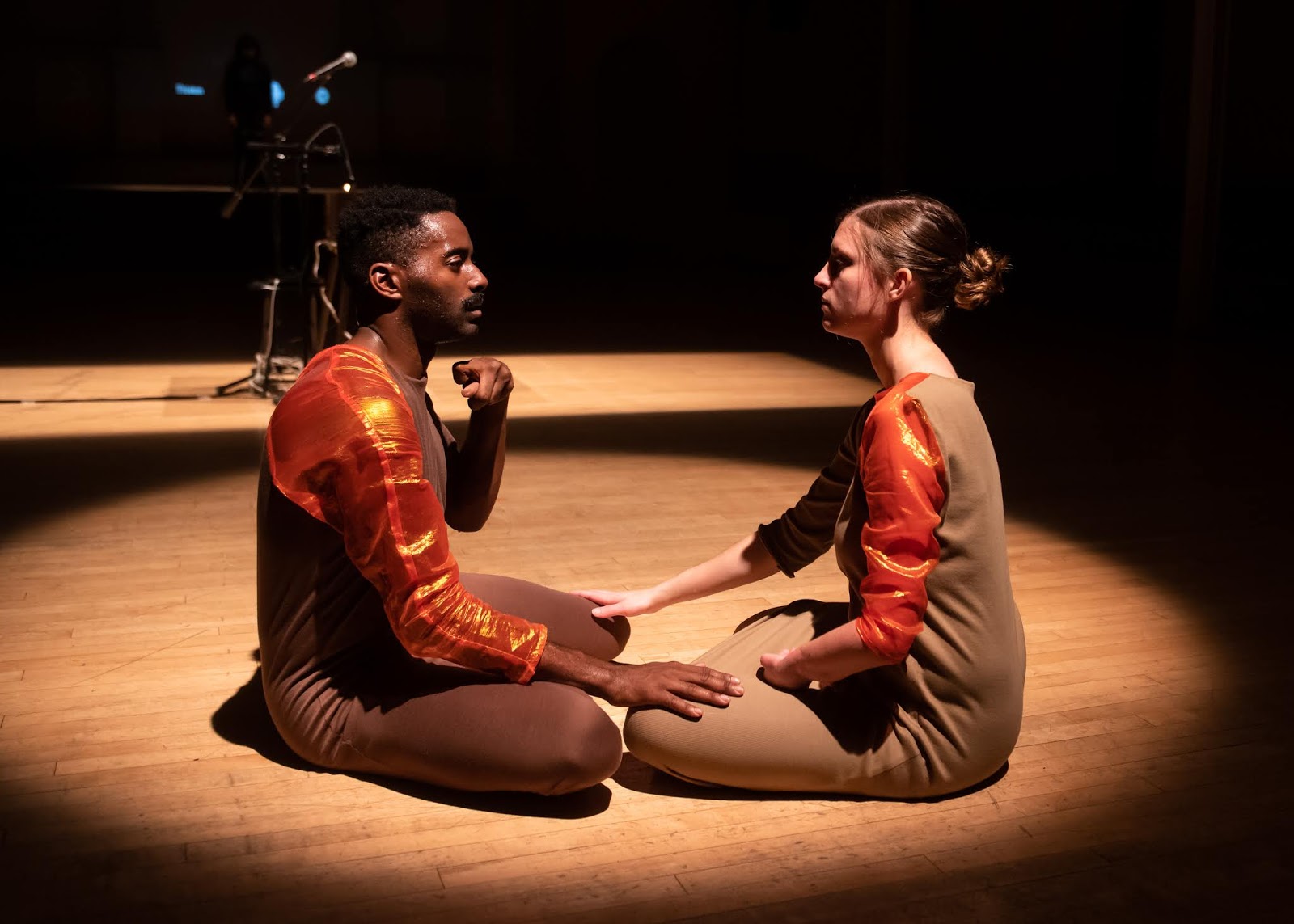
Dancer Colin Dunne in his solo, Concert,
given its US premiere this month at Baryshnikov Arts Center
(photo: Whitney Browne)

Concert
by Colin Dunne
Baryshnikov Arts Center
co-presented with Irish Arts Center
November 14-16

Irish step dancing might start with a bit of stomping, a bit of running, as Colin Dunne--best known as an early superstar of the Riverdance phenomenon--informed us in the casual opening of his piece, Concert. But it can claim a more expansive range than we might have ever seen or imagined. Dunne's imagination, however, remains unfettered and restless after exploring contemporary dance for nearly two decades. Furthermore, as presented in Concert, his aesthetic journey is inspired by virtuoso Irish fiddler, Tommy Potts. Potts' spirit guided and presided over this intriguing hour of solo performance.

I should put quote marks around "solo." Dunne, dressed in unglamourous running shoes and black jeans and t-shirt, might have been the only flesh-and-blood performer in BAC's space, but he was far from alone. Potts, dead since 1988, was very much in the house. We heard him speak, watched him play in a projected film and saw his eccentric artistry reflected in the thoughtful whimsy of Dunne's choices.

Like Dunne's costuming, his choice of props and sonic accompaniment tilted towards the humble and the analog, stripping away flash, getting down to the nitty gritty. There's no pretense of perfection (or restraint) in Dunne's physicality. That's the honest body of a man who has lived a while. And for equipment to invoke both history and the spirit realm, he employed a turntable spinning the LP of Potts' The Liffey Banks, his only recording. A couple of unremarkable speakers carried Potts' words. There was an upright piano that probably has seen a few years. And, for god's sake, a cassette player. With all of these, Dunne wove an atmosphere with character and authenticity and--would you believe it?--continuity.

Moveable patches of flooring, rearranged as needed, helped the dancer--sometimes barefoot, sometimes wearing heeled boots--lay down sound, some tentative and soft or bold and complex scrapes and patters with one arm or another un-traditionally free to flap out or lift in a kind of punctuation. It was impossible to be a tap dance fan and not sit there mentally pairing him with tap artists--Black ones in particular--soul to soul.

Direction: Sinéad Rushe
Composing/sound designer: Mel Mercier
Lighting: Colin Grenfell
Film design: Jeffrey Weeter

Concert is closed. For more information on events at Baryshnikov Arts Center, click here. For more information on events at Irish Arts Center, click here.

******

DISCLAIMER: In addition to my work on InfiniteBody, I serve as Senior Curatorial Director of Gibney. The postings on this site are my own and do not necessarily reflect the views, strategies or opinions of Gibney.

******

Subscribe in a reader

Saturday, November 16, 2019

Tiffany Mills premieres "Not then, not yet" at The Flea

Top: Kenneth Olguin
Bottom: left, Mei Yamanaka; right, Jordan Morley
in Tiffany Mills' Not then, not yet at The Flea Theater
(photos: Robert Altman)

Not then, not yet
Tiffany Mills Company
The Flea
November 13-16

Making themselves at home in one's subconscious are all manner of energies and drives eluding conscious control. This is the disquieting atmosphere of Not then, not yet, a work by dance artist Tiffany Mills with Puerto Rican composer Angélica Negrón and French vocalist/composer Muriel Louveau, now in world premiere at The Flea Theater in Tribeca.

The first sight of a few toppled metal chairs--with toppled dancers crumpled beside them--hints that this chair dance, led off by Jordan Morley, will surely go in a dark direction. Indeed, a kind of "musical chairs" game breaks out. But...no game, folks. The dancers--each dressed in Pei-Chi Su's costumes that bind together clothing details assigned along binary gender lines--don't play. Not at all. Their wary, tense actions around the chairs are cutthroat, life or death, driving towards a passage in which Morley obsessively arranges four chairs in a row that, nevertheless, ends up off-kilter. Negrón's music, including vocals by Louveau, invokes the relentlessness pace of time, pressure and complexity.

Inspired by novelist Mary Shelley's writing, the piece locates humanity in a place of precarious transition, the possibility that our inherent potential for monstrosity might consume us all. Is there a way out? Surely, the condition of life in these times raises this unsettling question every single day.

Strongly directed, the performers display physical vibrancy and vivid expressiveness--traits I've come to expect from Mills ensembles. Besides Morley and Mills herself, they are Kenneth Olguin, Nicholas Owens, Emily Pope and Mei Yamanaka, and Mills is fortunate to have every one of them.

Dramaturgy: Kay Cummings
Lighting design: Chris Hudacs

The Flea
20 Thomas Street (near Broadway), Manhattan
(map/directions)

******

DISCLAIMER: In addition to my work on InfiniteBody, I serve as Senior Curatorial Director of Gibney. The postings on this site are my own and do not necessarily reflect the views, strategies or opinions of Gibney.

******

Subscribe in a reader

Wednesday, November 13, 2019

can you can you: Jerron Herman and Molly Joyce at Danspace Project

Jerron Herman and Molly Joyce
in Breaking and Entering at Danspace Project
In deep background below: ASL Interpreter Kathleen D.Taylor
(photos: Ian Douglas)


Breaking and Entering
by Jerron Herman and Molly Joyce
at Danspace Project
November 12, 15-16

Breaking and Entering, a collaboration between two well-regarded disabled artists--Jerron Herman and Molly Joyce--creates an intriguing relationship among its players and with its audience. Early on, we're introduced to American Sign Language Interpreter Kathleen D. Taylor whose signing rings with a robust, dancer-ly flow.

Uh-oh, I thought at first sight of her hands in motion, knowing all too well my tendency to gaze long at ASL interpreters whose particular style draws me in. What if I look at Taylor and miss important things that Herman might be doing?

No chance of that, really, since Herman is not exactly someone you can miss. Moreover--and curiously--Taylor soon gets relegated to deep backdrop, removed to the upper reaches of St. Mark's Church's altar steps for the rest of the piece. Thinking back on that now, I realize that distancing, blurring any initial, vivid connection to Taylor, might be by complicating design.

The words accompanying the work's three movements--entitled "Compliance," "Defiance" and "Emergence"--suggest a negotiated relationship with others, perhaps with viewers, perhaps with parts of the performers' own bodies.

Herman, who bills himself as "an interdisciplinary artist, primarily working in dance," is a snazzy performer with hemiplegic cerebral palsy which has caused him to devise ways to work balance and propulsion differently. His energy in the space is wrenching, surprising and always thrilling. Composer/musician Joyce, disabled in an accident, often moves with Herman, sings high and sweet, and plays a vintage toy piano set up in the middle distance between far-off Taylor and the audience. Their textures are so different, they make me think of their performance space as a painting canvas generous enough to make room, at once, for the roughest impasto and a silky brush.

The evening ends in an invitation to the audience to join the artists on the floor and dance to a DJ's fifteen-minute set. Disability activist and scholar Kevin Gotkin dj'ed last evening; Michael Hammond and JIJI will do the honors on Friday and Saturday, respectively.

Text: Marco Grosse, Molly Joyce, Jerron Herman
Sound: Michael Hammon
Costumes: Gerald and Cynthia Herman

Breaking and Entering continues with performances this Friday, November 15, and Saturday, November 16, at 8pm. Besides ASL interpretation, audio description is also provide for each performance. Each concludes with a fifteen-minute dance party for the artists and audience. For information and tickets, click here.

Danspace Project
131 East 10th Street (and Second Avenue), Manhattan

******

DISCLAIMER: In addition to my work on InfiniteBody, I serve as Senior Curatorial Director of Gibney. The postings on this site are my own and do not necessarily reflect the views, strategies or opinions of Gibney.

******

Subscribe in a reader

Friday, November 1, 2019

Drury and Rankine: award-winning writers challenge whiteness


MaYaa Boteng portrays Keisha,
the pivotal character in Jackie Sibblies Drury's Fairview
(photo: Julienta Cervantes)


Hosted by Brooklyn's Center for Fiction and presented with Theater Communications Group, playwright Jackie Sibblies Drury and poet Claudia Rankine sat in conversation about Drury's Pulitizer-winning play, Fairview (2018), and Rankine's first published play, The White Card (March 2019). Both stories have scenes centered around a dinner party and deal with race and white surveillance, ultimately training a floodlight on what whiteness is and what it does. The writers discussed Fairview, mostly, including Rankine's experience of seeing Drury's play in the company of a white woman, a close friend and colleague, who (literally) failed to rise to its challenge. So, The White Card, which I have neither seen nor read will remain more of a mystery to me for a bit longer.

Though highly anticipated, the event proved to be frustrating, beginning with its late start (a half-hour) and a curious mismatch of speakers--both thoughtful, distinguished artists--whose personas could not have been more different. Rankine more reserved and watchful, read not from The White Card but from her essay responding to Fairview and contributed careful, finely-wrought, even mournful analysis at select moments. Drury, more accessible and endearing, too often seemed like a nervous student in awe of a visiting star scholar who is, yes, a MacArthur-certified genius. Rakine's 2014 multiple award-winning volume of poetry, Citizen: An American Lyric, zoomed her into mainstream awareness as a critical witness to everyday racist microaggressions that, along with the fundamental nature and tenacity of white supremacy, make any mention of "post-racial America" an absurd lie. Would that The Center for Fiction could have magically blended these two writers into one fascinating being.

Rankine largely supported Drury in working through the creative process and the varying audience responses to Fairview, a play that first soothes and reassures white audience members with a familiar sit-com scenario and then asks them to participate in gradual, then increasingly unsettling, hard-to-escape exposure of their own white privilege. This conversation gave me a moment to revisit my own reaction to Fairview's final section where the teenager Keisha invites white people to rise from their seats and reassemble on the stage. As a Black woman, I immediately got the system-tilting shift Drury was going for in this theatrical exercise, and I must admit I felt a little smug. No, a lot smug. I also recall that the white people in the SoHo Rep audience I had sat with were all quite cooperative. From Drury's report, it seems that reaction was far from common.

As with reading Rankine's Citizen: An American Lyric, I'm struck, once again, by a sense of unacknowledged tragedy--what Rankine refers to as the loneliness an oppressed person feels, the sense of having been abandoned by all to injustice. On many levels, for many reasons, so many of us live with unhealed trauma. Gaslighting deepens and worsens the tenacious psychological/emotional effects of injustice. It messes with our overall health as individuals, communities and a society, and we're living in a time when gaslighting is pretty much the National Anthem.

Artists like Drury and Rankine bring heroic witness to this incendiary, potentially transitional time. The rest is up to us--to clean these uncovered wounds and allow them to heal.

Learn about The Center for Fiction and its upcoming events--such as evenings with authors like Edwidge Danticat, Annie Baker and Branden Jacobs-Jenkins--here.

The Center for Fiction
15 Lafayette Avenue, Brooklyn

******

DISCLAIMER: In addition to my work on InfiniteBody, I serve as Senior Curatorial Director of Gibney. The postings on this site are my own and do not necessarily reflect the views, strategies or opinions of Gibney.

******

Subscribe in a reader

Sam Kim's "Other Animal" opens at Danspace Project

Sam Kim
(photo courtesy of the artist)

Other Animal
by Sam Kim
Danspace Project
October 31-November 2

When entering St. Mark's Church for Sam Kim's solo performance of Other Animal, you'll be directed towards one of two sections of chairs or cute floor cushions, all in a straight line spanning the width of the floor, facing and perfectly aligned with the church's distant altar space. When I was there last night, a few people took seats over on the carpeted risers along the side of the floor, as you're usually permitted to do, but ushers quickly redirected them to this linear set-up. Eventually, Kim made her first appearance, and the reason for this control of our angle of view became clear.

Kim entered the space from one of the sanctuary's doors, dressed in leopard-print leggings, a long white shirt and a loose wool coat in a bold, checked pattern. For a quite lengthy stretch of her 50-minute solo, she merely sauntered, assertively strode or simply hastened across the floor, unconcerned about her watchers, repeatedly disappearing somewhere behind us and through another of the church's doors. In the beginning, I was curious to know what she was doing outside my range of view and tried to crane my neck to see.

Impossible. I turned my whole upper-back, discovering that she was actually leaving us. I didn't notice more than maybe one or two other people checking on what was going on behind us, and I think they might have been content to just hear doors close and re-open, to see Kim when she was in view, to watch her exit and return through the two visible doors facing us. I wonder how many caught that momentary apparition up on the right-hand balcony.

Now you see her, now you don't. What's that about? And do you care? Why should you?

Kim's own don't-care look and sullen demeanor (butchy, I thought) actually endeared her to me, and I began to care. I'm not sure why I would or if I should, but I did. She had won me over, and it put me in a very good place to appreciate how she went on to labor in, fill and ironically dominate the space.

Watching Kim's performance felt like finding oneself inside of a restless but also persistent, generative mind. The video animation work of experimental filmmaker Stacey Steers seemed to swell and spill from that same source--a thick, unruly blossoming of imagery, possibly organic but largely indecipherable, weird though inexplicably appealing. It bloomed in sections of the altar-area's wall, eventually overtaking its entire arch.

"I'm messy," her movements and way of being seemed to say. "Kind of beautifully messy. I'm here. I claim it. Sometimes staggering, sometimes slumping, sometimes soft of step. Holding myself together. Letting myself go. Slipping uphill (the altar risers) and rolling down. No matter how awkward it all looks, how difficult, how stop-and-start the effort."

A muted, warm pool of light sometimes draped Kim's body in the overwhelming space of St. Mark's Church like a gesture of compassion. That light also looked as if it might be seeping from within her, softly brightening wherever her body landed.

She passed me as she left the space for the final time, and I would have tipped my hat--had I been wearing one--to a masterful performer, secure in herself and her vision.

Lighting design: Kathy Kaufman
Sound and projection design: Chloe Alexandra Thompson

Other Animal continues nightly through Saturday, November 2, with performances at 8pm. For information and tickets, click here.

Danspace Project
131 East 10th Street (and Second Avenue), Manhattan

******

DISCLAIMER: In addition to my work on InfiniteBody, I serve as Senior Curatorial Director of Gibney. The postings on this site are my own and do not necessarily reflect the views, strategies or opinions of Gibney.

******

Subscribe in a reader

Sunday, October 27, 2019

"THE DAY" arrives

Cellist Maya Beiser with Wendy Whelan
performing The Day
(photos: Hayim Heron, courtesy of Jacob's Pillow)


THE DAY
by Maya Beiser, Lucinda Childs, David Lang and Wendy Whelan
October 22-27

In all honesty, when I hear that the events of September 11, 2001 inspired a piece of art, I note and then turn away from that detail, hoping for an alternative reason to connect. The excellence of THE DAY's principal collaborators--cellist Maya Beiser, dancer Wendy Whelan, choreographer Lucinda Childs and composer David Lang--drew me to The Joyce this week for this work's New York premiere. (I went, in particular, for Beiser, and please hurry to her site's video page and share my new obsession.) Thinking back now, I find myself drifting between certainty that THE DAY reflects a moment in our history and, at the very same time, wavering certainty about what my eyes and ears testified as I gazed from my seat in the audience. Thus, for me, it might be the perfect evocation of the experience of witnessing 9/11.

Performed without intermission, the interdisciplinary work consists of two parts--The Day and World To Come, named for music previously composed by Lang for Beiser--and contemplates the aftermath of a soul's separation from its body. The width and height of the Joyce stage, backed by Joshua Higgason's video projection, contribute to THE DAY's monumentality and hallucinatory depth of field and dreamy elusiveness.

In the opening part, Beiser and Whelan occupy separate, opposing territories--cellist and cello crowning a translucent incline; white-draped ballerina starting off artfully perched on a stool as if posing for a fashion shoot. Sara Brown's minimalist, abstract set--angled lines suggest subtle demarcation--works in tandem with the strength, and severity, that Childs' ideas bring out in Whelan's deft improvisations which, at times, evoke an iconic rendering of the architectural proportions of the human body. She creates, and exists within, pristine, divine abstractions.

Lang crafted the voiceover text for Part 1, Beiser writes in her program notes, out of numerous statements crowd-sourced from the Internet, each phrase completing his own phrase "I remember the day I...." Each statement is separated from the next by six seconds, giving the text a hypnotic rhythm, like a prayerful litany, and I found it fascinating to find that he had carefully alphabetized the statements.

I stopped speaking. I stumbled. I switched. I talked. I talked to myself sternly.

Each statement, taken out of context, could sound as if it captured a mundane moment in time. But, in fact, Lang intends each to mark a significant turning point in a person's life. Carefully strung on a silver thread of breath, each statement takes its moment to shimmer in light before giving way to the next. So, in a way, each is extraordinary but no one surpasses any other. Each stands in as a symbol of human consciousness, symbol of human experience--and, it is painful to remember, a single loss out of many.

Some of the sonic and visual atmospherics of THE DAY tease the audience while also being unsubtle--a long, muffled, engine-like roar; two white lengths of fabric suspended from the stage's fly space suddenly rippling to the floor; the video speeding bodies into spectral visitations blurred across an interior space; Whelan increasingly wrapped by shroud-like fabric as her body rolls down the incline.

But the music. Beiser's strong, exacting control of her instrument; the energies generated and invoked in her playing. This mastery at the core of THE DAY anchors everything, gives everything else here a reason for being.

Sound design: Dave Cook
Lighting design: Natasha Katz 
Costume design: Karen Young

The Day concludes today with a performance at 2pm. For information and tickets, click here.

175 Eighth Avenue at West 19th Street, Manhattan

******

DISCLAIMER: In addition to my work on InfiniteBody, I serve as Senior Curatorial Director of Gibney. The postings on this site are my own and do not necessarily reflect the views, strategies or opinions of Gibney.

******

Subscribe in a reader

Saturday, October 26, 2019

For Colored Girls...yesterday, today, tomorrow

Cast of the 2019 production of Ntozake Shange's
For Colored Girls Who Have Considered Suicide/When The Rainbow Is Enuf
at The Public Theater
(photo: Joan Marcus)

October 19, 2019


When, in the mid-1970s, I first saw Ntozake Shange’s Black feminist choreopoem For Colored Girls Who Have Considered Suicide/When The Rainbow Is Enuf--back then, if I recall, all the letters in that title were still stylishly lower-cased--my Greek-American boyfriend emerged from the theater in a state of shock and horror. As for me--a colored Caribbean-American girl for whom the queer rainbow was yet to be enough--I relished the sheer moxie of it.

As it happened, one of my editors had already given the boyfriend a look-over and quickly summed him up as “not mature enough for you,” but it took me a bit longer to figure that out for myself.

That Shange, though. In For Colored Girls, she had handed me a clue. She handed so many of us a clue.

She had dreamed forth seven women who, through experiences of pleasure and of struggle, figured things out for themselves. Adorned in a rainbow of colors--each in blue, brown, orange, red, yellow, green or purple--her “colored girls” burst into the consciousness of early 1970s New York and proceeded to spin a web of influence in the theatrical arts that has never come to an end. I have since seen Shange’s aesthetics reflected in performers and choreographers I dearly love like Jawole Willa Jo Zollar, Maria Bauman, Andrea E. Woods Valdés, Sydnie L. Mosley, Camille A. Brown and countless other dance, performance and spoken word artists.


Shange’s choreopoem first hit city bars, then The Public Theater for its formal premiere, then Broadway and then--maybe for worse rather than better--television and film. Now in 2019, welcomed back to The Public--under graceful direction by Leah C. Gardiner and with Camille A. Brown’s vivacious and accessible choreography--these legendary "colored girls" inhabit a small, intimate set-up encircled by audience seating. Gardiner and Brown's fantastic ensemble includes Sasha Allen (Lady in Blue), Celia Chevalier (Lady in Brown), Danaya Esperanza (Lady in Orange), Jayme Lawson (Lady in Red), Adrienne C. Moore (Lady in Yellow), Okwui Okpokwasili (Lady in Green) and Alexandria Wailes (Lady in Purple).


At center: Alexandria Wailes (Lady in Purple)
(photo: Joan Marcus)

Okwui Okpokwasili (Lady in Green)
(photo: Joan Marcus)

With every finger snap, every hand clap, every stomp, every swirl, every satisfied press and slip of hands against their own bodies, Shange’s characters insist that attention finally be paid to Black women marginalized and endangered by racism and patriarchy. Because they have learned to pay attention to themselves. Know themselves. Enjoy themselves. Famously, find god in themselves. They speak the truths life has taught them.

Choreography connects the cast through a percolating, expandable cypher that protects childlike play--the inevitable “Little Sally Walker” clapping game--the embodied relaying of amusing, sexy or harrowing stories and the communal, compassionate laying on of healing hands. Movement turns poetic text vividly three-dimensional; through physical expression, memories become all the more shareable with an audience willing to be moved. Bring tissues. I needed a few.

Scenic design and lighting create an atmosphere of permission (the disco balls at first retracted above the stage), a space for sensory indulgence (those clustered hangings of abstract stalactites rotating through lights of deep colors). Original compositions by American Roots and soul artist Martha Redbone and hits from generations past--”Dancing in the Streets,” “Stay in My Corner”--underscore and heighten the narratives’ driving intensity.

Sasha Allen, an exciting singer,
portrays Shange's Lady in Blue.
(photo: Joan Marcus)

It's time to discover--or rediscover--the joy and potency of For Color Girls. Go and discover Wailes, a deaf actor and dancer of eloquent charm and fluidity who absolutely dazzles. Rediscover Okpokwasili, a star of contemporary dance and performance, whose trenchant, urgent presentation of one of Shange's most famous soliloquies reminds us--us colored girls, at least--that there's still always going to be someone new trying to walk off wid alla our stuff.

Scenic design: Myung Hee Cho
Costume design: Toni-Leslie James
Lighting design: Jiyoun Chang
Sound design: Megumi Katayama
Understudy: D. Woods
Director of American Sign Language: Onudeah Nicolarakis

For Colored Girls Who Have Considered Suicide/When The Rainbow Is Enuf has been extended through Sunday, December 8. For information and tickets, click here.

425 Lafayette Street (at Astor Place), Manhattan
(directions)

******

DISCLAIMER: In addition to my work on InfiniteBody, I serve as Senior Curatorial Director of Gibney. The postings on this site are my own and do not necessarily reflect the views, strategies or opinions of Gibney.

******

Subscribe in a reader

Copyright notice

Copyright © 2007-2023 Eva Yaa Asantewaa
All Rights Reserved

Popular Posts

Labels