Search This Blog

Saturday, March 5, 2016

Aakash Odedra Company brings "Rising" to Skirball Center

I want to keep my memories of dancer Aakash Odedra killing some James Brown funk three years ago in his joyous, Bessie-winning performance at the Apollo. And I want to forget Rising--his program of solos made by Akram Khan, Russell Maliphant, Sidi Larbi Cherkaoui and himself, brought to New York this week at NYU's Skirball Center for the Performing Arts.

Back in 2011, Rising marked a turning point for this British performer trained in classical Indian dance--his debut as a choreographer and commissioner of works in a contemporary vein. It draws heavily on the lush, picturesque qualities of his dancing and onstage design. It draws and draws, in fact, until both those wells run dry which, in the absence of anything more sustaining, takes just moments.

There appears to be a formula for Rising: a haze-filled stage; murky lighting; a vaguely mystical aura; and fluidity of movement that turns, time and again, to twirling and sinuous undulation. Odedra's own Nritta is the bland template for this pattern. Khan at least attempts a somewhat different direction for his handsome comrade in the next piece, In The Shadow of Man, invoking a screaming, yipping animal self that heaves and arcs and rotates off its axis. Maliphant's Cut locates Odedra in the triangular gap between two dark, framing curtains, yet again engulfed in billowing haze, bright light catching only splashes of his busy hands or forearms in a visual flamboyance that Alwin Nikolais surely would have admired. I thought, too, of David Parsons's Caught, the signature piece and perennial crowd-pleaser where flashing strobes make a leaping soloist appear to fly and fly and fly.

For Cherkaoui's Constellation, numerous globe-like light bulbs, sort of pomegranate-sized, hang on cords suspended from the flies. Individual lights can be moved from above like marionettes. That's lovely, but the design execution and the dancer's engagement with one or another dangling star only add up to pretty display. But I could not resist this thought: How many dancers does it take to change a light bulb? Just one. But that bulb has to want to change.

Rising is closed.

If you like what you're reading,
subscribe to InfiniteBody!

Pat Conroy, 70

Pat Conroy, Author of ‘The Prince of Tides’ and ‘The Great Santini,’ Dies at 70
by William Grimes, The New York Times, March 5, 2016

Friday, March 4, 2016

Juliana F. May's "Adult Documentary"

A two-toned carpet--dull brown and beige intermingled splotches--now covers a springy floor and seating risers at The Chocolate Factory. For some reason, just the sight of that carpet switches anxiety to HIGH and seems to make the ceiling feel like it has descended a foot or two and might press even lower. I can't swear this isn't the case.

Luckily, this setup (designed by Sara C. Walsh) won't last forever, although the season for Juliana F. May's new production, Adult Documentary, will continue its stretch over two weeks, a rare blessing for a choreographer and a rare chance for you, the viewer. Get your butt over to Queens and into one of those tightly-packed folding chairs. As another choreographer advised me last night, "Just surrender."

That won't be easy. A delicate, pixyish, ultimately irritating Connor Voss drifts into the space and begins lavishing the audience with high-pitched, childish babble obsessively repeated; fussy, high-strung gesturing; a startling screech for no apparent reason; a tendency to fold their body and gently tuck it at the end of an audience row. Listen carefully, and you eventually sense you're listening in on something of critical, telling import. Voss's lengthy, bravura performance is, at once, gorgeous and worrisome. Is it permissible to be tickled at times? Or to be alarmed by some aspects of it? Should we even be watching it?

Things grow more adult in this "documentary" first with the entrance of Kayvon Pourazar, intensifying the energy in the room with gruff sound and violently jutting movements. His screeching, lumbering presence seems to send Voss into orbit in a madhouse kind of way. You get more of the picture, and you shrink back. But we're just at the beginning.

May's concern with "the form of trauma" and "the trauma of form" takes clear shape as other dancers--Lindsay ClarkTalya Epstein and Rennie McDougall--complete the picture. What ensues next looks like a court dance staged inside a massive cuckoo clock--impersonal, cyclical movements neatly efficient, athletic, mechanically synchronized; the regular, clicking or striding rhythms; the repeated lines of text that hint at a story before spraying it with buckshot. Sharp barks replace words at frustrating places, making you wonder. Nudity, full and partial, insinuates something, falling short of declaration. Periodic variations on things you come to expect keep you off guard.

Integrated with vocal performance, the ensemble's dancing is damned amazing as physical phenomenon, imagery and durational performance. And it takes its toll. I have rarely seen a troupe of dancers line up for their curtain call with such looks of drained exhaustion, no smiles. May smiled--as she should. Her dancers went all out for her vision, and they scored.

With music by Chris Seeds, lighting by Chloe Z. Brown and costumes by Mariana Valencia

Adult Documentary runs through March 12, Tuesday-Saturdays, 8pm. For information and tickets, click here.

The Chocolate Factory
5-49 49th Avenue, Long Island City, Queens
(map/directions)

If you like what you're reading,
subscribe to InfiniteBody!


John Chilton, 83

John Chilton, Jazz Musician and Historian, Dies at 83
by Peter Keepnews, The New York Times, March 3, 2016

Thursday, March 3, 2016

My Eiko journal: Part 2

Eiko's A Body in Places
Wednesday, March 2

11:30am Delicious Movement workshop

I arrived a tad late but slipped off my shoes, got down on the floor with everyone else and took part in the second of Eiko's weekly Delicious Movement workshops at St. Mark's Church, learning so much about the genesis of her work. I enjoyed her focus on words like "surveying" and "landscape." The thought of every part and every millimeter of the body being unique terrain to be slowly surveyed, with the aid of the floor or a partner's body, effortlessly liberates the imagination. For the first time, I understand why she calls this movement "delicious." And Eiko is wickedly, wickedly funny! If you have only seen her perform, could you have guessed that?

May she get her wish to go the UN and teach Obama and Putin Delicious Movement, the critical aesthetic of hesitation! I'm grateful to Danspace Project for giving all of us this chance to get to know her better.

3pm Eiko solo

Can Eiko just stay in the East Village indefinitely and continue to reveal it? Please secure funding.

Yesterday, we walked south on Second Avenue and turned on Seventh Street into the office entrance of Middle Collegiate Church. We found Eiko sprawled on the floor of a brightly-lit meeting room where crimson fabric spilled against cream-colored tiles.


Eiko at Middle Collegiate Church
photos (c)2016, Eva Yaa Asantewaa

In the past, I might have written that Eiko made achingly-slow, minute "adjustments." After taking her workshop, I found the idea of "adjusting" too brain-oriented and deliberate for something that arises from discovery in the complex, intimate relationship of surfaces--body to floor, body to fabric. When force or sudden movement arises, it's like a dash of strong color across canvas or spice dropped into the recipe.

She worked that red stream, burying her face in it, gently pulling it to her, reaching into it, giving a sudden tug that reduced it to a puffy triangle. She crawled a bit and then withdrew with the fabric cascading from her chin to the floor. She protected it, perhaps, hid behind it in another moment. She struggled, finally smacking it against a blank white space on the wall where a film could have been projected. At one point, I got a good look at the fabric and noticed holes and tattered edges.

Here's a moment of Eiko walking against the carpet of the church's sanctuary where she took us next:

Eiko in Middle Collegiate Church sanctuary
photo (c)2016, Eva Yaa Asantewaa

Eiko's bits of business with a half-filled bowl of water, a sheet ripped from a presentation pad and the church's piano filled time in the church's handsome, empty sanctuary. That is all. But look at Eiko approaching light at the front door:

Eiko approaches Middle Collegiate's front entrance.
photos (c)2016, Eva Yaa Asantewaa

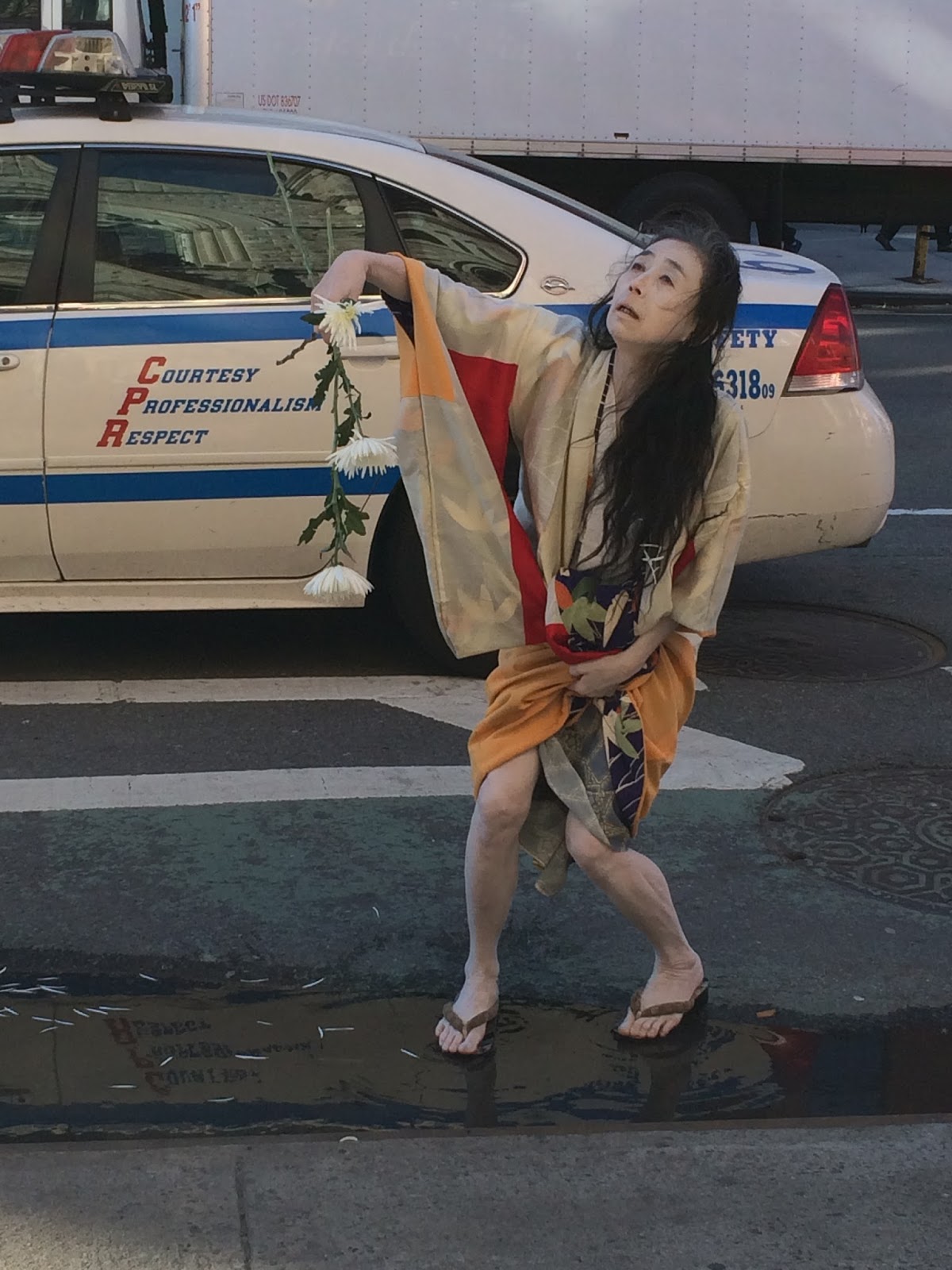
Here, with the incipient emergence of her body into the light and rush of the street, the solo took on tension and poignancy.

Courtesy, Professionalism, Respect...and Eiko
photo (c)2016, Eva Yaa Asantewaa

*****

Read My Eiko journal: Part 1 here.

*****

Eiko's A Body in Places platform continues at Danspace Project and other venues through March 23. There's so much going on in this platform's programming, that Danspace Project is actually offering consultation with a docent to help you get your bearings. Really. For detailed information, click here.

Danspace Project
St. Mark's Church in-the-Bowery
131 East 10th Street (at Second Avenue), Manhattan
(map/directions)

If you like what you're reading,
subscribe to InfiniteBody!

Wednesday, March 2, 2016

My Eiko journal: Part 1

Flower from Eiko
(photo: Eva Yaa Asantewaa)

Eiko's A Body in Places
Tuesday, March 1 -- 12pm

For my initial engagement with A Body in Places--Danspace Project's massive, multifaceted new platform--I join a group of people assembled at the gate of St. Mark's Church and await word of where to meet dance soloist Eiko. At noon, Danspace staff guide us across Second Avenue to a corner by Liquiteria, the juice/smoothies emporium. And there is Eiko, perched on Liquiteria's outdoor bench, wrapped in clothing of thin, vulnerable fabrics and a small comforter, feet in flipflops, scant defense against the late-winter chill. I'm certain that if my neighborhood noticed her at all, people would assume her to be homeless and pay no mind.

Those of us gathered with a purpose, though, we're rapt. This is Eiko who inserts her dancing body into places and makes you think about things you usually do not see. Eiko whose way of creating a separate channel for time adds dimension to the everyday. Stop and think. Stop and feel. Stop.

We stop. Gaze at her. She gazes back. She rises, silently draws us around the corner. She curves her comforter up into the air; her reach is small, vulnerable. She crouches near the pavement, near a parked taxicab, its driver alert to the presence of a woman with claw-like fingers and comforter lined in royal purple. She bunches it up against the bark of a tree. She bunches it up against her face and appears to grieve.

Arching. Stretching. Twisting. Trotting. Sudden cracks of hard slipper heels against concrete and garbage cans. Pretty soon, drivers stopped in traffic are looking; pedestrians, stopping and looking.

Ha-hah! Made you look!

Her ultimate destination? Kathy Kemp's tiny clothing and jewelry design boutique, ANNA, at 330 East 11th Street. Eiko has placed a few white flowers on the ground by the storefront. Some flowers will end up in her mouth, their petals spit out and scattered. She's less squeamish than I would be on these seriously skanky streets. She staggers, flinging petals, a stem. She heads through ANNA's screen door, most of her audience in tow.

We arrange ourselves around a small, rectangular table draped with several gold necklaces draped across it. We file past a rack of clothes, wondering how Eiko chose this delicate site and negotiated its use. Kemp stands by with her charming little dog resting quietly in her arms, its neck wrapped in chunky pearls.

Eiko fits herself into narrow space between curtained dressing rooms. We watch her and her reflection in the mirror. Beneath a sheer, dark tunic, she reveals the pink and salmon print of her underskirt. She emerges from this slot in space, pushes past a rack of clothes, tottering backward, humming to herself.

She seems alien, her body language foreign to these parts, her regard of her surroundings a sorrowful one on its way to self-abasement and erasure since it cannot accept what it perceives. Anyway, that's what I get and, at the same time, I'm feeling the following: "These fabrics and colors are really kinda nice. I wonder how much...."

The solo winding down, Eiko draws us back out into the noise of school kids at recess. She holds a flower out to me, and I take it. I realize that I want it. Very much. I'm hoping I won't have to give it back. And, as it happens, I won't have to. That makes me inexplicably happy. I'll take it home, just around the corner, down the avenue.

Eiko looks into traffic, crosses the street, does what I expected she would do. At first, her presence at the schoolyard fence seems to make the kids drift off. But, after a while, they watch before Eiko turns to us and sort of shoos us away before disappearing eastward.

*****

My Eiko journal will continue with reflections on Eiko's Delicious Movement workshop today and another site-specific A Body in Places solo in an undisclosed location. Check back for more.

*****

Eiko's A Body in Places platform continues at Danspace Project and other venues through March 23. There's so much going on in this platform's programming, that Danspace Project is actually offering consultation with a docent to help you get your bearings. Really. For detailed information, click here.

Danspace Project
St. Mark's Church in-the-Bowery
131 East 10th Street (at Second Avenue), Manhattan
(map/directions)

If you like what you're reading,
subscribe to InfiniteBody!

Tuesday, March 1, 2016

Revolution revisited: WOW pioneers celebrate now


Left: Carmelita Tropicana
Right: Claire Olivia Moed (at left) and Peggy Shaw
(photos: Eva Yaa Asantewaa)

Moments after the thought crossed my mind, Lois Weaver spoke it: "This is like the high school reunion I always dreamed of!" Then she held up a book to show to the merry, over-spilling crowd of, mainly, lesbians of a certain age (like mine) last night at Dixon Place. Co-edited by Holly HughesCarmelita Tropicana and Jill Dolan and published by University of Michigan Press, Memories of The Revolution: Celebrating the first ten years of the WOW Café  features "scripts, interviews, photos, and critical commentary documenting the riotous beginnings of this long-lived experimental theater space for women" founded in 1981.

Last night's gathering was pretty riotous, too, with many shrieks of recognition, hugs, laughter and gratitude for the way WOW nurtured community and encouraged DIY spirit and free expression. This funky, spunky theater space launched some notable careers including performance artist Hughes, poet Eileen Myles and Tony-winner Lisa Kron (Fun Home's book and score). "Coming to WOW," Kron said, "changed everything about my life."

Running close to three hours, the show featured numerous WOW favorites, such as the Split Britches team of Weaver, Peggy Shaw and Deb Margolin (performing their goofy West Side Story/Yiddish theater mashup) and the Five Lesbian Brothers (Moe Angelos, Babs Davy, Dom Dibbell, Peg Healey and Kron), reigniting crushes that we had on all these charming and inspiring performers back in the day. One of the strongest moments, though, was a serene one--Sharon Jane Smith, quietly singing and playing her mandolin, drawing her audience closer and closer.

It's heartening to know that, despite the challenge of surviving in a changing New York, WOW Café still carries on (click here). But it's a little sad to have to give this particular event and its audience a hashtag: #WOWSOWHITE. For the most part, it appeared that younger women and people of color found other things to do last night. Maybe that had something to do with the demographics of the cohort celebrated in Memories and reflected in last night's lineup. Or maybe it was the ticket price (which, to be fair, included a copy of the book).

*****

Don't miss the next Memories of The Revolution event--"Memories of The Revolution: Locating Lesbian Culture in the Age of Queer"--a panel discussion tomorrow, March 2, at 6:30pm at New York University's Bobst Library.
The panel, composed of WOW alumnae in dialogue led by theater historian and critic Alisa Solomon and performance studies scholar Ann Pellegrini, will address the impact of feminist and lesbian voices on the downtown New York culture of the 80s and 90s, and discuss the legacy of WOW for current generations. Karen Finley will introduce the event, and Jessica DelVecchio will open it by performing songs from the period.
Other participants include Alexis De Veaux, Gwendolen Hardwick, Holly Hughes, Lisa Kron, Eileen Myles and Carmelita Tropicana.

RSVP to
with your name and title/date of the event.


Bobst Library
New York University
70 Washington Square South (at LaGuardia Place), Manhattan
(map/directions)

*****

Help keep WOW Cafe Theater open for future generations of women and trans artists: CLICK!


If you like what you're reading,
subscribe to InfiniteBody!

Copyright notice

Copyright © 2007-2023 Eva Yaa Asantewaa
All Rights Reserved

Popular Posts

Labels